

A next step in work and learning
Content version · · Sources & references
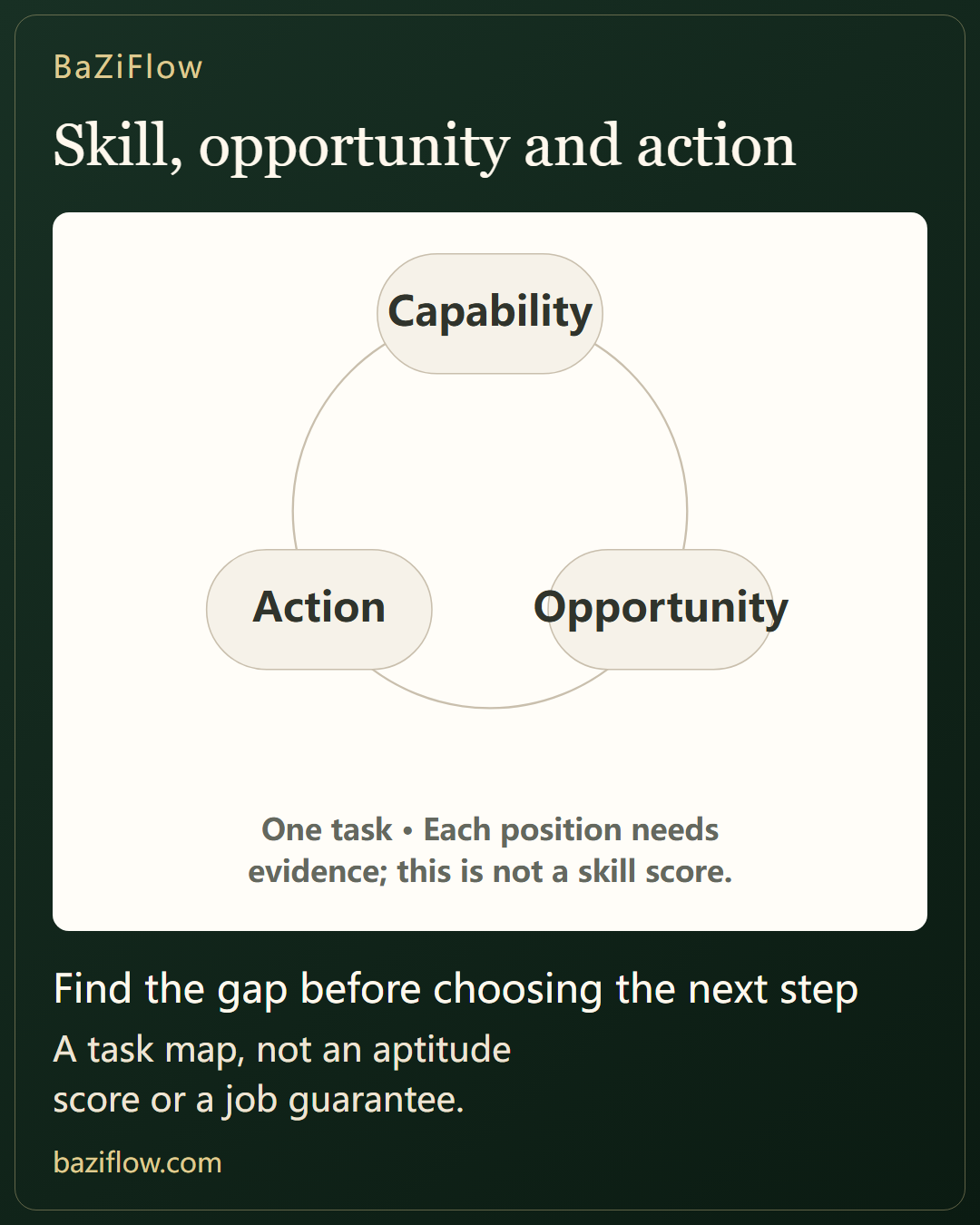
Use career and learning readings to formulate specific questions. Compare demonstrated work with real requirements, then choose a bounded next step without turning symbolic language into a job verdict.
The short version5 min read
An unused sample may need clearer instructions, or the opening may simply have closed. Those outcomes call for different next steps. Separate capability, opportunity and action before converting a reading into a practical question.
- Interest, demonstrated capability and an available opening are different information.
- Specific feedback on a sample points to a more useful practice target than a career label.
- A symbolic theme can prompt an action without proving completion or guaranteeing an opening.
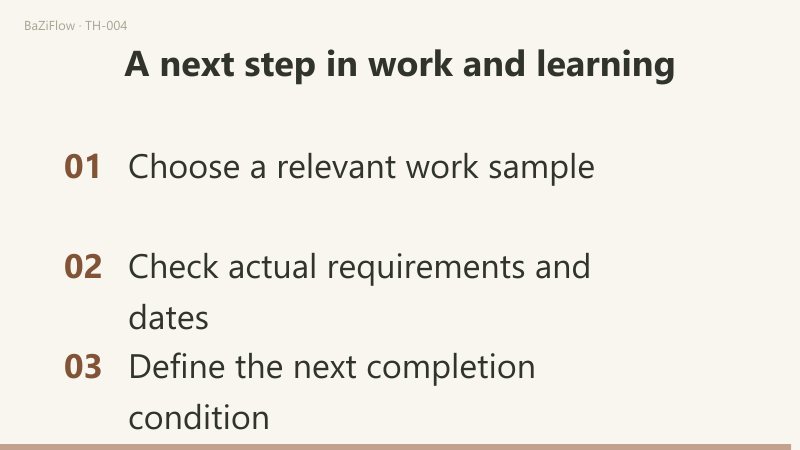
A promising opportunity can still be the wrong next step
An opening may exist while its requirements do not match your present preparation. You may have the skills while the opening has closed. You may be interested in a field without yet knowing whether you enjoy its everyday tasks. These are different situations, and a single “this suits you” label obscures the distinction.
Begin by identifying the task or decision. Are you choosing a course, preparing an application, or trying to improve one kind of work? State what must be decided and which information is missing. The reading can help you form questions, but the decision needs evidence appropriate to those questions.
Capability
- What can be demonstrated?
Opportunity
- Which conditions apply?
Action
- What can be done next?
Three kinds of evidence around one concrete task
- Capability evidence
- A sample, process and specific response rather than an overall opinion of yourself.
- Opportunity conditions
- The actual deadline, prerequisites, schedule and task requirements.
Compare work with requirements
For capability, look at something you have actually done: a sample, a process or specific feedback. “Good at communication” is too broad to guide practice. Explaining a topic within a time limit, revising an unclear instruction and adapting a message for different readers are tasks you can examine separately.
For opportunity, check the actual requirements, deadline, work involved, schedule and available support. A favorable symbolic period cannot reopen a closed application or replace a required qualification. Those conditions belong to the opportunity's own documentation, not to an interpretation of timing.
| Evidence category | Useful material |
|---|---|
| Capability | Work samples, completion process and specific feedback |
| Opportunity | Requirements, deadlines and the actual task conditions |
| Action | A feasible exercise, inquiry or check you can complete |
If a skill is missing, investigate whether it can be learned rather than immediately deciding that the field is unsuitable. If the opening is unavailable, do not automatically interpret that as a failure of direction. The location of the gap determines what kind of next step would help.
Three-minute explanation
- What was observed?
- A reader missed step two
- What could change?
- Clarify that particular step
Familiar task
- What was observed?
- Completed independently
- What could change?
- Check the opening’s requirements
Read the methods without converting terms into occupations
For BaZi, career-reading conditions introduces the importance of combinations and premises. A single Ten God name should not become a fixed list of jobs. For Ziwei, career-related palaces offers a route into connected topics rather than asking one palace to represent every practical ability.
These articles explain internal reading methods. They do not complete a work sample for you or establish that a position must be suitable. Translate an interesting tendency into an open question: do I enjoy this kind of task, and what happened when I tried it? Allow the answer to differ from the symbolic expectation.
The route from tarot career questions to action can be approached in the same way. If a theme of practice prompts you to organize a sample of work, name that action directly. Do not skip from the symbol to a guaranteed offer.
Unclear sample
- Skill requirement met?
- No
- External condition
- Applications remain open
- Next step
- Revise and test the explanation
Adequate sample
- Skill requirement met?
- Yes
- External condition
- Applications have closed
- Next step
- Check a future opening
A craft symbol is not evidence of an acquired skill
Waite's description of the Eight of Pentacles concerns an artisan at work and meanings related to work and craft. It supplies a textual source for that symbolic theme. Drawing the card does not demonstrate that the querent possesses the skill, or that employment will become available.
The distinction lets a symbol remain useful as a prompt without giving it an evidential role it cannot fulfill. You might decide to produce one sample and ask which part is unclear. The response to that sample, not the card alone, then informs what needs revision.
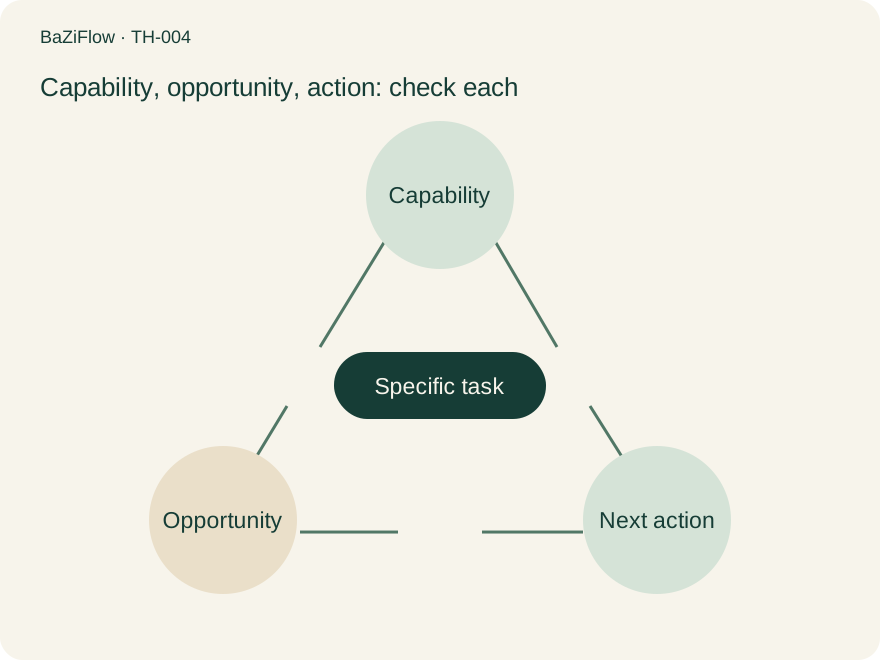
Original BaZiFlow career-and-learning triangle. It is not an ability score or a symbol-based career recommendation.
The triangle places a specific task between three information sources. None replaces another. It is not a calculation of talent or a ranking of careers. If one corner remains unknown, mark that gap and seek the corresponding evidence.
Use feedback to decide what changes
The Education Endowment Foundation's learning guidance describes planning, monitoring and evaluating. Here that organization is borrowed for a practice task: decide what to check, notice difficulties while working, and review the result against useful feedback. The education reference does not test divination or promise a career return from this exercise.
Choose a limited next action and a completion condition. If the problem is unclear writing, the condition might concern whether another reader can follow the explanation. If the task requirements are unknown, finding them can itself be the action. A vague instruction to try harder gives neither a stopping point nor a way to learn from the result.
Afterwards, locate the reason for the outcome. A weak sample may identify a skill to practice. A paused vacancy points to an external constraint. Confusing both with luck makes the next decision less informed. Keep the process and feedback, not only a success-or-failure label.
One difficult attempt need not become a permanent account of your abilities. One smooth attempt does not remove the need for preparation next time. Career and learning readings are most usable when they leave you with a sharper question, an identifiable gap and an action connected to real conditions.
Step two omits a material
- Existing feedback
- Add its name and use
- Next completion condition
- The reader can proceed
The opening is paused
- Existing feedback
- Not feedback on the sample
- Next completion condition
- Find the next confirmed date
Classify the feedback
An unclear instruction concerns the sample; a closing date concerns the opening.
Practice the identified skill
If a reader stops at step two, clarify its materials and actions and ask for another attempt.
Check external conditions at their source
If applications have closed, seek the next opening rather than revising the sample to explain a deadline.
Questions readers ask next
Does one Ten God specify a career?
Learn the tradition’s combinations and premises, then explore real tasks. Turning one name into a fixed job list skips those conditions.
Does the Eight of Pentacles establish skill?
It supplies a symbolic theme of work and craft. A relevant sample and actual performance are needed to determine whether a requirement is met.
What if the next action is unclear?
Identify the missing category. Find the requirements if they are unknown; if feedback is specific, choose one change you can test. The first step need not be a major decision.
Was this article helpful?
Start reading
Evidence for a career reading: distinguish chart relations from job requirements ↗ · BaZi
Which palaces does a Zi Wei career reading connect? ↗ · Zi Wei Dou Shu
Turn a career reading into a work sample you can inspect ↗ · Tarot
Sources & references
Continue reading
Evidence for a career reading: distinguish chart relations from job requirements ↗