

Four of Wands: a garland on four staves
Content version · · Sources & references
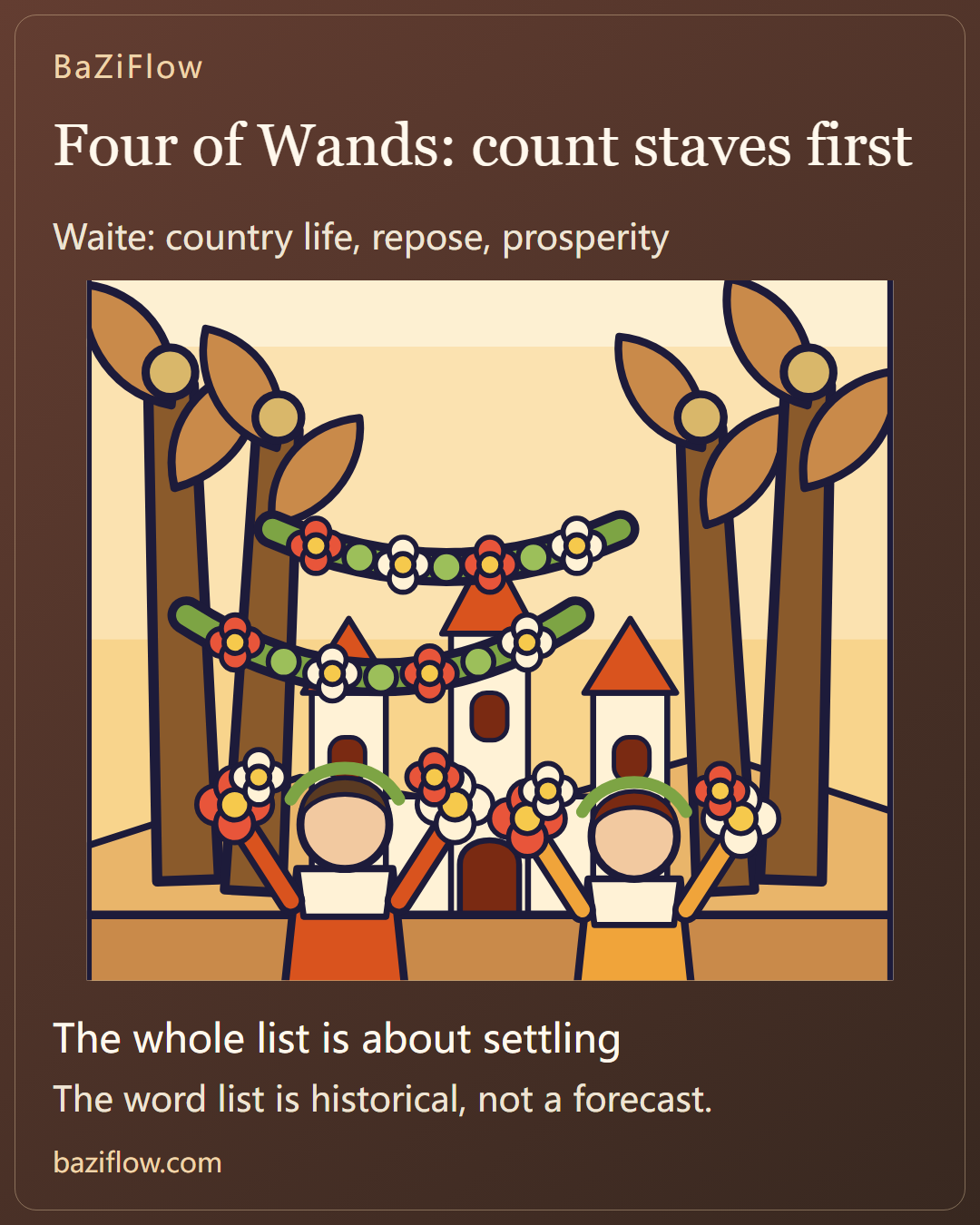
The Four of Wands shows a garland hung between four great staves, two women with bouquets and an old manor behind. Separate picture from list, then write a finish day into a four-week training plan.
The short version6 min read
In the Four of Wands four great staves hold up a garland while two women lift bouquets. Waite says the meanings are for once almost on the surface, and the list ends on the work perfected.
- The card is a quiet celebration: four staves, a garland, two bouquets, an old manor, and no conflict anywhere.
- No word in the list points to a start; all of them are about settling: repose, harmony, prosperity, and at the end "the perfected work of these".
- For the reversed card Waite writes "the meaning remains unaltered". The extras give unexpected good fortune, and, reversed, a married woman's beautiful children, in period wording.
Read first
Two under a garland: four great staves hold up a ring of flowers
Waite draws the card this way: from the four great staves planted in the foreground a great garland is suspended; two female figures uplift nosegays; at their side a bridge over a moat leads to an old manorial house.
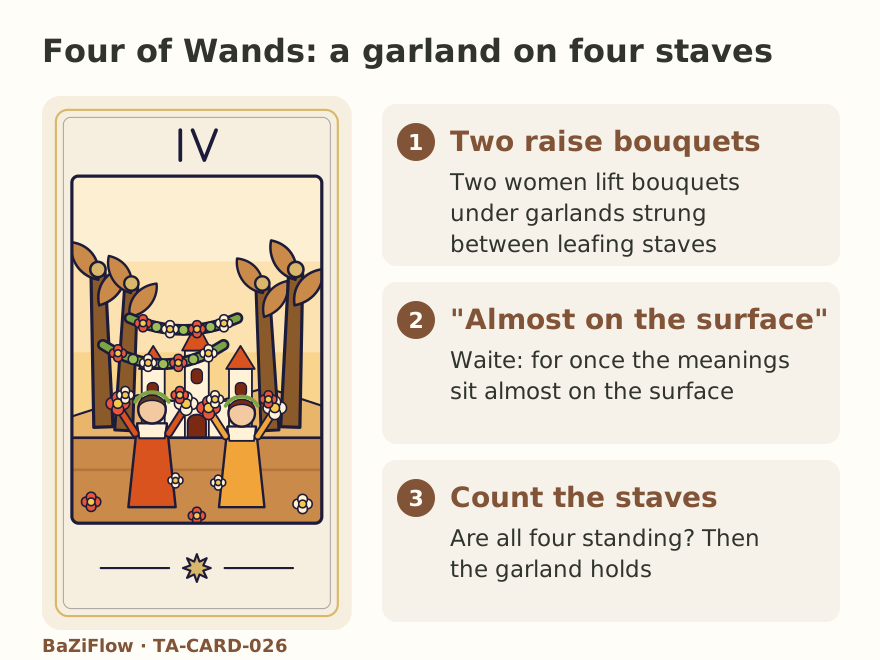
BaZiFlow's own Four of Wands, with three ways in.
The Rider-Waite-Smith original sets the four staves tall along the front edge, small leaves at their tops and red ribbons tied near the tops of the two outer ones. The garland is made of green leaves, red flowers and fruit and runs across between them. Two women stand in the middle, one in white with a blue wrap and one in deep red, each lifting a bouquet. Behind them are a gray wall and a red-roofed tower, with a few very small figures at lower left.
Enlarge diagram · scroll sideways to read
What Waite lists: "almost on the surface", ending on work perfected
Before the list Waite adds an aside: these meanings are for once almost on the surface, matching the picture directly. Then: country life, haven of refuge, a species of domestic harvest-home, repose, concord, harmony, prosperity, peace, and, last, the perfected work of these.
Country life, haven of refuge, a species of domestic harvest-home, repose, concord, harmony, prosperity, peace, and the perfected work of these.
Enlarge diagram · scroll sideways to read
Set it beside the Ace of Wands: there the words circle beginning and source; here they circle settling and completion. Within one suit, one card says where things come from and the other says where they have arrived.
Staves, garland, manor: Waite names them and explains nothing
Waite mentions every object in the picture and nowhere says what it symbolizes. For the major arcana he often spends whole paragraphs on symbolism; here he does not, which fits his remark about the surface.
Staves, garland, manor: whose statement is each?
- Four great staves
- Waite writes them planted in the foreground with the garland hanging from them, and does not say what "four" means. On the card the tops carry small leaves and the outer two have red ribbons.
- Garland
- Waite writes only "great" and "suspended" and does not name the flowers. On the card it is a ring of green leaves, red flowers and fruit.
- Bridge and manor
- Waite writes a bridge over a moat leading to an old manorial house, at the women's side, and does not say who lives there. What the card confirms is a gray wall and a red-roofed tower.
Enlarge diagram · scroll sideways to read
How to read it: count the staves first, then hang the garland
The order of the picture is already the practice: the four staves stand in front first, only then can the garland hang, and only with it hung do the two women lift their bouquets. Use that for an everyday matter: a running group has set four Saturday sessions ahead of a group run at the end of November, and what gets forgotten most is the day after the training.
Enlarge diagram · scroll sideways to read
Count the staves: are all four up?
Waite hangs the garland from four great staves; if a stave is not standing, nothing holds it. Write each of the four Saturday sessions as a line: date, time, meeting point. Whichever week is missing is the stave not yet raised.
Then hang the garland across them
In the Rider-Waite-Smith picture the garland stretches across the staves, red ribbons at the tops of the outer two. In the plan that is the weekend after the fourth Saturday: write a finish day in advance, an easy jog and a breakfast, on the same sheet, instead of improvising once training ends.
Who lifts the bouquets?
The bouquets are held by two particular people. For the finish day, that means two particular jobs with names on them: who books the table, who brings water and snacks. A job with no name tends to turn up unowned on the day.
A garland on the training plan: how far the card reaches
The card gives
- A garland held by four staves
- The finish as a cell of the plan
It does not cover
- Whether people come
- What the weather does
Add to the plan
- All four dates filled in
- Two names for the finish
Reversed and neighboring cards: the reversed card unaltered, and two more cards of feasting
Waite writes the reversed card in one sentence: the meaning remains unaltered; it is prosperity, increase, felicity, beauty, embellishment. He does not turn this card upside down.
The meaning remains unaltered; it is prosperity, increase, felicity, beauty, embellishment.
The extras come from other readers: upright, unexpected good fortune; reversed, a married woman will have beautiful children. The second line is period wording that today's teaching rarely takes as it stands.
Enlarge diagram · scroll sideways to read
Three cards, and how each places the celebration
The card before: ships still at sea
In the card before, the ships are still at sea and the watcher on the cliff can only look. The Four brings the picture ashore, staves close at hand and the garland overhead.
Another celebration, with maidens
Maidens in a garden lift their cups as if pledging one another. The list: the conclusion of a matter in plenty, perfection and merriment, with a note on the side of excess in physical enjoyment. The Four's celebration is quieter, hung from a garland the staves hold up.
The next card: staves crossing
A posse of youths brandish staves, as if in sport or strife. The list: imitation, such as a sham fight, and the strenuous competition of the search after riches; reversed, litigation, disputes, trickery. The staves go from holding a garland to crossing one another.
Questions readers ask next
Is the Four of Wands only about celebration?
Waite's list leans toward settling: country life, a haven of refuge, repose, concord, prosperity. A harvest-home feast is one item among them, and the rejoicing in the picture is quiet, two people holding bouquets and no uproar.
What does the Four of Wands mean reversed?
Waite writes that the meaning remains unaltered: prosperity, increase, felicity, beauty, embellishment, so he does not flip the upright. The extras' line about a married woman and her children is in period wording that teaching does not usually repeat as it stands.
What do the bridge and the manor on the Four of Wands mean?
Waite writes only that a bridge over a moat leads to an old manorial house and gives no symbolism. Reading it as "a place you can reach" is a later teaching borrowing; taking it simply as part of the scene works just as well.
Was this article helpful?
Sources & references
Continue reading
The World: a dancer in the wreath, a design Waite calls unchangeable ↗