

Five of Wands: five staves cross
Content version · · Sources & references
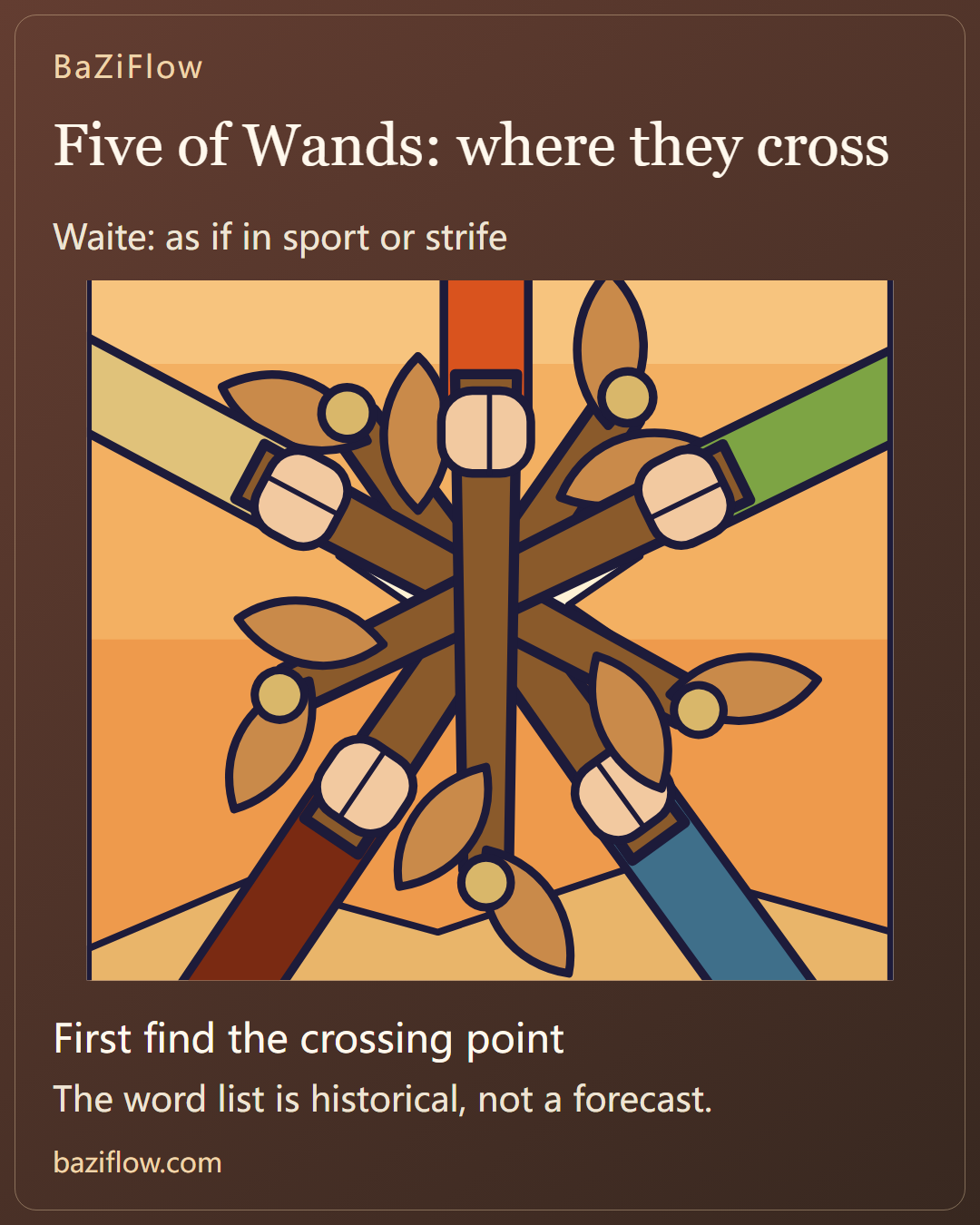
The Five of Wands shows youths brandishing staves, as if in sport or strife. Separate the picture, the chain from "sham fight" to "gold" and the reversed list, then find where five staves cross in a team kit purchase.
The short version7 min read
In the Five of Wands a posse of youths each hold a staff, and the staves cross in the middle. Waite himself leaves open whether this is sport or strife, so first find the one point they are after.
- The card is a posse of youths brandishing staves, "as if in sport or strife"; Waite calls it mimic warfare.
- The list runs from "sham fight" to the strenuous struggle after riches and fortune, then on to "some attributions" calling it gold, gain, opulence; reversed it is litigation, disputes, trickery, contradiction.
- The extras are other readers' lines: success in financial speculation upright, quarrels turned to advantage reversed.
Read first
Five staves cross at one place: as if in sport, as if in strife
Waite describes the card in one sentence: a posse of youths brandishing staves, as if in sport or strife. At once he adds that it is mimic warfare.
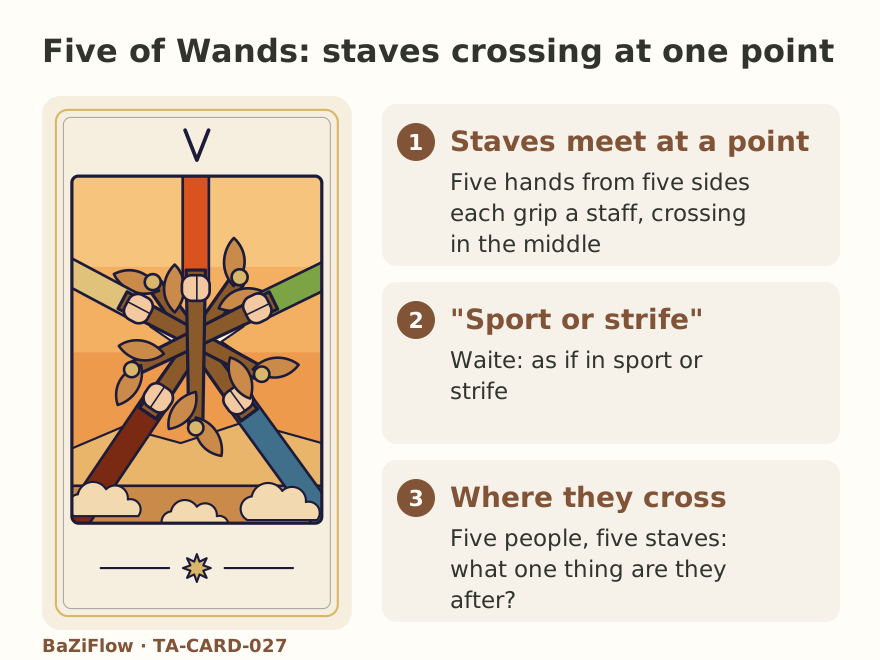
BaZiFlow's own Five of Wands, with three ways in.
The Rider-Waite-Smith card has five young men, each dressed differently: yellow, red, a dark tunic, green, and a short blue one with white dots. Each holds a staff with small leaves at the tip, and the staves cross diagonally in the middle of the picture. They stand on rough ground under a blue sky. Nobody is lying on the ground, and it is hard to say who has the upper hand.
Enlarge diagram · scroll sideways to read
What Waite lists: from "sham fight" to "gold", link by link
Waite's list is a chain in which each link comes from the one before: first imitation, for example a sham fight; "but also" the strenuous competition and struggle of the search after riches and fortune; in this sense it connects with the battle of life; "hence" some attributions say it is a card of gold, gain, opulence.
Imitation, as, for example, sham fight, but also the strenuous competition and struggle of the search after riches and fortune. In this sense it connects with the battle of life. Hence some attributions say that it is a card of gold, gain, opulence.
Enlarge diagram · scroll sideways to read
The first three links are Waite's own summing up; the last rests on "some attributions", which he reports. The heaviest phrase in the main entry is "strenuous competition and struggle"; not one word in it names an actual slaughter.
Five people, five staves, one ground: Waite writes only the action
There is hardly an object on this card to explain. What Waite writes is an action: brandishing. The people have no names, the staves no commentary, the ground no mention.
People, staves, ground: how much does Waite say?
- A posse of youths
- Waite writes youths, a band of young people, with no word on sex, standing or how they are related. On the card there are five, each dressed differently.
- The brandished staves
- Waite writes brandishing, waving, not striking. On the card the five staves cross in the middle, with small leaves at the tips, and nobody appears to be hit.
- Ground and sky
- Waite does not mention them. The card has a patch of rough earth and a blue sky.
Enlarge diagram · scroll sideways to read
How to read it: find the one point where five staves cross
Five hands each hold a staff and the staves cross in the middle: each staff is one person's own position, and the crossing is the one matter where they all meet. Take it to something concrete: in a team's chat five people each ask for a different purchase, and there is only one budget.
Enlarge diagram · scroll sideways to read
Count the staves: five people, one each
Keep one line per person: one item and one amount, all on one sheet. Each staff has its owner, so do not write B's staff under A's name.
Then find the crossing: where do they meet
In the picture all five staves point at the same spot in the middle. For the purchase that is the one budget: how much everyone asks for in total, and how far that is above what can be spent. The quarrel is about that gap, not about anyone's taste.
Last question: sport, or strife?
Waite himself does not decide; he writes "as if in sport or strife". The picture offers three things to check against: everyone holds the same kind of staff (one set of rules, say "choose only within the budget"), nobody is down (nobody has dropped out of the chat or been left aside), and the ground is the same (the goal is the same: the team's use). With all three in place it reads more like sport; where one is missing, supply that first.
In the purchase chat, where the card helps
Helps you see
- Five claims, one crossing
- The quarrel is the gap
Will not decide
- Which item to buy
- Who gives way
You supply
- One claim and amount each
- The budget ceiling first
Reversed and neighboring cards: litigation and disputes, and "quarrels turned to advantage"
Waite's reversed list is: litigation, disputes, trickery, contradiction.
Litigation, disputes, trickery, contradiction.
The upright can still be read as play, but all four reversed words fall on real quarrels: litigation is a formal lawsuit, trickery is someone working by stealth. The extras come from another reader: success in financial speculation upright, quarrels turned to advantage reversed. That last line runs nearly opposite to the main reversed entry, one toward dispute and one toward opportunity.
Enlarge diagram · scroll sideways to read
Three cards, and how each places the struggle
Also a five: some fall, one holds the field
A disdainful man looks after two retreating, dejected figures whose swords lie on the ground; he is the master in possession of the field. The list: degradation, destruction, revocation, dishonour, loss. In the Five of Wands nobody is down and nobody holds the field.
Also a five: two cups still stand
A cloaked figure looks sideways at three prone cups with two standing behind him. The list is loss, but something remains: three taken, two left. The Five of Cups is about a loss that has happened; the Five of Wands is a contest still in motion.
The next card: one staff, wearing a crown
A rider wearing laurel carries a single staff with a laurel crown on it, and footmen with staves walk beside him. The list reads as a victor triumphing, but also as great news. The staves go from crossing one another to one raised high.
Questions readers ask next
Is the Five of Wands a "conflict card"?
Waite's description leaves two possibilities open: as if in sport or in strife, and he calls it mimic warfare. The first item in his list is imitation, such as a sham fight, and only then the strenuous competition after riches. There is rivalry, but he does not fix it as a real fight.
What does the Five of Wands mean reversed?
Waite's reversed words are litigation, disputes, trickery, contradiction, which sit closer to real quarrels than the upright list does. The extras say quarrels may be turned to advantage, in the opposite tone. Say which one you follow.
What does the Five of Wands have to do with money?
Waite reasons from "the search after riches and fortune" and says hence some attributions call it a card of gold, gain, opulence. That is a chain of inference; "success in financial speculation" in the extras is other readers' wording.
Was this article helpful?
Sources & references
Continue reading
Seven of Wands: one staff on the height, six raised from below ↗