

The structure of a tarot deck: 22 cards and four suits
Content version · · Sources & references
Map a standard 78-card deck before memorising meanings. Separate Major and Minor Arcana, court ranks, historical evidence and the conventions of a particular reading method.
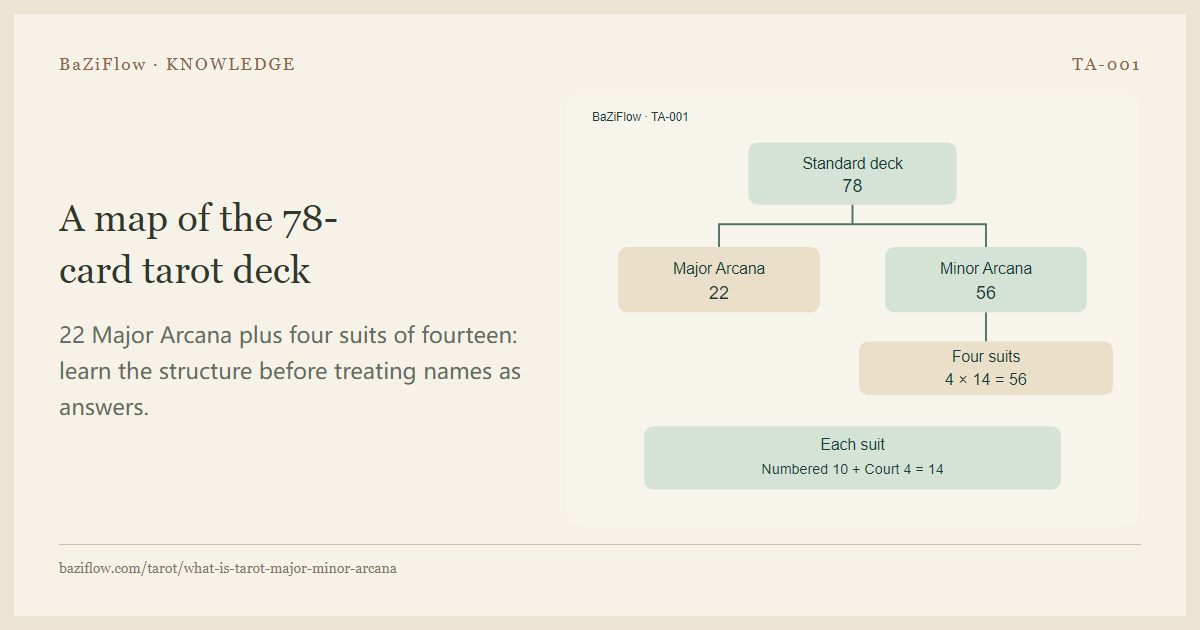
22 Major Arcana plus four suits of fourteen: learn the structure before treating names as answers.
Start with the object a museum can identify
You may meet tarot first in a museum label rather than at a reading table. That encounter poses a useful question: are you learning about a surviving pack, an author’s explanation, or a practice someone uses today? The answers need not have the same date or source.
The Metropolitan Museum's account places early tarot in the context of fifteenth-century card games and notes variations among surviving packs. This is a reason to avoid projecting every modern divinatory convention backwards onto every historical object. Museum evidence about cards and their use answers a historical question.
Waite's manual answers a narrower authorial question: how did he present and explain his system? It can be read critically as a primary source without treating its interpretation as an established fact about future events. Pamela Colman Smith's visual work is also part of the evidence a reader encounters; reducing the cards to a keyword list discards much of that material.
A contemporary reflective use of tarot can be stated plainly as such. It need not be disguised as the single original purpose of all decks. Nor does a story about antiquity establish accuracy. When a book describes a symbol as the only authentic meaning, ask which edition, author and passage support the claim.
Identify the reference before sorting the cards
Before learning keywords, identify the edition in your hands. This collection uses Rider–Waite–Smith as its default reference: the system associated with A. E. Waite and the illustrations of Pamela Colman Smith. Waite's 1911 Pictorial Key to the Tarot is a primary source for his scheme, rather than an authority that makes every later deck identical to it.
A standard deck contains 78 cards. The Major Arcana account for 22; the Minor Arcana account for 56, arranged as four suits of fourteen. Wands, Cups, Swords and Pentacles are the suit names used here. A different edition may use another name, so record the actual deck instead of assuming that a familiar word guarantees a familiar image.
Calling one group major and the other minor does not establish how important an issue is. A card from either group can be considered in a modest daily exercise or in reflection on a sustained concern. The category does not prove that an event is inevitable, severe or trivial.
A court rank is not a compulsory real-world identity
Page, Knight, Queen and King are ranks within the deck's organisation. They do not require a reading to identify four literal people of fixed ages or genders. A modern reader still needs to distinguish an image from a claim about somebody outside the image.
A useful non-divinatory exercise is to compare the same court rank in two suits. Record visible differences first: posture, direction, objects held and surroundings. Then write a tentative interpretation in a separate column. If the final notes are the same sentence with only the suit name replaced, the comparison has not used enough of the actual pictures.
“An illustrated figure is seated” can be checked on the card. “A particular person refuses to act” is an inference about a real person and needs other evidence. This distinction prevents an imaginative exercise from quietly becoming an assertion about another person's intentions. Numbered cards and court cards develops their different reading materials; the four suits examines the suit organisation.
Count the cards in a way that exposes mistakes
Each suit has Ace through Ten, which is ten cards, plus Page, Knight, Queen and King, which is four. That makes fourteen per suit. Four times fourteen is fifty-six, and fifty-six plus twenty-two is seventy-eight. The Ace is already included in the ten; it is not an extra card added after counting One through Ten.
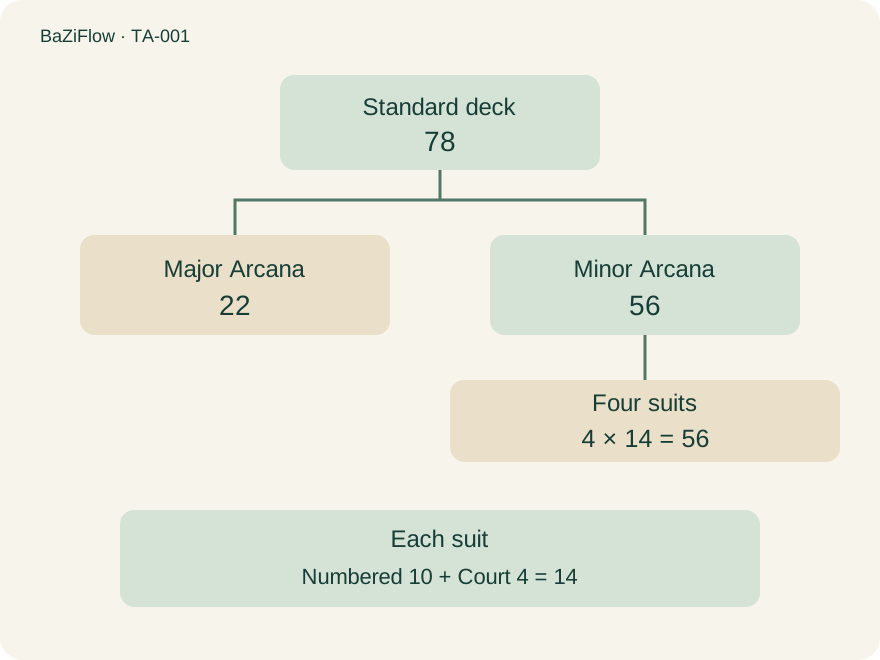
Original BaZiFlow teaching diagram; it shows deck structure without reproducing a commercial card face.
| Check | Expected in the reference structure | Common counting error |
|---|---|---|
| One suit | Ten numbered cards plus four courts | Counting the Ace twice |
| Four suits | 56 cards | Treating courts as a fifth suit |
| Major group | 22 cards | Forgetting the zero-numbered Fool |
| Standard complete deck | 78 cards | Including an advertisement or instruction card |
In the Rider–Waite–Smith numbering, the Fool is zero, followed by I through XXI; Strength is VIII and Justice XI. Those last two assignments should be checked when changing deck systems. A bonus card in the box does not automatically belong to the standard structure, although an artist may deliberately design a modified pack. Consult that edition's notes before declaring it incomplete.
Set the reading conditions before drawing
A first record can be simple: deck and edition, question, predetermined positions, and whether reversals are being used. Establish the positions before the cards appear. Changing a position's question after seeing the card makes it easy to manufacture a fit. Preserve awkward or inconclusive outcomes instead of redrawing until a preferred story appears.
The structure does not give a reader access to someone else's private thoughts. Nor do dramatic card titles diagnose illness, moral character or a coming disaster. Death, the Devil and the Tower are names and images within a symbolic deck; moving from them to a concrete claim requires evidence the names alone do not contain.
After distinguishing the historical object, the deck structure and your own exercise, continue with framing a question for tarot. It turns a pile of named cards into a defined observation exercise while leaving real decisions with the people and facts involved.
Part of a learning path
Tarot: from the question to the review · Step 1 of 1 available
Sources & references
- A. E. Waite, The Pictorial Key to the Tarot (1911), I.3: The Four Suits ↗
- A. E. Waite, The Pictorial Key to the Tarot (1911), III.1: Distinction between the Greater and Lesser Arcana ↗
- Tim Husband, Before Fortune-Telling: The History and Structure of Tarot Cards, The Met (2016) ↗
- A. E. Waite, The Pictorial Key to the Tarot (1911), contents: VIII Strength, XI Justice and Zero The Fool ↗