

The High Priestess: a half-hidden scroll
Content version · · Sources & references
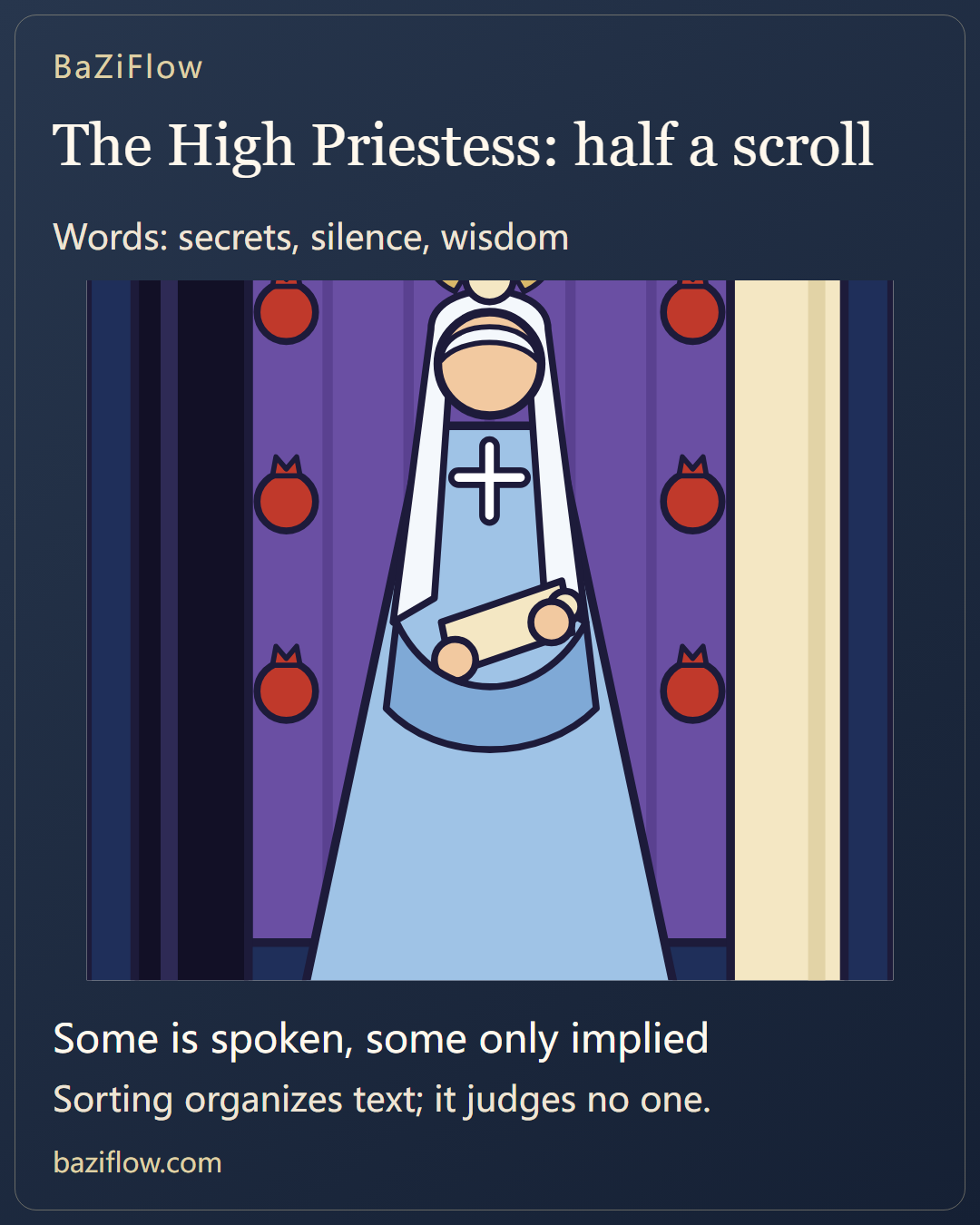
The High Priestess sits between a black and a white pillar, a scroll half covered by her mantle. Separate Waite's picture, word list and symbols, then sort a notice into what is written, implied and behind the veil.
The short version7 min read
The High Priestess sits between two pillars, a veil behind her and a scroll partly covered by her mantle. Waite gives a reason for that detail: some things are implied and some spoken.
- Waite's picture: a crescent at her feet, a horned diadem with a globe, a solar cross on her breast; the scroll bears the word Tora; she sits between the white and black pillars (J. and B.) with a veil of palms and pomegranates behind.
- The list includes secrets, mystery and the future as yet unrevealed, and also silence and tenacity; the reversed words (passion, ardour, conceit, surface knowledge) face them directly.
- For practice, take a notice that says only half of what matters, sort it into written, implied and behind the veil, and turn the implied into questions you can ask.
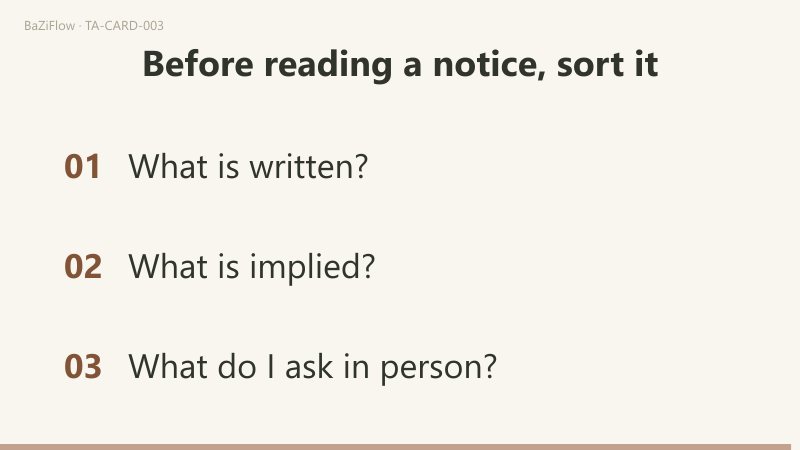
Read first
Start with the picture: two pillars, a veil and a scroll shown by half
Waite begins by counting what she wears and holds. She has the lunar crescent at her feet, a horned diadem on her head with a globe in the middle place, and a large solar cross on her breast. The scroll in her hands is inscribed with the word Tora, which he says signifies the Greater Law, the Secret Law and the second sense of the Word; it is partly covered by her mantle, "to shew that some things are implied and some spoken". She is seated between the white and black pillars, J. and B., of the mystic Temple, and the veil of the Temple is behind her, embroidered with palms and pomegranates. The vestments are flowing and gauzy, and the mantle suggests a shimmering radiance.
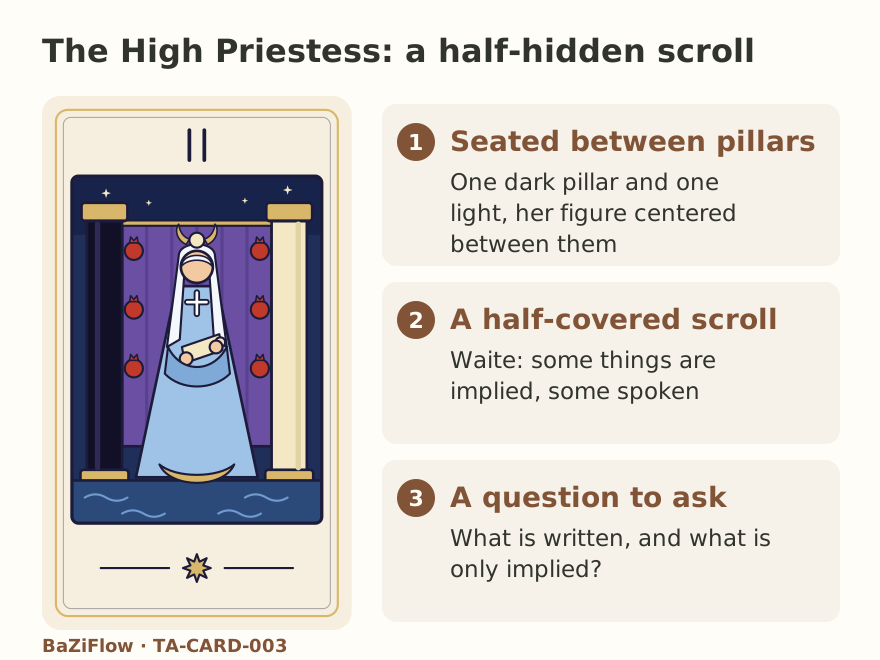
The High Priestess: BaZiFlow's card with three prompts
Turn to the Rider-Waite-Smith original and nearly all of it is there: the Roman numeral II at the top; a black pillar at the left marked B and a white one at the right marked J; the veil behind her filled with pomegranates and palms; a crown with two upturned horns and a white globe between them, and a white cross on her chest; a scroll in her hands on which some letters of TORA can be read, the rest under her mantle; a crescent lying at her feet. Counted from outside in, the picture has three layers: the two pillars outermost, then the veil, and in the middle the scroll in her hands.
Enlarge diagram · scroll sideways to read
What Waite lists: secrets and silence, with a reversed list that faces them
Her divinatory meaning begins with secrets and mystery, with the future as yet unrevealed; the woman who interests the Querent, if male; the Querent herself, if female; silence, tenacity; mystery, wisdom, science. Reversed: passion, moral or physical ardour, conceit, surface knowledge.
... the woman who interests the Querent, if male; the Querent herself, if female; silence, tenacity; mystery, wisdom, science. Reversed: Passion, moral or physical ardour, conceit, surface knowledge.
Enlarge diagram · scroll sideways to read
Set side by side, the reversed words are nearly the upright ones turned over: on one side silence and tenacity, on the other eagerness and heat; on one side wisdom and science, on the other conceit and knowledge that stays on the surface. Waite does not print this as a table. Still, the paired directions in the lists make her reversal easier to state than that of many cards.
Pillars, pomegranate veil, crescent: how Waite himself speaks
Part II on this card is long. Waite first corrects an older name: she has been called Occult Science on the threshold of the Sanctuary of Isis, but he says she is really the Secret Church, the House which is of God and man. He adds that her light is borrowed, though it is the light of all. Three groups of symbols deserve a look at their sources.
Three groups of symbols: who is speaking
- The white and black pillars (J. and B.)
- Waite writes that they are the pillars of the "mystic Temple" and that she sits between them with the veil behind. He does not explain the letters. The common-lore association is with Jachin and Boaz, the two pillars before Solomon's Temple (1 Kings 7:21).
- Palms and pomegranates on the veil
- Waite only says what is embroidered on it, not what it stands for. About the veil he writes that it belongs to the Temple and hangs behind her.
- Crescent, horned crown, solar cross
- Moon at the feet and sun on the breast. Waite says her light is borrowed yet belongs to everyone, and that the moon here is fed on the milk of the Supernal Mother, language drawn from Kabbalah, where he is relaying his own system of symbols.
Enlarge diagram · scroll sideways to read
Reading the pillars as "a pair of opposites" and the veil as "a threshold" is a modern borrowing. Waite writes of a Temple and its veil, with her seated between them; if you use either reading, label where it comes from.
How to read it: a notice sorted into written, implied and behind the veil
The card hands the practice a ready shape: the part of the scroll that shows, the part her mantle covers, and the veil behind her. Applied to reading a notice, it becomes three columns.
The visible half: what does the page say?
Copy only information that really appears: time, place, headcount, requirements. Write it line by line, with no interpretation of your own.
The covered half: which phrases imply something?
Look for meaning carried by the wording but not stated, such as "long-term participants preferred" implying an expectation of attendance. Record implied things as "to check", not as confirmed.
Behind the veil: what do you learn only by showing up?
What the work is exactly, who you are grouped with, how handover works: notices often leave these out. List two or three as questions to ask in person.
An example: a neighborhood book corner posts a notice asking for volunteers to sort books on Saturday morning, and you want to sign up but are wary of being tied down "long term". Read the notice as three columns:
Enlarge diagram · scroll sideways to read
With the three columns filled
Can be confirmed
- The time and work as written
- A list of questions from the implied
Not yours to settle
- What the organizer really thinks
- How the event will go
Ask one person
- Rewrite the implied as questions
- Ask the veiled two in person
Reversed and neighboring cards: passion and surface knowledge, and three cards that "sit firm"
The reversed list is short and follows straight after the upright one:
Passion, moral or physical ardour, conceit, surface knowledge.
In a reversed reading, "surface knowledge" is a useful anchor: it points to reading only the half that shows.
Neighboring cards on what is covered and what is shown
Everything on the table
The card before. Waite lays the four suit symbols out before him like counters; there is no veil here and no covered part.
Between two other pillars
Waite has him seated between pillars that are not those of the Temple guarded by the High Priestess; his hand gives the sign that separates the manifest from the concealed part of doctrine, and Waite notes that the High Priestess "makes no sign".
Also seated between pillars
Under Justice, Waite remarks that this figure is also seated between pillars, and that her pillars lead into a different world from that of the High Priestess. The subject there is a principle of reward by deeds, not a covered scroll.
Enlarge diagram · scroll sideways to read
Questions readers ask next
Is the High Priestess "intuition" and "a hidden truth"?
That is a common modern summary. Waite's list says secrets, mystery, the future as yet unrevealed, and also silence, tenacity, wisdom and science; "intuition" is not in the line. Her scroll is half covered to show "some things implied, some spoken", which does not say there is one hidden truth.
What does the High Priestess mean reversed?
Waite's reversed words are passion, moral or physical ardour, conceit, surface knowledge. Read against the upright list, one side is silence and learning, the other eagerness and shallow knowing. Phrases like "a secret exposed" come from later methods.
What do the J and B on the pillars mean?
Waite says only that they are the white and black pillars of the mystic Temple, marked J. and B., and he does not expand on them. A common association links them with the two pillars at the porch of Solomon's Temple, but that is general lore, not his explanation in this entry.
Was this article helpful?
Sources & references
Continue reading
The Magician: one hand to heaven, one to earth, and a table to take stock of ↗