

The Tower: struck by lightning
Content version · · Sources & references
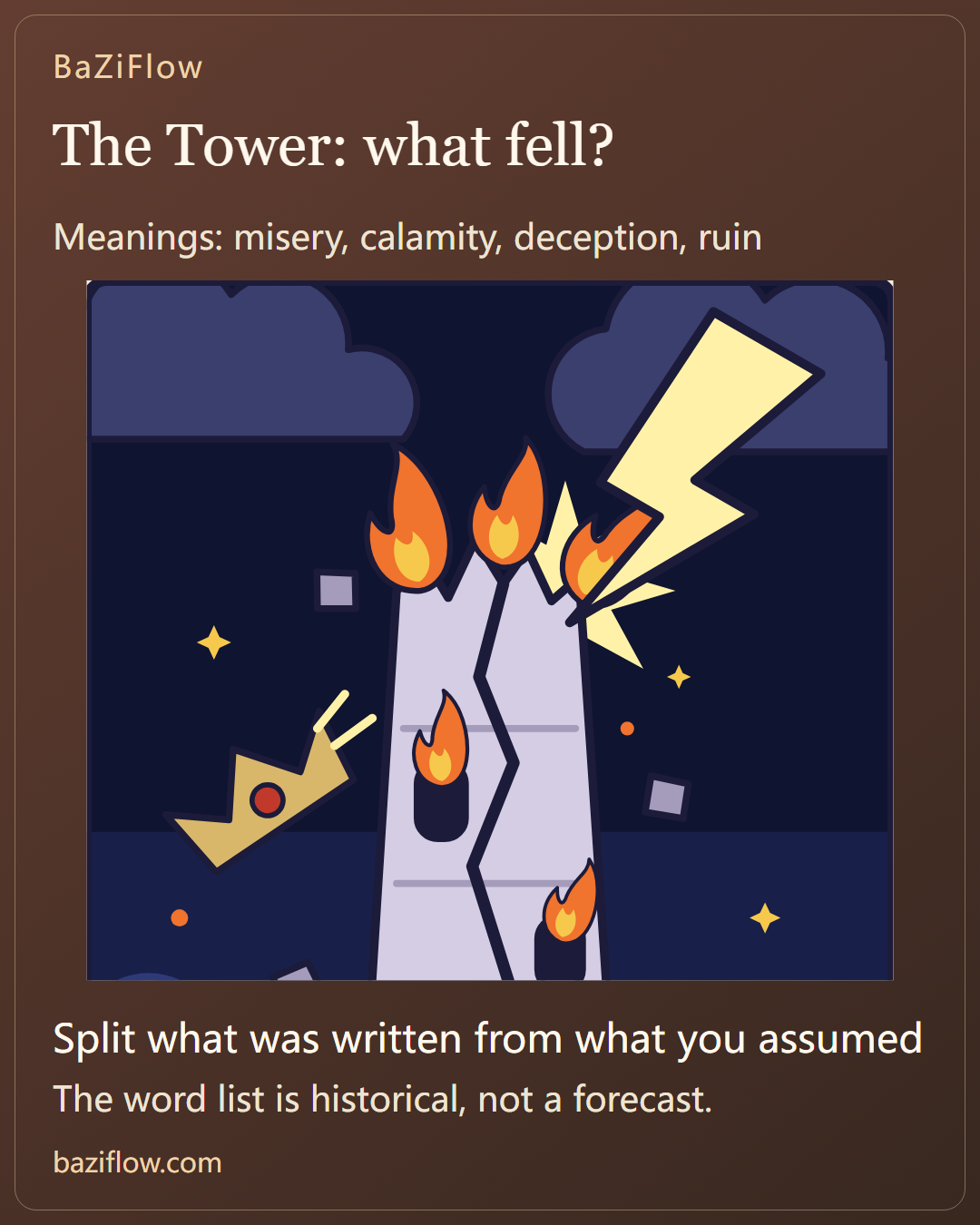
The Tower shows a tower struck at the top and two figures falling headfirst. Separate the picture, Waite’s word list and his House of Falsehood reading, then split a line closure into notice and assumption.
The short version7 min read
The Tower shows a tower struck at the top and two people falling. Waite says the ruin is written on the surface, so the real question is what the tower was built of.
- Waite hardly describes the picture; he says the card bears its evidence of ruin “on the surface”. What concerns him is the kind of house that fell, and he leans toward a House of Doctrine and a House of Falsehood.
- The list has eight words, from misery and indigence to deception and ruin, and calls the card one “of unforeseen catastrophe”. Reversed: one account says the same in a lesser degree; also oppression, imprisonment, tyranny.
- The practice is a commuter-line closure: write what the notice literally says in one column, what you had assumed in another, then count what is still standing.
Read first
The crown knocked off: count what happens in the picture
Waite’s Part II says almost nothing about the picture of the Tower. He opens by remarking that the occult explanations attached to the card are meagre and mostly disconcerting, and that it is idle to point out that it depicts ruin in all its aspects, because it bears this evidence “on the surface”.
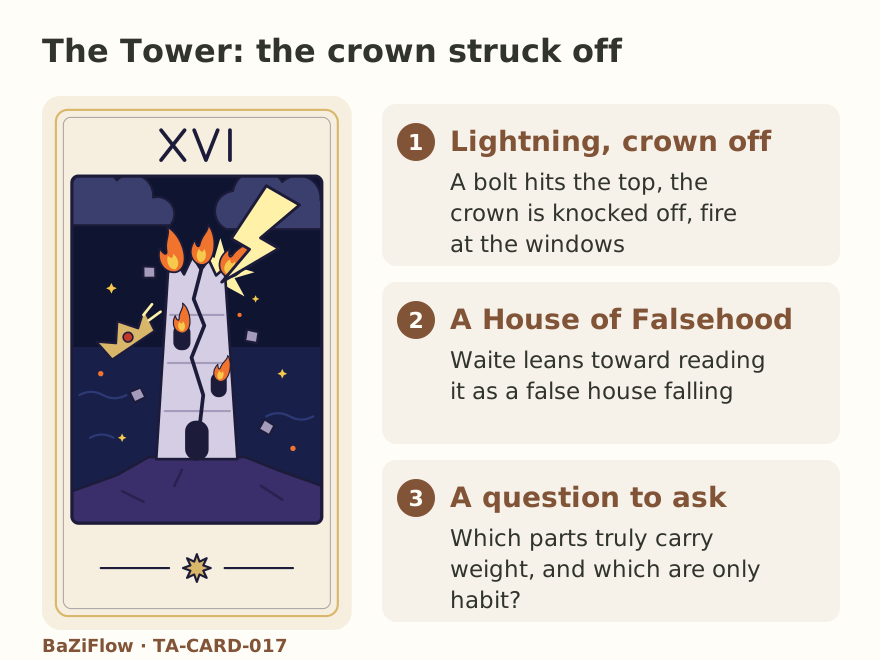
The Tower as BaZiFlow drew it: the crown struck off.
So the picture has to be read for yourself. In the Rider-Waite-Smith card you can confirm the following: XVI at the top; a yellow zigzag bolt coming from the upper right and knocking a gold crown off the top of the tower; flames bursting from the top and the windows; two figures falling head first, the one on the left in a red cloak, the one on the right in blue; a black sky scattered with small yellow flame-shaped drops; and the tower standing on a jagged crag.
Enlarge diagram · scroll sideways to read
An eight-word list with one phrase about how it arrives
Waite’s divinatory meanings run: misery, distress, indigence, adversity, calamity, disgrace, deception, ruin. Straight after comes one sentence: it is “in particular” a card of unforeseen catastrophe.
Misery, distress, indigence, adversity, calamity, disgrace, deception, ruin. It is a card in particular of unforeseen catastrophe.
Sorted loosely by meaning, the first four say where a person ends up, calamity and ruin say what happened, and disgrace and deception concern face and truth. That grouping is this article’s tidying; the original is one unbroken run. The only thing in it about how the matter arrives is the closing “unforeseen”.
Enlarge diagram · scroll sideways to read
“Deception” stands out in the run: of the eight words it is the only one that concerns true and false. Set it beside Part II, where Waite says the tower points to a House of Falsehood, and the two passages meet at this word.
What kind of tower: which account Waite sides with
People have offered many explanations of the Tower, and Waite answers them one by one without treating them alike. First, some say the card holds the first allusion to a material building; he sees no sign that the tower is more or less material than the pillars of three previous cards. Papus supposes it is literally the fall of Adam, for which Waite sees no warrant; his alternative, the materialization of the spiritual word, has more in its favor. The bibliographer Christian imagines the downfall of the mind seeking to penetrate the mystery of God. Waite agrees rather with Grand Orient: the ruin of the House of Life when evil has prevailed in it, and above all the rending of a House of Doctrine. Then he adds his own understanding: the reference is to a House of Falsehood.
Enlarge diagram · scroll sideways to read
He also quotes an old truth that he says the card illustrates in the most comprehensive way: “except the Lord build the house, they labour in vain that build it.”
Three things, and how far Waite goes with each
- Tower
- Waite says it is no more and no less material than the pillars of three earlier cards. What falls is a “house”: a House of Life, a House of Doctrine, and in his own understanding a House of Falsehood.
- Bolt and crown
- Waite does not explain them one by one. He reports a reading as the chastisement of pride, and later teaching often reads the crown as pride; that is a borrowing and is not in the text.
- The two fallers
- Waite holds that the earlier explanations do not account for these two “living sufferers”, and offers his own: one is the literal word made void, the other its false interpretation.
The pairing of “the literal word” and “its false interpretation” is Waite’s own symbolic reading. It separates what was said from the way people read it, and the practice below borrows exactly that split; the borrowed part is marked.
How to read it: take the tower apart in two columns
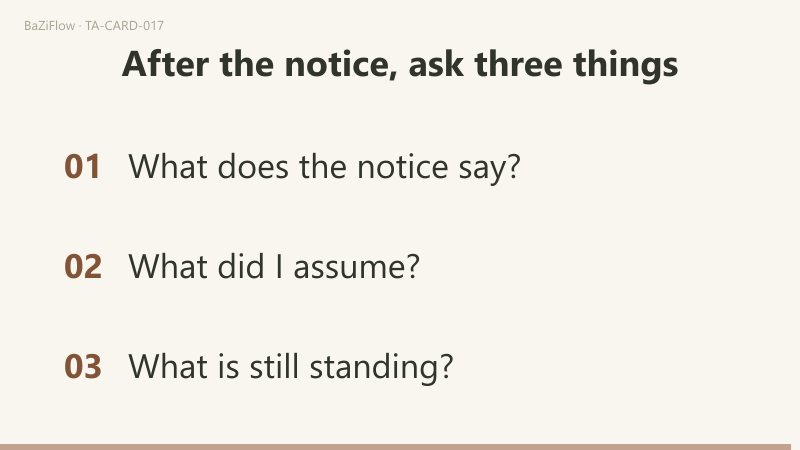
Waite says two persons fall: the word itself and its interpretation. Use that split on one small, concrete matter. On Sunday evening a notice arrives: the subway line you ride every day will be closed from Monday for three weeks of emergency repairs.
Copy the notice word for word
Take only what the notice states: which line, which stations, from which day to which day. This column matches “the literal word”, and you add nothing to it.
Write down your own defaults
A route you know by heart grows a lot of “shoulds”: it should take forty minutes, there should be a seat, the last train should run until eleven thirty. This column matches “the interpretation”, and many of its entries were never written down before.
Count what is still standing
The office has not moved, the start time is the same, the other lines and the walking distances are all still there. Count these first, and only then decide how to reroute.
Enlarge diagram · scroll sideways to read
What fell, and what only seems to have
Really fell
- This line is out for three weeks
- The forty-minute estimate
Only assumed fallen
- “I will certainly be late”
- “These three weeks are ruined”
To check
- Transfer and walking times
- Whether the start time can flex
Reversed and neighboring cards: one notch lighter, plus oppression, imprisonment, tyranny
Waite’s reversed reading is one line: according to one account, the same in a lesser degree; also oppression, imprisonment, tyranny. The first half is “the same meaning, lightened”, the second half a different set of words, and the two sit side by side without a choice between them.
According to one account, the same in a lesser degree; also oppression, imprisonment, tyranny.
Enlarge diagram · scroll sideways to read
Three neighboring cards, and where each puts the bad news
The card before: a material state
Waite says the Tower echoes the card before it, but only by analogy: the Devil speaks of a descent into matter and the beast, the Tower of ruin in the intellect. The Devil’s own words lean on violence and force, and on a fate that is not therefore evil.
A figure pierced by every sword
Waite writes: whatever is intimated by the design, also pain, affliction, tears, sadness, desolation, and adds that it is “not especially a card of violent death”. The Tower’s list circles standing and reputation.
The card after: another reading in the entry
The list opens with loss, theft, privation, abandonment, then says that another reading is hope and bright prospects. It also starts from hardship, but this entry holds two directions.
Questions readers ask next
Is the Tower simply a disaster card?
Waite’s list is all heavy words and it names unforeseen catastrophe. But when he turns to the picture he puts his effort into the thing that fell: a house of falsehood. The accounts that call it punished pride or an overwhelmed intellect, he says, do not account for the two people in it. You can ask what fell before asking how bad it is.
What does the Tower mean reversed?
The main entry gives one line: according to one account the same in a lesser degree; also oppression, imprisonment, tyranny. These come from the same line and are not split into layers, so say which half you are taking before you read.
Who are the two people falling from the tower?
Waite calls them the “living sufferers” of the card: one is the literal word made void, the other its false interpretation. That is his symbolic reading; the picture does not name them. He adds that the other explanations he reports leave these two unexplained.
Was this article helpful?
Sources & references
Continue reading
Justice: a sword held up, a scale hung low, and one measure for both sides ↗
The Devil: two chains before the altar, and a list of force and fatality ↗