

Kong Wang: placed by year stem, also a catch-all
Content version · · Sources & references
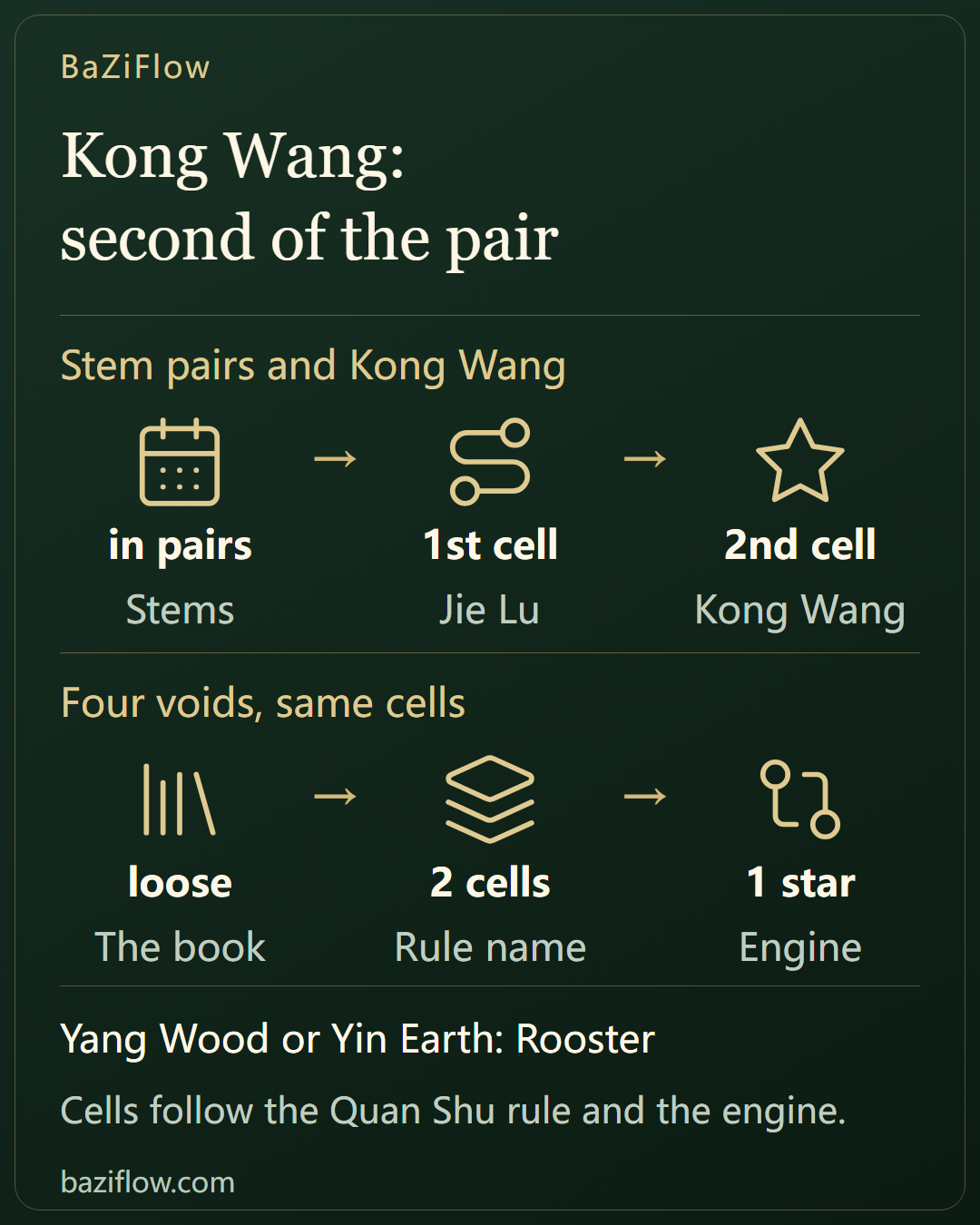
Kong Wang is placed by the birth-year stem, on the second cell of a pair. A stem table, the original rule, one real chart with five kinds of void and a same-cell count set the star apart from the catch-all word.
The short version7 min read
Kong Wang is a minor star placed by the birth-year stem: the ten stems form five pairs, each pair shares two cells, and Kong Wang takes the second; in the book, though, the two characters are more often a catch-all than the name of one star.
- In juans 1 to 3 as held here, the two characters of "Kong Wang" turn up 38 times, "Jie Lu" 6 times, "Xun Kong" twice and "Jie Kong" once; the most used word mostly does not point to one star.
- Juan 2 names its rule "Jie Lu Kong Wang" and gives two palaces for each stem pair; the engine splits them, the first becoming Jie Lu and the second Kong Wang, and Kong Wang can only sit at Rooster, Goat, Snake, Rabbit or Ox.
- On one chart the four kinds of void have separate inputs: Tian Kong reads the year branch, Xun Kong the decade of the year pillar, and Kong Wang and Jie Lu the year stem; some pairs share a cell, but Jie Lu and Kong Wang never do, nor Tian Kong and Xun Kong.
Read first
What do Zi Wei's supporting, malefic and minor stars actually do? ↗
The two characters of "Kong Wang" appear thirty-eight times
Search juans 1 to 3 of the Quan Shu (紫微斗数全书) as held here and "Kong Wang" (空亡) turns up 38 times, "Jie Lu" (截路) 6 times, "Xun Kong" (旬空) only twice and "Jie Kong" (截空) once. The most used of these words mostly does not point at a star on the chart called Kong Wang. First the star itself:
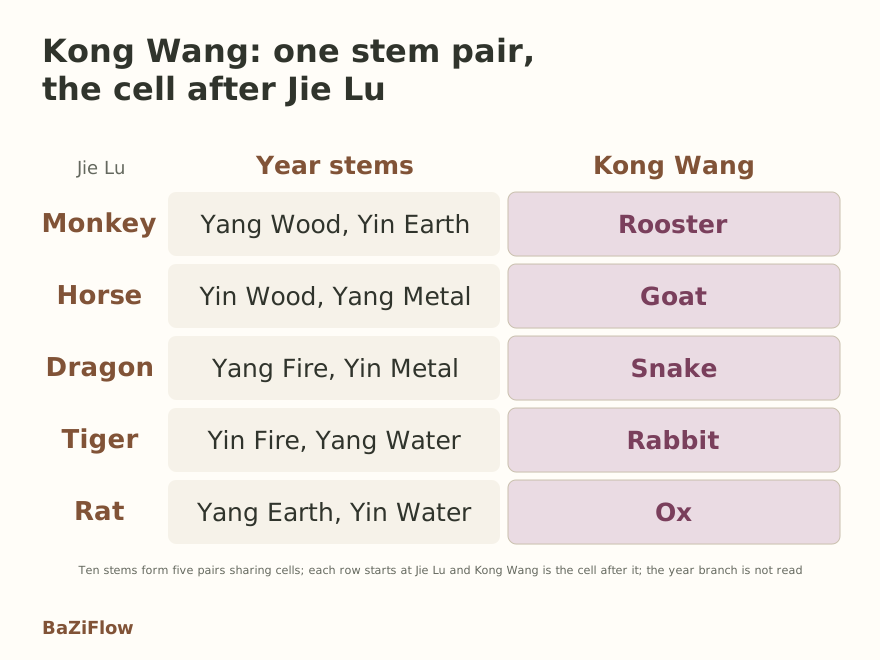
The stem table: cells follow the juan 2 rule, and putting Jie Lu first and Kong Wang second is the engine's way of splitting that rule, checked over all sixty year pillars.
The ten stems form five pairs, each stem paired with the one five places after it: Yang Wood goes with Yin Earth, Yin Wood with Yang Metal, Yang Fire with Yin Metal, Yin Fire with Yang Water, and Yang Earth with Yin Water. Both stems of a pair share one pair of cells, and the second one is where Kong Wang sits: Rooster for a Yang Wood or Yin Earth year, Goat for Yin Wood or Yang Metal, Snake for Yang Fire or Yin Metal, Rabbit for Yin Fire or Yang Water, Ox for Yang Earth or Yin Water. The year branch takes no part, so Kong Wang appears at only five cells, and each of them holds twelve of the sixty year pillars.
One rule that the engine splits into two stars
Juan 2 names the rule "Jie Lu Kong Wang", says it works by the birth year, and gives nothing more than five stem pairs with two palaces each:
Yang Wood and Yin Earth: the Monkey and Rooster palaces. Yin Wood and Yang Metal: Horse and Goat. Yang Fire and Yin Metal: Dragon and Snake. Yin Fire and Yang Water: Tiger and Rabbit. Yang Earth and Yin Water: Rat and Ox.
The rule does not name the two palaces separately. The engine records the first palace as Jie Lu and the second as Kong Wang, so one rule becomes two stars. That split is the engine's convention; the original has only the four characters "Jie Lu Kong Wang" written together.
Enlarge diagram · scroll sideways to read
Three jobs for one word
In the text "Kong Wang" has at least three identities, and reading them as one misplaces things:
Enlarge diagram · scroll sideways to read
Take the sentence "Tian Kong is the spirit of Kong Wang": the Kong Wang there is the catch-all, speaking of Tian Kong as one kind of void. It shares neither a placement rule nor a position with the star on the chart called Kong Wang.
Five kinds of void on one chart
Here is a chart for 1 October 2000 (lunar month 9, day 4), a Geng Chen (庚辰) year, born in the Rat hour with the Life palace at Dog, listing every kind of void together:
Enlarge diagram · scroll sideways to read
How often the four year-based voids share a cell across the sixty year pillars:
Enlarge diagram · scroll sideways to read
The two zeros are structural: Kong Wang sits right after Jie Lu and can never share its cell, while Tian Kong takes the opposite yin or yang of the year branch and Xun Kong the same one, so the two can never meet.
Another school, and only one Jie Kong remains
Under the engine's other setting, the Zhong Zhou school, Jie Lu and Kong Wang are gone and a single star called Jie Kong takes their place: in a year with a yang branch it sits where Jie Lu would, in a year with a yin branch where Kong Wang would. The ranking sentence of juan 3 uses exactly this name, "Jie Kong".
Enlarge diagram · scroll sideways to read
Before writing down a Kong Wang
Ask whether it is a catch-all
On reading "Kong Wang" in the book, decide whether it gathers several kinds of void or names one placement rule; a catch-all corresponds to no fixed cell on a chart.
The star takes the second cell by stem
Once it is the engine's star, look up the stem pair and take the later cell; record the split in the source column as an engine convention.
Keep it apart from the other voids
Tian Kong reads the year branch, Xun Kong the decade and Di Kong the hour; a shared cell is coincidence, so do not merge them into one star.
Two checks
Born in a Wu Zi (戊子) year: which branch holds Kong Wang?
Yang Earth and Yin Water form a pair, the rule gives Rat and Ox, and Kong Wang takes the second: Ox.
Born in a Geng Wu (庚午) year: which two of Tian Kong, Xun Kong, Kong Wang and Jie Lu share a cell?
In a Geng Wu year Tian Kong is at Goat and so is Kong Wang, Xun Kong is at Dog and Jie Lu at Horse; the two sharing a cell are Tian Kong and Kong Wang.
Jie Lu is the first cell of this rule, see Jie Lu; the void placed by decade is Xun Kong; and the BaZi counterpart is drawn in the twelve life stages and void branches.
Questions readers ask next
The book says "the horse meets Kong Wang" and "the body sits in Kong Wang". Is that the star called Kong Wang?
Mostly not. In these lines the words are a catch-all for falling into an "empty" place, and stars such as Tian Kong, Jie Lu or Xun Kong can all be gathered under it. To know which one is meant, go back to the context of the line and to each star's placement rule.
My year stem is Yang Wood. Why is Kong Wang at Rooster, and is the year branch ignored?
In the engine Kong Wang reads only the stem: Yang Wood and Yin Earth form a pair that lands at Rooster, Yin Wood and Yang Metal a pair that lands at Goat. The branch plays no part, so over the sixty year pillars Kong Wang appears at five cells only, twelve times each.
Is Kong Wang the same thing as the void in BaZi?
No. The BaZi void derives two branches from the decade of a pillar, while this Zi Wei star takes one of five stem-pair cells. The name is shared but the basis and the place of landing are not; say which system a note belongs to.
Was this article helpful?
Sources & references
Continue reading
Xun Kong (旬空): Two Voids per Decade, the Engine Takes One by Yin and Yang ↗
Jie Lu (截路): Five Cells by Year Stem, Two Back Each Pair, and Not the "Broken Bridge" ↗