

Virtue and Refinement: the month sets the lists
Content version · · Sources & references
The Virtue and Refinement (德秀) Nobleman reads the Three Harmony group of the birth month, takes two stem lists, Virtue and Refinement, and matches them to the four stems. A table from Sanming Tonghui and how it is built.
The short version7 min read
Virtue and Refinement starts from the month, not the day: the birth month branch belongs to one Three Harmony group, which gives two stem lists, Virtue and Refinement, to be matched against the stems of the chart.
- Each group has a pair of lists: for the Fire group Virtue is the two Fire stems and Refinement is Yang Earth and Yin Water, and Metal and Wood have pairs of their own; the Water group carries two extra stems in each.
- The lists follow a pattern: Virtue takes the stems of the group's own element, and Refinement the two stems whose five-combination turns into that element. This holds in every group except Water.
- The Monthly Virtue is the first stem of the Virtue list, so anyone with it falls inside Virtue; the Virtue and Refinement test is the wider of the two.
Read first
Symbolic Stars in BaZi: Check the Reference and Rule Before the Meaning ↗
Virtue and Refinement: two lists of stems
The Virtue and Refinement Nobleman (德秀贵人) does not start from the day stem or the year branch; it reads the birth month. The third fascicle of the Ming-dynasty Sanming Tonghui (三命通会) carries a chapter "On Virtue and Refinement", which opens with two definitions:
Virtue is the virtue in season in its own month; Refinement is what the centered qi of heaven and earth becomes as the five phases change.
"The virtue in season" means Virtue is the element ruling the birth month; "as the five phases change" means Refinement has to be produced by a five-way combination. The book sorts the stems into two lists by the Three Harmony group of the month branch.
This star is not marked on the site's chart pages, so the look-up below rests on the old books alone.
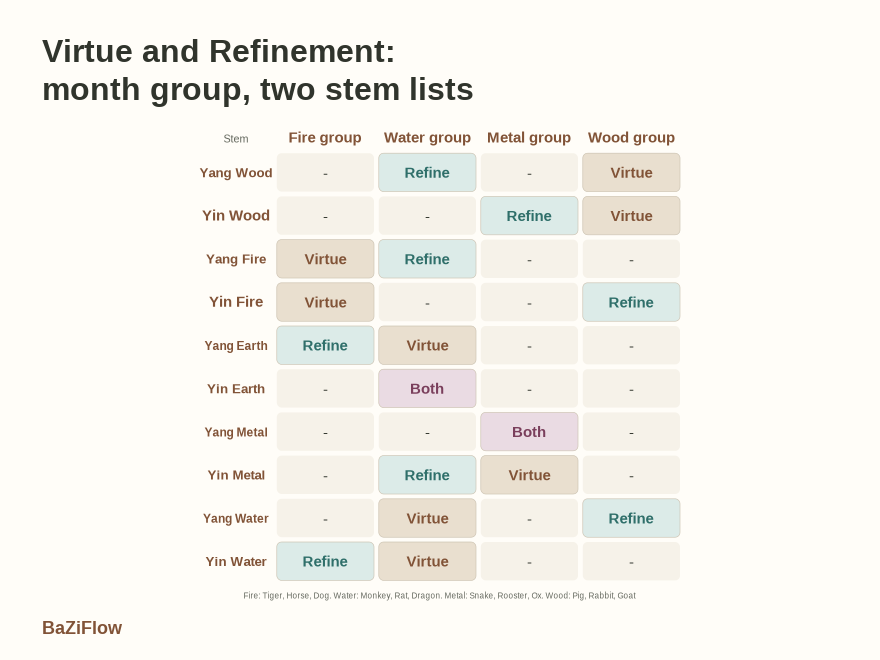
Look-up sketch: the left column holds the ten stems and the four columns the Three Harmony groups of the birth month; each cell says whether the stem is Virtue, Refinement or both in that group. Lists from the "On Virtue and Refinement" chapter of Sanming Tonghui juan 3, checked entry by entry.
The look-up has two steps: find which Three Harmony group the birth month branch belongs to, take that group's two stem lists, and match them against the stems of the chart one by one. Say the birth month is a Horse month: Horse sits in the Tiger-Horse-Dog trio, which is Fire, so Virtue is the two Fire stems (Yang Fire and Yin Fire) and Refinement is Yang Earth and Yin Water.
For the Metal group the text writes "Yin Earth, Rooster, Ox month" (己酉丑), but a Three Harmony group can only be Snake-Rooster-Ox (巳酉丑), and the Metal chapter of juan 6 writes it that way, so this article reads Snake-Rooster-Ox.
How the lists are built
Twelve stems in a table look arbitrary, but a short script check shows a clean rule everywhere except the Water group: Virtue takes the stems of the group's own element, and Refinement takes the two stems whose five-combination changes into that element.
Enlarge diagram · scroll sideways to read
The Water group is the exception. Its Virtue holds, besides Yang Water and Yin Water, the Earth stems Yang Earth and Yin Earth; its Refinement holds, besides Yang Fire and Yin Metal, which combine into Water, the stems Yang Wood and Yin Earth, which combine into Earth. Juan 3 gives no reason for these four extra stems and the site has not fixed their place; they are listed as the text has them.
Matching three charts
Take three made-up charts, with the pillars computed by a calendar tool in Beijing time and no true-solar-time correction, and match the four stems to the lists:
Enlarge diagram · scroll sideways to read
Chart A has three matches and meets Virtue and Refinement together; chart B matches none of its four stems; in chart C the day stem, Yin Earth, appears in both lists, an overlap in the Water group that comes from the extra stems above. The text says the star is found "in the chart" without limiting it to one pillar, so the table lists all four stems and gives no weights.
What the book says it brings, and the conditions
After a match, the book has little to say, just a line:
A person who has this Virtue and Refinement in the chart, with no damage, clash, overcoming or pressing on it, is by nature clever, warm and gentle.
The text goes on: if it also meets the Academy Star (see the Academy Star) and carries Wealth and Officer, it is noble; if it meets a clash, its strength is reduced. Put these together:
Enlarge diagram · scroll sideways to read
The juan 6 line is in a chapter on the Heavenly and Monthly Virtues, where "virtue and refinement" is used almost as an adjective:
This is the virtue-and-refinement qi of heaven and earth, a force that turns ill luck into good.
So in the book "Virtue and Refinement" is both a heading and a descriptive phrase, and you have to read which chapter it comes from.
Two similar names
"Virtue and Refinement" and "Fortune, Virtue and Refined Qi" (福德秀气) differ by one word, but they are two separate things in the Sanming Tonghui, and juan 11 has a note that runs several names together:
Enlarge diagram · scroll sideways to read
So when you meet the words "Virtue and Refinement", first ask whether it is the first kind (month and stems) or the second (a day pillar). The Yuanhai Zi Ping (渊海子平) speaks of an Earth-on-four-seasons pattern "meeting Virtue and Refinement and the Three Wonders", where the phrase stands beside the Three Wonders and no look-up is given; the Sky Net and Earth Net of the same series are another kind, which reads branches meeting. To weigh a star like this against the rest of a chart, start from the place of shensha.
Questions readers ask next
Is the Virtue and Refinement Nobleman the same as the Monthly Virtue?
No. The Monthly Virtue takes one stem per group and is the first stem of the Virtue list; Virtue and Refinement joins the two lists, with three to seven stems per group once merged, and a wider condition.
What does "refinement" mean here: good looks?
The book defines it as the clear, refined qi of heaven and earth, "the force in season in the four times of year", and says it comes from the centered qi of heaven and earth changing through the five phases. It is about the quality of qi, not appearance.
None of my stems match either list. Is something missing?
Not necessarily. One of the three sample charts below matches none of its four stems. The book only says that having Virtue and Refinement is good, and does not call having none a lack.
Was this article helpful?
Sources & references
Continue reading
Sky Net and Earth Net (天罗地网): Dog-Pig, Dragon-Snake, and Two Ways of Naming Dragon and Dog ↗
Three Wonders (三奇): Three Stem Sets, Read in Pillar Order, and the Books That Doubt Them ↗