

Luck Pillars, decades and transits
Content version · · Sources & references
Compare what actually changes in three timing methods: a Bazi pillar, a Ziwei palace perspective, or a planetary relationship. Keep dates and interpretive claims separate.
The short version6 min read
A Luck Pillar names a stem–branch phase; a Ziwei decade changes the palace perspective; a transit follows a position relationship. Compare the calendar interval without exchanging those definitions.
- A conventional ten-year duration does not determine the first calendar boundary.
- Transit windows depend on the body, reference point and orb; they are not uniform decade boxes.
- A repeated word such as pressure is not an independent observation of the same event.
Read first
BaZi and Ziwei on One Question: Preserve Each Structure Before Comparing ↗
Make the comparison sheet before combining the readings
Put three empty columns on a page: period, moving object, and claim. The first holds dates rather than a vague age label. The second names the pillar, palace context or planetary relationship being tracked. The third holds what an author actually says about it. If a column cannot be filled, that is a useful finding: the comparison is missing information.
For example, an entry might give a decade label but no starting convention. Another might mention a transit without specifying its reference point. These entries are not ready to be combined. A confident paragraph cannot repair the missing definitions. Keep the original wording beside the incomplete fields so a later correction remains traceable.
| Entry in a reading | Missing information to request | What must not be inferred |
|---|---|---|
| A Luck Pillar is continuing | Its calendar boundaries and calculation convention | A new phase starts at a round-number birthday |
| A Ziwei decade has changed | Palace context and age notation | It is the same change as a Bazi pillar |
| A transit is close | Body, reference point, aspect and orb | An event has already been identified |
The table shows how to log gaps in an entry, and the three-column comparison sheet is an editorial aid, not a traditional technique. It helps readers compare the information supplied by different techniques. The underlying chart structures are introduced in Bazi and Ziwei reading methods.
Phase
- Retain
- Dates and convention
- Do not invent
- Round birthday boundary
Transit
- Retain
- Body, point and orb
- Do not invent
- An identified event
Separate phases from contact windows
- Phase
- An interval defined by a timing method.
- Window
- An interval satisfying a stated positional condition.
- Event
- A recorded occurrence, not a consequence of drawing overlapping intervals.
Test whether the apparent agreement says anything specific
Suppose two anonymous teaching notes both contain the word pressure. One describes a long phase of responsibility; the other describes a short interval of difficult communication. They do not yet provide two independent answers to the same question. Their domains and time ranges differ, while the shared word is broad enough to cover many experiences.
To compare them, retain the proposed object, observation period and conditions that would not fit. A claim that expands to cover every possible outcome cannot gain much precision merely by appearing twice. Record a symbolic resemblance as a resemblance. Do not turn the repeated vocabulary into a combined confidence score.
The same test applies to apparent disagreement. An author can discuss a continuing background phase while another identifies a temporary contact within it. Continuing and changing are not opposites until the reader establishes what is continuing and what is changing. This is the point at which the three timing architectures become useful.
Long responsibility
- Broad phase
- One proposed domain
Brief communication
- Short window
- Another proposed domain
Two systems partition time; their partitions are not interchangeable
Traditional Bazi Luck Pillars form a sequence of stem-branch pairs, conventionally read as ten-year phases. The major-luck discussion in San Ming Tong Hui, volume 2, also addresses converting an interval relative to a solar term into a starting age. A phase's duration and its initial date are therefore separate questions. The word decade supplies the former, not the latter.
Ziwei's major decade organises a phase through the palace structure. Zi Wei Dou Shu Quan Shu, volume 3, treats the ten-year major limit and discusses its relationship with other timing layers. That historical organisation is not a warrant for applying the book's deterministic predictions to present-day lives. It also does not supply a conversion from a Bazi stem-branch label into a Ziwei palace label.
On the worksheet, these two methods need their own boundaries. If an output gives ages rather than dates, preserve its age convention. Do not silently replace an unresolved age boundary with a birthday. Coinciding dates would show a coincidence of intervals, not identity of the rules used to construct them.
A phase name alone also leaves interpretation incomplete. It must be read with the relevant chart context under that tradition's rules. No precise event date follows from the duration of a broad phase without some further, explicitly stated argument.
Luck Pillar
- Stem–branch sequence
- Own starting convention
Ziwei decade
- Palace structure
- Own age convention
A position relationship produces a different kind of interval
A transit starts from planetary positions at a selected time and compares them with specified reference positions, often natal ones. An orb is the angular tolerance used around an exact relationship. Changing that tolerance changes the window being discussed; changing the reference point changes the relationship itself.
Different apparent speeds and retrograde motion mean that a relationship can have unequal or repeated approaches. There is no universal transit duration that can be copied into every comparison sheet. Nor should repeated approaches automatically be narrated as separate guaranteed events.
Swiss Ephemeris technical documentation supports calculation of positions and time parameters. It does not establish the personal meaning of a contact. Keep the geometry on one side of the worksheet and the interpretive claim on the other. A very precise coordinate does not make an unsupported prediction equally precise.
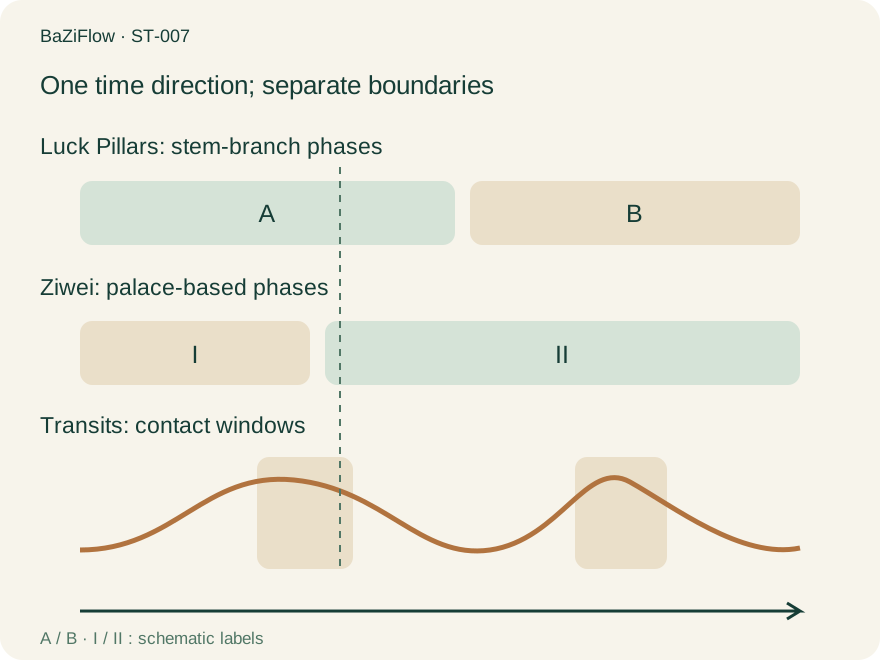
Original BaZiFlow teaching diagram; intervals and positions are schematic, not a personal chart.
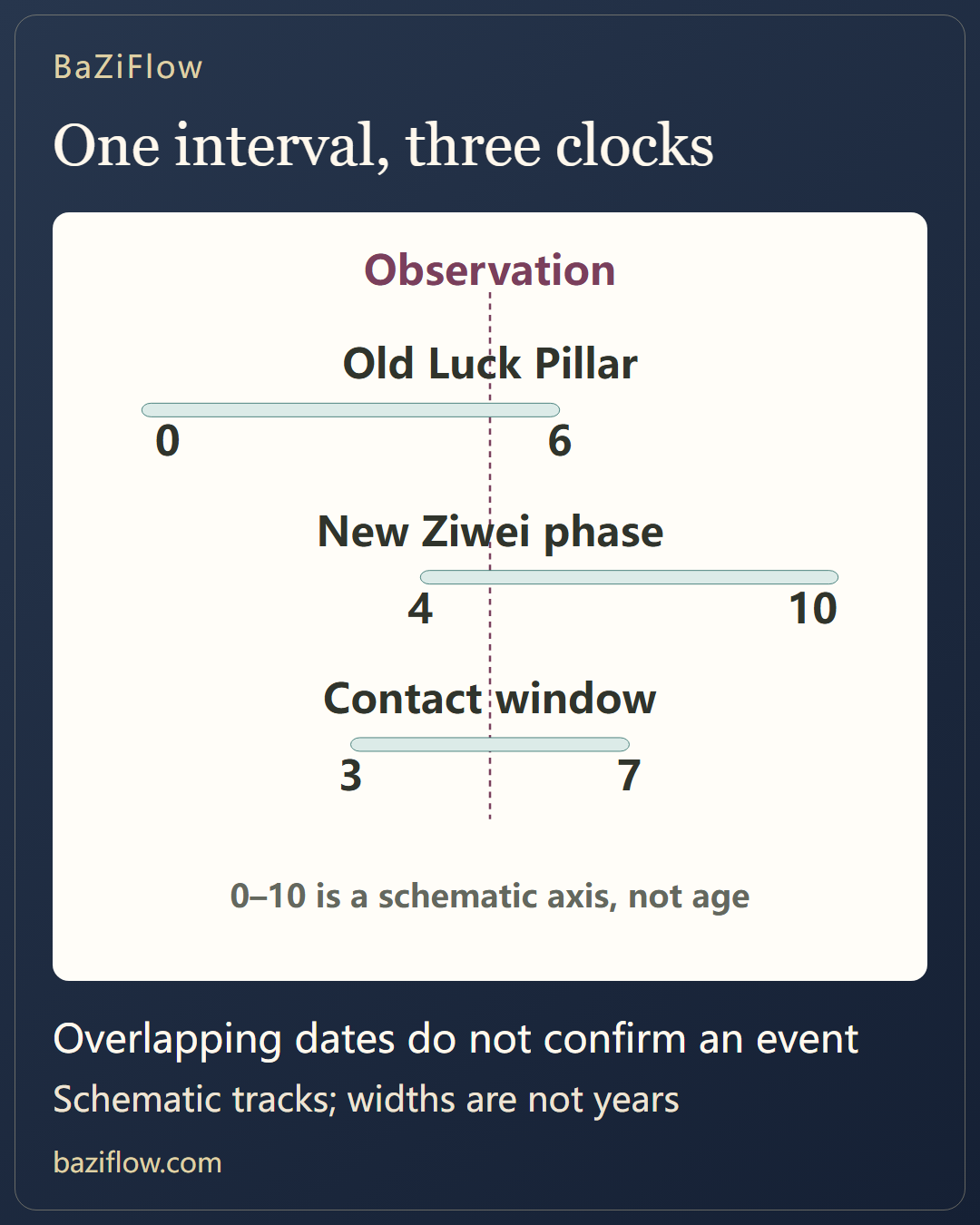
The schematic gives a quick check on the distinction. The upper two tracks have different segment boundaries. The lower track contains contact windows. A vertical line could cross an old Luck Pillar segment, a new Ziwei segment and a contact window without contradiction. None of the tracks contains a biography or an event record. Curve height is not a fortune score, and widths cannot be converted into ages or planetary speeds.
Observation · 5
0 ↔ 10
- Old Luck Pillar · 0–6
- New Ziwei phase · 4–10
- Contact window · 3–7
0–10 is a schematic axis, not age
Add observations without rewriting the earlier claim
Once the fields are complete, a reader may compare a stated expectation with later observations. Keep the date when the expectation was written. Selecting an interval after an event and specifying a condition before it are different activities; both can be recorded, but they should not share the same label.
Preserve non-matches as well as memorable matches. Otherwise the notebook becomes a collection of selected coincidences, and it becomes difficult to see how much the explanation changed after the facts were known. This is a modest record-keeping discipline, not a promise that a small personal log can establish a tradition's predictive validity.
The worksheet is complete when a reader can tell which period, object and claim belong together, including the unresolved parts. It need not end in agreement. Long phases and present questions considers a separate decision: whether a phase comparison is relevant to the question being asked at all.
Keep the order of evidence
Read each track at the observation line
At coordinate 5, the old phase spans 0–6, the new phase 4–10 and the contact window 3–7. All three labels coexist.
State the missing conclusion
No birth data, planet or event is supplied. The overlap alone cannot identify a personal outcome.
Keep the record in time order
Store the expectation before checking later observations, including intervals that did not match.
Questions readers ask next
Can the two decade methods exchange labels?
No. One tracks a stem–branch pillar and the other a palace perspective. Preserve their separate starting and age conventions.
What does a three-track overlap establish?
Only that the selected intervals coexist. An event is a separate observation, not a consequence of drawing the overlap.
Does a wider orb make a transit more valid?
It changes the angular condition and usually the window. It does not establish the meaning or outcome attributed to the contact.
Was this article helpful?
Theme: Time & life stages
Part of a learning path
Across systems: compare methods, not stitched conclusions · Step 3 of 3 available
Sources & references
Continue reading
Birth-Time Uncertainty: Boundaries, Ranges and Stable Fields ↗