

Recording a tarot draw
Content version · · Sources & references
Build a readable record of deck selection, orientation, dealing order and later additions. Two procedures in Waite’s 1911 manual show why a named method matters more than an invented universal ritual.
The short version7 min read
A draw creates information about sequence, position and orientation. Set the eligible pool and handling method first, then retain what actually happened. Draw numbers alongside a photograph show what later additions, rotations or rearrangements changed.
- Shuffling, cutting and rotating affect different aspects. Moving the top packet to the bottom does not automatically reverse any card.
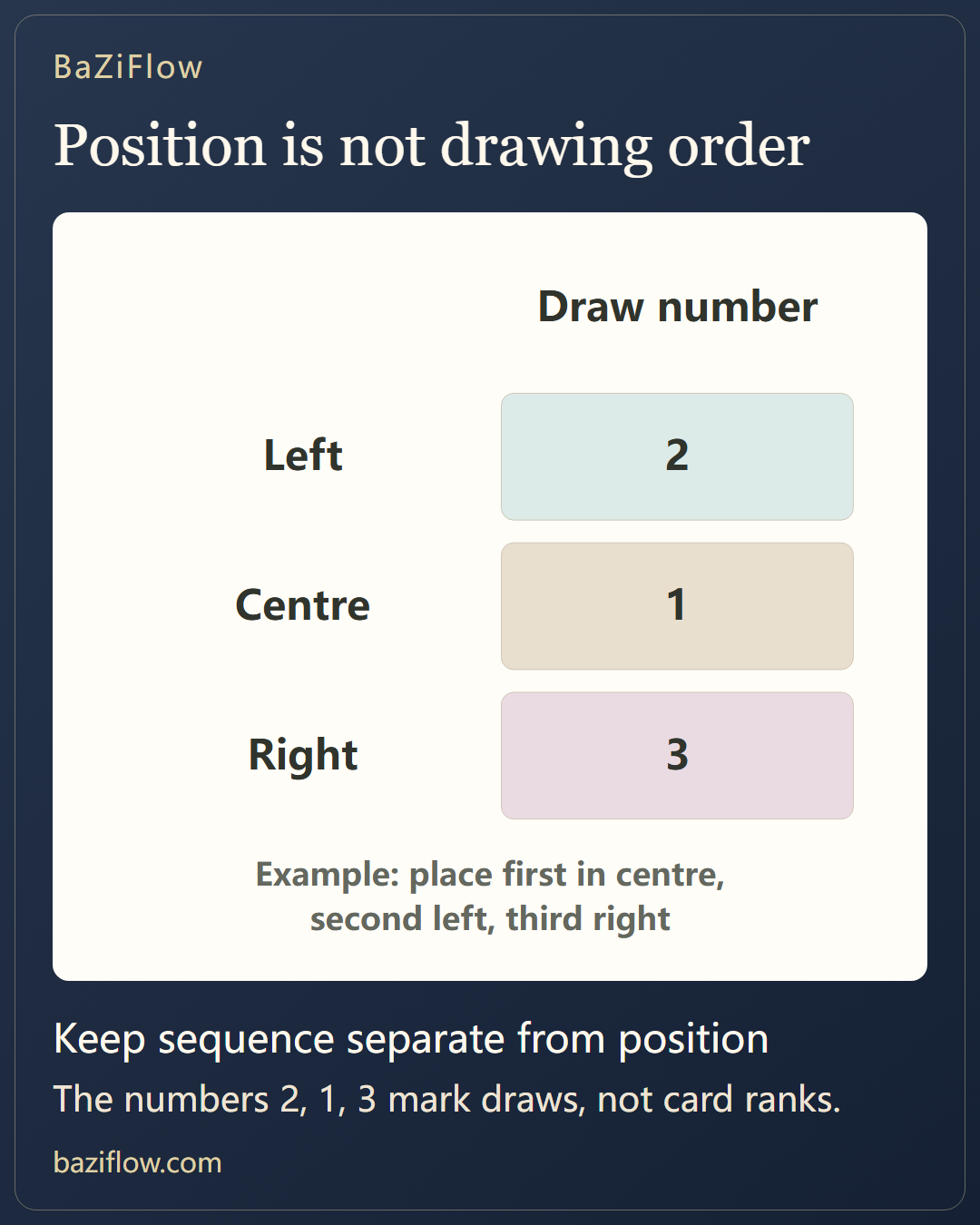
- The first card may be placed in the centre. Left-to-right order in a photograph need not match the order in which cards were drawn.
- Original cards, interpretation and later additions belong to different stages. New information can be appended without rewriting the earlier record.
Read first
Could another reader reconstruct what happened?
Imagine receiving a photograph of three cards. You can identify their faces, but you cannot tell whether they were dealt from the top, selected from a fan, or chosen deliberately. Perhaps the middle card replaced an earlier one. Perhaps the reader rotated every card upright before taking the photograph. None of those details can reliably be recovered from the image alone.
A useful record answers a narrower question than whether tarot works: what did this particular reader do? It preserves the difference between a rule chosen beforehand, an event during handling, and an interpretation added afterward. A beautifully detailed log is not evidence that the cards predict events. It simply makes the activity open to inspection instead of allowing its history to change with the story.
Number the draw
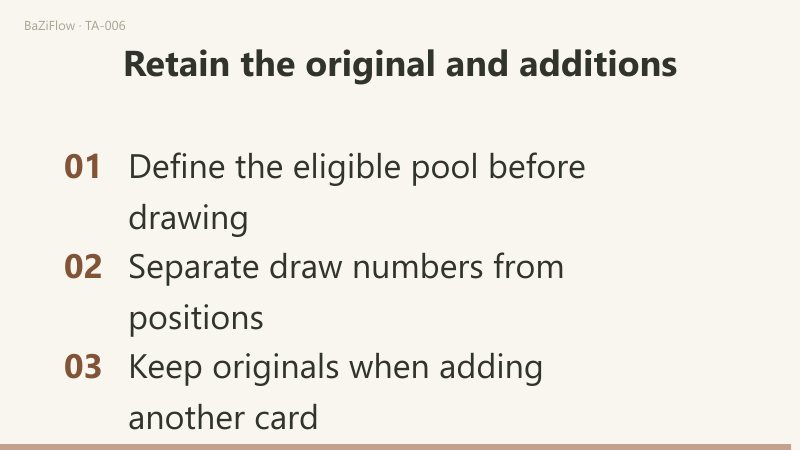
Record first, second and third in the order actually removed.
Label each position
Indicate the task assigned to the left, central or right place.
Fix the viewpoint
Use the same reader’s upper edge rather than the photographer’s changing position.
Write the dealing instruction before you see the faces
Try the positions “information already available”, “information still needed”, and “one action within my control”. Before drawing, say whether you will use reversals, how cards will be selected, and what happens if a card falls out. A simple choice is to return accidental drops and make a note of the interruption. Another practice may differ; what matters for this exercise is that the rule is not invented after seeing an attractive image.
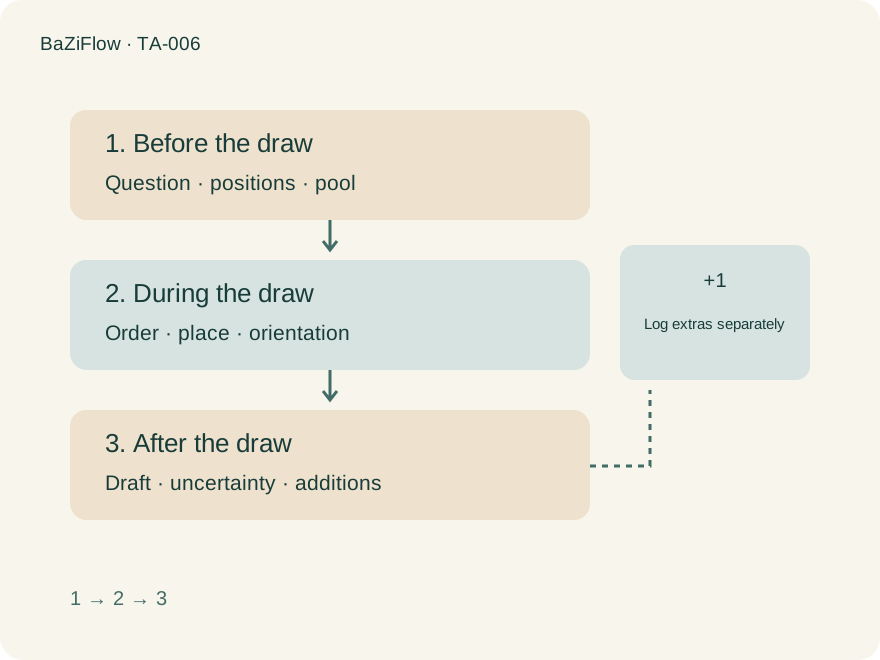
Original BaZiFlow process diagram. The arrows indicate the order of recording, not a claim of predictive accuracy.
| Decision made in advance | Example entry | Why it belongs before the draw |
|---|---|---|
| Eligible cards | All 78, no significator removed | Defines the pool |
| Selection | Deal the top three after handling | Distinguishes dealing from choosing faces |
| Orientation | Upright meanings only for this exercise | Avoids choosing the rule to fit a card |
| Positions | Known / missing / possible action | Prevents renaming an awkward position |
This small protocol leaves room for interpretation without rewriting the exercise itself. If the second card seems unrelated to missing information, write that down. Moving it to a new position called “what someone secretly thinks” would be a different question, not a successful completion of the original one. Framing a question helps keep the discussion connected to information and choices you can actually examine.
Start with the deck and edition, then state which cards are eligible. A full standard deck has 78 cards; a Major-Arcana-only exercise has 22. Taking out a significator before drawing changes the remaining pool. A missing card does so accidentally. These are different conditions even if the same three cards happen to appear at the end.
Check the deck before a first exercise, using the guide to deck structure if needed. Keep advertising or instruction cards separate. If cards stick together, are visibly marked, or have noticeably different sizes, record the problem and resolve it before describing the draw as an ordinary draw from the full deck. The point is not to turn a reflective practice into laboratory theatre; it is to avoid making a false statement about what was available.
Next, distinguish operations. Shuffling changes order. Cutting moves a packet relative to the remainder. Turning individual cards through half a rotation changes their orientation. A cut does not, by itself, necessarily introduce reversals. Nor does naming a shuffle technique demonstrate that every arrangement is equally likely; equal likelihood requires a separate mathematical analysis of the method.
Top to bottom
Before cut
- 1
- 1↑
- 2
- 2↑
- 3
- 3↑
- 4
- 4↑
- 5
- 5↑
- 6
- 6↑
Top 3 to base
- 1
- 4↑
- 2
- 5↑
- 3
- 6↑
- 4
- 1↑
- 5
- 2↑
- 6
- 3↑
Six numbered cards; arrows mark orientation. No card rotates during this cut
Which procedure does the citation actually describe?
A note saying “I followed Waite” still leaves an important question unanswered: which procedure? One method removes a representative card first; another begins from the whole pack. A later reader cannot reconstruct the eligible pool by the author’s surname alone.
In Part III, section 7 of the 1911 Pictorial Key, Waite selects a significator before shuffling and cutting the remaining pack three times. Section 8 presents an alternative starting with the whole pack, includes turning some cards around, and goes on to work with 42 cards. Read each procedure as a whole rather than extracting a gesture from one and a dealing rule from the other.
These are primary-source descriptions of an author's methods. They do not establish that a particular hand, number of cuts or physical gesture increases accuracy. The historical rules for assigning a significator by personal characteristics are not adopted here as a way to classify people. Likewise, a historical-sounding title is not sufficient evidence for a method's antiquity. The manual documents what its author printed; a claim about earlier origins requires further evidence.
For a modern exercise, it is entirely possible to state your own limited procedure. Just label it as such. The three positions above are an original recording exercise, not a reconstruction of Waite's Celtic layout.
III.7
- Remove significator first
- Shuffle/cut remaining pack three times
- Deal into positions
III.8
- Start with whole pack
- Turn some cards around
- Initially deal 42 cards
Two specific Waite procedures, not pieces of one universal ritual
Preserve sequence separately from position and orientation
A card dealt first may be placed in the centre, with the second to its left. A left-to-right photograph would then present a different order from the dealing sequence. Number the draw and label the positions independently. State whose view defines the top of a card; a person photographing the table from the opposite side should not silently reverse the recorded orientation of the whole spread.
Handling can also alter the evidence. If a card is turned through 180 degrees while being revealed, note that action rather than claiming its final direction was necessarily its direction in the pack. A practical record can be short: “Card 2 rotated during reveal; original orientation not retained.” Unknown is a better description than an invented certainty.
An additional card belongs on a new line. Record the new, specific question before drawing it, retain the original cards and interpretation, and distinguish clarification from replacement. Drawing repeatedly until a preferred combination appears and then displaying only that combination conceals the selection process. It also makes the result much harder to evaluate honestly.
Table place
Draw number
- Left
- 2
- Centre
- 1
- Right
- 3
Example: place first in centre, second left, third right
Revisit the note without editing the past
On a later date, add newly learned facts in a separate entry. Do not insert them into the original question as if they were available then. If your interpretation changes, preserve both versions and explain the reason for the change. A timestamp can help establish sequence, but it need not become a supposed mystical variable.
The most useful outcome may be a visible gap: a fact to check, an ambiguous image, or a question that the exercise cannot answer. A complete record can end with no conclusion. It does not grant access to another person's private intentions, and it should not substitute for real evidence when decisions have practical consequences. What it offers is a disciplined way to distinguish the cards you handled from the narrative you subsequently built around them.
Keep the original three
Retain the parts that were unclear or unwelcome.
Write the added question
Specify which local issue the extra card addresses.
Append later information
State when it became available rather than backdating knowledge.
Questions readers ask next
Does cutting the deck automatically create reversed cards?
No. Moving a packet without rotating its cards changes its place in the stack. If a card turns through 180 degrees during revelation, that action changes its orientation; record it from a fixed reader’s viewpoint.
Why distinguish the draw number from the position?
Placement can follow a different route. If the first card goes in the centre, the second left and the third right, the table displays 2, 1, 3. A photograph preserves positions while draw numbers preserve the sequence of events.
How should an extra card drawn after interpretation be saved?
Give the addition its own question and time, retaining the original cards, interpretation and unresolved issue. This distinguishes a specific clarification from drawing again because the original result was unwelcome.
Was this article helpful?