

Mulberry Wood: the Na Yin of Yang Water Rat and Yin Water Ox
Content version · · Sources & references
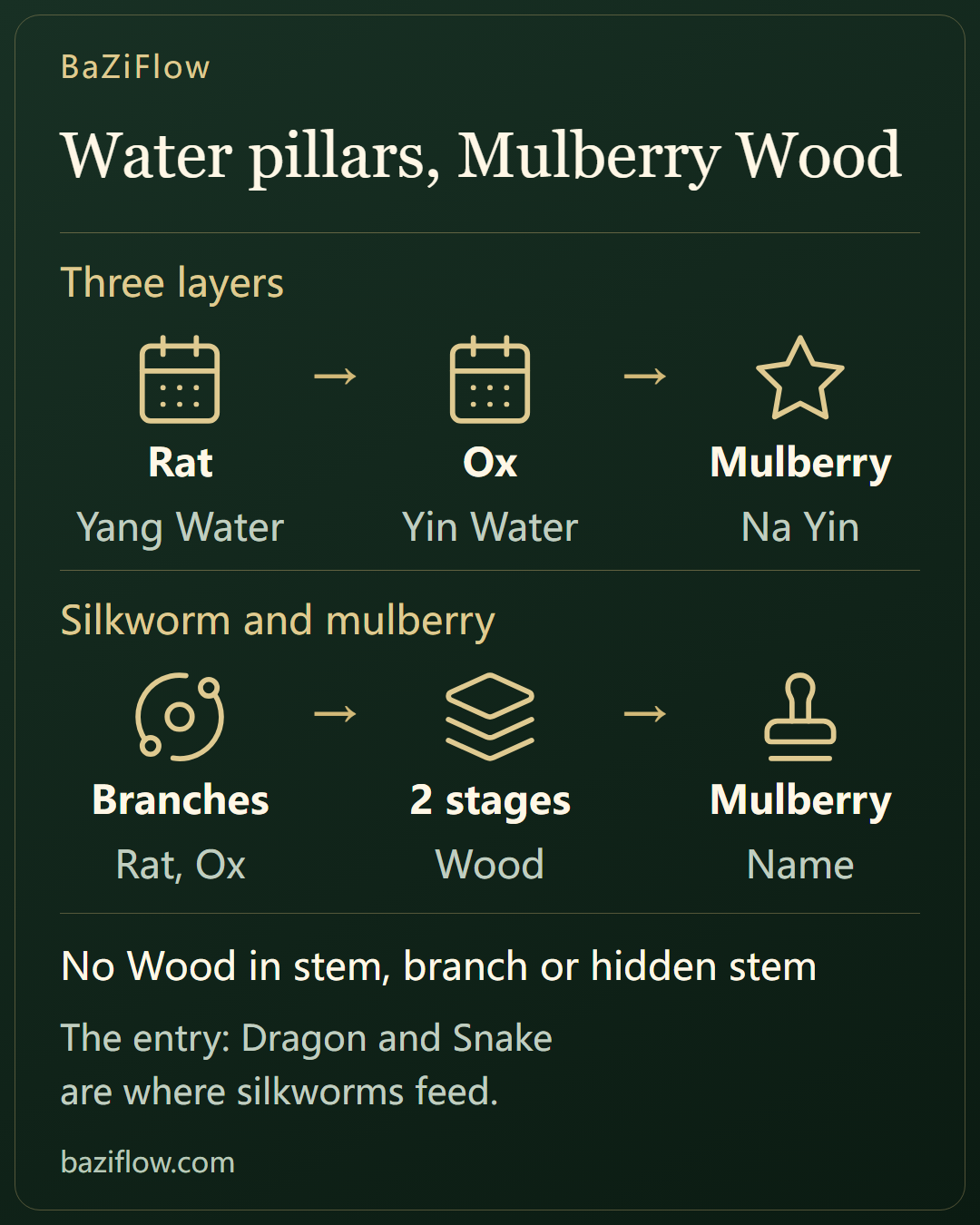
Yang Water Rat and Yin Water Ox share the twenty-fifth Na Yin name with no Wood in any layer: the Sanming Tonghui’s two lines of imagery, the Ox as Metal, silkworm pasture on Dragon and Snake, January births.
The short version10 min read
Mulberry Wood is the twenty-fifth Na Yin name, shared by Yang Water Rat and Yin Water Ox. Their stems, branches and hidden stems hold no Wood at all; the “wood” comes from the book’s picture of silkworms and mulberry.
- Both stems, Yang Water and Yin Water, are Water; the branches are Water and Earth; the hidden stems are Yin Water and Yin Earth, Yin Water, Yin Metal. No layer holds Wood, so the name is drawn from the book’s imagery.
- The Sanming Tonghui gives two lines: the qi is coiled while mulberry takes it in; and the calendar specialists read the Rat as Water and the Ox as Metal: Water has just begun to feed Wood when Metal fells it, as with mulberry fed to silkworms.
- The entry calls the Dragon and Snake the silkworms’ feeding ground, where Earth in the Sand, Lamp Cover Fire and Wood of the Great Forest sit; on the table they meet this pair mostly by stem union or half-combination, never by branch clash.
Read first
What is Na Yin in BaZi? Why Yang Wood Rat Gold in the Sea does not replace Yang Wood ↗
No Wood in any layer: Yang Water Rat and Yin Water Ox
Nothing in Yang Water Rat (壬子) or Yin Water Ox (癸丑), from top to bottom, belongs to Wood, yet the two share the Na Yin Mulberry Wood (桑柘木), twenty-fifth of the thirty names.
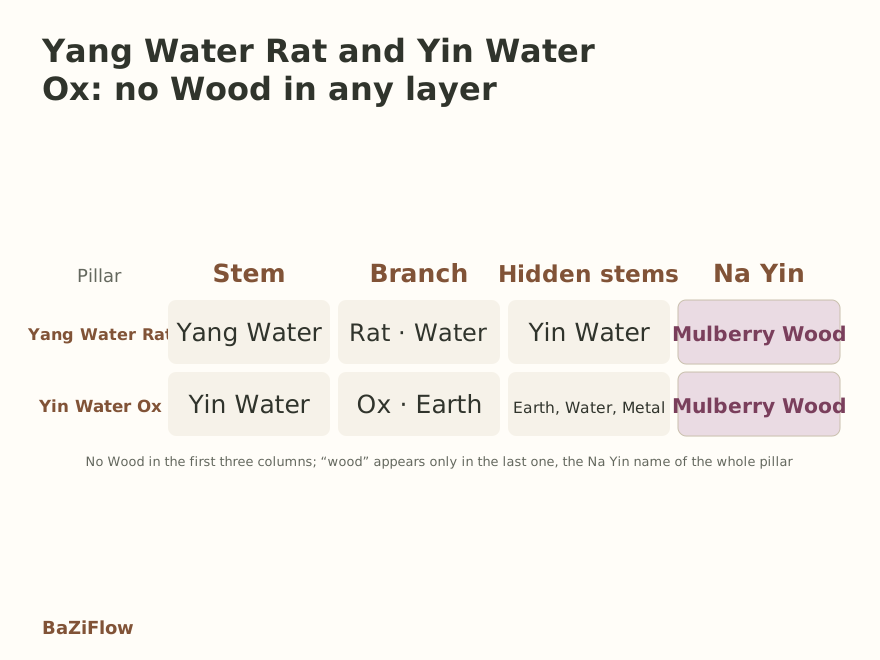
Comparison sketch: stems, branches and hidden stems use the usual entry-level assignments and the Na Yin name follows the Sanming Tonghui; the first three columns hold no Wood, so “wood” comes from the Na Yin alone.
The picture counts three layers. The stems, Yang Water and Yin Water, are Water. The branches are the Rat, which is Water, and the Ox, which is Earth. Inside the branches, the Rat hides only Yin Water, and the Ox hides Yin Earth, Yin Water and Yin Metal: Water, Earth and Metal, still no Wood. “Wood” appears only in the right-hand column, as the Na Yin name of the whole pillar.
Silkworms and mulberry: two lines in the book
When juan 1 of the Sanming Tonghui (三命通会) gives each Na Yin its imagery, it begins by placing the Rat and the Ox at the head of the twelve branches, where yin and yang are only just conceiving. For Yang Water Rat and Yin Water Ox it then says:
Why do Yang Water Rat and Yin Water Ox take the image of mulberry and cudrania wood? Because the qi is coiled and bent and the form has not yet stretched out. It dwells on watery ground; in the month when the silkworms are waning, mulberry and cudrania take in qi, and the name takes its image from that moment of growth.
“Coiled and bent” is a twig still curled up, “watery ground” points at the Rat, and the name is taken from the moment the mulberry first takes in qi.
The second line comes from the calendar specialists (日家), and it speaks in the elements of the two branches:
Yang Water Rat and Yin Water Ox: the Rat belongs to Water and the Ox belongs to Metal. Water has only just begun to bring forth Wood and Metal fells it, just as mulberry and cudrania have only just grown and people at once use them to feed silkworms. So it is called Mulberry Wood.
Water is only starting to bring Wood forth and Metal is already felling it, like mulberry that has barely grown before it is carried off to the silkworms. Both lines end on a young mulberry fed to the silkworms, one through form and season, the other through the Rat and Ox.
Enlarge diagram · scroll sideways to read
Mulberry, pine, willow: three Wood names on one ring
The specialists explain the three Wood names with positions from the twelve-stage ring, and Mulberry is the one that does not use them. First Pine and Cypress Wood (Yang Metal Tiger and Yin Metal Rabbit):
Yang Metal Tiger and Yin Metal Rabbit: Wood is at Establishment on the Tiger and at Peak on the Rabbit. Wood being born to strength, it is no match for the soft and weak. So it is called Pine and Cypress Wood.
Then Willow Wood (Yang Water Horse and Yin Water Goat):
Yang Water Horse and Yin Water Goat: Wood dies at the Horse and enters storage at the Goat. Wood being dead and in storage, though it is fed by the Water in the stems, Yang Water and Yin Water, it is soft and weak in the end. So it is called Willow Wood.
The two lines lay out the ring for Wood: the Tiger and Rabbit are Establishment and Peak, which is why pine is “no match for the soft and weak”; the Horse and Goat are Death and Storage, which is why willow is “soft and weak in the end”. Mulberry sits early on the ring. By this site’s table, counted by Yang Wood, Wood is at Bath on the Rat and at Coming of Age on the Ox: washed and capped, not yet at the strong positions. Yet they do not use those two stage names for it; they use the Rat’s Water and the Ox’s Metal.
Enlarge diagram · scroll sideways to read
The whole ring of stages is laid out in the stage-and-void article.
Near the end of the section On the Images of Na Yin, the book pairs the sixty pillars off as “opposites”. Yang Water Rat and Yin Water Ox are matched with Yang Water Horse and Yin Water Goat, and the book remarks only that one pair is bent and the other soft, each different in form and substance. The table shows that Yang Water Rat and Yang Water Horse share a stem while their branches clash, Rat against Horse; Yin Water Ox and Yin Water Goat share a stem and clash too, Ox against Goat, with a punishment on top. The book draws only “bent against soft”. Willow Wood has its own article.
The Dragon and Snake, where silkworms feed: earth, fire and wood in the entry
The entry for Mulberry Wood opens with a picture of silk, the floating sleeves of scholars and commoners and the neat robes of sages, and then says what this wood should be matched with. Its first sentence already names branches:
It loves Sand earth best as its root, and it takes the Dragon and Snake as the place where silkworms feed, so it should not be punished, clashed or broken there.
Five pairs of pillars sit on the Dragon and Snake, and the entry points to three of them, each time with a reason that mentions silkworms or the southeast:
Enlarge diagram · scroll sideways to read
The entry names Na Yin kinds, not pillars; the rows are this article's samples:
Enlarge diagram · scroll sideways to read
Two points deserve a pause. The first is “combine and transform”. Thunderbolt Fire (Yang Earth Rat, Yin Earth Ox) and Fire in the Sky (Yang Earth Horse, Yin Earth Goat) are the only two Fire names built on the stems Yang Earth and Yin Earth, and Yang Earth with Yin Water combines into Fire. For Yin Water Ox with Yang Earth Rat the stem has the Yang Earth–Yin Water combination and the branch has the Rat–Ox combination, so the entry’s “stem and branch combine and transform” fits that row exactly; on the Yang Water Rat side only the Rat–Ox combination is left, with no stem combination. The second is “mulberry and willow form a grove”: the two pairs clash, and the book still calls it an honored pattern, adding only one condition at the end.
The day the year turns: January births
On the calendar, 1972 is a Yang Water Rat year and 1973 a Yin Water Ox year; the pair came before in 1912 and 1913 and returns in 2032 and 2033. The pillar turns at the Start of Spring (立春); Beijing time put it at 01:20 on 5 February 1972, 07:04 on 4 February 1973 and 13:00 on 4 February 1974.
So someone born on 15 January 1973 still has the year pillar Yang Water Rat, and someone born on 20 January 1974 still has Yin Water Ox, both with the Na Yin Mulberry Wood. Once 13:00 on 4 February 1974 has passed, the year pillar becomes Yang Wood Tiger and the Na Yin becomes Water of the Great Stream.
Enlarge diagram · scroll sideways to read
Two exercises
Born on 15 January 1973: which year pillar and which Na Yin?
The year has not turned yet, since spring begins at 07:04 on 4 February, so the pillar is still Yang Water Rat with Mulberry Wood. Afterward it is Yin Water Ox, and the Na Yin is unchanged.
The text says “mulberry and willow form a grove”: what should be checked first?
First whether the other pillar is Yang Water Horse or Yin Water Goat (Willow Wood), then whether the birth falls in spring or summer. If either is missing, the sentence does not apply.
The pair after it is Water of the Great Stream; the root earth the entry names is Earth in the Sand. Na Yin and the elements inside a pillar are two separate ledgers, as set out in Na Yin and the regular five elements.
Questions readers ask next
Yang Water Rat and Yin Water Ox share Mulberry Wood. How does the book tell them apart?
The short notes in juan 1 call Yang Water Rat “wood hurt by too much water, liking fire, earth and summer” and Yin Water Ox “wood hurt by too little water, liking metal, water and autumn”. The commentary calls one wood in its own seat and the other wood in a side store, and says the pair is rich at Death and Severance, poor at growth and strength, short-lived with much Water. One name, opposite seasons.
Mulberry Wood and Willow Wood are both Wood. Why does the book set them up as a pair?
The “opposites” list at the end of the section on images matches Yang Water Rat and Yin Water Ox with Yang Water Horse and Yin Water Goat and says only “one bent, one soft, different in form and substance”. On the table the two pairs share their stems and their branches clash: Rat–Horse, and Ox–Goat with a punishment as well. The book does not speak of clashes; that layer is what the table adds.
Born in January 1974: is the year pillar Yang Wood Tiger or Yin Water Ox?
Yin Water Ox. The Start of Spring in 1974 fell at 13:00 Beijing time on 4 February, and all of January and early February come before it, so the pillar still belongs to the previous year. From 13:00 on 4 February it becomes Yang Wood Tiger, and the Na Yin changes from Mulberry Wood to Water of the Great Stream.
Was this article helpful?
Sources & references
Continue reading
Water of the Great Stream (大溪水): Why Yang Wood Tiger and Yin Wood Rabbit Take This Name ↗
Five Elements cycles: learn the relationships, not just the order ↗