

Repeated questions and selection
Content version · · Sources & references
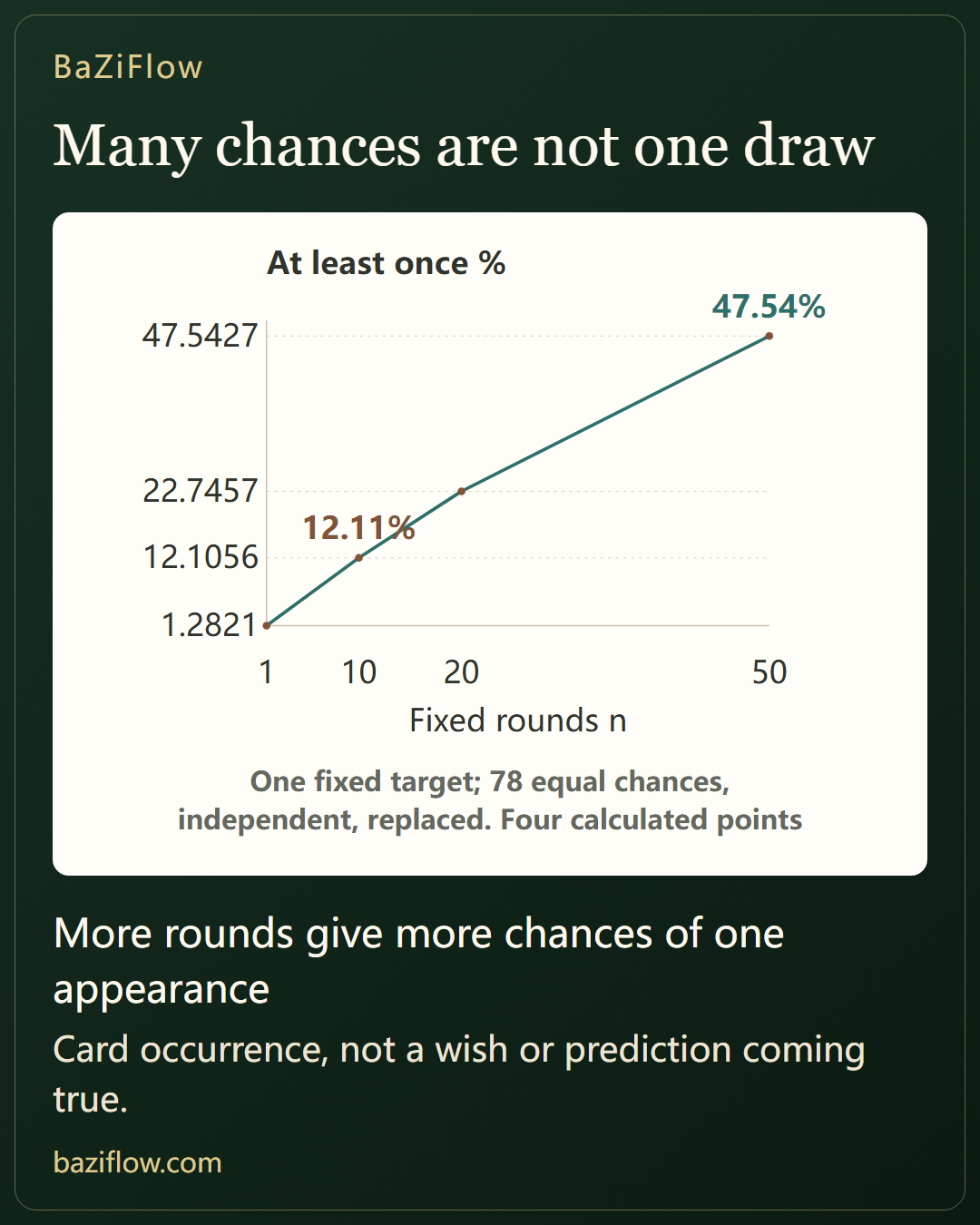
Distinguish a new question from a search for a preferred result. A tightly defined 78-card probability example shows why many opportunities cannot be presented as one unselected draw.
The short version6 min read
More rounds give more opportunities to encounter a card. Keeping only the welcome round also changes the sample another reader sees. Separate a single draw, a fixed batch and the stopping rule to understand what “eventually appeared” actually describes.
- Under independent draws with replacement, one preselected card still has chance 1/78 on every round; earlier misses do not improve the next draw.
- In a fixed batch of 50 rounds, at least one target appearance has chance about 47.54%. This is neither a single-draw chance nor reading accuracy.
- Clarification narrows a question and updates add information. Seeking a preferred answer instead selects results, so retain earlier attempts too.
Read first
What disappears when only the welcome result is shared?
Imagine asking the same question repeatedly, stopping only when a combination feels reassuring. The final image is not an unselected first draw. It is the result retained after earlier combinations failed a preference test. A complete account should include how many attempts occurred, what was discarded and why the process stopped.
A useful question is whether you would have continued if the first result had been welcome. If the answer is no, the stopping rule depends on the observed result. You do not need to decide which reading was more meaningful to recognise that this changes the record another person sees.
The same selection can happen without drawing again. Rewriting the question, changing position meanings or switching interpretive conventions until a pleasing explanation appears selects among interpretations instead of among cards. Saving only the last version conceals that process.
A preference-based stop
The retained round is selected; earlier rounds remain part of the record
Compare one chance with a batch of fifty
The figure of 47.54% below concerns a batch of fifty opportunities. It is not the chance on the next draw and not the chance that a reading is true. Keeping that distinction in view shows why a single retained round can conceal the scale of the experiment behind it.
Consider an ideal experiment, not a description of ordinary handling. Each round draws one card uniformly from a complete 78-card deck, replaces it, and starts a new independent round. One exact target card is selected in advance; orientation is ignored.
The probability of missing the target in one round is 77/78. Missing it in all n independent rounds has probability (77/78)^n. Therefore seeing it at least once has probability 1−(77/78)^n. This uses the complement of zero occurrences in a binomial model, as given by the NIST distribution formula.
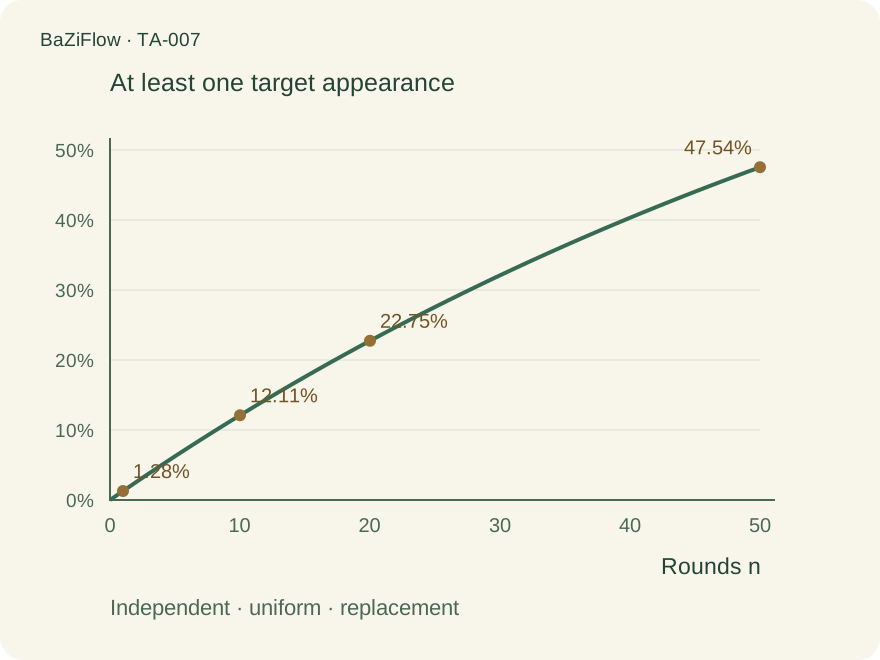
Original BaZiFlow theoretical curve. It is a card-occurrence model, not a measurement of real shuffling or predictive accuracy.
| Number of rounds fixed in advance | Chance of at least one target appearance |
|---|---|
| 1 | About 1.28% |
| 10 | About 12.11% |
| 20 | About 22.75% |
| 50 | About 47.54% |
Each individual round still has probability 1/78. Earlier misses do not make the next independent round more favourable. What increases is the chance across the whole batch of opportunities. Reporting an eventual appearance without the earlier attempts can make a many-attempt event look like a rare one-attempt event.
These figures concern the appearance of a card. They are not probabilities that a prediction is true or a wish will be fulfilled. The calculation does not establish any link between those different events.
Do not stretch the model beyond its assumptions
A three-card draw without replacement is a different procedure. Missing cards, visible faces, uneven handling or a persistent order may also invalidate the uniform and independent assumptions. This article has not measured the quality of any real shuffle.
If you decide which card counts as the target after seeing it, you have changed the event being counted. If any pleasing card is acceptable, that is not the preselected single-card event either. Keeping the event definition stable matters as much as calculating correctly.
The lesson is limited but useful: more attempts provide more chances to encounter a selected result. If only the welcome attempts are retained, the visible record is further shaped by preference. A striking appearance should therefore be described alongside the total attempts and stopping conditions, rather than isolated from them.
Next draw
- 1 / 78
- Unchanged after misses
50 rounds
- 47.54%
- At least one appearance
Same independent replacement model, different events
Separate clarification from a request for a different answer
A clarification narrows an unresolved point. For example, a vague concern about preparation might become a question about which information is missing. An update follows a real change, such as a revised venue time or a new reply. In either case, write what changed before continuing.
If no new fact or question exists and the motive is simply dislike of the result, record the next draw as a repeat. Calling it verification does not make it independent evidence. Similar cards do not prove that reality is fixed, and different cards do not identify which earlier attempt was invalid. Both situations first require an honest account of what was asked and done.
Waite's Celtic procedure includes suggestions for another operation in particular unclear ending situations. That documents one author's method in context. It does not require endless repetition of every question, nor justify deleting the previous operation from a record. Refer to the conditions of the method rather than extracting a general permission to keep going.
Reason to continue
Clarify
- What changed
- A narrower unresolved issue
- What to retain
- Original and local question
Update
- What changed
- New real-world information
- What to retain
- Information and arrival time
Seek a preferred answer
- What changed
- Preference, not a new fact
- What to retain
- All rounds and stop reason
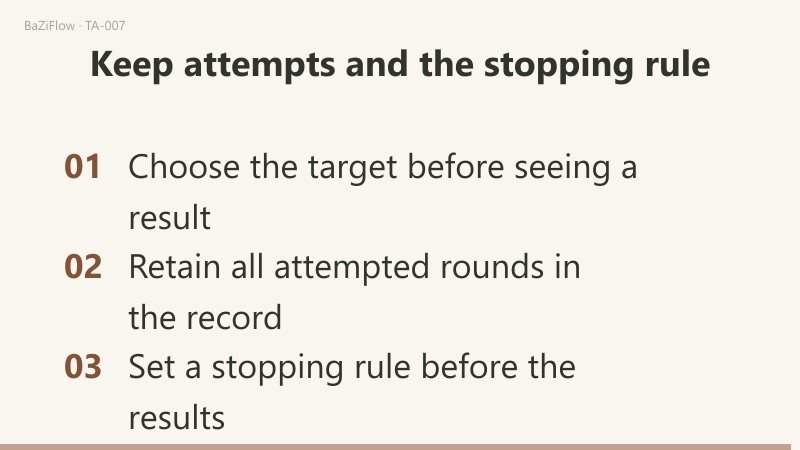
Decide how this exercise will end before it begins
A practical agreement might be one recorded reading followed by an external information check. Another might allow one separately logged clarification tied to a specific unresolved question. These are optional recording practices, not universally effective ritual numbers. Their purpose is to keep the endpoint from moving whenever the answer is unwelcome.
A missing reply, agreement or document does not gain a source because another card is drawn. Checking that information may move the practical issue forward more directly. When it is unavailable, the record can end with uncertainty rather than a forced affirmative conclusion.
Keep all rounds and distinguish the original question, later questions and subsequently learned facts. Draw records covers the mechanics, while reviewing tarot notes addresses selective hindsight. The concern here is hidden selection, not a claim that repetition incurs a supernatural penalty.
Set the endpoint first
One round or one local clarification is an exercise rule, not a mystical count.
Keep unwelcome rounds
Make the attempts behind the retained result visible.
Separate factual updates
Date new replies or venue information when received.
Questions readers ask next
Why does the next draw stay equally likely after many misses?
The model replaces the card and begins a new independent, uniform draw. The eligible pool and rule stay the same, so each chance remains 1/78. What grows is the opportunity to see the target at least once across a larger batch.
Can the 47.54% after 50 rounds estimate tarot accuracy?
No. The event is one preselected card appearing at least once in a fixed batch of 50. No real-world prediction or correctness measure enters the calculation, and the quality of a physical shuffle has not been measured.
Is reconsidering a question after new information also selection?
Identify what changed. A revised venue time is a new fact, while narrowing an unresolved issue is clarification. If only dissatisfaction drives repetition, preserve the earlier attempts and stop reason rather than calling the process independent verification.
Was this article helpful?