

Indirect Resource: the overturned food and the owl
Content version · · Sources & references
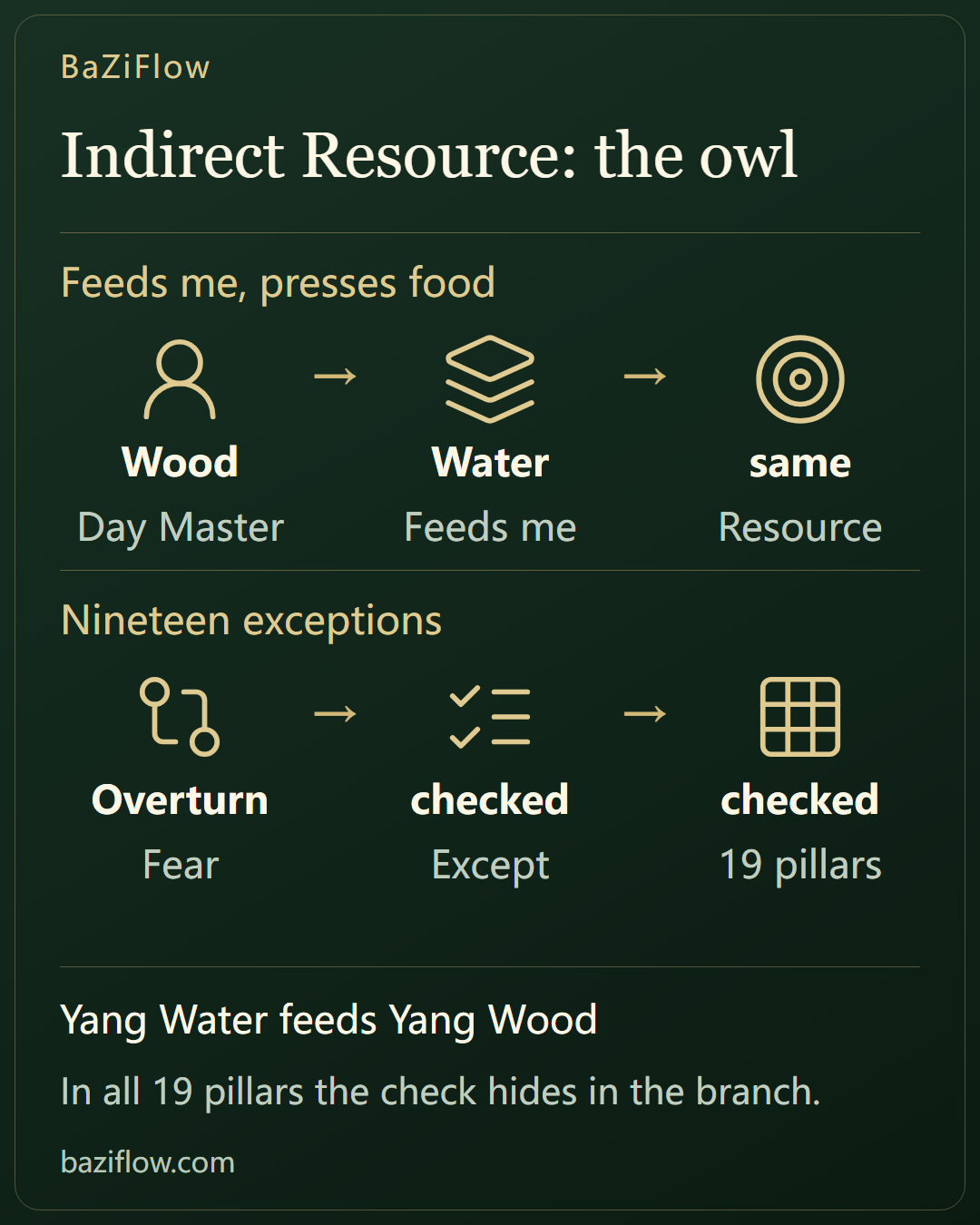
The Indirect Resource feeds the Day Master with the same polarity. A triangle, the fact that it is the Eating God's own Seven Killings, the book's nineteen checked pillars, three Wood-day charts, and how it meets Wealth.
The short version9 min read
The Indirect Resource is the stem that feeds the Day Master with the same polarity; the book calls it overturned food and the owl star, fears it for the Eating God, and then adds a run of "checked" exceptions.
- Each of the ten Day Masters has one Indirect Resource, feeding it with the same polarity. It also controls the Eating God that the Day Master feeds, and all ten make the same triangle.
- The book names nineteen pillars where the Indirect Resource "cannot harm the food"; in every one the branch hides a stem that controls it: twelve in main qi, five in middle qi and two in residual qi.
- At the end of the entry the book sets three Wood-day charts, each holding Yang Fire and Yang Water, with opposite verdicts, which is why its closing line is not to call the overturned food ill at first sight.
Read first
How the Ten Gods are derived: five relationships and two polarities ↗
It feeds me, with the same polarity: finding the Indirect Resource
The element that feeds the Day Master holds a yang and a yin stem; the one with the same polarity as the Day Master is the Indirect Resource (偏印). Yang Wood is fed by Water, and Water holds Yang Water and Yin Water: Yang Water shares the Day Master's polarity and is the Indirect Resource, Yin Water is the Direct Resource. The Yuanhai Ziping (渊海子平) writes the rule very short:
The Resource star is what feeds me and is also called the living qi. Yang meeting yin, or yin meeting yang, is called the Direct Resource; yang meeting yang, or yin meeting yin, is called the Indirect Resource.
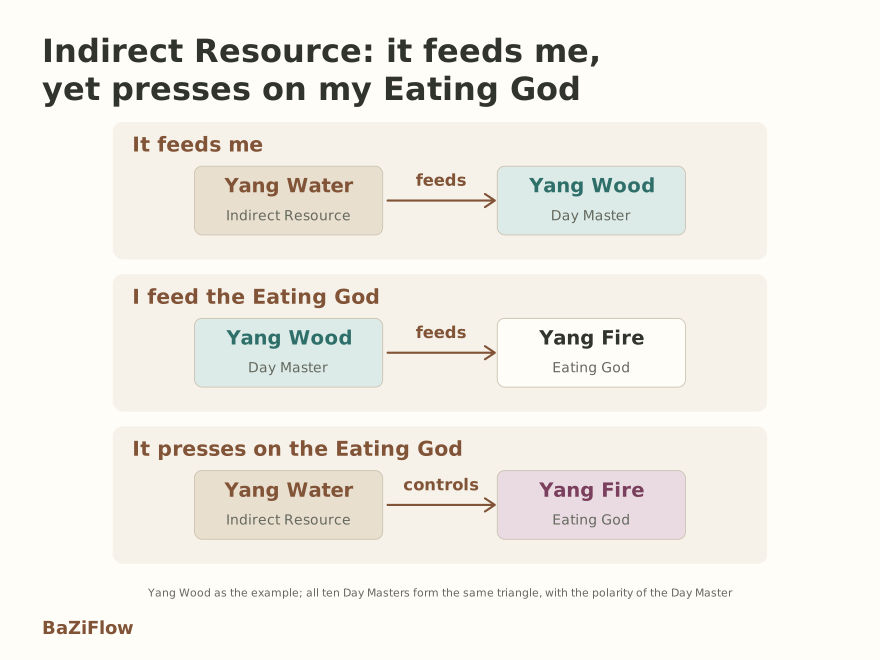
Triangle sketch with Yang Wood as the example: Yang Water feeds it, it feeds Yang Fire, and Yang Water controls Yang Fire; data from the Ten Gods table of this site.
The picture holds three relations: Yang Water feeds Yang Wood and Yang Wood feeds Yang Fire, while Yang Water controls Yang Fire. Yang Fire is what Yang Wood feeds with the same polarity, the Eating God. So the Indirect Resource feeds the Day Master and also sits on the Eating God that the Day Master feeds, and the triangle holds for all ten Day Masters.
Yang Water presses Yang Fire: why "overturned food"
The "food" is the Eating God. The book works it through for a Yang Wood day: Yang Fire is its food, Fire generates Earth as its wealth, and wealth generates Metal as its officer; when Yang Wood meets Yang Water, a strong Yang Water controls the Yang Fire away, the Fire can no longer feed Earth, and "Yang Wood has no wealth". The Eating God's path to Wealth is cut, which is why the book says the Eating God fears this stem most. The table says it more exactly: in all ten Day Masters the Indirect Resource controls the Eating God, and with the same polarity, Yang Water on Yang Fire without any offset. Put another way, the Indirect Resource is the Eating God's own Seven Killings: seven places on from the Eating God lands on it (the count is in Seven Killings).
Enlarge diagram · scroll sideways to read
How the Eating God feeds Wealth and checks the Killings is in Eating God. Here it is enough to hold that overturned food means the Indirect Resource pressing the Eating God. With no Eating God in the chart there is nothing to press, and the book itself writes "if the chart has no Eating God, read it only as an Indirect Resource".
The book's exceptions: nineteen checked pillars
The book first puts it heavily: "a chart that carries overturned food is thin in fortune and short of years". It then gives a run of exceptions, naming for each Day Master the pillar where the overturned food does not act:
Indirect Resources of this kind cannot harm the food, since they are checked.
The list reads: Yang Wood meeting Yang Water over the Dragon or the Dog, Yin Wood meeting Yin Water over the Goat or the Ox, Yang Fire meeting Yang Wood over the Monkey, and on, ten groups and nineteen pillars. The stem named is the Indirect Resource in every case, in agreement with this site's table. Checked again against the hidden-stem table, in all nineteen the branch hides a stem that controls that Indirect Resource.
Enlarge diagram · scroll sideways to read
Of the nineteen, twelve have the controller as main qi of the branch, five as middle qi (the one in Yin Wood Snake, Yang Fire Monkey, Yang Earth Dragon, Yin Earth Pig and Yin Metal Goat), and two as residual qi (Yang Fire Dragon, Yang Metal Dog). The book says "checked", and the hidden-stem table gives the place it holds in the branch; keep the two layers apart.
Three Wood-day charts: the same Yang Water and Yang Fire, two verdicts
At the end of the entry the Sanming Tonghui records three charts of a Yang Wood day, each holding Yang Fire (Eating God) and Yang Water (Indirect Resource), yet the book's verdicts differ, and its closing sentence is:
Fear overturned food as I may, meeting a check or a combination it turns noble instead; one must never call it ill at first sight.
Enlarge diagram · scroll sideways to read
On chart one the book says: the Wood is born in the Monkey month and held down by the Killings (Yang Metal) with no qi; the two Yang Fires let the Day Master's qi leak, Yang Water checks the Fire, so the Killings get their way, hence "no name or gain". The other two it writes as greatly noble: one for "Resource gathered to salary, the marvel of water-essence and fire-spirit, the image of Wood and Fire bright together", the other for "the Killings turned to Resource and gathered to salary, with elegance". Taken apart in the ten gods the difference is this: chart one has no Rat (Yin Water, Direct Resource) and no Tiger (where Yang Wood has its salary); charts two and three have both. Whether those two are what the book's noble and base turn on, the book does not say item by item here, so only the chart is described.
Giving up the Resource for Wealth: the Indirect Resource in the month order
The book has an old poem on the Indirect Resource and Wealth:
The star of the Resource that is indirect is the owl; in the chart it most wants to see a Wealth star. A strong self meeting it is blessed; a weak self with a strong owl is all the more unkind.
Wealth controls the Resource, so the Indirect Resource "most wants to see a Wealth star": Wealth presses it down and the Eating God is saved. The poem adds a condition, a strong self. In the passage on "giving up the Resource for Wealth" the same book is more specific:
If an Indirect Resource in the month order, the year or the hour meets Wealth it does no harm; this is giving up the Resource for Wealth, letting go the light and using the heavy. Take Yang Water born in the Monkey month, or Yang Fire born in the Tiger month, sitting on the place of growth, with Wealth in the year or hour: the self is strong and welcomes Wealth.
"Letting go the light and using the heavy" means putting down the Resource and taking up Wealth. Checking the book's two examples: for a Yang Water day in the Monkey month, the Monkey's main qi is Yang Metal, the Indirect Resource of Yang Water, and Yang Water sits at growth; for a Yang Fire day in the Tiger month, the Tiger's main qi is Yang Wood, the Indirect Resource of Yang Fire, and Yang Fire sits at growth. The Indirect Wealth of Yang Water is Yang Fire, which controls Yang Metal; that of Yang Fire is Yang Metal, which controls Yang Wood. In both, Wealth controls the Indirect Resource.
Enlarge diagram · scroll sideways to read
Find the Indirect Resource first
It feeds the Day Master with the same polarity; counting back from the Day Master it is the third place.
Then see whether the Eating God is pressed
Is there an Eating God, and does the Indirect Resource control it? With none, read the Indirect Resource as itself.
Last, look for a check in the branches
Open the hidden stems for a stem that controls it, and note main, middle or residual qi; name the line when you cite it.
Three small checks
Day Master Yang Fire: who is the Indirect Resource, and which Eating God does it press?
Yang Wood is the Indirect Resource and Yang Earth the Eating God; Wood controls Earth with the same polarity.
Day Master Yin Fire meeting Yin Wood Rooster: does the Rooster hold a stem that controls Yin Wood?
The Rooster holds only Yin Metal, which controls Yin Wood, and as main qi; that matches the book's "Yin Fire meeting Yin Wood Rooster".
Yang Earth is the Indirect Resource of which Day Master?
Backwards: Yang Earth feeds Yang Metal with the same polarity, so it is the Indirect Resource of Yang Metal.
The Indirect Resource has a counterpart in the Direct Resource: the same feeding of the Day Master with the opposite polarity, and the books speak of it quite differently.
Questions readers ask next
Is the Indirect Resource the "overturned food", to be avoided on sight?
The book speaks in two layers: it first says the Eating God fears the Indirect Resource, then adds "where there is a check or a combination" and "meeting the check turns it noble", and states it must not be judged ill at first sight. In the Ten Gods table it is only a place; what matters is whether the chart has an Eating God and a stem that checks it.
The book says the Indirect Resource "most wants to see a Wealth star". Is more Wealth always better?
No. The old poem adds its condition at once: "a strong self meeting it is blessed; a weak self with a strong owl is all the more unkind". The two examples under giving up the Resource for Wealth, Yang Water in the Monkey month and Yang Fire in the Tiger month, both have the Day Master sitting at growth, "the self strong and welcoming Wealth". Wealth can press the Indirect Resource down only when the Day Master can carry it.
My chart has no Eating God. Does the overturned food still matter?
The book says so itself: "if the chart has no Eating God, read it only as an Indirect Resource". The overturned food is the Indirect Resource pressing on the Eating God; with none present, there is nothing to press and it is read as itself.
Was this article helpful?
Sources & references
Continue reading
Direct Officer (正官): Why the Sanming Tonghui Allows Only One ↗
Direct Resource (正印): What "the Resource Leans on the Officer" Means ↗
Output Generates Wealth and Officer Generates Resource: Chains and Conditions ↗