

Dui (兑): the gap on top and the word delight
Content version · · Sources & references
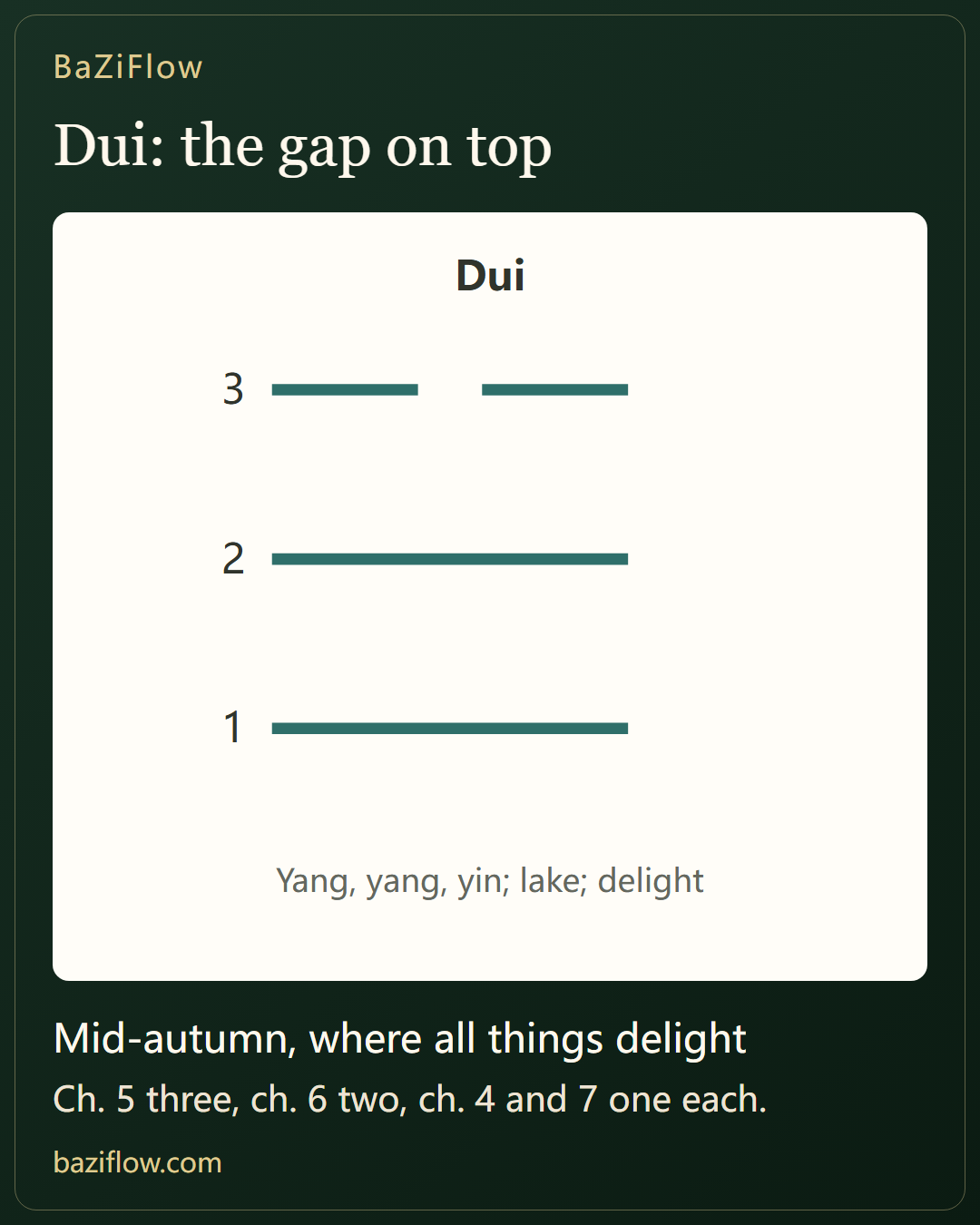
Dui has two yang lines under a broken top line and is the inverse of Gen. Follow the word delight through seven appearances in the Shuo Gua, then its season, position, images, and the double lake of hexagram 58.
The short version6 min read
The word the Shuo Gua gives Dui, delight (read yuè), appears seven times in the body of the book, always around Dui and the lake, and chapter 7 makes it Dui's nature. The figure is two yang lines below and a broken yin line on top.
- Dui reads yang, yang, yin and is the opposite of Gen on every line, so the two are inverses; chapter 3 calls the pair "mountain and lake share their breath".
- The word for delight appears seven times in chapters 4 to 7, and chapter 5 says why delight sits at Dui: Dui is mid-autumn, what all things take delight in.
- Some images repeat across chapters: youngest daughter in 10 and 11, sheep in 8 and 11, mouth in 9 and mouth-and-tongue in 11.
Read first
Eight Trigrams: Three-Line Structure and Basic Images, Read Through the Shuo Gua ↗
The gap on top: Dui and Gen, drawn opposite
Dui (兑) has two yang lines at the bottom and a broken yin line on top, and a later rhyme for the shapes says "Dui lacks at the top". Set it beside Gen (艮) and every position turns out opposite: Dui's first and second lines are yang while Gen's are yin, and Dui's third line is yin while Gen's is yang. A pair that swaps yin and yang at every position is called inverse.
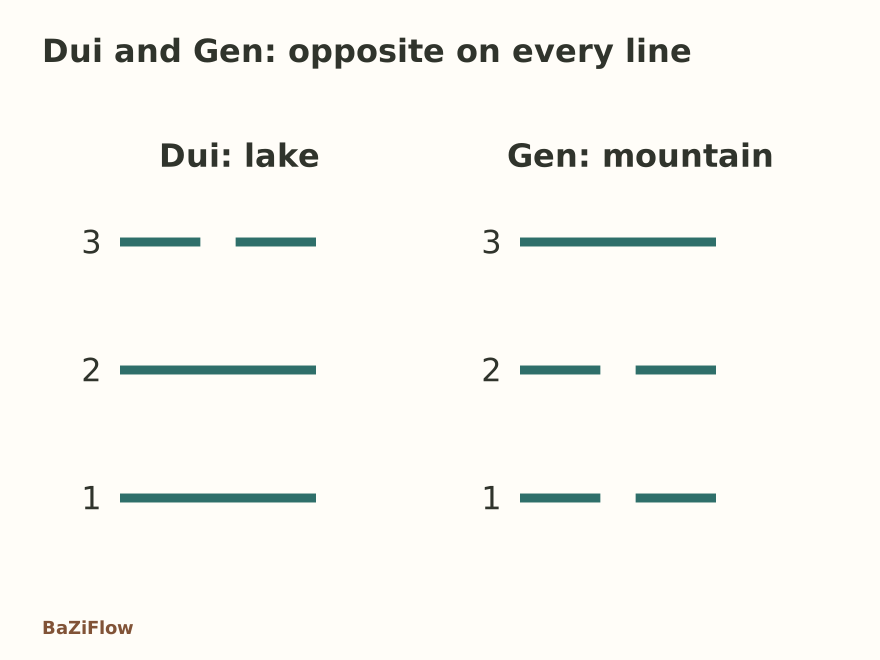
Dui beside Gen: every line is opposite, which makes the pair inverses; Dui's image is the lake and Gen's is the mountain.
Enlarge diagram · scroll sideways to read
Chapter 3 of the Shuo Gua (说卦) writes the two down as a pair: "mountain and lake share their breath". The image of Dui is the lake and the image of Gen is the mountain; Gen has its own piece in the Gen trigram. When Meihua (梅花易数) turns a number into a trigram, the number two stands for Dui; the full list of numbers is in the Meihua primer.
One word, seven appearances: delight
Dui's nature is a single word, delight, and the character for it occurs seven times in the Shuo Gua, always around Dui and the lake:
The word for delight, seven times
Dui pleases them
Among the eight verbs, Dui receives this one: to make things glad.
Delight in Dui · what things delight in · so it says delight in Dui
Once in the line that sets the order of the stops, and twice in the entry that explains Dui, which comes back to say why the order line put delight at Dui.
Nothing delights things more than the lake
One sentence with the word at both ends: of everything that gladdens the ten thousand things, none does so more than the lake.
Dui is delight
The single word that belongs to Dui among the eight.
In the title Shuo Gua the same character is read shuō, "to explain". In these seven places it is read yuè and is used for the word for delight. Chapter 5 uses the character twice in its entry on Dui and ties it back to the order line:
Dui is mid-autumn. It is what all things take delight in; so it is said: delight in Dui.
Autumn is the season in which the ten thousand things are glad, so delight falls at the Dui stop; that is the "delight in Dui" of the order line. All eight chapter-7 words are laid out in the eight trigrams, structure and basic images.
Mid-autumn: west on one diagram, southeast on the other
Chapter 5 assigns positions to the eight, and not in a single way. Six of them get a direction word: Zhen east, Xun southeast, Li south, Qian northwest, Kan due north and Gen northeast. Kun gets only "the earth", and Dui gets a season, "mid-autumn". Autumn goes with the west, the usual pairing, and so the Later Heaven diagram puts Dui in the west.
Enlarge diagram · scroll sideways to read
The other diagram is built from the pairs in chapter 3, each pair set at opposite ends, and Dui with Gen is one of them. The two positions have separate grounds: one comes from a season, the other from a pairing.
Youngest daughter, sheep, mouth: images that repeat
From chapter 8 to chapter 11 Dui's images are spread over four places:
Enlarge diagram · scroll sideways to read
The list in chapter 11 starts with the lake and then goes on with youngest daughter, shaman, mouth and tongue, breaking and snapping, and what is attached breaking off, before opening a new sentence: "Of the ground, hard salty soil; the concubine; the sheep." Youngest daughter and sheep have already appeared in earlier chapters, and mouth and tongue name the same part of the body as the mouth of chapter 9.
Two lakes joined: from "after entering, delight" to the Great Image
The six-line Dui is hexagram 58 and follows Xun. The Xu Gua links the two with "after entering comes delight": entering is Xun's word, delight is Dui's. The Great Image (大象) reads:
Joined lakes: Dui. The noble person meets friends for discussion and practice.
With Dui above and Dui below there are two lakes side by side. The word translated "joined" is Li's word in chapter 7, and here it means linked together; the Great Image lands the delight on discussion and practice among friends.
Enlarge diagram · scroll sideways to read
The six-line Dui is read in Dui, the hexagram; the word for "joined" belongs first to Li, in the Li trigram.
Questions readers ask next
Is the character for Dui's word read shuō or yuè?
In the book title Shuo Gua it is read shuō, to explain. In the seven places that speak of Dui it is normally read yuè, the same as the character for delight. Chapter 7, "Dui is delight", and the Commentary on the Judgments of the hexagram both take the second reading.
How does one get from Dui to youngest daughter, sheep and mouth?
The three come from chapters 10, 8 and 9 and stand on their own. For sheep and mouth the text gives no reason. For youngest daughter it does: chapter 10 says Dui "obtains a daughter on the third seeking, so it is called the youngest daughter". Matching that third seeking to the yin line at the top is a later reading of the figure.
How do the Dui and Xun trigrams mirror each other?
Turn Dui upside down and you get Xun, so each is the other's reversed figure (综卦). In the sixty-four, Xun comes right before Dui, and the Xu Gua joins them with "after entering comes delight": entering is Xun's word and delight is Dui's.
Was this article helpful?
Sources & references
Continue reading
Qian (乾): three unbroken lines and the fourteen images the Shuo Gua lists for it ↗
Li (离): a broken line in the middle, the word "clinging" and facing the light ↗
Trigram imagery: why a round clay bowl has two possible routes ↗