

Check three conditions with their own inputs
Content version · · Sources & references
Three separate examples distinguish a door–palace relation, a six-instrument punishment placement and a wonder-stem tomb placement. Check the operands before treating the traditional labels as comparable.
The short version6 min read
Open at Zhen three tests door metal controlling palace wood. Yang Metal (standing for Yang Wood Monkey) at Gen eight checks an instrument placement; Yang Fire at Qian six checks a wonder’s tomb mapping. One valid condition cannot supply the others’ missing inputs, and control must retain its direction.
- The cited Men Po definition requires door-to-palace control, not either direction of conflict.
- Yang Metal (standing for Yang Wood Monkey) at Gen eight needs the association, layer and actual destination together.
- Wonder and time-stem tomb rules use different inputs; independent examples are not one chart.
Read first
Counting ominous words is not a method
A note might list door restriction, striking punishment and tomb entry, then conclude that three adverse signs make an event three times worse. The arithmetic has no basis here. The labels test different kinds of relationships, and the note has not yet shown that any of them is relevant to the question.
This article separates the inputs. Door restriction (Men Po, 门迫) concerns a directional element relationship between a door and its palace. Six-instrument striking punishment (Ji Xing, 击刑) uses an instrument's association with one of the six Yang Wood (甲) cycle heads and a specified placement. Three-wonder tomb entry (Ru Mu, 入墓) checks a wonder stem against the selected tomb-position rule.
The English names can sound like physical events. In this context, however, punishment is not evidence that someone has been penalized, and tomb is not a finding about death. They are traditional chart terms whose conditions should be checked before interpretation begins.
Relation test
- Door → palace
Placement test
- Named stem + palace
Three independent cards, not a complete timed chart
| Condition | Example used here | What must be retained |
|---|---|---|
| Door restriction | Open at Zhen 3 | Door metal controls palace wood |
| Instrument striking punishment | Yang Wood Monkey (甲申) represented by Yang Metal (庚) at Gen 8 | The Yang Wood association, instrument and listed placement |
| Wonder tomb entry | Yang Fire (丙) at Qian 6 | The wonder stem and the cited tomb mapping |
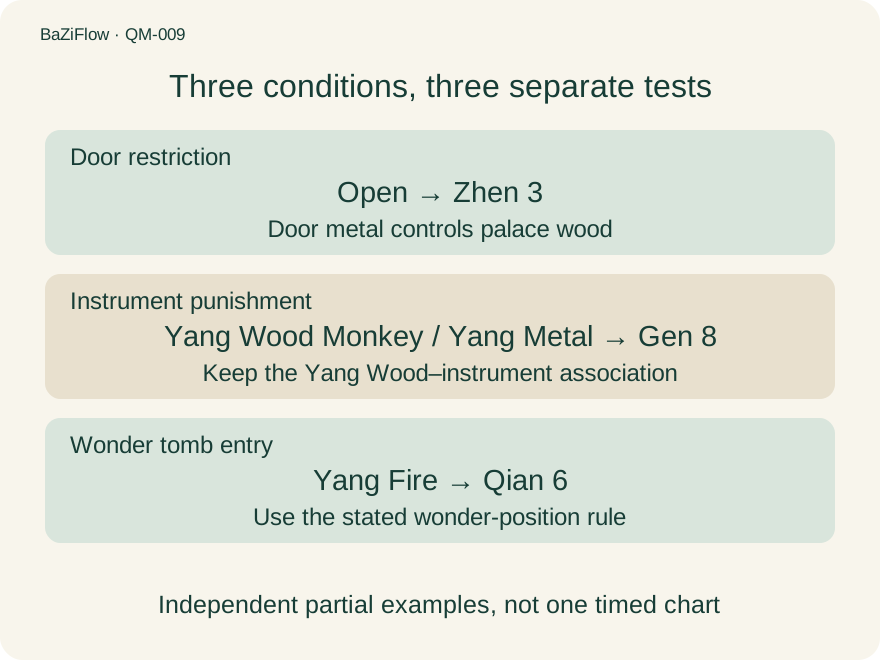
Original BaZiFlow condition cards, using Tong Zong entries checked against volume one of the Siku Dun Jia Yan Yi. The examples are independent partial arrangements.
The cards do not describe a single person or a chart calculated for a civil date. Each supplies only the material needed to inspect one condition. They cannot be combined to fill missing fields in one another, and they do not establish an accumulated probability of misfortune.
If several conditions occur in an actual arrangement, document the evidence for each separately. A correct label in one layer does not prove a condition involving another layer. The same discipline applies when only part of a screenshot is available.
Card
Men Po
- Operands
- Door + palace elements
- Test
- Door controls palace
Ji Xing
- Operands
- Yang Wood Monkey / Yang Metal + Gen 8
- Test
- Named punishment condition
Ru Mu
- Operands
- Heaven Yang Fire + Qian 6
- Test
- Fire tomb at Dog
Independent teaching cards
For Men Po, the direction of control matters
The restriction entry in Qi Men Dun Jia Tong Zong includes Open at palaces 3 or 4, explained as metal controlling wood, and Rest at palace 9, explained as water controlling fire. The door supplies the controlling element; the palace supplies the controlled element. The verse in Dun Jia Yan Yi distinguishes this from the reverse direction.
Open at Zhen 3 therefore fits the definition used here: door metal controls palace wood. Compare Scenery at Kan 1. In that separate example, palace water controls door fire. There is still a controlling relationship, but it cannot be assigned the same Men Po label merely because the two elements conflict.
Keep the arrow with the record. Also confirm that the position is the door's actual placement in the arrangement under discussion, rather than its home association. Finding the words metal and wood somewhere in a description does not establish the required door-to-palace relation.
This check identifies a structure within the chosen convention. It has not shown that a real person is obstructing another, or that an action will fail. Those are additional claims that the relation alone cannot supply.
Open at Zhen 3
Open at Li 9
Opposite roles in the control relation
For Ji Xing, Yang Metal needs its Yang Wood Monkey association
Tong Zong's six-instrument list associates Yang Wood Monkey with Yang Metal. Its configuration list places the Yang Wood Monkey chief at palace 8 among the striking-punishment conditions. The corresponding verse in Dun Jia Yan Yi pairs Monkey (申) with “tiger”, the conventional name for the Tiger branch (寅).
The second card therefore keeps the full description: Yang Metal representing Yang Wood Monkey at Gen 8 under the cited condition. Dropping the Yang Wood association leaves an isolated stem; dropping the stem leaves a palace that could contain many different items. Neither fragment preserves the test being discussed.
The chart layer and placement convention should remain attached as well. This one example is not a complete algorithm for every instrument or center-hosting variant. It also does not license importing a punishment rule from Four Pillars or six-line divination without checking the Qimen operation that connects the fields.
The animal word in the verse is a symbolic reference, not an animal sighting. Retaining that context avoids turning a mnemonic into an invented observation.
For Ru Mu, identify which tomb rule is being used
Tong Zong lists Yin Wood (乙) at Kun, Yang Fire at Qian and Yin Fire (丁) at Gen in its three-wonder tomb entry. The third card uses only Yang Fire at Qian 6. Volume one of Dun Jia Yan Yi also discusses Yang Fire (丙) and the Dog (戌) tomb position, providing a parallel point of comparison for this mapping.
The text separately discusses time-stem tomb conditions using stem–branch time labels. That is a different input from the placement of a wonder in a palace. If the exercise gives only Yang Fire at Qian, it is not legitimate to invent an unprovided time pillar and add a second tomb claim.
A useful record names the assessed stem, its role, the layer and position, and the exact rule. Two conditions sharing the translated word tomb do not automatically share all their inputs. Nor does either one establish a person's health or physical circumstances.
After the label has been checked, the selection of an object and its palace explains why that object matters to the question. Time and palace conditions addresses other information a reading may require. These connections must be stated rather than supplied by the ominous tone of a name.
The old texts attach strong judgments to these structures. Here, those judgments are treated as traditional interpretation, not demonstrated causes of events. Distinguishing the three tests makes mistakes discoverable: a reversed arrow, a lost Yang Wood association or a borrowed tomb rule can each be corrected on its own evidence.
Wonder input
- Yang Fire at Qian 6
Time-stem input
- Time label required
Questions readers ask next
Does keeping the door name preserve Men Po?
Recheck its destination. Open at Zhen gives metal-door control over wood-palace; Open at Li gives fire-palace control over metal-door. The changed direction does not preserve the cited label.
Does palace eight establish the condition of Yang Metal standing for Yang Wood Monkey?
The relevant layer must actually place the instrument representing Yang Wood Monkey there. A palace number cannot supply a missing stem identity or turn a home association into a current placement.
Does Yang Fire at Qian also establish a time-stem tomb?
It supplies only the wonder–palace relationship. A time-stem condition needs its own time label and rule. Sharing the word tomb does not make the missing inputs interchangeable.
Was this article helpful?
Sources & references
Continue reading
Choosing a Qimen significator before looking for its palace ↗