

Wheel of Fortune: turning in the picture
Content version · · Sources & references
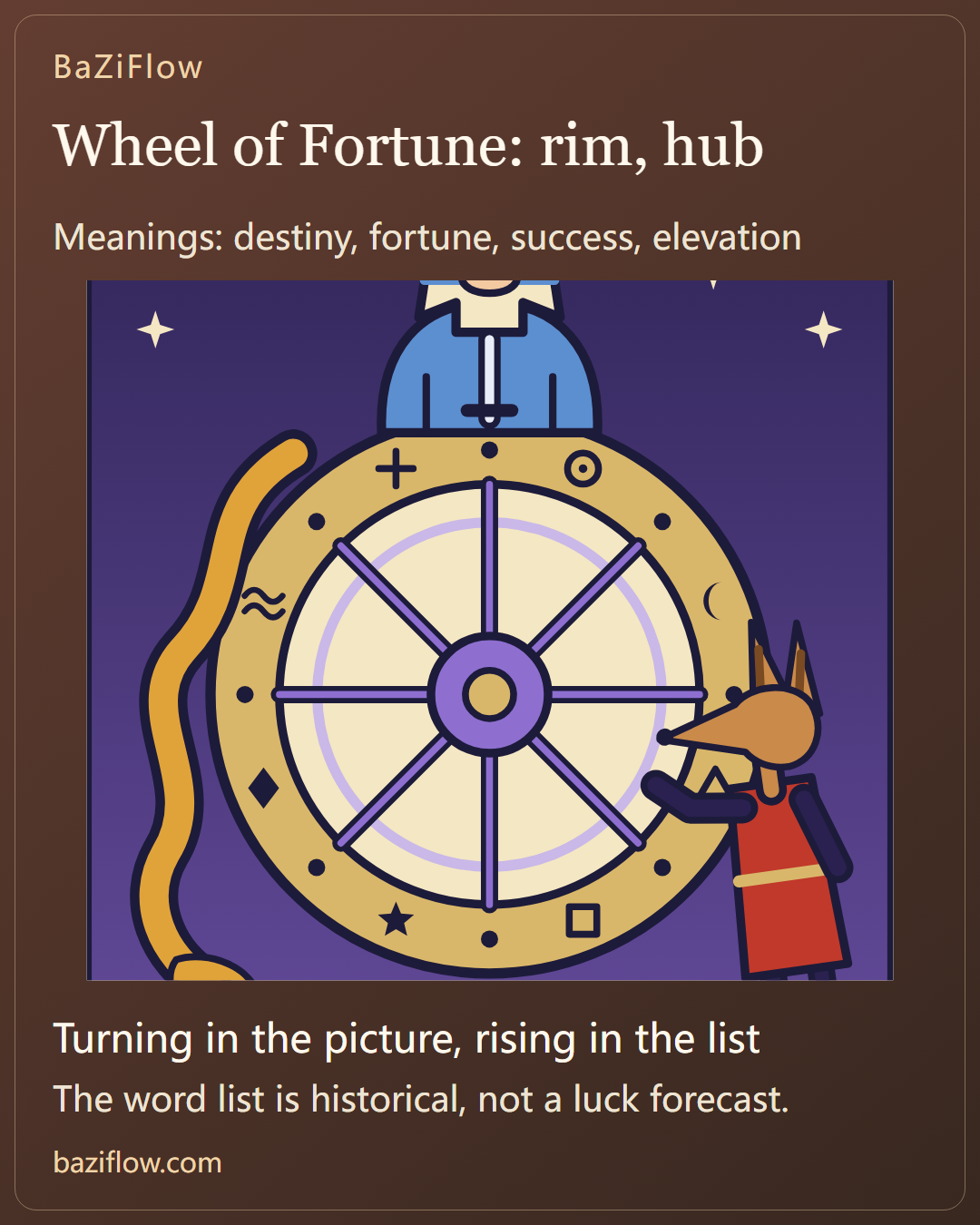
The Wheel of Fortune shows a lettered wheel with a sphinx on top and four creatures at the corners. Separate Waite's picture commentary from his word list, then practice "rim and hub" on a household chore rota.
The short version7 min read
The turning of the Wheel of Fortune is in Waite's commentary on the picture. In the word list he gives, there is no "cycle" and no "fall".
- The picture: a lettered wheel, a sphinx on top, Typhon as a serpent and four living creatures; Waite says it stands for the perpetual motion of a fluidic universe and the flux of human life, and the sphinx is the equilibrium in it.
- The list holds destiny, fortune, success, elevation, luck, felicity; reversed, increase, abundance, superfluity. "Cycle" and "ups and downs" are not in it.
- Waite says there lies behind the symbol a denial of chance. The practice: plan a chore rota by asking what turns on the rim, what the hub holds, and what keeps it balanced.
Read first
A lettered wheel, with a sword-bearing sphinx on top
In Part II Waite says he has again followed the reconstruction of Éliphas Lévi, who furnished several variants. It is legitimate, he adds, to use Egyptian symbolism when this serves our purpose, provided that no theory of origin is implied; so he presents Typhon in his serpent form. The symbolism is not exclusively Egyptian either, for the four Living Creatures of Ezekiel occupy the angles of the card. With Lévi, and in the design itself, the symbolic picture stands for the perpetual motion of a fluidic universe and for the flux of human life, and the Sphinx is the equilibrium therein.
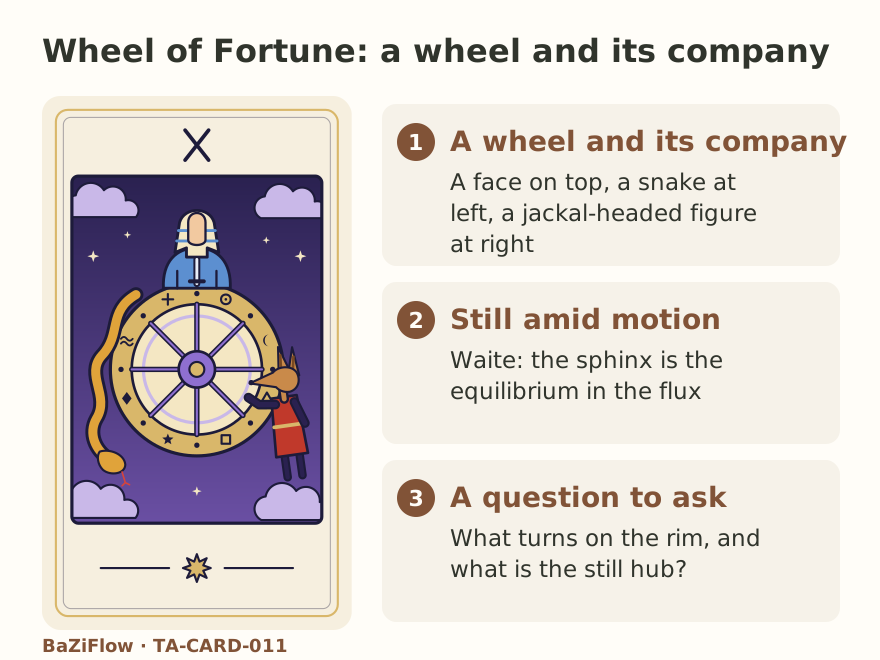
Wheel of Fortune: the wheel, a face on top, a snake and a jackal-headed figure.
On the Rider-Waite-Smith card the numeral X sits at the top, and between blue sky and gray cloud hangs an orange wheel with eight spokes. On its rim you can make out the letters T, A, R, O, alternating with another set of letters. On top sits a sphinx in a striped headdress holding a sword; a yellow snake hangs down at the left and a red jackal-headed figure rises at the right; each of the four corners holds a winged figure with a book: an angel (a man), an eagle, a bull and a lion. The jackal-headed figure is not mentioned in Waite's text.
Enlarge diagram · scroll sideways to read
What Waite lists: only words that rise, and the "turning" is elsewhere
Waite's divinatory meanings are: destiny, fortune, success, elevation, luck, felicity. Reversed: increase, abundance, superfluity.
Destiny, fortune, success, elevation, luck, felicity. Reversed: Increase, abundance, superfluity.
Enlarge diagram · scroll sideways to read
The letters, the sphinx and the four creatures: what Waite says
Three things in Waite's Part II commentary on this card are stated outright: the letters on the wheel, the sphinx, and the figures at the four corners.
Three symbols, in Waite's words
- Letters on the wheel
- Waite says the transliteration of Taro as Rota is inscribed on the wheel, counterchanged with the letters of the Divine Name, to show that Providence is implied through all. On the Rider-Waite-Smith card the letters T, A, R, O are visible.
- The sphinx
- Waite says it is the equilibrium in the flux. He objects to versions that show it couchant on a pedestal above, which defrauds the symbolism by stultifying the essential idea of stability amidst movement.
- Four creatures
- The four Living Creatures of Ezekiel occupy the angles. Waite says the divine intention within is shown by the letters, and the similar intention without by the four creatures.
Enlarge diagram · scroll sideways to read
How to read it: plan a chore rota, rim first and hub second
The Wheel of Fortune has a structure of its own: the rim turns, the center stays, and a figure on top keeps the balance. Carry it to an everyday matter: three people share a flat and want to take weekly chores in turn.
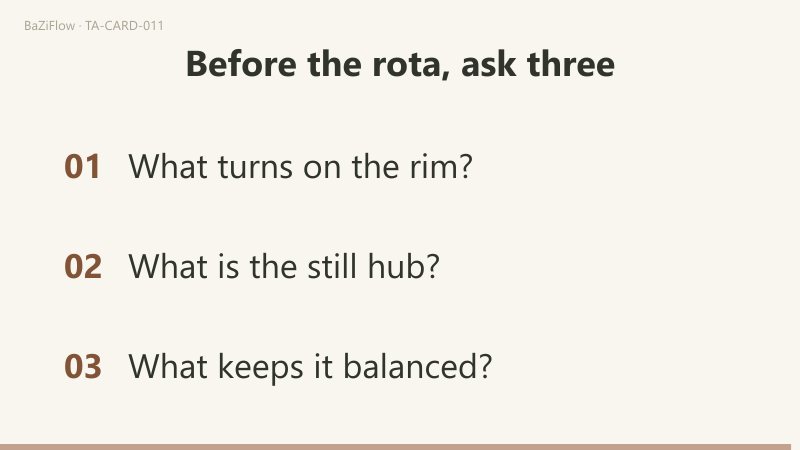
What turns on the rim?
List the tasks that change hands: taking out the rubbish, washing up, mopping. One task a row, a new person each week, and after one round everyone has done everything. The turning follows an order and is not drawn by lot; Waite says there lies behind the symbol the denial of chance.
Which agreement is the hub?
A wheel has a center that does not turn. In teaching it matches the agreement that does not rotate: where the rota is posted, ten minutes every Sunday to check it, what happens when someone cannot do their turn. The wheel runs steadily because of that center.
What keeps it balanced?
Waite writes the sphinx as the equilibrium. In teaching that reads as: each person's weekly load stays about equal, and when someone does extra, there is a way to make it up next week.
An example: A, B and C, three tasks, one round in three weeks:
Enlarge diagram · scroll sideways to read
A chore rota: what the card can do
What can turn
- The same task changes hands weekly
- After one round everyone has had a go
What it cannot arrange
- Who does it better
- Whether people want to turn
What you decide
- When and how to check
- What to do when someone cannot
Reversed and neighboring cards: "more" and "overflow", and three cards about moving and standing still
Waite's reversed words are increase, abundance, superfluity. All three lean on "more", and the last carries a sense of overflow. None says "retreat" or "fall". That is something seen by reading the list against the picture; Waite does not state it.
Motion and stillness in neighboring cards
The card before: a light that stands still
The Hermit holds his lamp up and still; Waite says it means "where I am, you also may be". The Wheel's motion is written in the commentary on the picture, while its list has only words of good fortune.
The card after: according to works
Waite says the moral principle of Justice deals to every man according to his works. Behind the Wheel he writes the denial of chance and a fatality; each card speaks of an order, in its own way.
Moving words in the list
The World's list is assured success and recompense, together with voyage, route, emigration, change of place; reversed, inertia, fixity, stagnation, permanence. The words for moving and standing still are written on that card.
Enlarge diagram · scroll sideways to read
Questions readers ask next
Is the Wheel of Fortune a card of good luck and bad luck taking turns?
Waite's list is all rising and fortunate words, with no "misfortune" or "ups and downs". His commentary on the picture speaks of the motion of a fluid universe. "Good and bad in turn" is a later reading.
Does the Wheel of Fortune mean "leave it to chance"?
Waite writes that behind the symbol lies the denial of chance, and the fatality implied in that. In his hands it comes closer to an ordered turning than to a throw of dice.
Is the Wheel of Fortune reversed a bad card?
No word in Waite's reversed list names misfortune; all three lean on "more", and the last carries a sense of overflow. Whether you read it as good or bad depends on which word you take.
Was this article helpful?
Sources & references
Continue reading
The Chariot: a black and a white sphinx, and a victor who won on the outside ↗
Timing and action: define the start before choosing a moment ↗