

Tuo Luo: the cell before Lu Cun, and overlap
Content version · · Sources & references
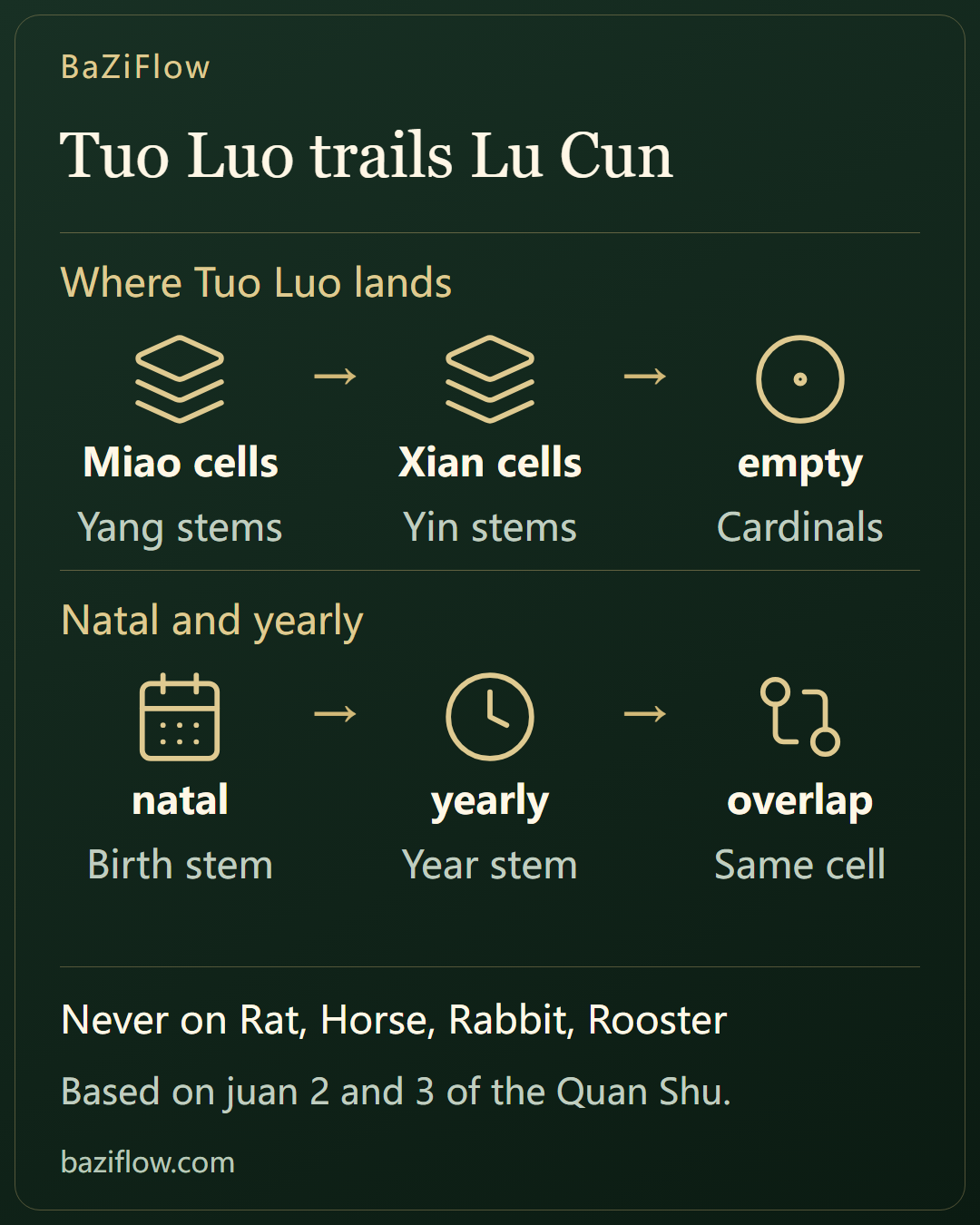
Tuo Luo goes on the branch before Lu Cun, never on Rat, Horse, Rabbit or Rooster. A comparison, the "Ji" naming puzzle, the Tuo-Lu-Yang triple and the juan 3 overlap example explain its pattern and the yearly overlap.
The short version9 min read
Tuo Luo goes on the branch before Lu Cun, read from the birth-year stem alone. Look the same table up for the year's stem and you get the yearly Tuo Luo; two on one cell is the positional precondition of what the Quan Shu calls die bing, an overlap.
- The eight landing points are Ox, Tiger, Dragon, Snake, Goat, Monkey, Dog and Pig. Yang stems fall on the cells the book marks Miao and Yin stems on those marked Xian, the reverse of Qing Yang.
- The "Ji" in "Tuo transforms into Ji" is Tuo Luo's own transformed-qi name. In the juan 2 list it appears next to the Hua Ji of the four transformations, and the two come from different mechanisms.
- A natal and a yearly Tuo Luo share a cell exactly when the birth-year stem and the year stem give the same Lu Cun cell, so one stem repeats it every ten years.
Read first
What do Zi Wei's supporting, malefic and minor stars actually do? ↗
Tuo Luo: the cell before Lu Cun, and never on Rat, Horse, Rabbit or Rooster
In plain words first: Tuo Luo (陀罗) and Qing Yang are neighbors, and both are measured from Lu Cun (禄存). Qing Yang takes the next branch in the sequence, Tuo Luo the previous one. The details of that placement are in the article on Qing Yang; only the result is used here.
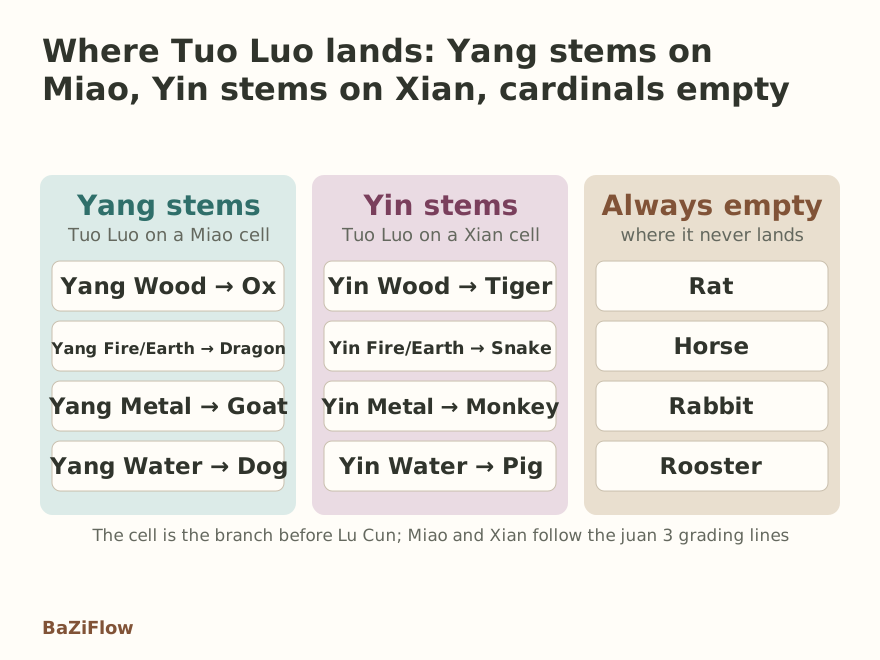
Comparison sketch: Yang stems on the left, Yin stems in the middle, and on the right the four branches Tuo Luo never takes; Miao and Xian follow the juan 3 grading lines.
The picture sorts the ten stems into Yang and Yin. Yang stems put Tuo Luo on the Ox, Dragon, Goat or Dog, the four cells the book marks Miao; Yin stems put it on the Tiger, Snake, Monkey or Pig, the four marked Xian; and the third column, Rat, Horse, Rabbit and Rooster, is where it never goes. The ranking section of juan 3, "Lun Ge Xing Shu Gao Xia" (论格星数高下), puts the same split on one line:
For Tuo Luo the Miao cells are Dragon, Dog, Ox and Goat, and the Xian cells are Tiger, Monkey, Snake and Pig.
Set beside Qing Yang the direction is exactly reversed. Qing Yang has Yang stems on Xian cells and Yin stems on Miao cells; Tuo Luo has Yang stems on Miao cells and Yin stems on Xian cells.
"Transformed qi called Ji": Tuo Luo's own name, not the Hua Ji of the four transformations
The section "Lun Zhu Xing Fen Shu Nan Bei Dou" (论诸星分属南北斗), juan 2, gives each star a line of attributes, and Qing Yang and Tuo Luo each end with an extra word:
Qing Yang belongs to Metal, a floating star of the Northern Dipper, transformed qi Punishment; Tuo Luo belongs to Metal, an assisting star of the Northern Dipper, transformed qi Ji.
"Punishment" and "Ji" are the transformed-qi names of these two stars; the general remarks of Master Yuchan in juan 1 say it more plainly: "Yang transforms its qi into Punishment, Tuo transforms its into Ji". A few lines further down the same list there is another entry:
Hua Ji belongs to Water and is the Ji Du star.
This Hua Ji (化忌) is the fourth of the four transformations, a mark attached to whichever star the birth-year stem points at: Tian Tong for a Yang Metal year, Tai Yin for a Yin Wood year. One character, two sources:
Enlarge diagram · scroll sideways to read
One more naming point is not settled in the book itself. The juan 2 grouping section calls Tuo Luo an assisting star of the Northern Dipper, whereas the Tuo Luo entry later in the same juan and the general remarks in juan 1 write it as a floating star of the Northern Dipper. The text does not explain the difference between the two words, so both are recorded as written. For the four-transformations side, see why Hua Ji is not simply bad news.
Three cells in a row: Tuo, Lu and Yang move together
In plain words: think of Tuo Luo, Lu Cun and Qing Yang as three joined cells; change the stem and the trio slides along the ring of branches.
Take a Yang Earth year: Lu Cun is on the Snake, Tuo Luo on the Dragon, Qing Yang on the Horse, three cells in a row.
Enlarge diagram · scroll sideways to read
The ten stems read best in pairs: Yang Wood with Yin Wood, Yang Fire with Yin Fire, Yang Earth with Yin Earth, Yang Metal with Yin Metal, Yang Water with Yin Water. Within a pair the Yang stem puts Tuo Luo on one cell and the Yin stem puts it on the next. The five pairs start on the Ox, Dragon, Dragon, Goat and Dog, so the Fire pair and the Earth pair land on exactly the same two cells, which is the other face of the Lu Cun verse writing those stems together. In every pair the Yang stem is on a Miao cell and the Yin stem on a Xian cell, in line with the split in the first section.
A yearly one on top: when the natal and yearly Tuo Luo share a cell, it is "die bing"
In plain words: the year has a stem of its own, so the same look-up places a second Tuo Luo, called the yearly Tuo Luo (流陀) on the chart, and a yearly Qing Yang (流羊) in the same way. A yearly Tuo Luo on the cell of the natal one is the positional precondition of what the book calls die bing (迭并), "overlap". Juan 3 has a short section on it, and its text is a position example:
Take a person born in a Yang Metal year with Life at the Rabbit and Travel at the Rooster. If Yang and Tuo are met, and the year is again Yang Metal with Lu at the Monkey, the yearly Yang is at the Rooster and the yearly Tuo at the Goat; so the Life palace at the Rabbit already has Qing Yang at the Rooster facing it, and the year adds yearly Yang and yearly Tuo, which is called the overlap of Yang and Tuo.
In the example the native's natal pair already stands on Rooster and Goat. The year is again a Yang Metal one, so its Lu Cun is also at the Monkey and the yearly pair goes to the same two cells: the two layers coincide. The Life palace is at the Rabbit and the Rooster is its opposite palace, hence the book's remark that the Life palace "already has Qing Yang facing it". So the overlap in the example has two layers: the year's pair lands on the natal pair, and the natal Qing Yang already faces the Life palace from the opposite side. The first layer depends on stems alone, the second on where each chart's Life palace sits; this article computes only the first.
Whether the first layer holds depends on two stems only, the birth-year stem and the year's stem: when they give the same Lu Cun cell, the cells coincide. That covers the same stem, and also Yang Fire with Yang Earth and Yin Fire with Yin Earth. A given stem comes round every ten years, and the Fire and Earth pairs add one more hit per decade. Checked in the engine on the chart of someone born in 1990, a Yang Metal Horse year:
Enlarge diagram · scroll sideways to read
Converting a year depends on the setting: whether the year pillar changes at the Start of Spring or at the lunar new year makes January and February births, and early-year look-ups, differ by one year. Check the setting before counting.
Compare only two stems
The whole procedure fits into three layers:
Enlarge diagram · scroll sideways to read
Two checks to run by hand
Born in a Yin Fire year (say 1987): in which years from 2026 to 2040 does the yearly Tuo Luo share a cell with the natal one?
Lu Cun for Yin Fire is on the Horse, so Tuo Luo is on the Snake. The cells coincide only when the year stem is Yin Fire or Yin Earth: 2027 (Ding Wei), 2029 (Ji You), 2037 (Ding Si) and 2039 (Ji Wei).
The 2026 yearly Tuo Luo is on the Dragon: which birth years have the natal Tuo Luo on the Dragon too?
Tuo Luo is on the Dragon for Yang Fire and Yang Earth births, years ending in 6 or 8, for example 1986, 1988, 1996 and 1998.
How to keep the natal layer and the yearly layer apart is in natal, decade and annual layers. The next star is Huo Xing, whose position moves from one cell per year to one cell per double-hour.
Questions readers ask next
Is Tuo Luo the same thing as Hua Ji?
No. Tuo Luo is a star of its own, placed from Lu Cun. Hua Ji is a mark attached to some star, picked out by the birth-year stem in the four-transformations table. The book happens to use the same character in both places; the two are found and located differently.
Why do Qing Yang and Tuo Luo always stand on either side of Lu Cun?
Both are measured from Lu Cun, one taking the next branch and the other the previous one, so wherever Lu Cun goes they follow. Which palace lies beyond them depends on the Life palace of the chart in hand.
How do I tell whether this year is an overlap year for me?
Start with two stems: the birth-year stem and this year's stem. If the Lu Cun look-up gives the same branch for both, the yearly pair lands on the natal pair. The book's example also has the pair facing the Life palace, which depends on where your Life palace sits; birth month and hour matter only there.
Was this article helpful?
Sources & references
Continue reading
Qing Yang (擎羊): The Star One Step After Lu Cun, With Only Eight Landing Points ↗
Huo Xing (火星): Year Group Sets the Start, the Birth Hour Counts the Steps ↗