

Yijing, Meihua and Liu Yao: who does what
Content version · · Sources & references
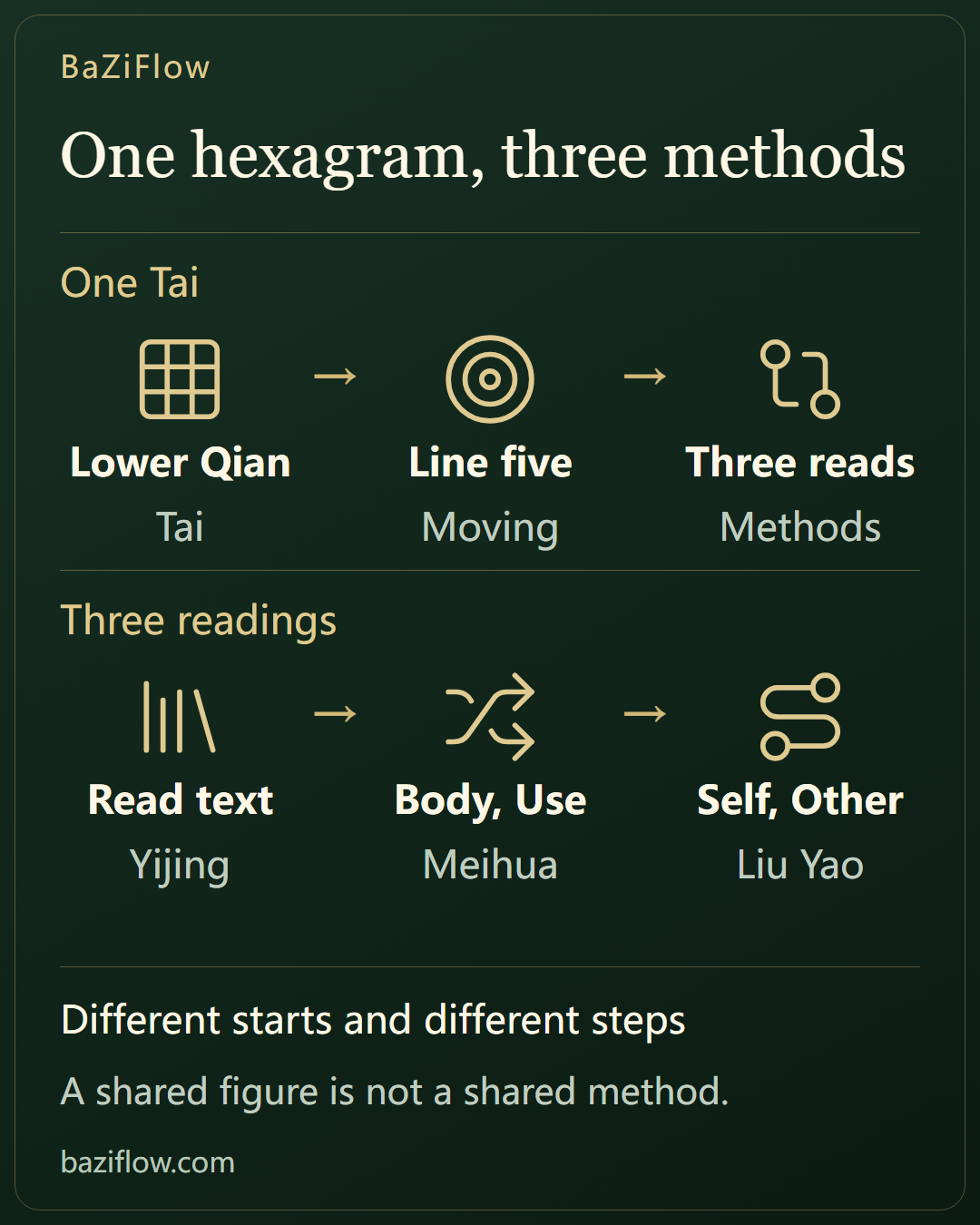
One example, Tai with line five moving, read three ways: the Zhou Yi text by position, Meihua by Body and Use, Liu Yao by Self, Other and Six Relatives. Same figure, different start, steps and unit read.
The short version10 min read
The three methods share the sixty-four hexagram figures but not the work done on them: the Zhou Yi reads text, Meihua reads phase relations between trigrams, and Liu Yao reads the marks on each line.
- The starting points differ: the Zhou Yi begins from a hexagram and a line position, Meihua from a few numbers, Liu Yao from six recorded throw values.
- Tai with line five moving yields three unlike things: the line-five statement, a split of Kun as Use and Qian as Body, and one annotated row for a moving Pig Water line.
- The units read are a passage, a trigram and a single line, so inner and outer trigram, Body and Use, and Useful God belong each to its own method.
Read first
The Sixty-Four Hexagrams: How Upper and Lower Trigrams Form One Figure ↗
Judgment and Line Statements: Whole Hexagram or Single Line? ↗
One hexagram, three different questions
The Zhou Yi (周易), Meihua Yishu and Najia Liu Yao all draw six lines and arrange them into the same sixty-four hexagrams. The drawn figure is all they share; what each method does with it afterwards is a different job. This article uses a single example throughout: Tai (泰), with Qian (乾) as the lower trigram, Kun (坤) as the upper trigram, and the fifth line moving.
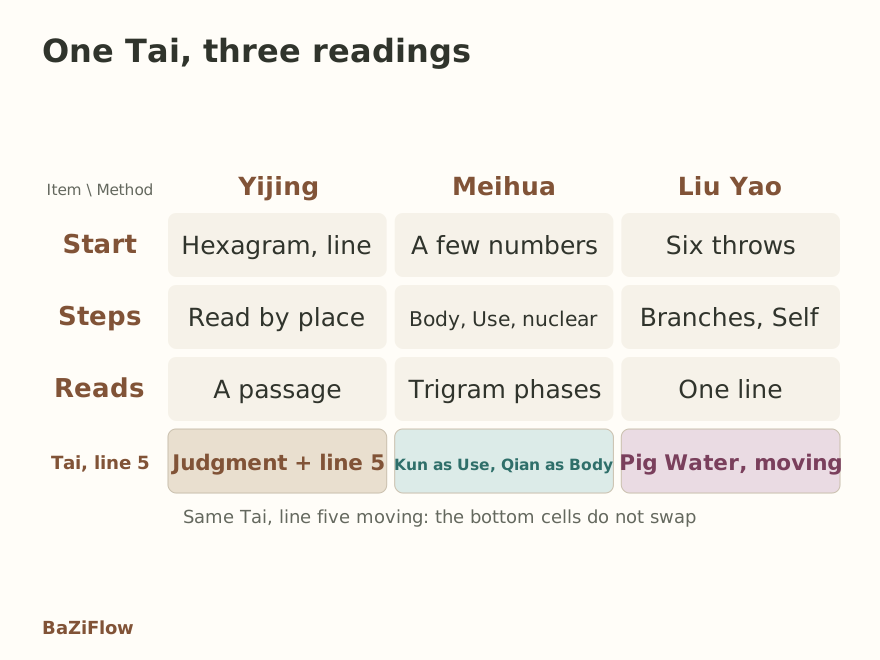
Comparison sketch: the same Tai with line five moving. The three bottom cells answer different questions, do not swap, and are not an accuracy ranking.
Read the table one column at a time. Each column is a method: what it starts from, what it does, what it reads, and, in the last row, what it produces for Tai with line five moving. The bottom cells cannot stand in for one another, because they answer different questions.
Enlarge diagram · scroll sideways to read
"Tai, line five moving" is a teaching stipulation, not the record of an actual casting; the next three sections show how each method could arrive at it. The detail of the other two methods already has its own pages: Meihua and Liuyao: the same figure, different records works through Qian, and Hexagram texts and Najia Liuyao use different evidence works through Jie. This page starts from the Zhou Yi text with a new hexagram.
Three questions on one figure
What do this hexagram and this line say?
Read the Judgment and the line-five statement, then the commentaries that explain them.
Which half is Body, which is Use?
The trigram holding the moving line is Use, the other half Body; then the nuclear and changed figures.
What branch and relative sits on each line?
Give each line a branch phase and a relative, mark Self, Other and the moving line, then see what it becomes.
The Zhou Yi side: reading the statements by address
The Zhou Yi's material is text. A whole hexagram has a Judgment (卦辞); each line has a line statement (爻辞); and two commentaries, the Commentary on the Judgments (彖) and the Images (象), explain them. To read Tai, first decide which layer and which line, then read the words.
Enlarge diagram · scroll sideways to read
For line five of Tai, the line statement and the Image that explains it run:
Line five (Six): Di Yi gives the young woman in marriage; thereby blessing, supreme good fortune. The Image says: "Thereby blessing, supreme good fortune." Being at the center, one acts on what one wishes.
Nothing in these lines speaks of Metal, Earth, Self or Use. The "Six" only names a yin line; it does not say the line moved. Line five is read here because the teaching condition says it moves, and how each school decides which statements to read is a separate question. The words "gui mei" (归妹) are simply a phrase inside this line statement. The Commentary on the Judgments reads Tai's two trigrams by position as well: "yang within and yin without" means, for Tai, Qian inside (below) and Kun outside (above). See Judgment and Line Statements: Whole Hexagram or Single Line? for how the layers divide the work.
How text meets a question is described in the Great Commentary (Xi Ci, 系辞), part I, chapter 9, which gives the yarrow-stalk procedure: "the Great Expansion number is fifty, of which forty-nine are used", and "eighteen changes complete a hexagram". Six lines from eighteen changes is three changes per line; that division is arithmetic on the passage, not a statement in it.
Choose the layer
Say whether a sentence is Judgment, line statement, Commentary or Image, and name the layer.
Match the address
A line statement follows its line: line five reads the Six; a neighbour cannot fill a gap.
Keep the voices apart
The classic itself, a commentator, and a modern gloss each carry their own source.
The Meihua side: numbers become two trigrams, then Body and Use
Meihua starts from numbers, not from the text. In the year-month-day-hour procedure of volume 1 of Meihua Yishu, the total of year, month and day, divided by eight, leaves the upper trigram; adding the hour number and dividing by eight again leaves the lower; the total of all four divided by six leaves the moving line. An exact multiple of eight is taken as eight, which is Kun.
The numbers below are stipulated for practice: year number 3, month 5, day 8 and hour number 1. This is an arithmetic exercise, not a casting record.
Enlarge diagram · scroll sideways to read
Volume 3 says: "the moving is Use, the still is Body." Line five lies in the upper trigram, so upper Kun is Use and lower Qian is Body. The nuclear figure is defined in volume 1: drop the first and sixth lines and split the middle four into lines 2 to 4 (Dui) and lines 3 to 5 (Zhen); volume 3 adds that when Body is below, the lower nuclear trigram belongs to Body and the upper one to Use. The changed figure turns the yin line five into yang, so the upper trigram becomes Kan.
| Role | Trigram | Phase | Relation to Body (Metal) |
|---|---|---|---|
| Body (half without the moving line) | Lower Qian | Metal | Reference |
| Use (half with the moving line) | Upper Kun | Earth | Use produces Body |
| Nuclear of the Body side (lower) | Dui | Metal | Same phase as Body |
| Nuclear of the Use side (upper) | Zhen | Wood | Body restrains it |
| Upper trigram of the changed figure | Kan | Water | Body produces it |
The phases come from volume 1's table of palace elements: Qian and Dui Metal, Kun and Gen Earth, Zhen and Xun Wood, Kan Water, Li Fire. Volume 3 then ranks Use as most pressing, the nuclear figure next and the changed figure last, and weighs seasonal strength; no season is given here, so the example stops at the relations. These phase labels belong to Meihua's own table and are not read out of the Zhou Yi text.
Tai: primary, nuclear and changed hexagrams
Tai (泰)
The upper and lower trigrams the procedure gave: Kun above, Qian below.
Guimei (归妹)
Drop lines one and six and take the middle four: Zhen above, Dui below.
Xu (需)
Line five turns from yin to yang: Kan above, Qian below.
The Liu Yao side: the same fifth line becomes a row of branches
Liu Yao starts from six recorded throw values. Written bottom to top as 7, 7, 7, 8, 6, 8, the sevens are still yang lines, the eights still yin lines and the six a moving yin line, which gives Tai with line five moving. The figure matches the Meihua arithmetic, but the record keeps six numbers instead of one remainder.
Enlarge diagram · scroll sideways to read
The palace table in Zengshan Buyi places Tai in the Kun palace, whose phase is Earth. Relatives follow the palace phase: Water, which Earth restrains, is Wealth; Wood, which restrains Earth, is Officials/Ghosts; Earth is Siblings; Metal, which Earth produces, is Descendants. The chart marks Self on line three and Other on line six; the moving line, line five, is neither.
Line five, Pig Water (亥水), moves; in the changed hexagram Xu the fifth line is Dog Earth (戌土), so the relative changes from Wealth to Siblings. The position of Self and Response is fixed by the hexagram's rank within its palace, while movement depends only on the throw values, so a moving line can fall on any line regardless of Self and Response. With no question there is also no Useful God to choose; for how it is chosen, see What is Liu Yao? From a single question to an assembled hexagram chart.
Four terms in this one row
- Self and Response
- Their positions are fixed by the hexagram's rank in its palace and do not change with the throws.
- Six Relatives
- Labels such as Wealth and Siblings given to each branch phase relative to the palace phase.
- Moving line
- The line that moves in the primary hexagram; here line five.
- Changed line
- The moving line after it changes, found in the changed hexagram; here line five of Xu.
Side by side: do not lend words across methods
Once the three readings sit side by side, the commonest slip is borrowing: a word that looks alike but points at a different thing.
Enlarge diagram · scroll sideways to read
Three pairs of borrowed words
Common borrowing
- Treating the Commentary's "within" and "without" as Meihua's "Body" and "Use"
- Treating every "Six" of Six in the fourth place, Six in the fifth and Six at the top as a throw of six
- Linking the nuclear hexagram Guimei to the words "gui mei" in the line-five statement
Where each rests
- Inner and outer go by place, lower and upper; Body and Use go by the moving line, and the half holding it is Use. The two sets of names have no fixed match: with line five moving, Use happens to be the upper, outer trigram
- Six names a yin line; in this example only line five moved, and the lines at four and at the top are still yin lines
- The nuclear figure comes only from the yin-yang pattern of lines two to five and reads no word of the line statements
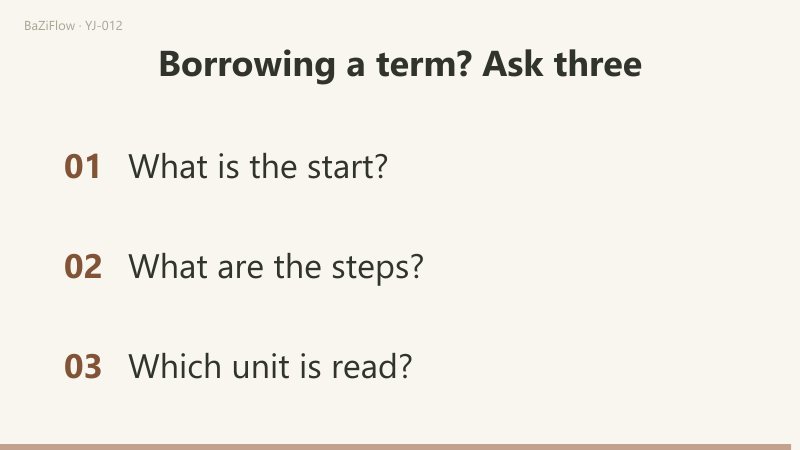
Every record can open with three questions:
What is the start?
The text for a hexagram and line, a few numbers, or six throw values.
What are the steps?
Read by place, assign Body, Use and the nuclear and changed figures, or annotate branches, relatives and Self or Other.
Which unit is read?
A passage, a trigram, or a single line.
Questions readers ask next
Are the inner and outer trigrams of the Zhou Yi the same as Body and Use in Meihua?
No. Inner and outer depend only on position: the lower trigram is inner, the upper outer. Body and Use depend on where the moving line falls, and the half containing it is Use. So with the moving line in the lower trigram, Use is the inner trigram; with it in the upper trigram, Use is the outer one, and the two sets of names have no fixed correspondence. With line five of Tai moving, Use happens to be the outer trigram; make line one the moving line and Use becomes the inner one.
If I build one hexagram by Meihua and again by Liu Yao, will the conclusions agree?
The figure can agree, but the conclusions have no common unit. One method compares the phases of trigrams; the other looks up the branch, relative and Self or Other marker of a particular line. To compare them, write out the basis for each step separately rather than setting two final statements against each other.
Do I need to learn Najia before reading the Zhou Yi text?
No. The text consists of Judgments, line statements and commentary, with no stem-branch or relative markers. Najia is a separate way of labelling lines, worth learning for reading Liu Yao records and not for reading the classic.
Was this article helpful?
Part of a learning path
Yijing: from textual layers to lines and reading · Step 9 of 9 available
Sources & references
Continue reading
Meihua and Liuyao: the same figure, different records ↗
What is Liu Yao? From a single question to an assembled hexagram chart ↗