

“Outer planets” means different things in different books
Content version · · Sources & references
Separate a modern astrological grouping from astronomical categories, compare five sidereal orbital periods, and test why a shared slow-planet sign is insufficient for an individual interpretation.
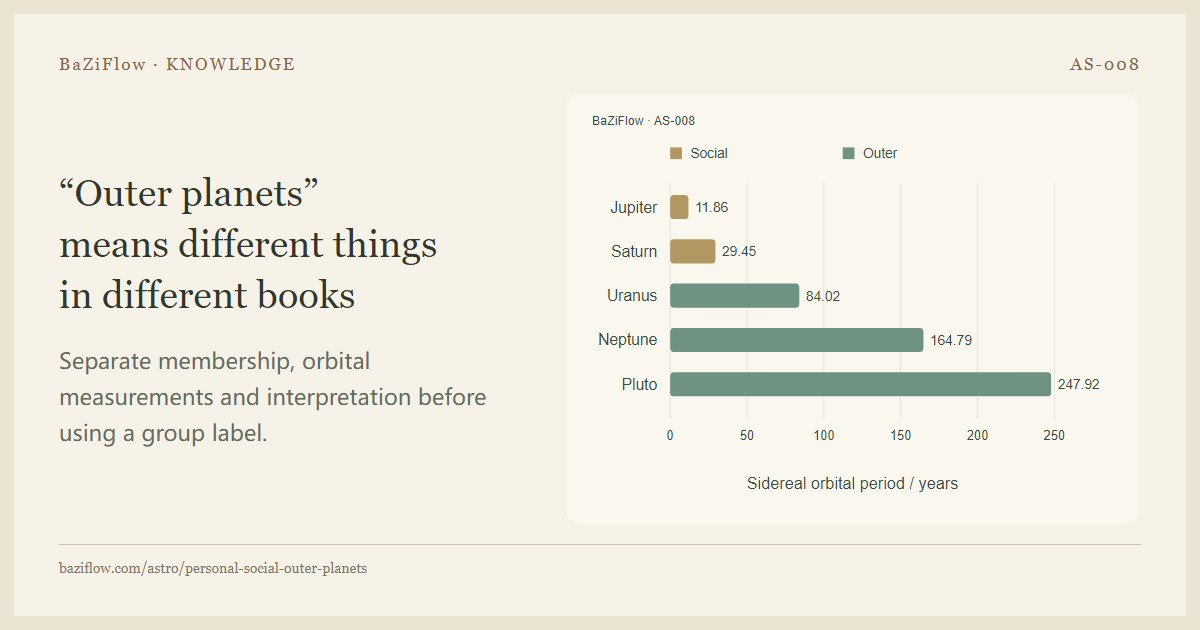
Separate membership, orbital measurements and interpretation before using a group label.
Read first
Check the membership before comparing the label
A solar-system guide and a modern astrology lesson can both discuss “outer planets” while listing different objects. In the astronomical grouping of four outer major planets, Jupiter and Saturn sit alongside Uranus and Neptune. In the astrological usage adopted here, the outer or transpersonal group is Uranus, Neptune and Pluto, with Jupiter and Saturn placed in a separate social group.
Nothing has moved between orbits when the terminology changes. The classification has a different purpose. Before deciding that two sources contradict each other, write out the members each source includes. This simple check is especially helpful when a sentence starts with an apparently universal claim about “all outer planets.”
The astrological scheme is a teaching convention and an interpretive vocabulary. It is not a replacement for astronomical classification or a demonstrated causal model of personality. Keeping that distinction visible allows you to learn the vocabulary without attributing psychological claims to NASA's measurements.
The three groups used in this lesson
The personal group contains the Sun, Moon, Mercury, Venus and Mars. The social group contains Jupiter and Saturn. Uranus, Neptune and Pluto form the outer or transpersonal group. Some authors give the Sun and Moon their own heading as luminaries; check the list rather than assuming a different heading must mean a missing object.
Linda Reid's lessons are an identifiable example of modern personal, social and transpersonal language. Their symbolic claims should be read as the author's astrological framework, not as physical mechanisms established by orbital data. The purpose here is to identify that framework's scope, not to import all of its assertions about people.
“Personal planet” is also broader than the scientific noun planet. The Sun is a star, the Moon is Earth's natural satellite, and Pluto is a dwarf planet. Their inclusion in a chart does not change those identities. Likewise, the word social is not a sociability score, and transpersonal does not rank one person as spiritually superior to another.
| Question about a source | Why it matters |
|---|---|
| Are the luminaries listed separately? | The personal-group heading may use a narrower list |
| Are Jupiter and Saturn called outer? | The source may be using an astronomical grouping |
| Does Pluto appear among chart objects? | Chart usage does not settle astronomical classification |
A glossary that records membership will often resolve these questions more efficiently than a long list of psychological keywords. The labels organise what you are reading; they do not supply a complete interpretation of any chart.
Orbital periods illustrate scale, with a specific definition
JPL defines the sidereal orbital period as the time required for a body to complete an orbit around the Sun relative to the fixed stars. Its table gives values that round to 11.86 years for Jupiter, 29.45 for Saturn, 84.02 for Uranus, 164.79 for Neptune and 247.92 for Pluto. The figure plots those five quantities on the same linear scale.
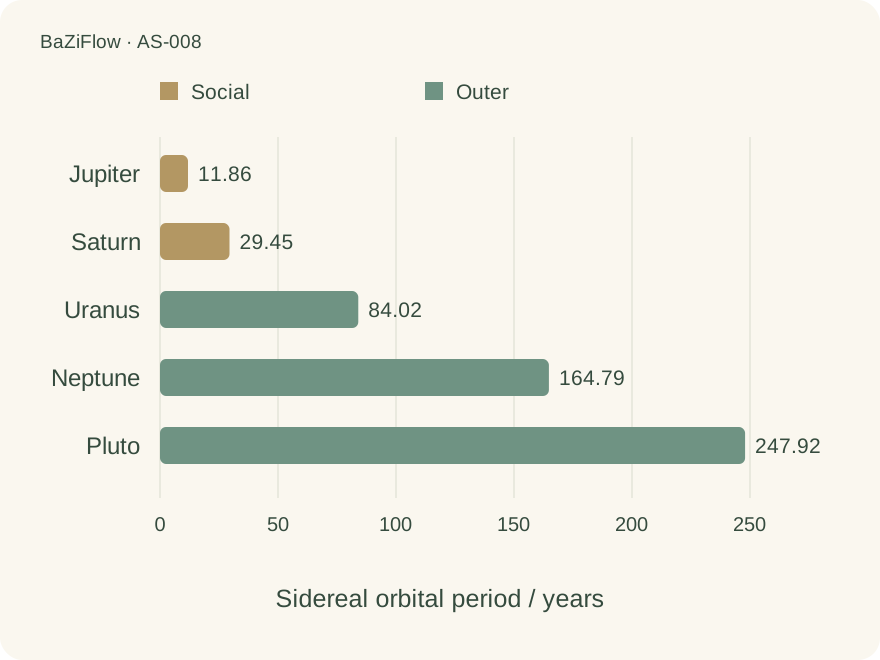
Rounded JPL sidereal orbital periods. The bars measure time around the Sun, not time in a sign or strength of personality.
Do not relabel these numbers as exact stays in a zodiac sign. Dividing a period by twelve may produce an arithmetic average, but it does not calculate the date of an observed ingress. Actual apparent longitude is viewed from Earth, and retrograde motion can produce repeated crossings of a boundary. An ephemeris with a specified zodiac setting is needed for a date-specific statement.
The bars also do not show how long each body takes to cross a particular person's house. House boundaries depend on the chart's time, location and house system. A period around the Sun and an interval between house crossings answer different questions, even though both may be expressed in years.
A longer bar is not a stronger influence score. No numerical conversion from years to psychological importance is established by this diagram. Its limited job is to make differences in orbital timescale visible. For the separate issue of apparent backward motion, see retrograde planets.
Test the information shared by a cohort
A slow-moving body's sign can be shared by many people born around the same period. That makes it a poor basis, by itself, for a claim presented as uniquely personal. If two reports use the same shared sign to make identical detailed conclusions about careers or relationships, the missing specificity is in the evidence, not merely in the choice of adjectives.
Consider a schematic angle exercise, not two asserted birth charts. Both records place an outer body at longitude 210°. In one record another body is at 210°; in the other it is at 300°. The smallest separations are 0° and 90°. The shared outer longitude does not determine every relationship in the record.
A proper aspect judgement would additionally specify which angles count and what orb is allowed. A house comparison would need sufficiently reliable birth information. Do not manufacture a precise house position from an unknown time just to make two readings appear different. Aspect angles and orbs explains the geometric part of that comparison.
These checks distinguish recorded chart features; they do not demonstrate that geometry determines life outcomes. A responsible explanation keeps the structural comparison separate from any interpretation proposed within an astrological tradition.
Use the grouping as an index, then return to the case
When taking notes, label a statement as a membership definition, an astronomical measurement or an interpretive association. “Jupiter is in this social group” belongs to the first category; its orbital period belongs to the second. A statement about what Jupiter symbolises belongs to the third and needs its own scope.
That separation prevents an accurate astronomical number from lending unearned authority to an unrelated personality claim. It also prevents a broad generational description from filling gaps in an individual's actual circumstances.
The three groups can help you navigate a course and recognise its time scales. They cannot decide who is more mature, which chart must be more important, or what every member of a generation will experience. Once the vocabulary is clear, the next useful question is which specific, reliable features of the current chart support the interpretation being offered.