

Give each symbol layer its own field
Content version · · Sources & references
Compare the eight-door home positions, nine-star inventory and a named classical spirit list. Learn why a symbol name, its home position and its placement in a time chart are different records.
The short version6 min read
Tian Peng and Rest share a home association with Kan one, yet the cited Yang-one Yin Wood Ox example places them at nine and two. Inventory, home and current placement answer different questions. The duty-star role and the spirit named Zhi Fu also need separate labels.
- Use the eight-door ring and the nine-star numbered table as separate inventories.
- Shared homes do not force shared destinations, and merged display slots do not erase members.
- Keep the spirit list’s version and disambiguate Zhi Fu by layer.
Read first
Two meanings of Zhi Fu need two labels
A Qimen note that says only “Zhi Fu” (值符) can be ambiguous. It may be discussing the duty star selected from the star layer, or the spirit-layer name. Sharing a name does not make those entries the same kind of object. The site’s Qimen glossary lists the spirit in English as Chief; this article keeps Zhi Fu wherever the shared name is the point.
That is a useful starting point for doors, stars and spirits more generally. Several names may appear in one palace, but each needs a category before it can be interpreted. Looking up a favorable or unfavorable phrase for every name and adding the phrases together does not establish a reading of the actual combination.
This article uses the inventories and home associations in Tong Zong, volume two, with a time example from the Siku text of Dun Jia Yan Yi. It does not impose a single slogan such as “doors mean action, stars mean timing, spirits mean secrets” on every lineage. A named reading method must explain what role it gives each layer.
Duty star
- Tian Peng
Spirit name
- Zhi Fu
A door table gives home associations
| Home palace | Door name used here |
|---|---|
| Kan 1 | Rest |
| Gen 8 | Life |
| Zhen 3 | Injury |
| Xun 4 | Obstruction |
| Li 9 | Scenery |
| Kun 2 | Death |
| Dui 7 | Alarm |
| Qian 6 | Open |
These correspondences follow the cited Tong Zong passage. In outer-ring order, the sequence is Rest, Life, Injury, Obstruction, Scenery, Death, Alarm and Open. English translations vary between authors; keep the source's underlying names attached when comparing terminology.
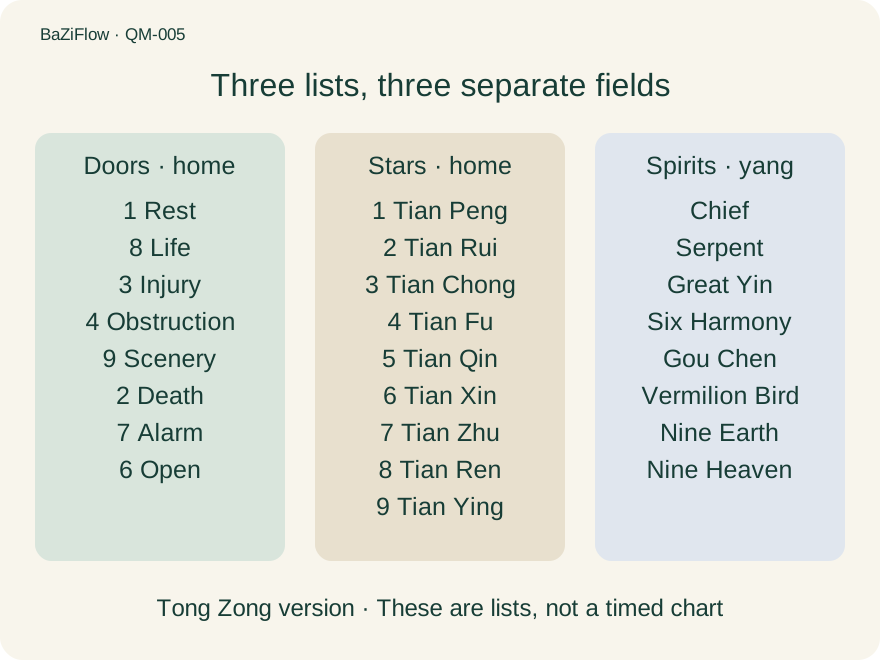
Original BaZiFlow category card based on Tong Zong, volume two. The spirit list preserves that text’s named version; no time-specific placements are implied.
A home position is a reference association, not a claim that the door remains there in every setup. The center also does not create a ninth door merely because the grid contains nine boxes. Its treatment belongs to the selected placement rules.
The everyday meaning of a door's name is not an event report. Death Door does not establish that a person will die, just as Open Door does not confirm that a real building is open for business. Those conclusions would require information that the name alone does not contain.
5 · No door
Outer palace order; door names are paired in the home-position table.
Nine stars are a separate inventory
In palace-number order, the same text gives Tian Peng, Tian Rui, Tian Chong, Tian Fu, Tian Qin, Tian Xin, Tian Zhu, Tian Ren and Tian Ying. The numbers identify their home associations from one through nine. These are names in Qimen's symbolic system, not measurements of physical objects currently observed in the sky.
Tian Qin's center-five home and its subsequent lodging treatment are separate details. A rotating display may combine it with another star under a specified rule. Two names shown together do not reduce the underlying inventory from nine stars to eight.
Nor does a shared home association make a star and door move together in every time chart. The cited Yang-one Yin Wood Ox (乙丑) example places Tian Peng at nine while Rest Door is at two. Their home association with Kan one has not been erased; it simply is not their current placement in that example. See the duty star and duty door for the distinct roles.
Tian Peng
Rest
Cited Yang-one Yin Wood Ox example
Preserve the spirit list's version
The Yang-mode sequence in the Tong Zong passage is Chief (Zhi Fu, 值符), Serpent (螣蛇), Great Yin (太阴), Six Harmony (六合), Gou Chen (勾陈), Vermilion Bird (朱雀), Nine Earth (九地) and Nine Heaven (九天). Its Yin-mode passage adds notes associating Black Tortoise (玄武) beneath Vermilion Bird and White Tiger (白虎) beneath Gou Chen. The article retains that named textual version instead of silently replacing its fifth and sixth entries with another manual's list.
If a modern chart shows White Tiger and Black Tortoise as entries, consult its own inventory and ordering rules. The difference deserves a source check; it is not, by itself, enough to declare one chart incorrect. Similar names across lists do not guarantee identical placement conventions.
Here “spirits” names a traditional symbolic category. The labels do not demonstrate supernatural entities, and they do not establish that a person is deceitful or hiding something. Those are additional claims about reality, not information recovered merely by identifying a field.
When writing Zhi Fu, say whether the record concerns the duty star or the spirit layer. The extra category is short, but it prevents a later comparison from merging two different roles.
Turn the inventory into a record of this chart
For an actual palace, record the layer, symbol name, placement and relevant time conditions separately. The home tables help identify the members. Current positions must come from the chart being examined. A missing spirit layer should remain missing rather than being copied from another time.
Comparing rotating and flying plates also requires checking inventory size, center treatment and display choices. An eight- or nine-spirit arrangement, or a door layer with an unassigned slot, must be understood under its named rules rather than normalized to make two tables look alike.
Only after that transcription should a reading explain how it selects a focus for the question and weighs the combination. The distinct roles of doors, stars and spirits emerge through those stated operations. A memorable label can organize study, but it cannot answer the real-world question on its own.
Yang 1 / Yin Wood Ox
Tian Peng star
- Home
- 1
- Current
- 9
Rest door
- Home
- 1
- Current
- 2
Questions readers ask next
Do three symbol layers provide three independent confirmations?
They are placements within a common chart procedure, not automatically independent observations about the world. Identify the layer facts before explaining how a named method combines them and what further conditions it requires.
Does a combined Qin–Rui display mean there are eight stars?
Keep nine members in the inventory and record the shared display position separately. Element count and occupied-slot count can differ without losing a member.
Which spirit list should be changed when manuals disagree?
First preserve each source’s names, order and mode. Correct a record when it misrepresents its own source; a difference between named versions alone does not justify silently rewriting one to match the other.
Was this article helpful?
Sources & references
Continue reading
Duty chief and duty door: track the role before the position ↗
Rotating and Flying Qimen Plates: Check the Placement Rules ↗