

One group, different situations
Content version · · Sources & references
Count the ordered pairs compressed into six groups, then compare two newsletter projects with matching positions but different schedule and attribution problems.
The short version6 min read
Six Sukuyō groups compress many positional inputs: twenty-seven references paired with twenty-seven targets give 729 ordered pairs. Even two pairs with An–Huai offsets three and twenty-four can face different newsletter problems—availability or acknowledgement. A category retains a positional relation, while advice needs the situation’s actual evidence.
- The 729 ordered position pairs comprise 27 Ming, 54 Ye–Tai and 162 in each remaining group; these are neither surveyed relationships nor real-world probabilities.
- Mao–Shen and Bi–Jing both have forward offset three. Moving both endpoints together preserves the offset while changing the actual mansion names.
- Changing only Mao to Bi while keeping Shen changes the offset from three to two. Track which input changed before calling two classifications equivalent.
Read first
Six groups compress many ordered pairs
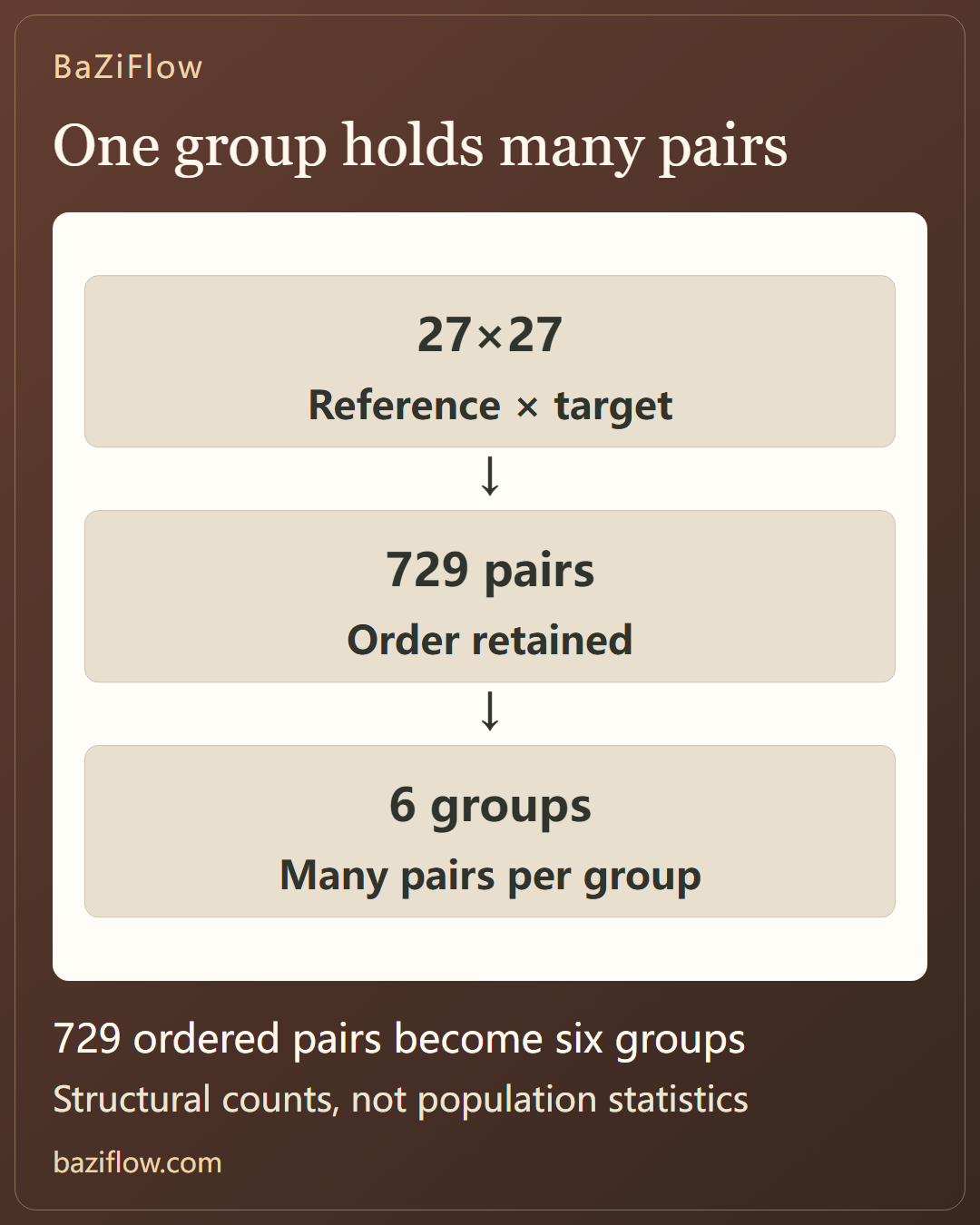
Fix a 27-position mansion ordering and preserve the distinction between the reference person and the target person. There are 27 × 27 = 729 ordered position pairs. In the reciprocal grouping derived from the three-nine sequence, each reference has one Ming target, two Ye–Tai targets and six targets in each of the other four groups.
That yields 27 Ming pairs, 54 Ye–Tai pairs and 162 pairs each for Rong–Qin, Shuai–You, An–Huai and Wei–Cheng. The totals add to 729. These are cells in a structural model, not a survey of 729 relationships. No assumption has been made that birthdays, mansion assignments or encounters are uniformly distributed.
The sequence is grounded in the three-nine ordering of the Sukuyō text in the Taishō canon (T1299); the 27-name condition used here is consistent with the calendar account of the National Astronomical Observatory of Japan (NAOJ). The counting is an explicit derivation under those assumptions. It cannot establish the probability that a reader will meet someone in a particular group, and it says nothing about a group's success rate.
This compression has a practical consequence: many different inputs receive the same group name. A category cannot retain all the information about the people, their tasks and their circumstances. More detailed language about the category does not recreate information that was never entered.
Ming: 27
- Ordered position pairs
Ye–Tai: 54
- Ordered position pairs
Other four: 162 each
- Ordered position pairs
27 + 54 + 4×162 = 729
Hold the label constant and change the problem
Consider two fictional pairs preparing a neighbourhood newsletter. Pair A has trouble maintaining a weekly schedule because the participants are available in different weeks. Pair B can meet regularly but has not agreed how to acknowledge individual writing and editing contributions. Suppose both are classified An–Huai. The shared label does not make their immediate problems the same.
| Question | Pair A | Pair B |
|---|---|---|
| What is actually known? | Availability does not support the proposed weekly cycle | Attribution expectations have not been agreed |
| What information is needed next? | Available weeks and the workload per issue | Each person's understanding of authorship and editing credit |
| What should not be assumed? | That someone can simply commit more time | That one person has accepted invisible work |
Pair A may need a different publication frequency or a smaller issue. Pair B needs an explicit discussion of credit and responsibilities. Those possibilities arise from the supplied conditions, not from interpreting An or Huai as a fixed personality.
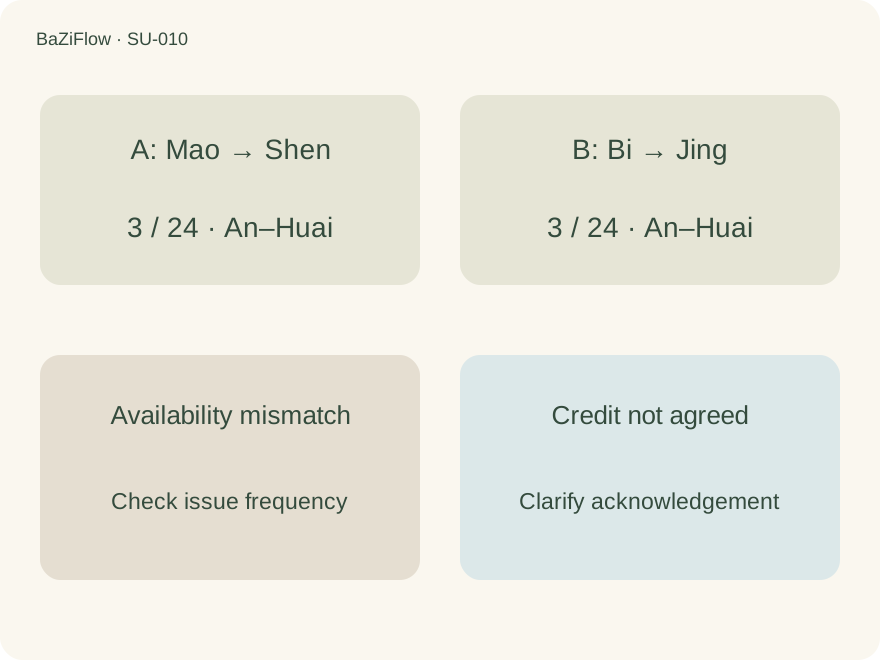
Original controlled comparison using invented labels and situations, not observed predictive results.
The two rows of the figure preserve the same category while showing different evidence fields. They do not present two inevitable outcomes. They show why an explanation that ends with identical advice about attraction, tension and boundaries may fail to address either task.
Availability
- Check issue frequency
Acknowledgement
- Agree writing and editing credit
Even matching directional offsets do not recover the missing context
For a controlled position exercise, let the first pair be Mao (昴) and Shen (参), and the second Bi (畢) and Jing (井). In the adopted 27-position sequence, which omits the Ox mansion Niu (牛), both forward offsets are three and both reverse offsets are twenty-four. Both therefore produce the same An–Huai pairing in the same directional arrangement. These are assumed mansion labels, not calculated birth records.
The matching offsets do not tell us which weeks the newsletter volunteers are free or what acknowledgement they want. Adding a near/middle/far field would still not supply those facts. Distance categories explain another positional convention, not an alternative way to obtain the participants' schedules or consent.
The same limit appears over time. One pair may work comfortably on a short project and struggle with a recurring commitment. If the birth labels remain unchanged, a report should still recognise the changed workload. Reusing the earlier advice simply because the category is stable ignores the new evidence.
Make the shared classification testable with a small transformation. Number Mao zero, then Bi one, Zui (觜) two, Shen three and Jing four in the adopted order. Mao–Shen runs from zero to three; Bi–Jing runs from one to four. Advancing both endpoints by one preserves their difference of three. The mansion names have changed, but the directed offset has not.
Now change only one input: replace Mao with Bi while keeping Shen as the target. Zero-to-three becomes one-to-three, giving forward offset two and reverse twenty-five, Shuai–You. This counterexample identifies what preserved the earlier classification and what changes it. Neither calculation has introduced availability or acknowledgement data, so a new group cannot itself resolve either newsletter problem.
Mao–Shen
- Reference index
- 0
- Target index
- 3
- Forward offset
- 3
Bi–Jing
- Reference index
- 1
- Target index
- 4
- Forward offset
- 3
Bi–Shen
- Reference index
- 1
- Target index
- 3
- Forward offset
- 2
Test a report by hiding its category name
Put two readings side by side and temporarily hide the names and labels. Can you identify which paragraph concerns irregular availability and which concerns attribution? If both begin with strong attraction, move to inevitable friction and conclude with generic communication advice, the text may be a category description presented as a personalised analysis.
A statement specific to Pair A should point to its schedule constraint. A statement specific to Pair B should identify the unresolved credit agreement. Neither needs to invent a hidden motive. If the available information does not establish a cause, preserve that uncertainty rather than filling the paragraph with a plausible story.
This test also catches superficial variation. Changing a few adjectives or reversing the order of a generic advice list does not add evidence. The question is whether the recommendation follows from a fact that distinguishes this situation from the other one.
Leave unknown facts unknown
If all that is supplied is a pair of mansion names, it is reasonable to explain how the classification was obtained and describe the scope of the tradition. It is not reasonable to fabricate an everyday conflict so that the reading appears deep. Ask what practical question is being considered before assigning a personalised conclusion to it.
Once concrete facts are available, they need not all be translated back into symbolism. A weekly schedule can be unworkable because of availability. An attribution dispute can remain an unresolved agreement. Both can be discussed accurately without declaring one person destined to be controlling or inattentive.
The 729-cell calculation is a structural exercise, and the newsletter cases are original comparisons. Neither is an empirical test of Sukuyō. A useful ongoing record keeps the inputs, current conditions, initial advice and later observations separate. Recording cases explains how to preserve those differences rather than collecting interchangeable stories under one label.
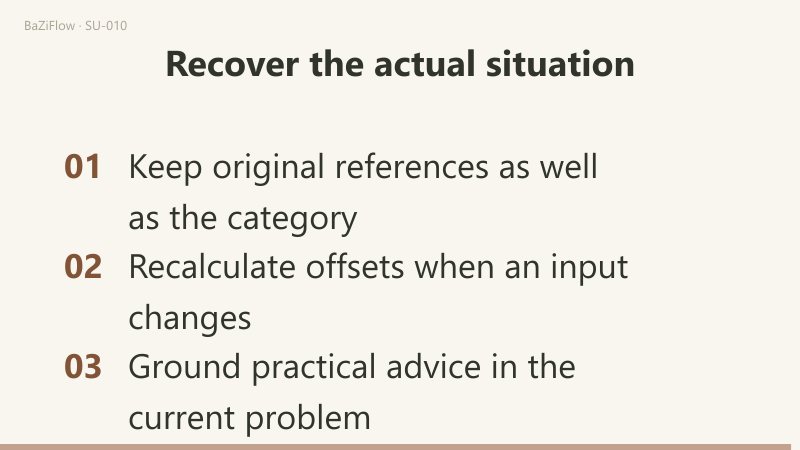
Position inputs
- Calculate the category
Situation inputs
- Schedules, tasks and stated wishes
Questions readers ask next
Why can one relationship group contain many different pairs?
On a fixed 27-position cycle, each reference can have several targets in one group. An–Huai has six targets per reference, hence 162 ordered pairs across twenty-seven references. Grouping retains the label pair while dropping the actual mansion names and other details.
Can 729 ordered pairs establish a real meeting probability?
No. It counts cells in a twenty-seven by twenty-seven table, without population sampling, birth distributions or encounter data. Selecting table cells uniformly would be an additional model assumption, not an observed property of people’s relationships.
Why does changing one endpoint differ from changing both?
Moving Mao and Shen forward together produces Bi and Jing with the same gap of three. Moving only Mao to Bi while leaving Shen gives gap two, Shuai–You. The result depends on which inputs changed, not merely on how many mansion names look different.
Was this article helpful?