

King of Cups: a sceptre and a cup
Content version · · Sources & references
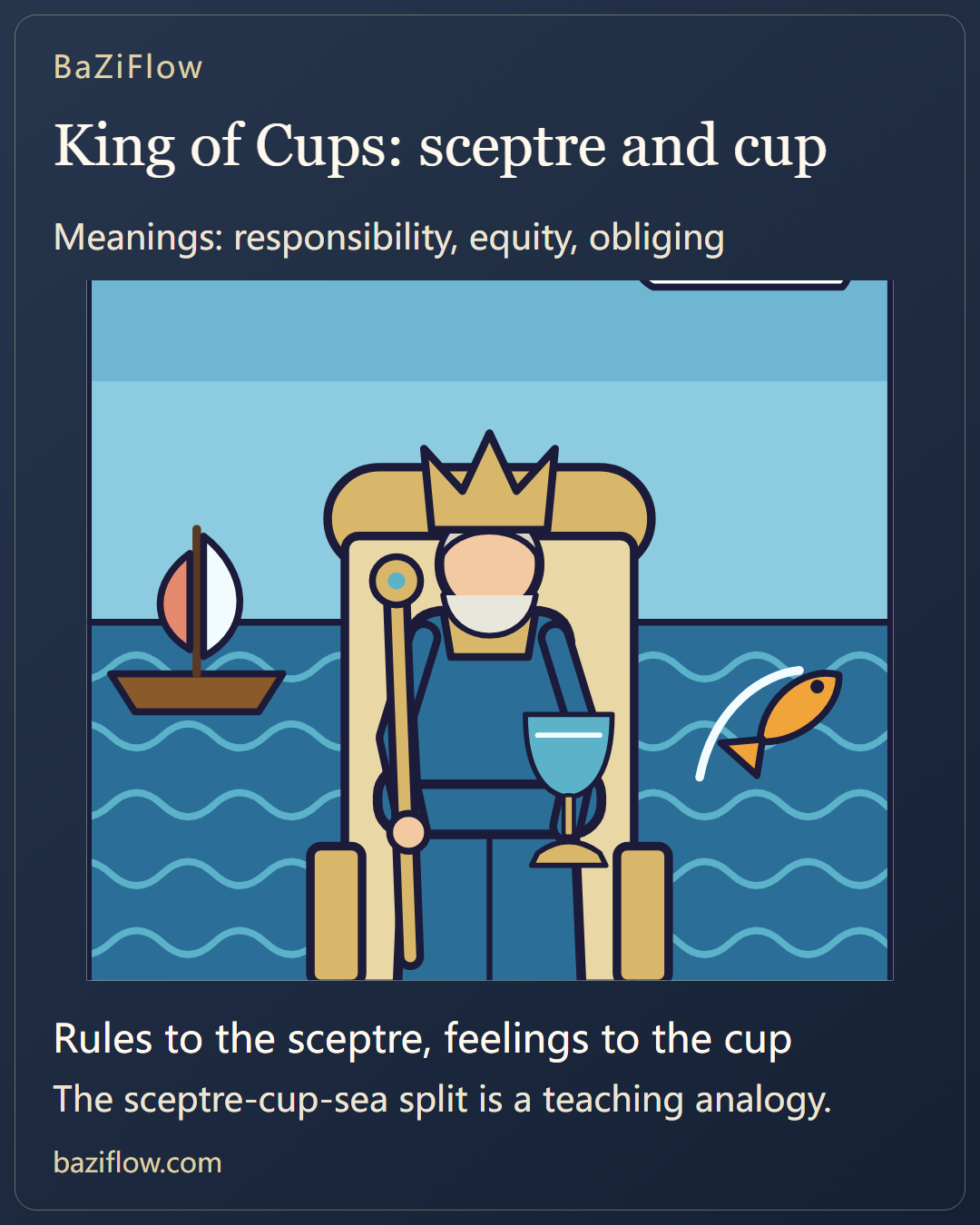
The King of Cups holds a short sceptre and a great cup on a throne set in the sea. Separate the picture, the word lists and the warning in the extras, then sort a shared-kitchen problem into sceptre, cup and sea.
The short version7 min read
The King of Cups sits in a throne on the sea with a sceptre in one hand and a cup in the other, the water moving at his sides. Waite's word list rests on "responsible" and "disposed to oblige".
- Waite's description: a short sceptre in the left hand, a great cup in the right, a throne set upon the sea, a ship riding on one side and a dolphin leaping on the other.
- The divinatory meanings: a man of business, law or divinity who is responsible and disposed to oblige, with equity, art and science and creative intelligence; reversed, a long run of dishonesty and loss.
- The additional list's upright entry is a warning (ill-will from a man of position, hypocrisy pretending to help), the opposite direction to the main upright entry, so say which layer you use.
Read first
A throne on the sea: a sceptre, a cup, a ship and a dolphin at the sides
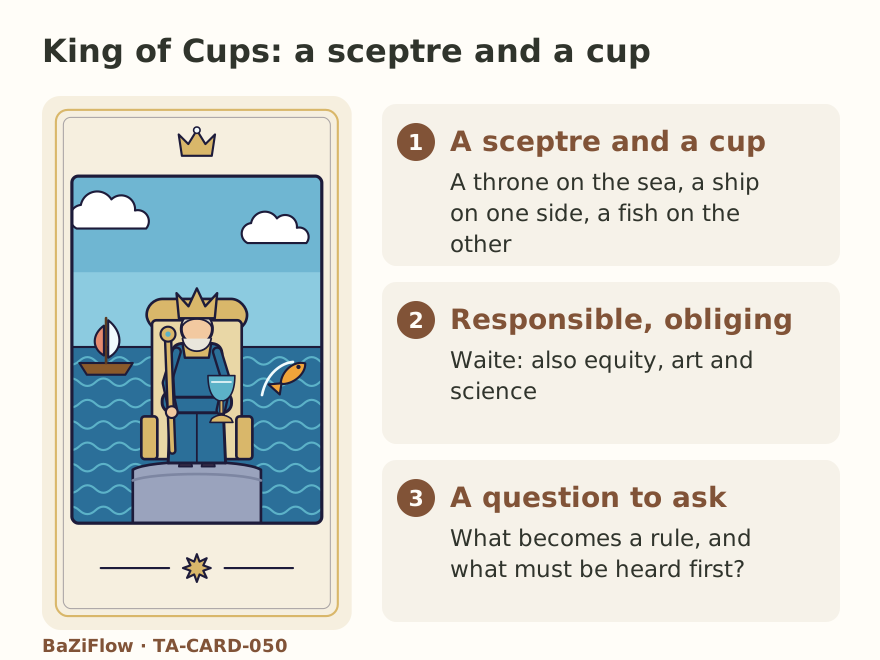
Waite's description is two sentences. He holds a short sceptre in his left hand and a great cup in his right; his throne is set upon the sea, with a ship riding on one side and a dolphin leaping on the other. He then adds a note that the cup, as a suit, goes naturally with water, so each court card carries some.
King of Cups: a sceptre and a cup
In the RWS original the King wears a crown with a red cap, a yellow-green cloak over a pale blue robe, and sits on a round-backed throne that stands on a stone platform among rolling waves. The great cup is on the left of the picture and the sceptre on the right; behind on the right is a ship with a red sail, and on the left a sea creature leaps from the water. Waite writes only the sceptre, cup, sea, ship and dolphin; everything else here belongs to the picture alone.
Enlarge diagram · scroll sideways to read
What Waite lists: responsibility and equity, and a warning pointing the other way
Waite's divinatory meanings read: a fair (light-complexioned) man; a man of business, law or divinity; responsible, disposed to oblige the Querent; also equity, art and science, including those who profess science, law and art; creative intelligence. The reversed entry reads: a dishonest, double-dealing man; roguery, exaction, injustice, vice, scandal, pillage, considerable loss.
Responsible, disposed to oblige the Querent; also equity, art and science... creative intelligence.
The additional list does not run in the same direction. Its upright entry is a caution, "beware of ill-will on the part of a man of position, and of hypocrisy pretending to help", and its reversed entry is a single word: loss.
Enlarge diagram · scroll sideways to read
The thing to notice in these four cells is that "disposed to oblige" and "hypocrisy pretending to help" sit side by side: the same act of helping appears once as the original's description of the stance and once as other readers' warning. So the useful question for this card is less "is he a good person" than "how far does this help go as stated, and who looks at whether it was done".
Sceptre, cup, ship and dolphin: who speaks for each
All of these are in the picture, but Waite describes only where they are:
Sceptre, cup, one ship and one dolphin
- The short sceptre
- Waite places it in the left hand and does not say what it stands for. That a sceptre is a ruler's emblem is general knowledge, not his explanation.
- The great cup
- Waite places it in the right hand and calls it "great". The cup is the mark of the suit, and his note in this entry is that the suit goes with water.
- A ship on one side, a dolphin on the other
- Waite says only that the two stand on either side of the throne and gives no meaning for them. In the RWS picture the right side shows a ship with a red sail and the left a sea creature leaping.
Enlarge diagram · scroll sideways to read
Teaching often hands the three out to three kinds of matter: the sceptre for what has to be settled as a rule, the cup for feelings that need to be heard, and the sea for changes that rise and fall by themselves and cannot be fixed beforehand. The split works well, but it is a later analogy; what Waite wrote is only that the King holds both a sceptre and a cup and sits upon the sea.
How to read it: a community kitchen, handing each problem to sceptre, cup or sea
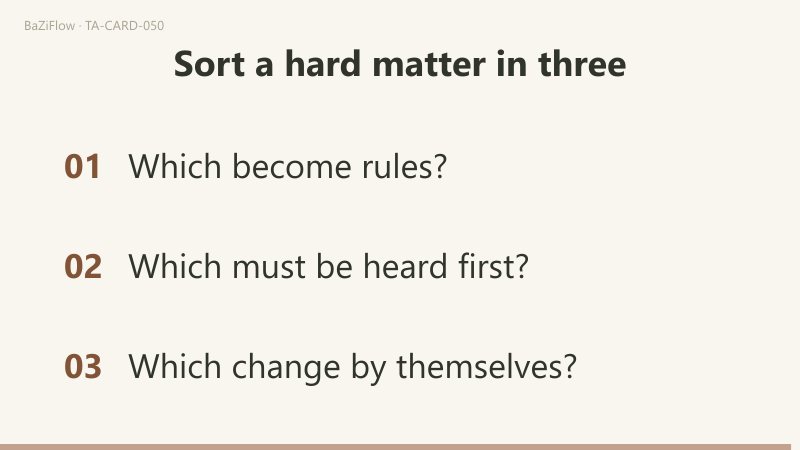
Picture a community kitchen where volunteers take turns cooking on Thursday evenings. Lately there is more talk: someone feels they are always the last to clean up, someone finds the soup too salty, and someone asks what to do when nobody comes on a rainy night. Mixed together, it wears everyone down. Following the three things in the King's hands, sort them into three boxes:
Sceptre: what becomes a rule
Things you can write down and check afterward: who washes the pots, when the door is locked, who keeps the key. Put it in a sentence or two and post it in the kitchen.
Cup: what must be heard first
"Always the same person cleans up" is first of all a feeling. Learn who, when and where the tiredness comes from, and only then judge whether a rule is missing behind it.
Sea: what changes by itself
How many people come, how much food arrives: none of that can be fixed in advance. What you can do is leave slack, with one plan for a thin night and another for a full one.
Enlarge diagram · scroll sideways to read
Using the three boxes
Sceptre: write it
- Who does what, and when
- What happens if it slips
Cup: hear, then judge
- No rush to rule on right and wrong
- Do not turn a mood into a clause
Sea: leave slack
- Keep an alternative plan
- Adjust when it shifts, no blame
Reversed and neighboring cards: a long run of dishonesty, and what the other kings hold
The reversed column is long and heavy: dishonest, double-dealing, roguery, exaction, injustice, vice, scandal, pillage, considerable loss. These words describe conduct, not the portrait of a "bad man"; a reversed reading holds up better as a comparison of promise and deed than as a label for a person.
Three more cards, and what each holds
Both hands on one cup
Two courts of one suit, two kinds of intelligence: hers is loving, his is creative, and only his list speaks of equity or responsibility.
A flowering wand held up
Waite writes honesty and conscientiousness, with the line that the card always signifies honesty; this king has only a wand and no cup.
Seated, with an unsheathed sword
Waite says he sits in judgment, and the words run to judgment, power and authority, where the King of Cups' words run to responsibility and equity.
Enlarge diagram · scroll sideways to read
Questions readers ask next
Does the King of Cups describe an older man?
The list does include "a man of business, law, or divinity", which is how 1910 described people. A steadier way to teach it is as a stance in the middle: someone who can hold a rule and also take in a feeling. Use it to ask about yourself or the matter, not to decide something about a real person.
Does a reversed King of Cups mean someone will deceive me?
The reversed words are heavy: dishonest, double-dealing, roguery, exaction, injustice, vice, scandal, pillage, considerable loss. They are the original's phrasing, and a card does not point at a particular person. A more practical use is to compare what was promised with what was done, and keep records you can check.
How do I use "hypocrisy pretending to help"?
That is the voice of other readers whom Waite collects, and it is not in his own entry. Treat it as a reminder list: when someone offers help, ask what the help is, until when, and who checks it.
Was this article helpful?
Sources & references
Continue reading
Queen of Cups: a lidded cup by the water, and Waite's line "she sees, but she also acts" ↗
Ace of Swords: a hand, a sword and a crown, and a word list built around force ↗