

Great Yin: two from the Chief, three to match
Content version · · Sources & references
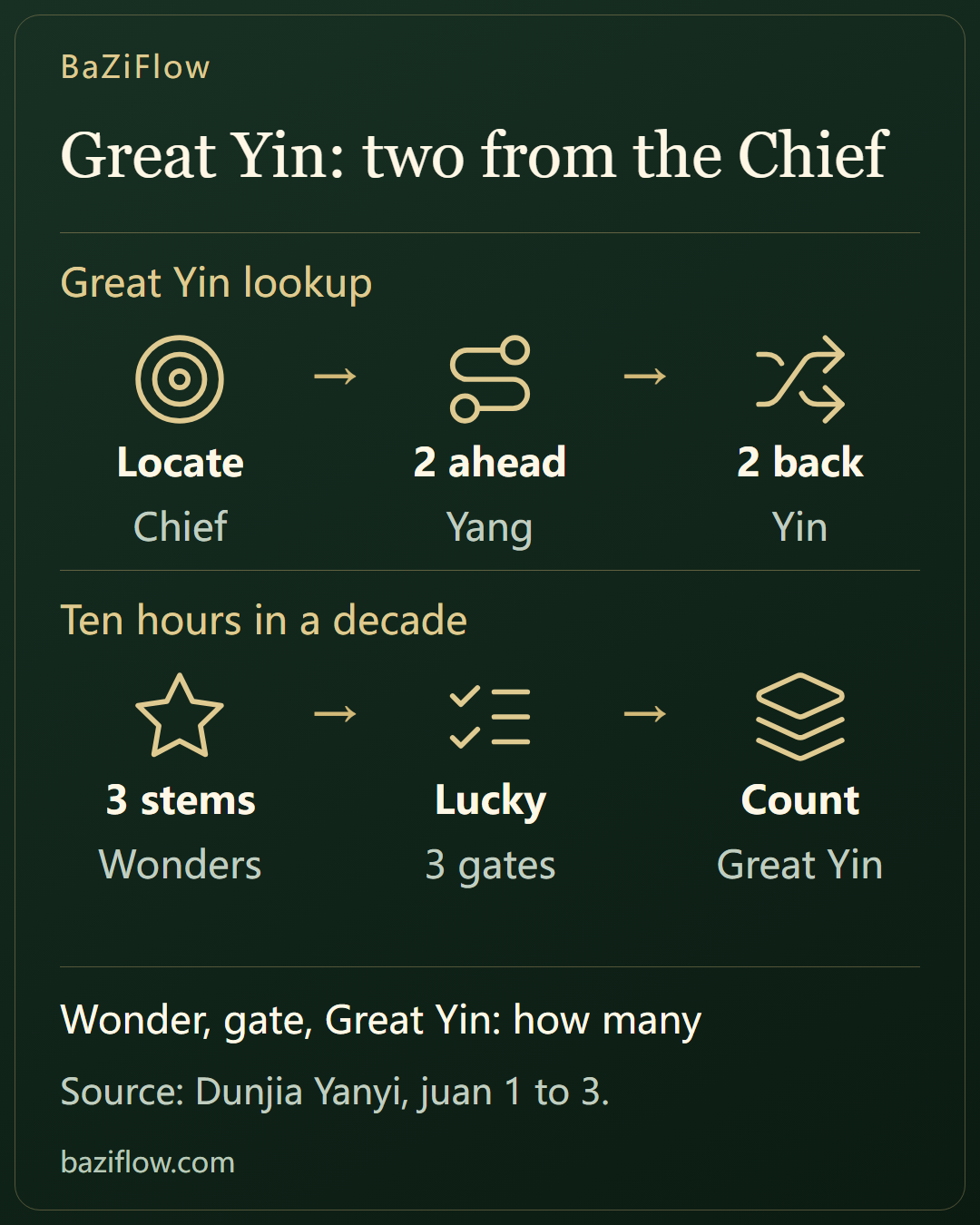
Great Yin sits two ahead of the Chief, two behind in Yin mode. The Dunjia Yanyi's verse on wonder, gate and Great Yin, its old ten-and-seven rule and a stray "seven ahead" are set against a whole decade of hours.
The short version10 min read
Among a wonder, a gate and Great Yin, getting two counts, says one line in juan 2. Great Yin itself sits two ahead of the Chief, two behind in Yin mode, and its place can be looked up in a small table.
- In Yang mode Great Yin is two ahead of the Chief and in Yin mode two behind; the book's two worked charts, Yang ju 1 and Yin ju 9 at a Yang Fire Tiger hour, both put it in Xun Four.
- Of the four numbers in a Yin-mode line in juan 1, three match the worked chart and only "seven ahead" disagrees with "two behind"; this site always lays it two behind.
- The verse calls two of the three fortunate, while a quoted classic lists "Yin without wonder" separately as unfavorable. Across a decade the heaven stem in Great Yin's palace never changes, only its palace and gate do.
Read first
A small lookup table: where the Chief is, there Great Yin is
A quick rule first: once you know the Chief's palace, Great Yin (太阴) is two boxes forward along the outer ring in Yang mode and two boxes back in Yin mode. A note in the section on the three ruses and five feints, in juan 2, gives the whole rule in one line:
In Yang mode the palace two ahead of the Chief is Great Yin; in Yin mode the palace two behind the Chief is Great Yin.
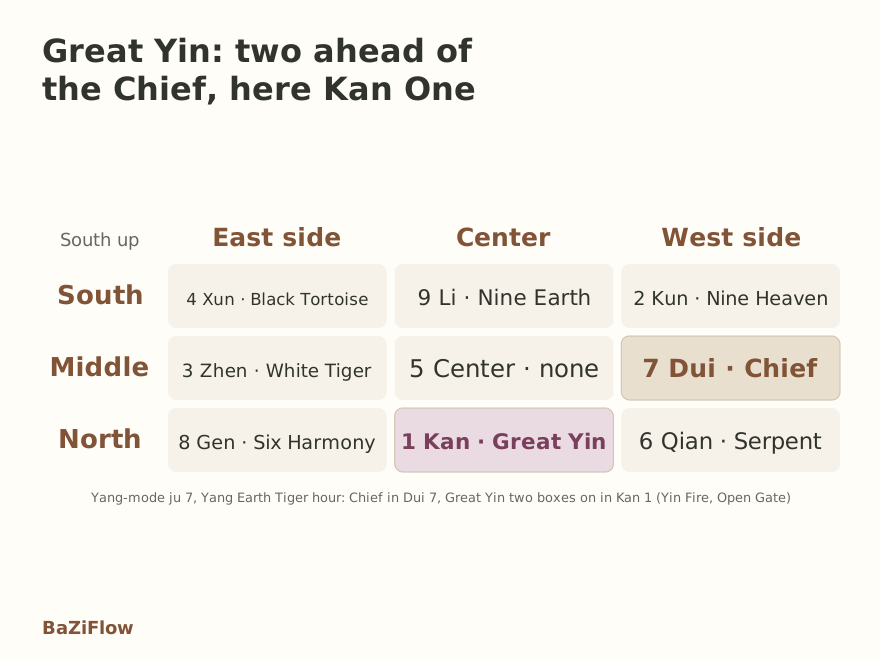
Nine-palace base grid with south at the top and east on the left; the order of the spirits follows juan 3 of the Dunjia Yanyi and the positions come from this site's rotating-plate method. Beige is the Chief and pink is Great Yin.
The picture is a Yang-mode ju 7 chart for the Yang Earth Tiger (戊寅) hour: the Chief is in Dui Seven, two boxes forward, through Qian Six, is Kan One, and Great Yin is in Kan One. The Chief has eight possible positions and each has one Great Yin position, which fits in a table (how to find the Chief is in the article on the Chief):
Enlarge diagram · scroll sideways to read
Juan 2 works out two boards to compare with. In ju 1 (Yang mode) at a Yang Fire Tiger hour of a Yang Wood or Yin Earth day the Chief is in Gen Eight, and the table gives Xun Four; in ju 9 (Yin mode) at the same hour the Chief is in Kun Two, and the table gives Xun Four again. The book's Great Yin is in palace four both times. The Chief sits in different palaces and Great Yin still lands in one, because two directions each counting two happen to meet; it is a coincidence and not a rule.
Four numbers in one line: three agree, one does not
The book has a third way of putting Great Yin's place. A rhapsody in juan 1, the Shenji Fu (神机赋), gives a string of "ahead" counts for Yin mode:
In Yin mode, from the twelve terms after the Summer Solstice: one ahead of the Chief is Nine Heaven, two ahead is Nine Earth, five ahead is Six Harmony, seven ahead is Great Yin.
Count it on the ju 9 board (Yin mode) for that same Yang Fire Tiger hour. The Chief is in Kun Two, and "ahead" is forward along the outer ring: one ahead is Dui Seven, two ahead Qian Six, five ahead Zhen Three, seven ahead Li Nine. The book's own worked chart puts Nine Heaven in palace seven, Nine Earth in six, Six Harmony in three and Great Yin in four. The first three numbers agree and only "seven ahead" lands in Li Nine, against the book's palace four.
Enlarge diagram · scroll sideways to read
The note in juan 2, the juan 3 rule that Yin mode lays the spirits backward, and the worked chart all point to "two behind", and two behind along the ring is exactly Xun Four, the same as six boxes forward. Whether "seven ahead" is a copying slip or another way of counting, the book does not say. This site always lays Great Yin two behind and does not use "seven ahead".
A wonder, a gate and Great Yin: how many of the three
The section on the three ruses and five feints opens with a four-line verse:
A wonder, a gate and Great Yin: to have all three arriving together is hard. Getting two is still fortunate, and acts, comings and goings follow one's wish.
The three are: the Three Wonders (三奇) of the heaven plate, which are Yin Wood, Yang Fire and Yin Fire; the three lucky gates, Open, Rest and Life; and Great Yin of the spirit layer. All three in one palace is too rare, and two still counts, says the verse. The note adds that wonder, gate and Great Yin cannot all be had, and that two are fortunate too. A quoted classic then splits "how many" into tiers:
Where Great Yin, Six Harmony and Nine Earth help the wonder and the gate, all complete, using them brings ten parts of gain. If the three gates join the three wonders with no ruse palace, that is called wonder without Yin, and brings seven parts. If the three gates join Great Yin without the three wonders, that is called Yin without wonder, and whoever offends it fares ill.
Enlarge diagram · scroll sideways to read
Within the all-complete tier, the case that lands on Great Yin's palace has its own name in the same section, True Ruse (真诈), with its use given in one line: "the True Ruse suits doing favors, hiding away and seeking the immortals".
One thing in the section does not line up. The verse and its note say that two is fortunate without saying which two, while the quoted classic lists "gate with Great Yin, no wonder" on its own as unfavorable. The book does not say whether the two lines use one standard, so this site records them separately.
Ten hours of a decade: what shares Great Yin's palace
Do the count over one decade. In Yang-mode ju 7, the Yang Wood Dog decade, Great Yin lands as follows across its ten hours:
Enlarge diagram · scroll sideways to read
Two things never move: across these ten hours the heaven stem in Great Yin's palace is always Yin Fire, and the star in it is always Tian Fu. The reason is how the plate turns. Both the star plate and the spirit plate are counted from the Chief's palace by the same number of boxes, so the whole ring moves to a new landing together, a spirit keeps its place relative to a star, and the heaven stem travels with the star. What changes is only which palace Great Yin falls in and which gate happens to be there. The Human Escape of the Rest Gate article (the Yang Fire Rat hour) is the third row of this table; see Rest Gate.
Laying out all 108 combinations of the two modes, nine ju and six decades, the heaven stem in Great Yin's palace stays fixed through all ten hours in every one; and in 44 of them one of Yin Wood, Yang Fire and Yin Fire shares that palace.
How the book describes this spirit: hidden protection
The verdict on Great Yin is in juan 3, in the same passage as the Serpent and Six Harmony:
Great Yin is the god of hidden protection: with it one can tread the charm and bar the enemy, shut the city and hide troops; a person in sudden trouble may leave by this direction to escape harm.
"Hidden protection" means protection given quietly, and the verbs in the line are all about hiding and avoiding: shut the city, hide troops, escape trouble. A line in that same rhapsody of juan 1 is in the same key, "Great Yin hides its form and withdraws", and the note after the song in juan 3 says "under Great Yin troops can be hidden in ambush". Next to the Serpent's "falsehood and deceit" and the White Tiger's "fierce and ill-omened", Great Yin's line carries no exception of its own; its condition is written elsewhere, in the count of wonder, gate and spirit above.
Placing Great Yin: a self-test
With the Chief in Qian Six, where is Great Yin in Yang mode and in Yin mode?
In Yang mode two boxes forward is Gen Eight, in Yin mode two boxes back is Kun Two.
In the Yang-mode ju 7 Yang Wood Dog decade, does the heaven stem in Great Yin's palace change?
No, it stays Yin Fire throughout; only the palace and its gate change.
The spirit before Great Yin is the Serpent and the one after is Six Harmony.
Questions readers ask next
Does Great Yin have anything to do with Yin mode?
Both names contain "yin", but they are two things. Yin mode only decides which way the eight gods are counted; Great Yin is one fixed spirit that appears in every chart, Yang or Yin, only with its place set at two ahead or two behind.
What is the quickest way to find Great Yin?
Fix the Chief's palace, then step two boxes along the outer ring: forward in Yang mode, back in Yin mode. With the Chief in Dui Seven, Great Yin is in Kan One in Yang mode and Li Nine in Yin mode. The eight Chief positions fit in one small table.
Does "two is fortunate" mean that having Great Yin is enough?
Great Yin is always on the chart, so it is the one of the three already in hand. What gets counted is whether the wonder and a lucky gate share its palace. The verse says two without naming which two, and the classic's "Yin without wonder" line is a separate one, so quote them apart.
Was this article helpful?
Sources & references
Continue reading
The Serpent: the Box After the Chief, a One-Line Verdict, and the Pattern Named for It ↗
Six Harmony: Three From the Chief, and the Same Name in the Stems and the Branches ↗