

Dao and De in the Laozi
Content version · · Sources & references
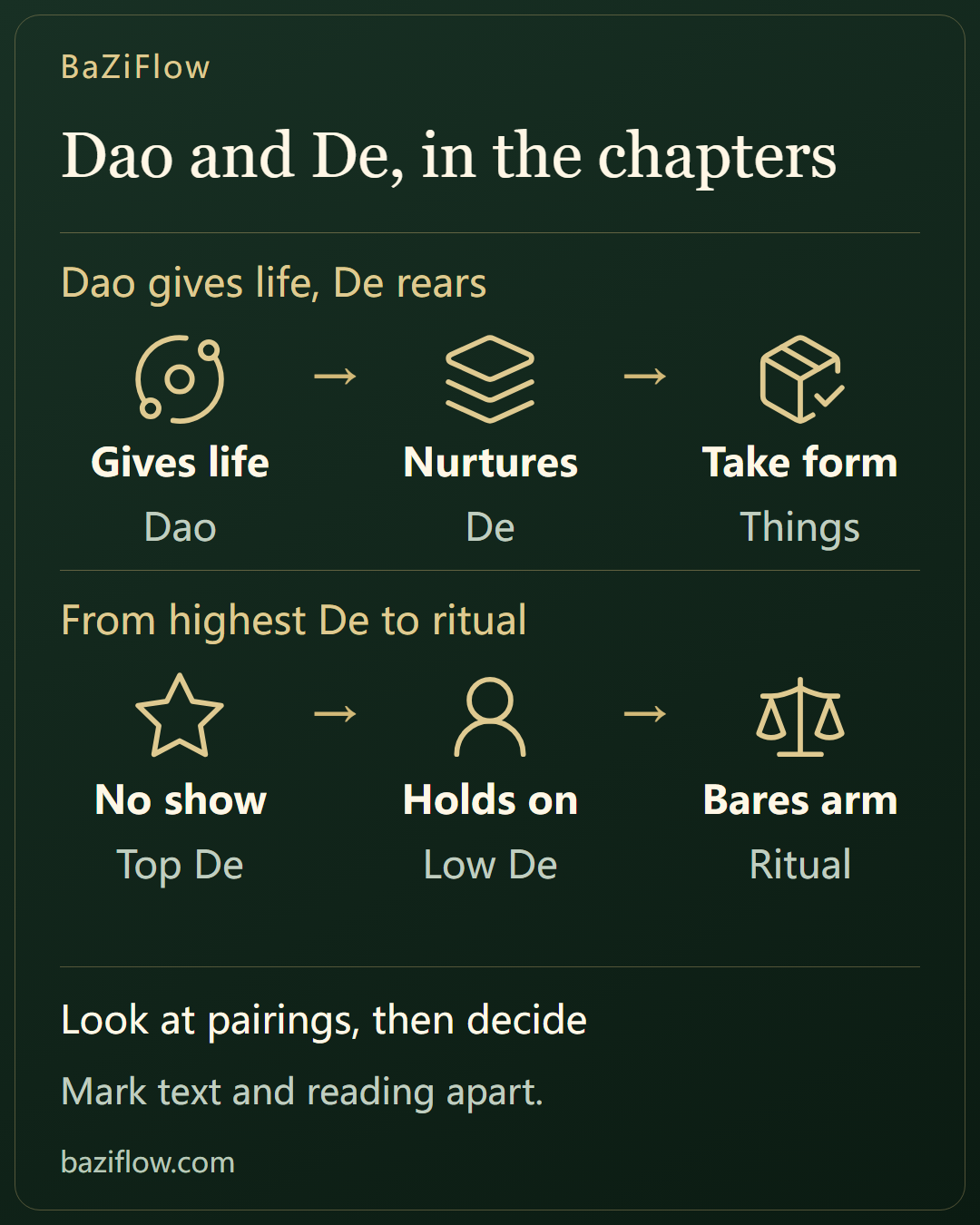
Dao and De read through five chapters: a chapter map, the passages on a Dao with no known name, De as what each thing receives, and the ladder of chapter 38, with text, tradition and modern borrowing kept apart.
The short version9 min read
"Dao" is the Laozi’s word for the root of how things come to be and keep moving, and "De" is the share each thing receives from it; the two words appear in pairs and are not a moral score.
- The two words in the title match the two parts of the book: in the received text chapters 1 to 37 are the Dao part and 38 to 81 the De part, named from their openings, yet both words occur in both parts.
- Chapter 25 says "I do not know its name; I style it Dao", so Dao is a makeshift word; chapter 21 nevertheless says that within it there are things and something reliable, so it is not simply emptiness.
- Chapter 51 writes the coming-to-be as four steps: Dao gives life, De nurtures, things give form, conditions complete; in chapter 38 De ranks before humaneness, rightness and ritual, a position and not a score.
Read first
Daoist Thought and Religious Daoism: Sorting the Books, the Name and the Religion ↗
One book, two words: the Dao part and the De part
The Laozi is also called the Daodejing (道德经), and the two words in that title are the two most discussed words in the whole book. The received text (the Wang Bi version) has two parts: chapters 1 to 37 are called the Dao part, chapters 38 to 81 the De part.
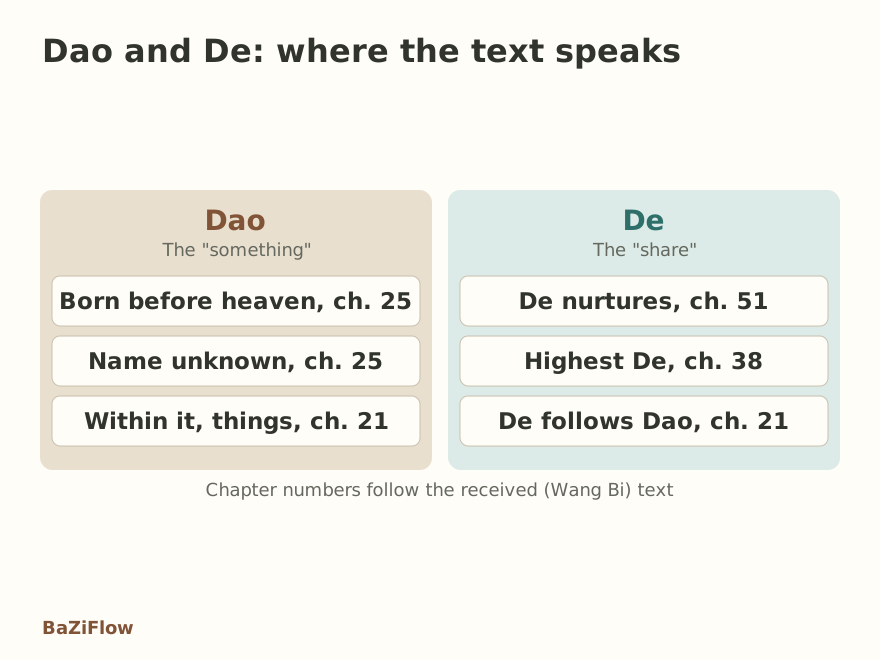
Sketch of passages: chapter numbers follow the received (Wang Bi) text and only the most typical passages for each word are listed; translations are ours from the original, and traditional readings are marked as such.
The figure ties each word to a few passages. Dao is the "something" that was "born before heaven and earth" and whose name is unknown. De is the share of Dao that reaches a particular thing and raises it, and it is also one rung on the ladder of chapter 38, standing before humaneness, rightness and ritual. Here is where those passages sit in the book:
Enlarge diagram · scroll sideways to read
The two parts are named from their openings: the first begins "A Dao that can be spoken", the second "Highest De does not insist on being De". The usual explanation is that the names come from these openings, and it does not mean the first part is only about Dao or the second only about De. Chapter 21 lies in the Dao part and says that "the form of Kong De (孔德) follows only Dao"; chapter 51 lies in the De part and says "Dao gives them life, De nurtures them". The Mawangdui silk manuscript B puts the De part first and orders the chapters differently; see the article on the editions.
Dao: the "something" whose name is not known
In one plain sentence: Dao is the book’s word for the root of where the myriad things come from and how they keep moving, and the text itself says that this root cannot be said clearly.
A Dao that can be spoken is not the constant Dao; a name that can be named is not the constant name. Without a name, it is the beginning of heaven and earth; with a name, it is the mother of the myriad things.
The tradition usually reads it this way: a Dao that can be put into words is not the constant, unchanging Dao, and the same holds for names. A limit is set down first, and the later chapters come at the matter from different directions.
There was something formed in an undifferentiated way, born before heaven and earth. Silent and empty, standing alone and unchanging, moving everywhere without tiring: it may be taken as the mother of all under heaven. I do not know its name; I style it "Dao", and if forced to give it a name, I call it "great".
Chapter 25 uses the word "thing" (物): there is something "formed in an undifferentiated way", before heaven and earth, standing alone and unchanging, moving everywhere without rest, and it may be called the mother of all under heaven. Yet the naming is careful: "I do not know its name", "Dao" is only a style, and "great" is a name given under protest. Now chapter 21:
The Dao as a thing is faint and indistinct. Indistinct, faint, yet within it there are images; faint, indistinct, yet within it there are things. Deep and dark, yet within it there is essence; its essence is very true, and within it there is something to be relied on.
Faint and indistinct, yet "within it there are images", "within it there are things", "within it there is essence", and "its essence is very true, and within it there is something to be relied on". In the text, hard to make out and not there are two different matters.
Enlarge diagram · scroll sideways to read
Chapter 14 uses three words, "yi" (夷), "xi" (希) and "wei" (微), for what cannot be seen, heard or grasped, and says the three "blend into one". Taken together the four chapters make a way of writing that points at the thing while reminding the reader again and again that pointing never exhausts it.
De: the share of Dao that reaches each thing
In one plain sentence: De is the part of Dao that reaches a particular thing and becomes its own. The tradition often glosses it with "De means getting": what each thing gets from Dao.
Dao gives them life, De nurtures them, things give them form, conditions complete them. So the myriad things all honor Dao and value De. Dao is honored and De is valued because no one commands it: it is always so of itself.
"Nurture" (畜) means to keep and rear. The sentence writes the coming-to-be as four steps, each with its own part:
Enlarge diagram · scroll sideways to read
Here is a comparison, only as a memory aid: a seed sprouting is "giving life"; its growing into the plant of its own kind is "nurturing"; its roots, stem and leaves are "form"; and soil and seasons bring it to completion. The original has only the four clauses, and the comparison is not in it.
Further on, the same chapter names this attitude of rearing without owning "Mysterious De":
To give life and not possess, to act and not presume, to lead and not rule: this is called Mysterious De.
De and Dao always appear together: chapter 21 says "the form of Kong De follows only Dao", so De goes where Dao goes. Tradition glosses Kong (孔) in different ways, as "great" and as "empty" among others; the word is left untranslated here, and only the pairing, De following Dao, is taken from the line.
Highest De does not show off: a rung of the ladder in chapter 38
Chapter 38 is the chapter most often used to talk about De, and the easiest to read as a moral lesson. First the text:
Highest De does not insist on being De, and so it has De; lower De never lets De slip, and so it has none. Highest De does not act and has nothing it acts for; lower De acts and has something it acts for.
The tradition usually reads it this way: those of the highest De do not treat De as an achievement to be guarded, and so they have it; those of lower De guard it everywhere and so lack it. "Nothing it acts for" means no deliberate aim, and "something it acts for" means acting in order to reach some aim. What follows is the ladder of this chapter:
So when Dao is lost there is De; when De is lost, humaneness (仁); when humaneness is lost, rightness (义); when rightness is lost, ritual (礼). Ritual is the thinning of loyalty and trust, and the start of disorder.
Enlarge diagram · scroll sideways to read
Highest and lower De, as the text sets them side by side
Does not insist on De, and so has De
"Does not act and has nothing it acts for": no deliberate aim in what it does.
Never lets De slip, and so has none
"Acts and has something it acts for": every deed aims at something.
Here De sits before humaneness, rightness and ritual, right next to Dao. Today "morality" often takes the rules of conduct such as humaneness and rightness as the content of De; the order of chapter 38 runs the other way, saying that they appear one after another once Dao and De have been lost. How to judge that order is another question, and only what the text says is read here.
Three layers of reading: text, tradition, modern borrowing
Putting the earlier sections into one table shows the same word falling on three levels:
Enlarge diagram · scroll sideways to read
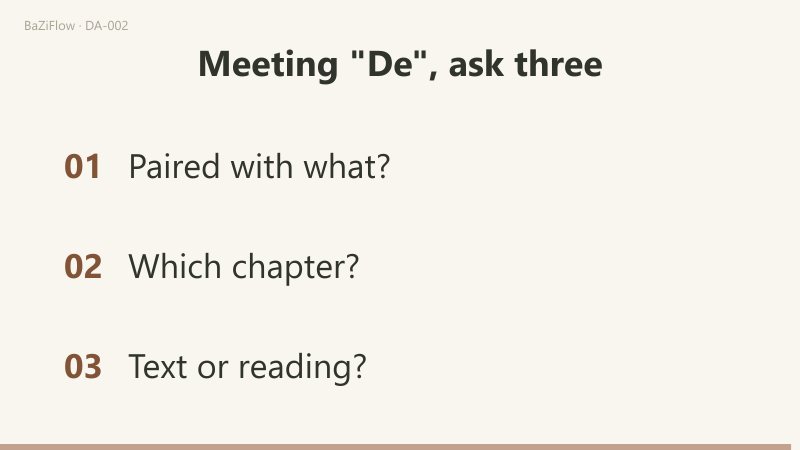
On meeting the word De it helps to look first at what it is paired with:
Three pairings, three readings
Dao gives life, De nurtures
Chapter 51: De is a link in raising the myriad things, read as the share each one gets.
When De is lost, humaneness
Chapter 38: De is a rung on the ladder, next to Dao.
This is called Mysterious De
Chapters 10 and 51: the way of giving life without possessing, acting without presuming, leading without ruling.
Questions readers ask next
Is the "De" of the Daodejing the same as morality?
The words overlap in modern translation but sit on different levels. In the book De usually pairs with Dao and means what a thing receives from Dao and grows into; the tradition often glosses it as "De means getting". Chapter 38 also ranks De before humaneness, rightness and ritual. Modern "morality" evaluates conduct, and reading it into the book narrows the meaning.
Can Dao simply be read as a law of nature?
The book does not write it that way. Chapter 25 calls Dao "born before heaven and earth" and "moving everywhere without tiring", and says that "Dao follows what is so of itself"; Dao is the thing that is imitated. Translating it as "law" or "truth" is a modern borrowing that catches the moving-everywhere side and loses the "something formed in an undifferentiated way" side.
Why is the Dao part first and the De part second? Is that so in the silk manuscripts?
The received text puts the part that opens with "A Dao that can be spoken" first and calls it the Dao part. In the Mawangdui silk manuscript B the De part comes first and the chapters run in another order. The difference between title and order is a question of editions, taken up in the article on the editions.
Was this article helpful?
Part of a learning path
Sources & references
Continue reading
Daoist Thought and Religious Daoism: Sorting the Books, the Name and the Religion ↗
Wu Wei: Why It Is Not Doing Nothing, Read Through Chapters 2, 48, 57 and 64 ↗