

Mingyi: light in the earth, dimness as a tool
Content version · · Sources & references
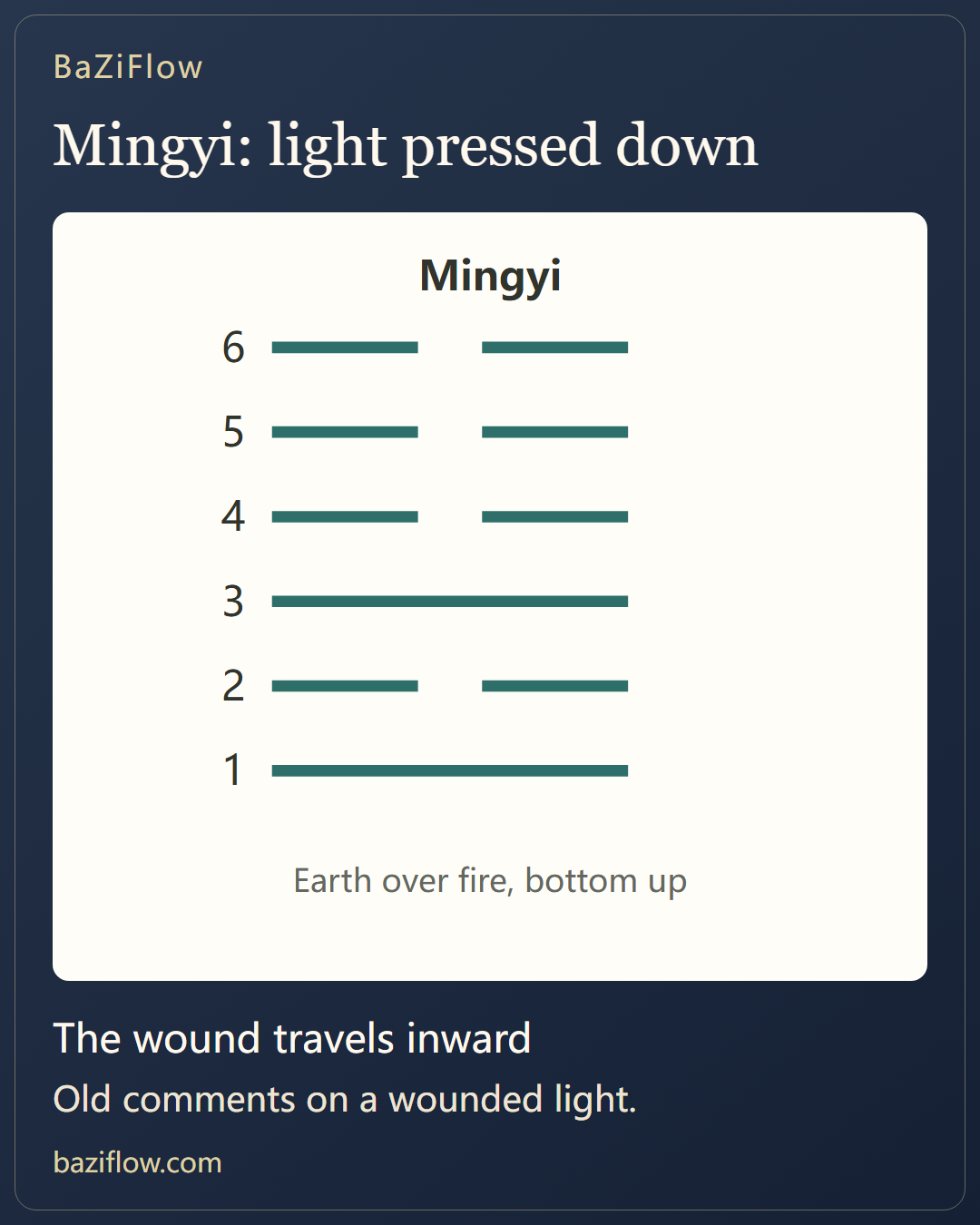
Mingyi is the 36th hexagram: Kun (earth) above Li (fire, the sun), light going into the ground. See the two people in the Commentary, the Image’s “use dimness”, and a wound traveling from wing to heart.
The short version7 min read
The “yi” in Mingyi means a wound, so Mingyi is the light wounded. The text writes that wound inward step by step: a wing, the left thigh, the left belly, the heart, and last the sun that climbs the sky and then enters the earth.
- Mingyi stacks Kun (earth) on Li (fire, the sun): three yin lines on top press down the whole of Li below. The Xu Gua glosses the key word: “yi means wound”.
- The Commentary on the Judgments explains the hexagram with two people: luminous inside and yielding outside for King Wen, hardship within yet an upright will for Jizi. The Image’s “use dimness” pairs with Jin’s “shine your own virtue”.
- The wounds run wing, then left thigh; line 3 turns to a hunt that takes the great head; line 4 reaches the left belly and the heart; line 5 falls on Jizi, and line 6 shows light climbing the sky and then entering the earth.
Read first
The Sixty-Four Hexagrams: How Upper and Lower Trigrams Form One Figure ↗
Judgment and Line Statements: Whole Hexagram or Single Line? ↗
Light goes into the earth: three yin lines over Li
Mingyi (明夷) is Kun (earth) above and Li (fire, the sun) below, and turned upside down it is the Jin of the previous article. The eye goes first to this: all three upper lines are yin, and the lower three are yang, yin, yang. The light of Li is pressed down under three yin lines.
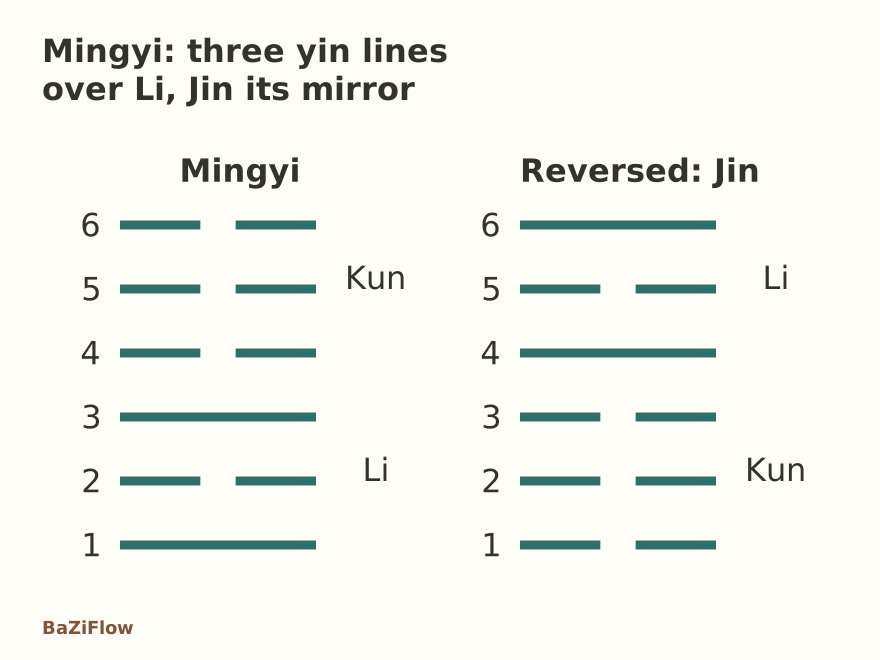
Mingyi and its reversed hexagram Jin: reversing turns the whole figure over, so the three yin lines pressing from above in Mingyi support from below in Jin.
Enlarge diagram · scroll sideways to read
The Xu Gua puts Mingyi after Jin and glosses the word “yi” in its name:
One who advances is bound to be hurt, and so Mingyi is received next; yi means a wound.
“Yi” is a wound, so Mingyi is “light wounded”. This whole article reads that wound: where it falls, how it travels and who bears it.
The judgment and the Commentary: King Wen and Jizi
The judgment is three characters (利艱貞): fitting to stay on course in hardship. In explaining it, the Commentary on the Judgments (彖传) names two people.
Light goes into the earth: Mingyi. Inside it is luminous and cultured, outside yielding, and so it bears great hardship; King Wen did this. “Fitting to stay on course in hardship” means dimming one’s light; with hardship within, one can still keep one’s will upright; Jizi (箕子) did this.
Enlarge diagram · scroll sideways to read
“Luminous inside and yielding outside” can be read right off the figure: the lower trigram Li, on the inside, is brightness, and the upper trigram Kun, on the outside, is yielding. “Bears great hardship” means enduring great trouble in that form, and the Commentary says King Wen did so. The second half explains the judgment: “fitting to stay on course in hardship” is “dimming one’s light”, gathering the light in; with hardship inside, the will can still be kept upright, and the Commentary says Jizi did so.
Two people, two situations, in one hexagram. Jizi appears a second time in the statement of line 5.
The Great Image: use dimness, and read it beside Jin
The Great Image (大象) of Mingyi has a pair of opposite words: dimness and brightness.
Light goes into the earth: Mingyi. The noble person, in presiding over the many, uses dimness and yet is bright.
To preside is to face and govern, so presiding over the many is dealing with a crowd; dimness is darkness, and “use dimness and yet be bright” means darkness is used and brightness remains. Set beside the Great Image of Jin, the previous hexagram, it forms a pair:
Enlarge diagram · scroll sideways to read
Jin has light coming out over the ground, and its conduct is “shine your own”. Mingyi has light going into the earth, and its conduct is “use dimness”. The premise, presiding over the many, matters as well: this is conduct when facing people, not conduct for withdrawing home.
Six lines: the wound from wing to heart
Through the six statements the words “wounded light” keep returning, mostly followed by body parts that move steadily inward (lines 3 and 5 are exceptions).
Enlarge diagram · scroll sideways to read
Line 1, “the light is wounded in flight, and its wing droops”, has a flying light hurt, its wing hanging; the noble person on a journey goes three days without eating, and the Small Image says it is a matter of right. Line 2, “wounded in the left thigh”, uses a strong horse to rescue, with good fortune. Line 3, a “southern hunt”, takes “the great head”, and adds “do not hurry to stay on course”; the Small Image says the aim is greatly attained.
At line 4 the wording changes: “he enters the left belly and grasps the heart of the wounded light”. One reading: the word “enters” counts: line 4 is the lowest line of Kun, the upper trigram, the exact step where the light crosses from Li into Kun. The wound too has gone from wing and thigh into the belly and then the heart of the wounded light. The Small Image says he grasps its intention.
Line 5 is a single sentence, “Jizi’s wounded light: fitting to stay on course”, and the Small Image says the light cannot be put out. This is the Jizi of the Commentary. Line 6, “not light but darkness”, is read by tradition as not bright but dim, and it is followed by a picture: “at first he climbs into the sky, afterward he enters the earth”. The Small Image gives one comment to each half: climbing the sky is “lighting the four realms”, and entering the earth is “losing the rule”.
Jin, Song and Xie: neighbors of Mingyi and the link to Jiaren
Turn Mingyi upside down and you get Jin (晉), so Jin is the reversed hexagram (综卦) of Mingyi, shown above. The inverse hexagram (错卦) is Song (訟) and the nuclear hexagram (互卦) is Xie (解): the middle four lines of Mingyi (lines 2 to 5), split apart: lines 2–4 form Kan below, lines 3–5 form Zhen above.
Enlarge diagram · scroll sideways to read
The Xu Gua sentence quoted at the start, about being hurt while advancing, is the introduction to Mingyi; the hexagram after Mingyi is Jiaren, and what the Xu Gua says is that someone hurt out in the world has to come back home. From the sunrise of Jin to the pressed light of Mingyi and then the homecoming of Jiaren, the three hexagrams are meant to be read in a row.
Questions readers ask next
Is Mingyi an ominous hexagram?
Its judgment is “fitting to stay on course in hardship”. Among the lines there is “good fortune” as well as a caution, “do not hurry to stay on course”; the text is not ominous from start to finish.
Does “use dimness and yet be bright” mean playing dumb?
Literally no: dimness is used, and the result is still bright. The Image places it after “presiding over the many”, so it describes conduct toward other people, and the text does not go on to say when to adopt it.
How are Mingyi and Jin related?
They are each other’s reversed hexagram: turn Mingyi upside down and you have Jin. In Jin the light of Li stands above and comes out over the ground; in Mingyi it is below, covered by Kun.
Was this article helpful?
Sources & references
Continue reading
Jin: light over the earth, from three audiences to the horns ↗
Jiaren: wind from fire, from “set a guard” to “turning back to oneself” ↗
The Sixty-Four Hexagrams: How Upper and Lower Trigrams Form One Figure ↗
Judgment and Line Statements: Whole Hexagram or Single Line? ↗