

Room: the tent at position fifteen
Content version · · Sources & references
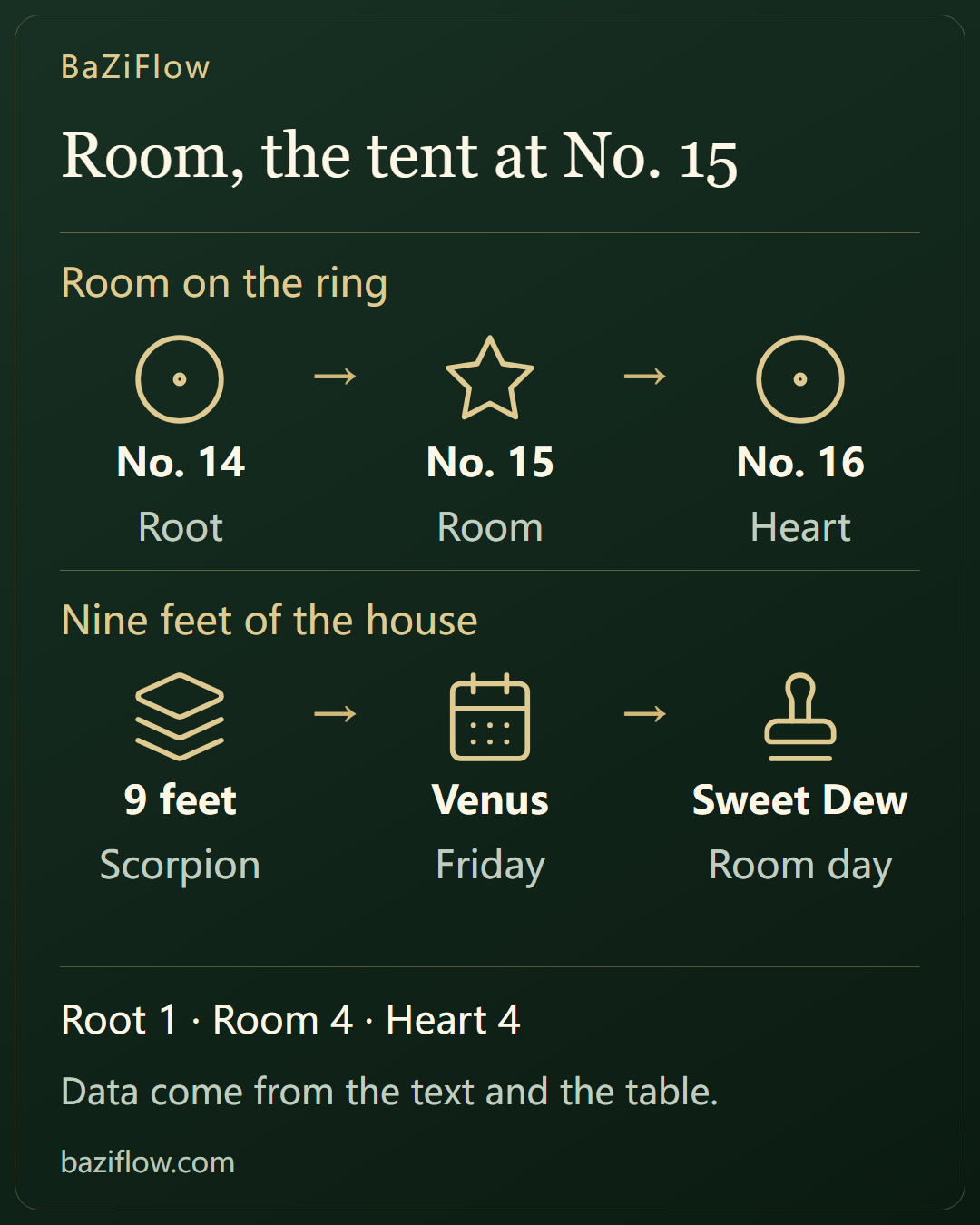
Room is the fifteenth of the twenty-seven mansions, after Root and before Heart. Read the sutra picture beside its neighbors, see how nine feet divide in the Scorpion house, and find Room days in the old calendar.
The short version7 min read
Room is the fifteenth of the twenty-seven mansions, counted from Hairy Head, with Root before it and Heart after it. The Sukuyō Sutra pictures it as four stars shaped like a tent, gives it four feet in the Scorpion house and pairs it with Friday.
- Room sits between Root and Heart. The notes for Horn through Winnowing Basket all end "a mansion of the east", and Room is the fourth of those seven.
- The picture opens with four stars, a tent shape, a deity and a clan name; the note says the Chinese-astronomy Room also has four stars, so picture and note agree.
- The Scorpion house has nine feet: Root one, Room four, Heart four. Friday is paired with Room, and on the site's month table three Fridays four weeks apart from 1 January 2027 are Room days.
Read first
What is Sukuyō astrology? How a birth mansion is found ↗
Sukuyō 27 mansions vs the 28 lunar mansions: what is the difference? ↗
Position fifteen, between Root and Heart
Arrange the twenty-seven mansions in a ring and count from Hairy Head (昴). The fourteenth is Root (氐), the next is Room (房), and the one after Room is Heart (心). The annotator of the Sukuyō Sutra marks this whole run of neighbors as mansions of the east.
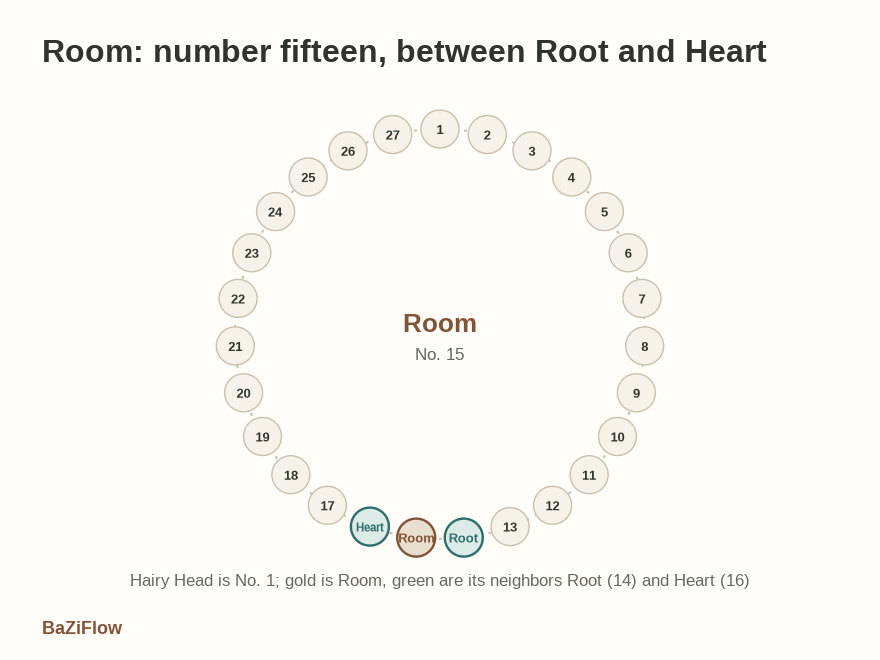
Position sketch: the twenty-seven names are spaced evenly in their order, with Hairy Head as No. 1; the even spacing is typography, not the width of any sky region.
In the picture Room is gold and its two neighbors are green. The annotator, Yang Jingfeng, added a note on Chinese astronomy to the picture of every mansion. The notes for Horn, Neck, Root, Room, Heart, Tail and Winnowing Basket (角, 亢, 氐, 房, 心, 尾, 箕) all end with "a mansion of the east", and Room is the fourth of those seven, right in the middle.
The sutra's picture of Room, read beside its neighbors
The second chapter of the first fascicle gives every mansion a short "picture" entry. An entry opens with the number of stars and their shape, then a deity name, then a clan name. Here are the openings for Root, Room and Heart side by side, with the annotator's note on how Chinese astronomy describes the same stars:
Enlarge diagram · scroll sideways to read
The opening of the Room entry is only a few short sentences:
Room has four stars, shaped like a tent. Its deity is Mitra (布密多罗). Its clan name is Duo-luo-pi-ye (多罗毗耶).
Two comparisons are in play here. The mansion is named "Room", meaning a chamber; the picture says its four stars look like a tent, a hanging cloth that encloses a space. One comes from the Chinese mansion name, the other from the sutra's imagery, so it is best to record them separately. The star counts can also be checked: Root four, Room four, Heart three, and picture and note match. That is not true of every mansion. The picture of Tail gives two stars while the note says Chinese astronomy has nine, as discussed in Tail.
Nine feet in the Scorpion house: Root one, Room four, Heart four
The sutra divides the sky into houses before it speaks of mansions. Each of the twelve houses is given nine "feet", and a mansion counts as four feet, so the twenty-seven mansions come to 108 feet, exactly nine for each house. The entry for the Scorpion house reads:
The fourth: Root, one foot; Room, four feet; Heart, four feet. Mars is stationed there. Its deity is shaped like a scorpion, hence the name Scorpion house.
Enlarge diagram · scroll sideways to read
One foot is a quarter of a mansion. The four feet of Room and the four of Heart fall wholly inside the Scorpion house, and only Root is cut: three feet lie in the previous house (the Scales house has Horn two, Neck four, Root three) and one foot lies here, so the first foot of the Scorpion house is really the tail end of Root. By house, Room and Heart belong together and cannot be told apart; by mansion, they are two neighboring steps.
Friday meets Room: the sutra's "Sweet Dew day"
The fifth chapter of the first fascicle, on secret miscellaneous divinations, takes the seven luminaries, Sun, Moon, Mars, Mercury, Jupiter, Venus and Saturn, pairs each with one mansion and calls the seven pairings "Sweet Dew days"; the eighth chapter, in the second fascicle, lists them again: Sun with Chariot, Moon with Net, Saturn with Star, Mars with Tail, Mercury with Willow, Jupiter with Ghost and Venus with Room. Room's partner is Venus, whose day is the Friday of the modern week.
Enlarge diagram · scroll sideways to read
Applying the pairing to the site's calendar is a small question with a checkable answer. The site assigns a mansion to each day from the National Astronomical Observatory of Japan month-start table. 1 January, 29 January and 26 February 2027 are all Room days and all Fridays, four weeks apart; on 25 March the Room day falls on a Thursday and the pairing breaks. This applies the site's day mansions to the sutra's pairing. The sutra carries a month chart made by Jingfeng, a different table, and the same date need not land on the same mansion; the difference is covered in why the calculation methods differ.
These days come from the month table of the Japanese old calendar, with each new moon fixed by Tokyo time. Chinese New Year 2027 is 6 February while the Japanese old new year is 7 February, one day later; on the Chinese lunar month starts, the same rule would put the February Room day on Thursday 25 February, and the pairing of three Fridays would break.
Which old-calendar days are Room days: reading the month table
The site's day mansion rests on a fixed month table. Each old-calendar month has a starting mansion on its first day, and the count moves one step per day within the month. The position of the starting mansion plus (day minus one), taken modulo 27, is the mansion of that day; to make the sum easy, Hairy Head is written as 0 here, one less than the earlier place numbers where it is No. 1, so Room is 14, Root 13 and Heart 15.
Enlarge diagram · scroll sideways to read
Month nine starts at Root (13), so its second day is Room (14). Month ten starts at Heart (15) and needs 26 steps to come round to Room, so the Room day of month ten is the twenty-seventh. When month nine has twenty-nine or thirty days, day twenty-eight is back at Root and day twenty-nine is Room again, which gives month nine two Room days.
Two lookups to try
What is old-calendar month 10, day 27?
Month ten starts at Heart (15). After 26 steps, 15 + 26 = 41, minus 27 gives 14, which is Room.
Why does month nine hold two Room days?
Month nine starts at Root (13), so day two is Room. After a full lap of 27, day twenty-eight is Root again and day twenty-nine is Room once more.
One step on from Room is Heart and one step back is Root; how a date is counted all the way to a mansion name is set out in reading the counts on a Sukuyō calendar.
Questions readers ask next
Why is Room number fifteen rather than number four?
The twenty-seven-mansion ring is counted from Hairy Head, which makes Room fifteenth. The twenty-eight list is usually counted from Horn, which makes it fourth. A number only means something inside one starting point; Room's neighbors do not change, with Root before it and Heart after it.
The sutra calls Room a tent, but the name means a room. Which is right?
Both are faithful records. "Room" is the mansion name inherited from the Chinese twenty-eight list, and "shaped like a tent" is the sutra's description of the four stars. Each picks its own comparison and neither cancels the other. When quoting, say whether you mean the name or the sutra's picture.
Are the Room days on this site's calendar the Room days of the sutra?
Not necessarily. The site follows the National Astronomical Observatory of Japan month-start table day by day, while the sutra carries its own table of the months with a different starting point. The same date can land on a different mansion, so say which table you used when comparing.
Was this article helpful?
Sources & references
Continue reading
Root (氐): The Middle of the Ring, Two Miswritten Characters, and a Repeated Day ↗
Heart (心), Mansion No. 16: the Heart Month and Two Places in the Month Table ↗