

Core text and commentaries
Content version · · Sources & references
On one page of hexagram Qian, tell the core text (figure, Judgment, line statements) from the commentaries (the Ten Wings). Label each sentence, then sum up each Wing in a line.
The short version10 min read
A page of the received Zhou Yi carries two layers: the core text is the figure, the Judgment and the line statements; the commentaries are the texts written around it. Before reading a sentence, ask which layer it belongs to.
- The core text is the figure, the Judgment and the line statements. The commentaries, traditionally grouped as the Ten Wings, come as separate blocks after it on a hexagram page.
- The words "hidden dragon, do not act" can appear in a line statement, in the Images and in the Wenyan. Which layer they belong to is settled by the block they sit in, not by how much they look like the core text.
- The Wenyan exists only for Qian and Kun. The Xi Ci, Shuo Gua, Xu Gua and Za Gua are not attached to a particular hexagram page but stand as texts of their own.
Read first
One page of Qian, two layers of text
Open the page for hexagram Qian (乾) and you find two different kinds of writing. The figure, the Judgment (卦辞) and the line statements (爻辞) are the core text (经), the original that gets explained. What follows under "The Judgment says", "The Image says" and "The Wenyan says" is commentary (传), written around the core text.
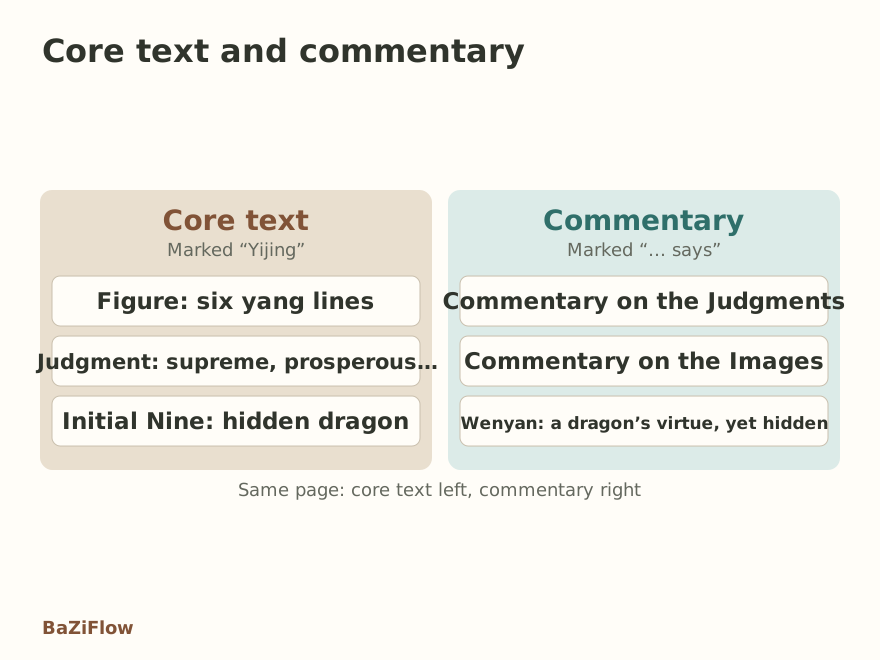
Core text and commentary in two columns (the Qian page): the left column is the text that is explained, the right the commentaries that explain it. Every excerpt comes from the Wikisource page for Qian.
In the Wikisource edition of the received text, the Qian page is cut into blocks. First comes a block the page itself labels "Yijing" (易经). That is a Wikisource column label for a block holding only the core text, which is not how this series uses "Yijing"; see names and scope. The block holds the Judgment, "Qian: supreme, prosperous, advantageous, steadfast", the six line statements, and Use Nine (用九), which only Qian has (Kun has Use Six, 用六). After it come three more blocks, opening with "The Judgment says" (彖曰), "The Image says" (象曰) and "The Wenyan says" (文言曰). The Yijing block is core text; the other three are commentary. So the first step in reading is not to understand a sentence but to label it, core text or commentary.
Three names to know first
- Core text (经)
- The figure (six lines stacked into a pattern), the Judgment and the line statements. This is the original that gets explained.
- Commentary (传)
- The texts built around the core text. Some explain a hexagram one by one, others discuss the Changes in general terms. A commentary is neither a Judgment nor a line statement.
- Ten Wings (十翼)
- The traditional name for ten commentary texts: Commentary on the Judgments (two parts), Commentary on the Images (two parts), Great Commentary (two parts), Wenyan, Shuo Gua, Xu Gua and Za Gua. Section five sums each up in a line.
The core text: figure, Judgment and line statements
The core text of Qian has three things: a figure made of six yang lines, one Judgment that speaks to the whole figure, and the line statements, one for each line. All three are the text being explained, and none of them explains itself.
Enlarge diagram · scroll sideways to read
For how two trigrams stack into a figure, see the article on upper and lower trigrams. Words come under the figure, and the Judgment comes first:
Qian: supreme, prosperous, advantageous, steadfast.
The whole Judgment is four words. Nothing in it says why they stand in that order. Initial Nine is just as brief:
Two pieces of core text
Supreme, prosperous, advantageous, steadfast.
It speaks to the whole figure and gives only four words. How to read them is not written in the core text.
A hidden dragon: do not act.
It names the lowest line. "Hidden dragon" is a figure of speech and "do not act" a terse verdict; the original stops there.
On this Qian page the core text is brief and gives no reasons for these lines. So when a sentence on the page gives reasons and has a "because" in its voice, it is probably no longer in the core text but in a commentary.
The commentary: three blocks after the core text on the Qian page
On the Qian page, three blocks of commentary follow the core text in order: the Commentary on the Judgments (彖传), opening with "The Judgment says"; the Commentary on the Images (象传), opening with "The Image says"; and the Wenyan (文言, the Commentary on the Words of the Text), opening with "The Wenyan says". Each explains the block of core text before it.
Enlarge diagram · scroll sideways to read
One sentence from each shows how they hang on the core text.
Three commentary blocks, one sentence each
Preserving the great harmony, it is then advantageous and steadfast.
Further down the same block, this sentence ends with "advantageous and steadfast", reusing two words of the Judgment, so the block is explaining the Judgment as it goes on.
Heaven moves with strength; the gentleman strengthens himself without rest.
The first sentence under "the Image says" speaks to the whole figure. After it comes one sentence per line, bottom to top; the one for Initial Nine is "Hidden dragon, do not act: the yang is below."
"Supreme" is the chief of what is good; "prosperous" is the gathering of what is excellent; "advantageous" is the harmony of what is right; "steadfast" is the trunk of affairs.
It takes the four words of the Judgment one by one and gives each a line of explanation.
The Wenyan has a second way of writing. It sets out a sentence of the core text, then asks and answers.
Initial Nine says: "A hidden dragon; do not act." What does that mean? The Master said: "One with a dragon's virtue who lies hidden. ..."
"Hidden dragon; do not act" is Initial Nine's own sentence from the core text, brought into the Wenyan to be questioned. The words inside the quotation marks come from the core text, but the whole passage is commentary. What decides it is which block the sentence sits in and who asks and answers, not whether the wording resembles the core text.
Labelling sentence by sentence: where does each belong?
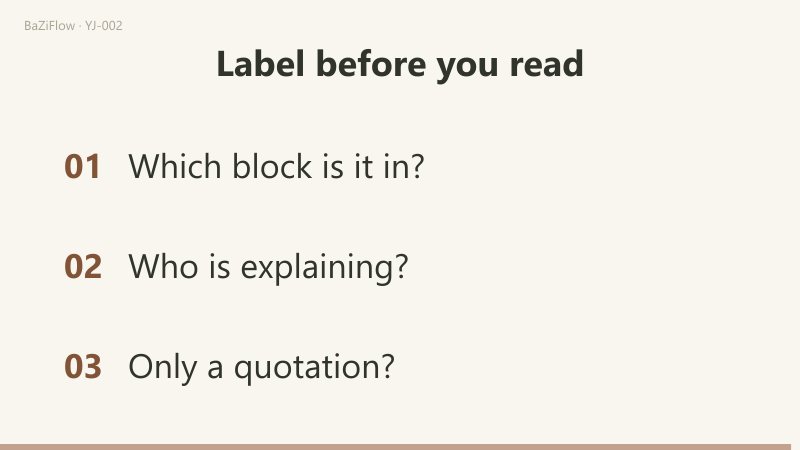
Any sentence on a hexagram page can be placed in three steps. The same words, "hidden dragon, do not act", turn up in several places and belong to different layers, which makes them the best practice material.
Enlarge diagram · scroll sideways to read
Look at the heading
Does the sentence fall in the block labelled "Yijing", or under "the Judgment says", "the Image says" or "the Wenyan says"? Sort by that first.
See who is explaining
Core text is the original that gets explained; commentary is the side that explains it, often in an explaining tone or opening with "what does this mean?". Tone is a cross-check and cannot replace the first step.
Check whether it is only a quotation
Commentary often sets out a sentence of the core text and then explains it. Core words inside quotation marks do not change the layer they sit in; the outer layer decides.
Run the three steps on "hidden dragon, do not act". In the Yijing block it is the line statement of Initial Nine, and so core text. Under "the Image says", "Hidden dragon, do not act: the yang is below" is a line of the Commentary on the Images explaining it. Under "the Wenyan says" it is set out again to be asked about and answered, and is still commentary. The wording is the same and the places are three. How the core text itself divides into Judgment and line statements, and whether each speaks to the whole figure or to a single line, is covered in the article on the Judgment and line statements.
The Ten Wings: what each one covers, in a line
Only three kinds of commentary appear on the Qian page. Tradition groups the commentary texts as the Ten Wings (十翼), and the Wikisource page for the Yi Zhuan (易传, the Commentaries on the Changes) lists ten. Some come with a hexagram page and some stand on their own.
Enlarge diagram · scroll sideways to read
Each text, in one line
- Commentary on the Judgments (彖传)
- Explains the Judgment and the gist of a hexagram, and appears with each hexagram.
- Commentary on the Images (象传)
- First one sentence on the whole figure, then one sentence per line, and appears with each hexagram.
- Wenyan (文言)
- Exists only for Qian and Kun, and unfolds the Judgment and line statements sentence by sentence.
- Great Commentary (Xi Ci, 系辞), parts I and II
- Not tied to any one hexagram; it discusses the hexagrams, lines, statements and change in general terms.
- Shuo Gua (说卦, "Discussion of the Trigrams")
- Mainly sets out which images each of the eight trigrams takes; see the article on the trigrams and their images.
- Xu Gua (序卦, the Sequence of the Hexagrams)
- Explains in order why one of the sixty-four hexagrams follows another.
- Za Gua (杂卦, the Miscellaneous Hexagrams)
- Sets hexagrams side by side in pairs and points out in a few words how they differ.
How each of these is written and read belongs to another article; for now it is enough to be able to put each of them in the commentary layer.
Questions readers ask next
The Wenyan also contains "hidden dragon, do not act". Is it a line statement?
No. The Wenyan takes the sentence from Initial Nine, asks what it means, and then answers. The words in the quotation come from the core text, but the whole passage is commentary. To decide, look at which block it sits in and who is asking and answering, not at the wording.
Are the Commentary on the Judgments and the Commentary on the Images part of the Judgment and line statements?
No. On the page they follow the core text and open with "the Judgment says" and "the Image says", so they are an explanation of it and belong with the commentaries. When citing, say "the Commentary on the Images" rather than "the line statement says".
Must the core text be read through the commentaries?
It is not required, but the commentaries are the explanations most commonly consulted. When you do, say that this is the commentary's way of reading, one view among others. On this page the core text itself offers only very short wording. Label the layer first, then decide whether to read with the commentary.
Was this article helpful?
Part of a learning path
Sources & references
Continue reading
Yijing and Zhou Yi: Sorting the Names and Their Scope ↗
Judgment and Line Statements: Whole Hexagram or Single Line? ↗
Eight Trigrams: Three-Line Structure and Basic Images, Read Through the Shuo Gua ↗
The Sixty-Four Hexagrams: How Upper and Lower Trigrams Form One Figure ↗