

Clash, Punishment, Harm and Destruction Are Not Verdicts
Content version · · Sources & references
Relationship names identify traditional branch structures, not guaranteed events. Compare their membership rules, a documented variation in destruction tables, and the layers needed for interpretation.
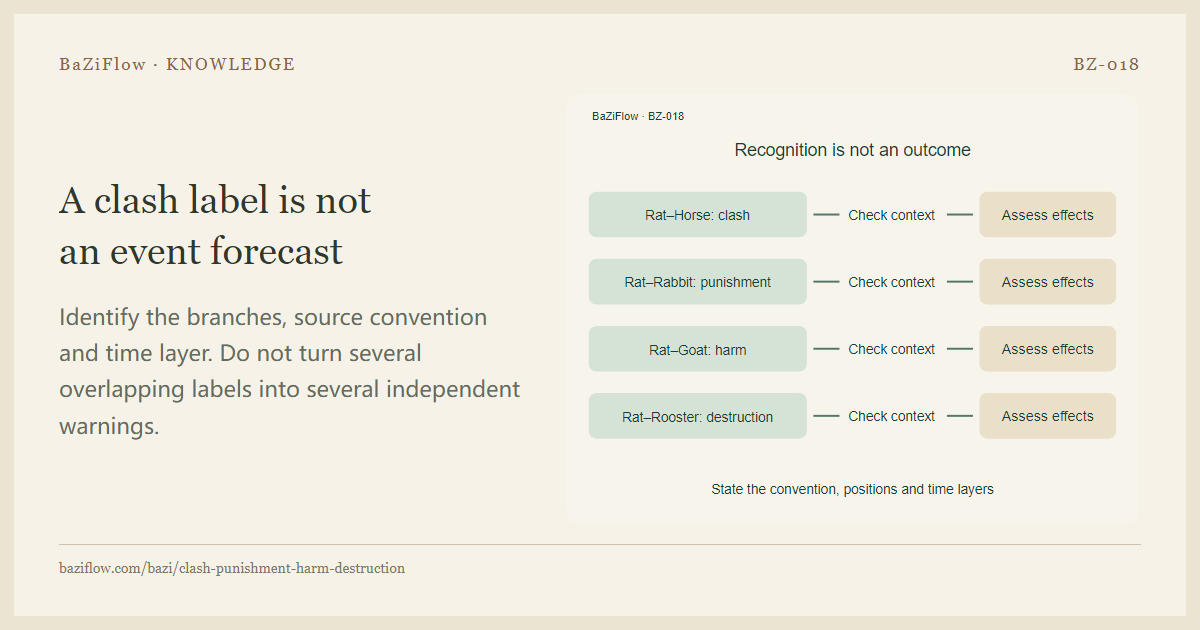
Identify the branches, source convention and time layer. Do not turn several overlapping labels into several independent warnings.
Read first
A relationship count is not a count of dangers
Tiger–Snake can appear in a harm list and also enter a punishment discussion. Has the reader found two independent pieces of evidence that an injury will occur? No. Two rule names may refer to overlapping symbols. Counting their alarming descriptions separately would conceal the shared input rather than strengthen the argument.
That problem comes before any attempt to rank clash, punishment, harm and destruction. First identify the actual branches, their positions and the rule being invoked. Then ask which conditions remain unresolved. A relationship label does not supply a real-world event, and an additional label does not automatically supply an additional risk.
Keep the historical meaning attached to its passage
The Siku edition of San Ming Tong Hui, volume 3, has a named destruction-affliction passage listing Rabbit–Horse, Ox–Dragon, Rat–Rooster and Goat–Dog. It separately explains not taking Tiger, Monkey, Snake and Pig in that treatment. This provides a specific, inspectable four-pair scope.
The discussion of clash and breaking in volume 2 of Wu Xing Da Yi uses opposite positions, including Rat–Horse and Ox–Goat, and makes further distinctions among the opening, middle and closing branches of seasons. Its use of the word translated as “breaking” should not be silently converted into the later passage's four-pair table. The same word is doing a different classificatory job.
These two passages demonstrate why a source needs more than a book title. If another table adds Tiger–Pig and Snake–Monkey to make six destruction pairs, ask for that table's own source and convention. The passages just described do not establish that every classical author used such a six-pair list. Nor does a historical classification validate the event predictions attached to it.
Separate four kinds of membership checks
Volume 2 of San Ming Tong Hui treats harm, punishment and clash in separate discussions. For an introductory comparison, keep their memberships and unresolved conditions visible:
| Name | Membership used for this comparison | Further question |
|---|---|---|
| Clash | Rat–Horse, Ox–Goat, Tiger–Monkey, Rabbit–Rooster, Dragon–Dog, Snake–Pig | Which positions and time layers are involved? |
| Punishment | Tiger–Snake–Monkey; Ox–Dog–Goat; Rat–Rabbit; self-punishment discussions for Dragon, Horse, Rooster and Pig | What members or repetitions does the method require? |
| Harm | Rat–Goat, Ox–Horse, Tiger–Snake, Rabbit–Dragon, Monkey–Pig, Rooster–Dog | Which participants overlap with other relationships? |
| Destruction | The Siku passage's Rat–Rooster, Ox–Dragon, Rabbit–Horse and Goat–Dog | Is another source using the same word differently? |
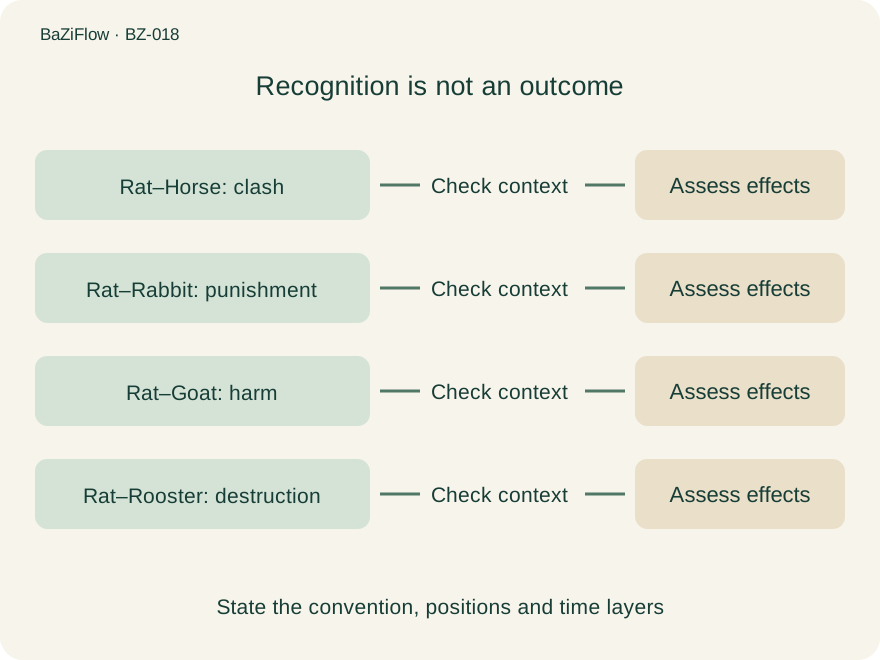
Original BaZiFlow comparison of four relationship examples; it does not forecast personal events.
The clash list has a straightforward consistency check: each pair is six steps apart on the twelve-branch circle, and every branch occurs once. That verifies an arrangement, not a prediction of relocation or separation. The other lists require their own checks; they are not interchangeable names for this geometry.
“Punishment” is particularly easy to misread in English. It does not establish criminal behaviour or moral failure. “Self-punishment” is not a clinical diagnosis or a synonym for self-harm. A single Dragon entry also does not establish every condition that a method might require for a repeated-branch interpretation. State the rule instead of allowing an ominous translation to do the reasoning.
Test a claim by moving one branch to another time layer
Imagine a record with natal Rat and annual Horse. A reader may identify a Rat–Horse relationship across those stated layers. The reader may not report that both branches were present in the natal chart. Moving Horse from an annual field to a natal field changes the evidence even though the pair name stays the same.
Ownership must survive the calculation as well. Horse in a comparison partner's chart is not a missing branch to add to the current person's four pillars. A conditional sentence about a future Horse Luck Pillar is different again: it states a possibility, not an existing chart member.
These distinctions are lost when a program scans ordinary prose for matching branch characters. Relationship identification should begin with explicit, authoritative branch fields and their subject and time labels. Otherwise a mistaken member can propagate into relationship counts, scores and recommendations.
Record the limit of the conclusion
When only a pairing has been established, write that the pairing is identified and its role remains to be assessed within the whole configuration. Seasonal context, the Day Master and placement may matter to that assessment. There is no need to fill missing evidence with a vivid event forecast.
Overlaps also need an explicit method. Tiger–Pig and Snake–Monkey are Six Harmony pairs; if another chosen convention additionally labels them destruction, neither “harmony always cancels it” nor “destruction always wins” explains how that convention works. Preserve the shared members and the stated conditions instead of accumulating generic positive and negative phrases.
The comparison of Six Harmony, Three Harmony and directional assemblies develops the complementary structures. The article on natal, Luck Pillar, annual and monthly layers explains how to keep time scope attached. Neither relationship vocabulary is a reason to blame an animal-year category or a person for practical problems that require real-world evidence.