

Xian: feeling climbs from the toe to the tongue
Content version · · Sources & references
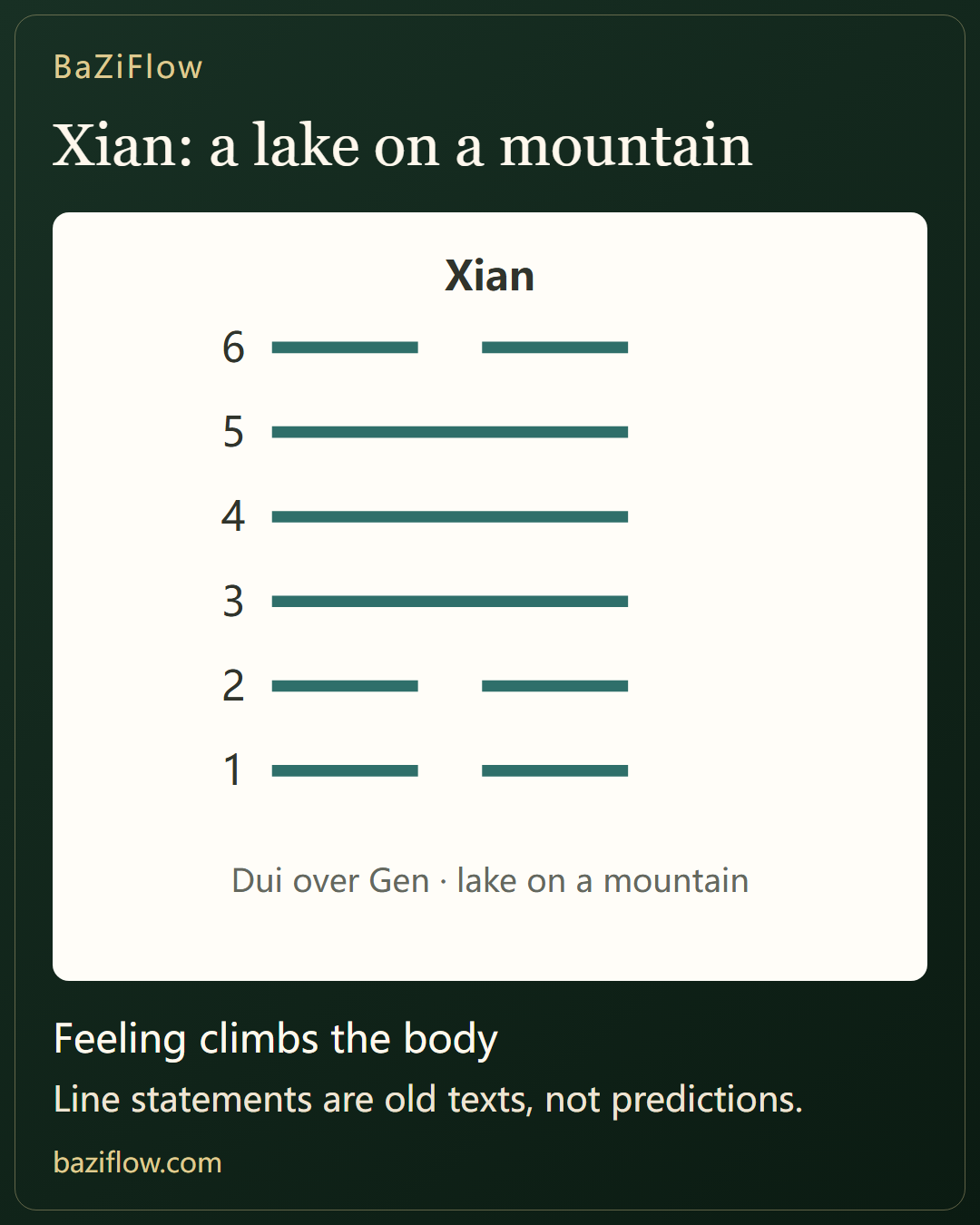
Xian opens the lower part of the Zhouyi: Gen below, Dui above, a lake on a mountain. The Commentary says Xian means to feel; the statements list body parts upward, pause at line 4 for a thought, and end on the tongue.
The short version8 min read
The Commentary on the Judgments explains the name with one word, to feel. The statements do not talk about romance or events; they count up the body, big toe, calf, thigh, back, and at last jaw, cheeks and tongue, and only line 4 turns to what a person thinks.
- Xian (咸) is Dui (lake) over Gen (mountain). In the Shuo Gua Gen is hand and finger and Dui is mouth and tongue, which can recall the lowest statement (big digit) and the top one (jaw, cheeks, tongue), though the Shuo Gua ties them to no line.
- The Commentary reads "the yielding above, the firm below", explains "taking a wife" through "the man places himself under the woman", then widens "feeling" to heaven, earth and the sage.
- Five statements read "feeling in the" plus a body part; line 4 alone says "pacing back and forth, friends follow your thoughts". Lines 1 and 6 carry no verdict, and the Small Images use the word "aim" three times.
Read first
The Sixty-Four Hexagrams: How Upper and Lower Trigrams Form One Figure ↗
Judgment and Line Statements: Whole Hexagram or Single Line? ↗
A lake on a mountain: Gen below, Dui above, and to feel
Xian (咸) is the 31st hexagram and opens the lower part of the Zhouyi. The lower trigram is Gen (mountain), the upper is Dui (lake). The first and second lines at the foot are yin, the third, fourth and fifth are yang, and the top line is yin again. The Commentary on the Judgments opens with three words: "Xian means to feel." Today the character usually means salty, but as a hexagram name it means feeling, being moved and responding. The word for "feel" is the character with a heart radical added, a point the Commentary does not raise, though it comes to mind when line 4 speaks of "your thoughts".
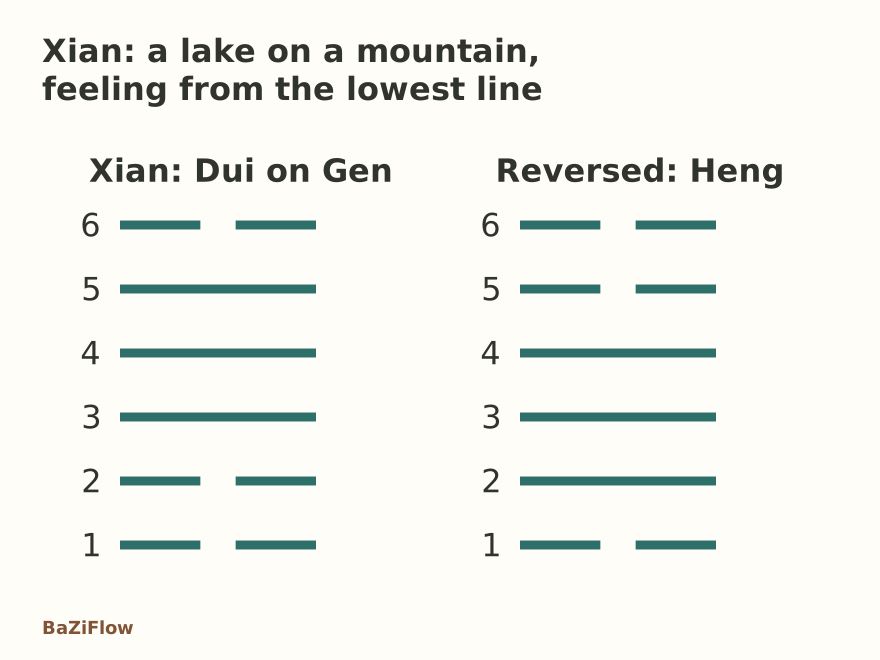
Xian and its reversed form Heng: Heng is Xian turned upside down, so the Gen below becomes the Zhen above and the Dui above becomes the Xun below.
Enlarge diagram · scroll sideways to read
The Shuo Gua gives Gen the word "stopping" and Dui the word "delighting", and the Commentary later joins them: stopping and delighting. The Shuo Gua also says that Gen is the youngest son and Dui the youngest daughter, by the third seeking; with a young man below and a young woman above, the Commentary says "the man places himself beneath the woman".
The judgment and the Commentary: two kinds of qi respond
The judgment of Xian reads "success; fitting to stay on course; taking a wife: good fortune". The verb is to take a woman as wife. The Commentary on the Judgments explains these clauses and, as it goes, widens "feeling" more and more.
Xian means to feel. The yielding is above and the firm below; two kinds of qi respond to each other and join. Stopping and delighting, the man places himself beneath the woman. Therefore there is success, it is fitting to stay on course, and taking a wife brings good fortune. Heaven and earth feel each other and the ten thousand things are born and transformed; the sage feels the hearts of people and the world is at peace. Look at what they feel, and the true nature of heaven, earth and the ten thousand things can be seen.
Enlarge diagram · scroll sideways to read
The first half is read off the figure: the yin trigram Dui sits above and the yang trigram Gen below, and the two kinds of qi respond; Gen stops and Dui delights; the man stands below the woman, hence "taking a wife" in the judgment. The second half pulls away from marriage and says that when heaven and earth feel each other the ten thousand things come to be, and when the sage touches people's hearts the world is at peace. The last clause, "look at what they feel", is built like the Commentary on the hexagram Yi (頤), "look at what is nourished": see what a thing is moved by and the real nature of heaven, earth and all things shows.
The Image: a lake on the mountain, and taking in others by being empty
The Image has a single act.
On the mountain there is a lake: Xian. The noble person, being empty, takes in others.
Enlarge diagram · scroll sideways to read
"On the mountain there is a lake" draws a strange picture: the mountain is solid and yet the water is at the top. The common reading is that the summit must dip and be hollow to keep water, so the noble person is "empty" and takes in others with an empty heart. "Empty" is empty and "take in" is to accept. The Image does not say what is taken in or what follows; it leaves these two words alone.
The six lines: body parts, counted upward
Five of the six statements read "feeling in the" and a part of the body.
Enlarge diagram · scroll sideways to read
The order is clear. Line 1 is the big digit, read as the toe; line 2 the calf; line 3 the thigh; line 5 the flesh of the back; line 6 the jaw, the cheeks and the tongue. In the Shuo Gua, Gen is the hand and the finger, which calls to mind the digit at the bottom, and Dui is the mouth and the tongue, which calls to mind the jaw, cheeks and tongue at the top; this is an association, and the Shuo Gua does not assign them to line positions.
Line 2 says "ill; staying put, good", so keeping still is good; line 3 says "going brings shame", and the Small Image follows at once with "he also does not stay". One stays and one goes, which is how later readers often take the pair. Lines 1 and 6 give only the part and no verdict. The word "aim" occurs three times in the Small Images: "his aim is outward", "his aim is to follow people", and "his aim is at the tip".
Heng, Gou and the Xu Gua: the start of the lower section
The reversed hexagram of Xian is Heng (恒): turn Xian upside down and the lower trigram becomes Xun and the upper becomes Zhen. The two stand side by side, each with its own article. The inverse is Sun (損), and the nuclear hexagram is Gou (姤): split the middle four lines into two triples that share two lines, and Xun comes out below and Qian above, which together read Gou.
Enlarge diagram · scroll sideways to read
There is a small coincidence in that nuclear hexagram. The Shuo Gua says "Xun is the thigh", and line 3 of Xian is exactly "feeling in the thigh", which lands inside the lower trigram of the nuclear hexagram, Xun.
In the lower section, the Xu Gua is written differently. There is no "and so it was followed by Xian". It starts from heaven and earth, moves on through the ten thousand things, then the sexes, then married couples, parents and children, rulers and subjects, and only then says that the way of husband and wife cannot go without lasting, so Heng follows. The word Xian never appears in that chain, and the reader has to find its place from the passage before.
Questions readers ask next
Is Xian a hexagram about romance and marriage?
Only in part. The judgment includes "taking a wife brings good fortune", and the Commentary on the Judgments explains it with "the man places himself under the woman". But the Commentary then moves "feeling" to heaven, earth, the sage and people's hearts, and the statements are a run of body parts. Marriage is one way in, not the whole text.
Is the first word of "feeling in the big toe" a finger or a toe?
The word means the big digit, and can be on a hand or a foot. Because the statement sits at the bottom line it is traditionally read as the toe, though the text does not say so. Quoting it as the big digit, or marking the toe as a common reading, is safer than insisting on one.
How are Xian and Heng related?
Heng is the reversed hexagram of Xian: turn Xian upside down and the lower trigram becomes Xun and the upper becomes Zhen. The two stand side by side in the lower section, and each has its own article; each reads from its own text and neither is a mirror copy of the other.
Was this article helpful?
Sources & references
Continue reading
Li: to cling, from tangled steps to the slanting sun, and a run of "likes" ↗
Heng: thunder and wind, and why lasting is not standing still ↗
The Sixty-Four Hexagrams: How Upper and Lower Trigrams Form One Figure ↗
Judgment and Line Statements: Whole Hexagram or Single Line? ↗