

Comparing relationship readings
Content version · · Sources & references
Audit a studio-planning example across synastry and Sukuyō, keeping symbolic claims separate from an actual reply about the arrangement.
The short version6 min read
Keep the named chart objects, mansion-count direction and an actual reply in separate columns. The studio example makes the difference concrete: an offer to bring equipment still does not confirm a 9 a.m. start.
- Planetary separation and a mansion-count category are different structures, with no conversion into a common compatibility score here.
- Morgan offered equipment, but 9 a.m. remains unconfirmed; the real reply answers a narrower question.
- A proposal, acceptance and an unanswered question are distinct records, even after a useful conversation.
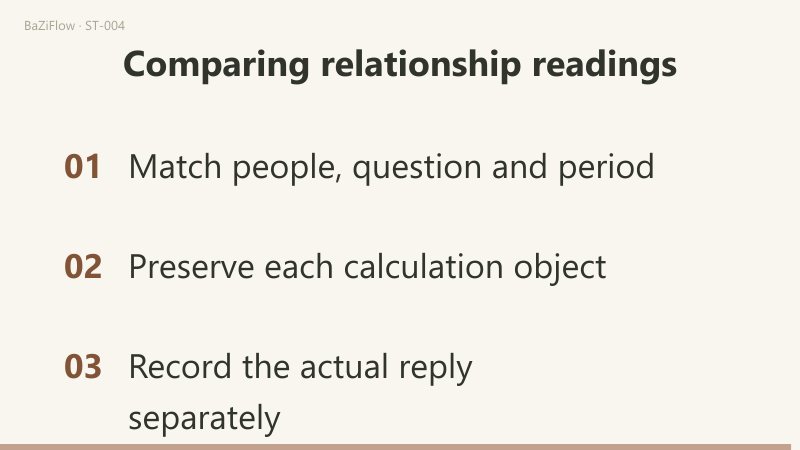
Read first
Combination, clash and star in BaZi, Ziwei and astrology: different rules ↗
Start with a claim that could actually disagree
“This relationship needs work” and “you have a strong connection” are not two measurements of the same variable. They may not even conflict. Before comparing readings, write a concrete question: have both people agreed to the proposed arrangement, for what period, and on which terms? A reading about a relationship's symbolic pattern cannot by itself supply those answers.
Consider a fictional pair planning a shared studio session. Alex has offered Saturday morning; Morgan has agreed to bring equipment but has not confirmed a starting time. One interpretation describes cooperation, while another describes friction. Neither statement tells us whether Morgan accepted a 9 a.m. start. This distinction matters because a practical decision can remain unresolved even when both readings sound reassuring.
The comparison below uses Western synastry and Sukuyō as examples of different structures. It is a way to audit the reasoning in reports, not a combined compatibility instrument. No birth details or calculated charts are claimed for the studio example, and no score is inferred from its outcome.
Symbolic claims
- Strong connection
- Needs work
Concrete question
- Saturday session
- Has 9 a.m. been accepted?
Keep the objects and replies separate
- Calculation object
- Keep both owners in a named pair, such as Alex’s Venus and Morgan’s Moon.
- Actual reply
- A response to a specific proposal, including refusal, a counterproposal or uncertainty.
Build an evidence ledger before looking for agreement
Give each assertion its own row. Keep the original wording, the object it refers to, and the information that would be needed to act on it. Do not put an interpretation into the observation column just because it feels familiar.
| Entry | What the entry can preserve | What is still missing |
|---|---|---|
| A synastry statement | The named planet belonging to each person and the chosen aspect rule | Whether either person accepts the proposed session |
| A Sukuyō statement | Both mansion labels, counting convention and direction | A reply about the start time |
| A message from Morgan | An offer to bring equipment | Confirmation of 9 a.m. |
| A joint arrangement | Explicitly agreed time and responsibilities, if obtained | Any later change, which needs a new entry |
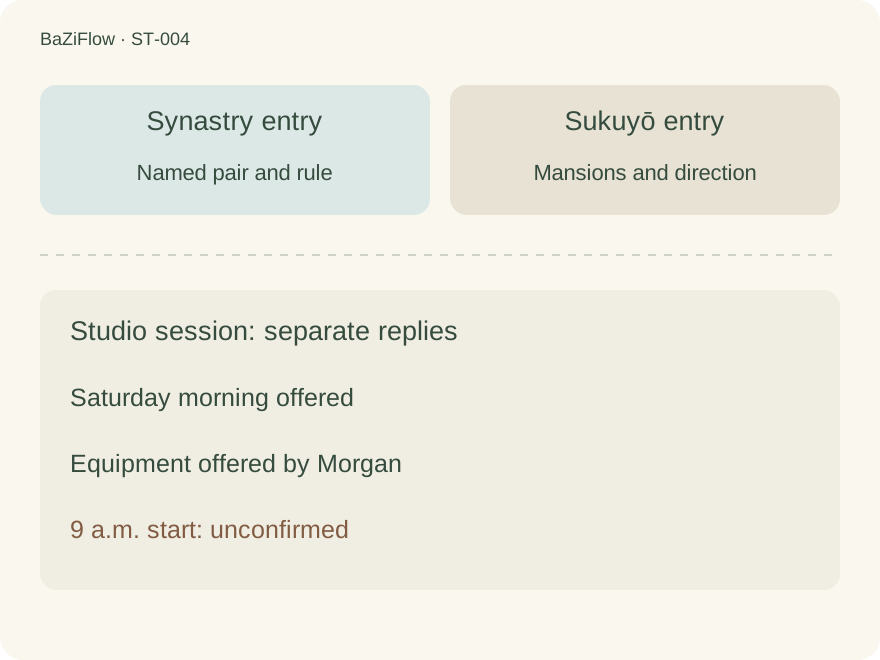
Original fictional ledger: a symbolic interpretation cannot supply a missing reply.
Notice the asymmetry in the ledger: an equipment offer is real information, but it answers a narrower question than the one Alex needs answered. Labeling it “positive relationship evidence” loses that precision. Conversely, a delayed response does not establish hostility, disagreement or a private motive. The missing answer should remain missing until further information arrives.
This method also makes an incomplete report visible. If the report names no planetary pair or mansion calculation, record that omission. Do not reconstruct a plausible configuration merely to give its prose an authoritative-looking foundation. A good comparison can end with fewer claims than it started with.
Alex
- Known
- Saturday morning offered
- Still open
- A mutually accepted time
Morgan
- Known
- Equipment offered
- Still open
- Acceptance of 9 a.m.
Two structures, no conversion rate
Chapter 12 of the TimePassages manual describes synastry as a comparison between two natal charts, retaining planetary interactions across them. That description supports an important bookkeeping distinction: Alex's Venus in relation to Morgan's Moon is not the same named pair as Morgan's Venus in relation to Alex's Moon. The manual is being used for the definition of the chart operation, not as experimental evidence for a psychological interpretation. More detail is available in synastry and composite charts.
The three-nine passage in the historical T1299 text, by contrast, treats mansion relationships from each person's side. Its sequence and reciprocal perspective need to be retained when reporting a traditional label. A mansion-count category is not a planetary angular separation. There is no conversion provided here that would turn one into the other, and sharing a relationship topic does not make their outputs commensurable.
These brief source descriptions establish what is being compared. They do not establish that either symbolic system measures consent, trust or scheduling reliability. Those are separate claims. In particular, replacing several traditional names with the single word “challenging” discards structure rather than demonstrating agreement. Keep the native terms in the ledger and explain their scope before considering any broader interpretation.
Synastry objects
Mansion objects
Run a useful comparison, then stop where the evidence stops
First hide the reassuring or alarming adjectives and ask what each report contributes to the studio question. If both merely recommend “communication,” they have not supplied two independent answers. If one makes Alex notice an unconfirmed time, the useful next step is a direct question about that time. Any answer then comes from Morgan, not from the reports corroborating each other.
Source of new information
Received information and unresolved conflicts
Research by Eyal, Steffel and Epley distinguished imagining another person's perspective from obtaining information through conversation. Its findings caution against treating confident perspective-taking as new knowledge. This is a reason to separate a guess from a received answer; the study did not test astrology or Sukuyō, and it does not promise that every conversation produces agreement.
For this example, a suitably narrow follow-up is: “Does 9 a.m. work, or should we choose another time?” If Morgan proposes noon, keep that proposal separate from an accepted joint plan. Alex may be unavailable at noon. The next observation could be agreement, disagreement or a still-open schedule, without any of those outcomes defining either person's character.
Finally, preserve genuine conflicts. If two readings make incompatible claims about the same event and deadline, do not average them into a percentage. Check their inputs and scope, retain the original claims, and record what was observed independently. Agreement in wording is not an additional observation; disagreement is not permission to select whichever statement is more comforting. A comparison is complete when its remaining uncertainties are visible enough to guide the next real question. For traditional directional terminology, continue with the six Sukuyō relationship groups.
Different scopes
- Long-term symbolism
- One studio session
Conflicting claims
- Same event
- Same deadline
Copy one checkable claim from each report
Retain its wording, owners, question and time scope; mark missing calculation details rather than inventing them.
Ask for the missing scheduling information
Ask whether 9 a.m. works. Keep an offered alternative separate from Alex’s acceptance of it.
Preserve the new record
Write who proposed what and who accepted, declined or has not answered. Do not backdate later agreement.
For the distinction between a relationship prompt and another person’s decision, see relationship questions and choice.
Questions readers ask next
Do matching conclusions double the evidence?
No. Repeated interpretive language is not another observation. Identify the specific information added by the second report.
Can an angular separation become a Sukuyō compatibility score?
No conversion is supplied here. A planetary separation and a directed mansion count retain different objects and rules.
Does receiving a reply establish agreement?
No. A reply may decline, propose another time or leave the matter open. Receiving information and reaching agreement are distinct events.
Was this article helpful?
Theme: Partnerships
Sources & references
Continue reading
Synastry and composite charts: why two correct calculations can differ ↗
Two people, four planet labels: keeping synastry ownership clear ↗
Six Sukuyō groups: derive both directional labels ↗
Relationship readings without speaking for the other person ↗