

Read the Celtic Cross in layers
Content version · · Sources & references
Follow the specific layout in Waite’s 1911 text, including its separate significator and direction-dependent side positions. Keep aims, foundations, fears and the assigned outcome from becoming interchangeable claims.
The short version7 min read
Waite’s Celtic Cross uses ten dealt cards plus a selected significator. The vertical pair compares aim and foundation; the sides compare passing and incoming influences. Separate these jobs before linking the images into an interpretation.
- The significator is selected before ten cards are dealt, so eleven physical cards can represent ten dealt positions without a counting error.
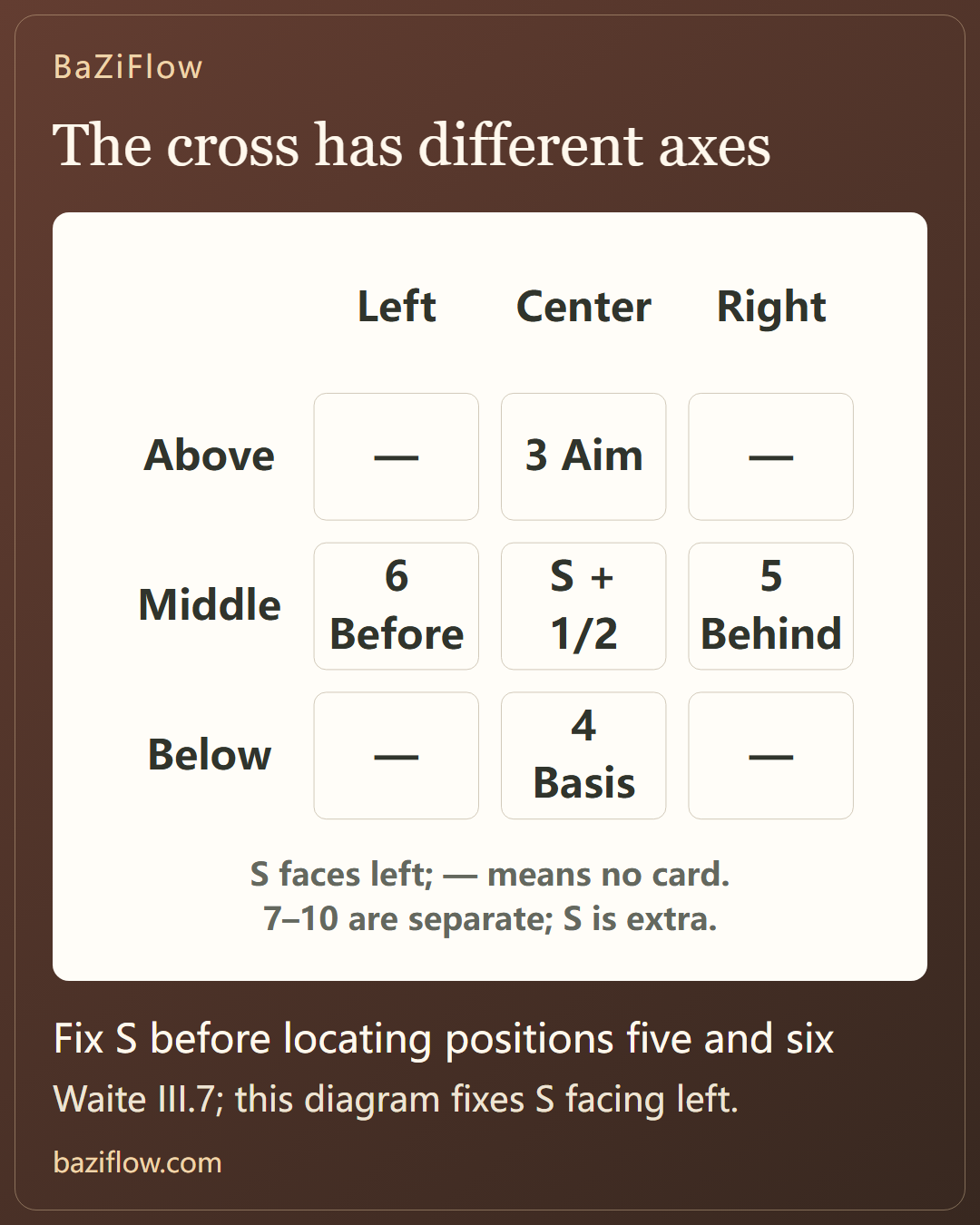
- Five is behind the significator and six before it. Fix its facing direction before translating those roles into left and right.
- Read influence and limitation at the center, aim and foundation vertically, and keep subject, environment, hopes and outcome distinct in the column.
Read first
A tarot draw needs a record, not just a photograph ↗
Fix the diagram before you deal
Waite's version starts with a selected significator. The ten dealt cards are additional to it: the first covers it and the second crosses the center. There may therefore be eleven physical cards on the table while only ten dealt positions are being discussed. A modern version without a separate significator should be labeled as a variation rather than silently treated as identical.
S
- Selected first
- Marks topic
1–10
- Dealt next
- Ten roles
1 significator + 10 dealt cards = 11 physical cards
Fix the facing reference
The side positions depend on the significator's facing direction. Five is behind it and six before it. When it faces left, five is on the right and six on the left. If the selected card has no evident facing direction, the text instructs the operator to decide before beginning. Our diagram fixes a left-facing reference so that its labels are unambiguous.
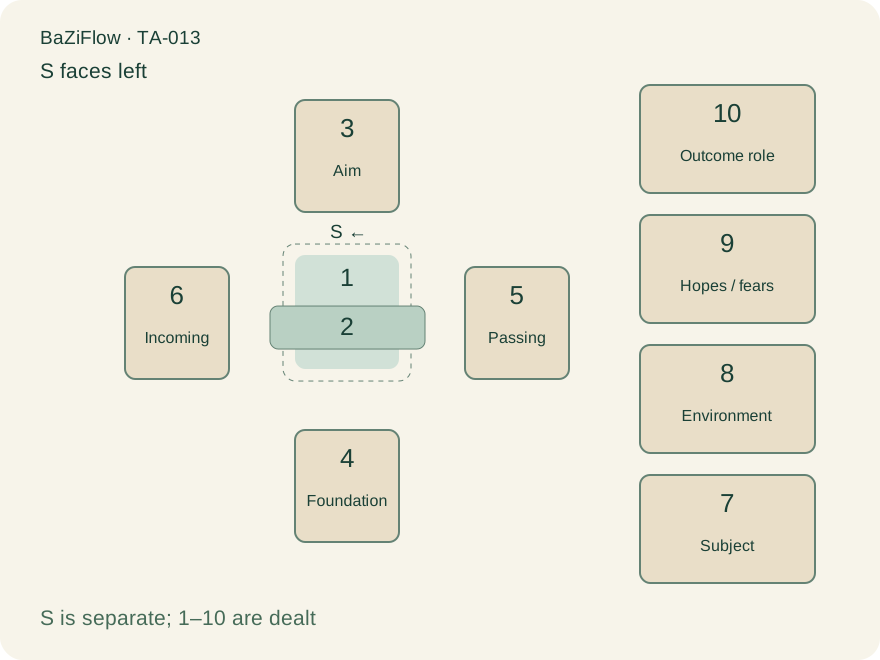
Original BaZiFlow position diagram based on Waite III.7, with a left-facing significator fixed for clarity. No card artwork is reproduced.
The historical instructions also contain personal classifications for choosing a significator. Those are not adopted here as rules for identifying or evaluating real people. For a practice exercise, you can state that a chosen card marks the topic. If you omit it or change the layout, document the change. The following section of the same book offers a different method using 42 cards; instructions should not be imported from it without explanation. Your draw record can name the section being followed. A familiar spread name is not enough to reconstruct an unfamiliar version.
Let the central pair form a sentence
The first dealt card concerns the general influence or atmosphere around the subject. The second concerns an obstacle. Its crosswise placement is a layout instruction, not an automatic reversal. If you use reversed meanings, preserve the original orientation rule separately from the act of turning the card sideways to form the cross.
Waite notes that something favorable in itself may fail to be helpful in the particular connection. A contemporary analogy is training that is valuable overall but consumes time needed for a deadline this week. The obstacle is the relationship between a useful activity and a current constraint; it need not be a universally bad thing.
Try a sentence with two linked parts: “The matter is currently shaped by this influence, which is limited in this specific way.” The image, question and known circumstances must do the work of filling those parts. If all you have are two isolated keywords, do not disguise the gap by adding a longer narrative.
For a constructed partial exercise, select the Eight of Pentacles at one and Four of Swords at two. The worker makes a coin; the second image is a still, praying effigy on a tomb. Given a real preparation deadline and limited working time, the pair can focus attention on making something, constrained by the available hours. The Four is not universally bad: if the task were to reserve quiet study time, its stillness could support the purpose. This explicitly practices two central positions, not a completed ten-card reading.
1 Eight of Pentacles
- Craftsperson at work
- Preparation needs making
2 Four of Swords
- Still praying effigy
- Work time is limited
Constructed pair: making is limited by available time, not a good/bad sum
Read the cross as comparisons, not a single timeline
The upper position, three, concerns an aim, ideal or a possible best attainment not yet made actual. The lower position, four, concerns an established foundation. Their useful contrast is aspiration versus what is already in place. Calling them simply future and past loses part of that distinction.
Five concerns an influence just passed or passing away; six concerns an influence coming into operation. These side positions supply a different comparison, concerned with change over time. Even here, a symbolic proposal about an incoming condition should not be reported as if the condition has already been verified.
| Pair | Distinction to retain | What goes wrong if it is lost |
|---|---|---|
| 3 and 4 | Aim versus established foundation | A wish is reported as a resource already available |
| 5 and 6 | Passing influence versus incoming influence | Direction or timing gets silently swapped |
| 7 and 8 | Subject versus environment | An external constraint becomes a character verdict |
| 9 and 10 | Hope or fear versus assigned outcome | Concern is treated as confirmation |
Consider an original teaching example: extending a community archive’s opening hours. The aim is a regular Saturday session; the established foundation is one volunteer available for a single trial date. That offer does not yet supply a continuing rota, building access or permission to change public hours. A positive story about the aim cannot supply those missing arrangements. This is a way to understand the positions, not an assertion that a particular card foretells the archive’s expansion.
For the vertical pair, place Four of Wands at three: its garland and gathering figures can express the desired regular gathering. Page of Pentacles at four, absorbed in the pentacle above its hands, can stand for careful groundwork: one volunteer’s trial session. In the archive example that single offer remains the actual foundation; the continuing rota does not exist yet. Swapping these cards requires new questions about the arrangements already in place and the program actually intended, not merely exchanging card names.
3 Four Wands
- Garland and gathering
- Aim: regular gathering
4 Page of Pentacles
- Intent gaze at a coin
- Basis: initial study
Initial interest or one booking is not a continuing program
Position nine is not position ten
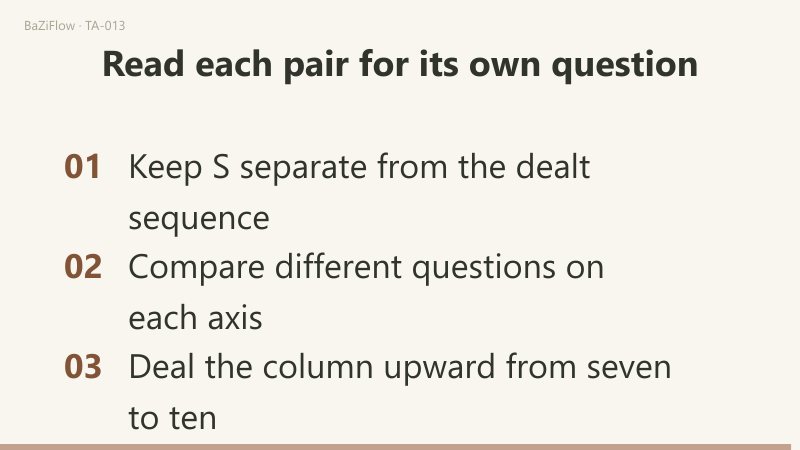
The right-hand column is dealt upwards: seven at the bottom, then eight, nine and ten. Read each position for its own question, then ask how it relates to the distinctions already made in the cross. Does the proposed attitude in seven differ from the environmental constraint in eight? Is nine describing a desire that was mistakenly used as evidence in three?
At ten, retain every uncertainty introduced earlier. A card does not gain factual authority because it is dealt last. You may use the assigned outcome position to examine a conditional direction suggested by the discussion, while separately identifying what needs to be checked in the real situation. Do not turn a chain of tentative interpretations into a categorical verdict at the final step.
The version described in the text includes suggestions for a further operation in some unclear cases. That documents the author's procedure; it is not a requirement to repeat until a satisfactory answer appears. Preserve the first layout and interpretation before deciding whether a genuinely different follow-up question exists.
10 Outcome role
Retain earlier conditions
9 Hopes / fears
Desire and concern
8 Environment
Surrounding influences
7 Subject
Own position / attitude
Shown top to bottom 10→7; deal upward from 7 to 10
Reduce the exercise when the positions stop helping
A ten-card layout can produce more material than a beginner can distinguish. If position meanings keep drifting, practice with three clearly defined positions first. Returning later with a stable understanding of how a position constrains a question is more useful than memorizing ten labels while reading every card in the same way.
For a review, keep the version, facing convention, significator choice, dealt order and position list alongside the cards. Record unresolved points rather than filling each box for the sake of completeness. The layout's educational value lies in separating kinds of questions. More cards do not, by themselves, provide more reliable knowledge of the future.
Recover a pair
Cover the explanations and state the separate jobs of three and four.
Trace the cue
Identify how the worker, still effigy or gathering entered this interpretation.
Retain the gap
Keep aims, resources and limits distinct after all ten positions are considered.
Questions readers ask next
Does the Celtic Cross use ten cards or eleven?
Waite’s III.7 selects a significator before dealing ten additional cards, allowing eleven physical cards on the table. A variation that omits the significator may use ten, but it should not count S as the first dealt card in this version.
Is the sideways second card automatically reversed?
No. Turning it crosswise is an instruction about placement, not evidence of its orientation when drawn. If reversals are used, preserve the drawn orientation before making the cross so that the two rules remain separate.
Why are positions five and six sometimes on opposite sides?
This version locates them behind and before the significator. If S faces left, five is right and six left; a right-facing S reverses them. Other manuals may use fixed sides, so identify the version before comparing diagrams.
Was this article helpful?
Sources & references
Continue reading
Reversals are not a universal minus sign ↗
Review the whole tarot journal, not just the memorable matches ↗