

Ziran in the Laozi: so of itself
Content version · · Sources & references
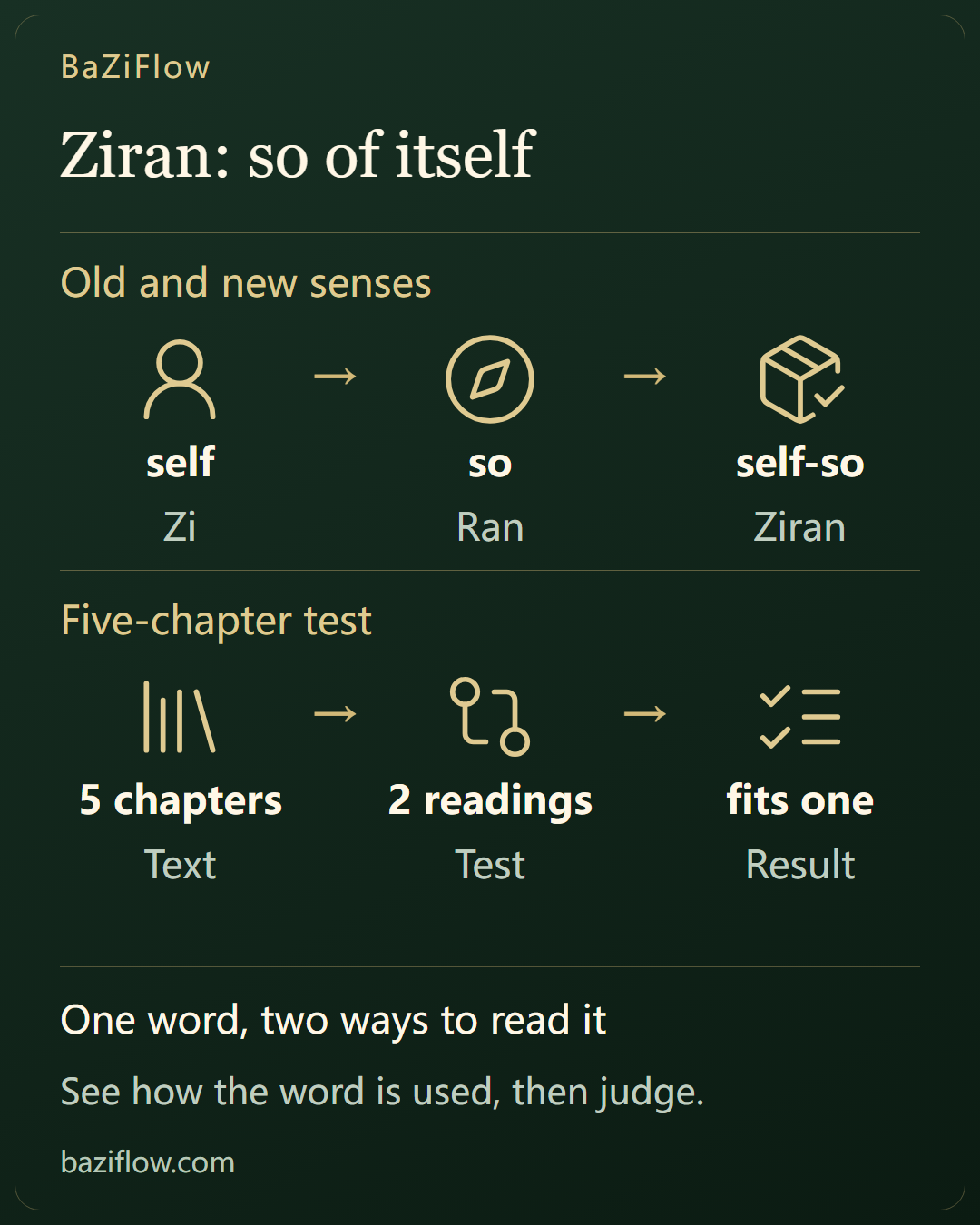
Five passages in the Laozi use ziran. Substituting "so of itself" and "the natural world" into each line, then comparing the Zhuangzi, separates what the text says, how tradition reads it and what modern speech borrows.
The short version9 min read
In the Laozi ziran splits into two characters, zi, "self", and ran, "so": together they describe a state of being so of oneself, while the "nature" of landscape and weather is the later, more common sense.
- Ziran is zi (self) plus ran (so, thus): a way of being in which things are so of themselves and nobody pushes them there.
- In the received Laozi the word occurs in chapters 17, 23, 25, 51 and 64 only, and each of the five lines reads well as "so of itself".
- "The Way takes ziran as its model" is commonly read as: nothing stands above the Way for it to lean on, so it runs on its own pattern.
Read first
Dao and De in the Laozi: Reading Chapters 1, 21, 25, 38 and 51 ↗
One word, read in two halves
Today "nature" mostly means mountains, rivers, plants and weather. The ziran (自然) of the Laozi calls for a different reading: it is two characters, zi and ran.
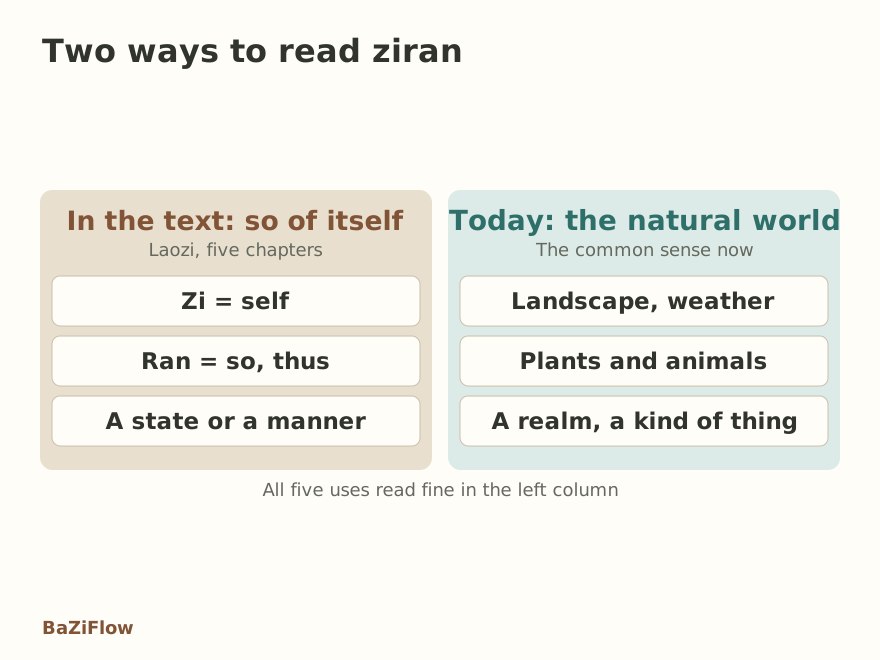
Word-sense comparison: all five uses in the Laozi read well in the left column; the right column is the most common sense today.
Zi (自) is "self", and ran (然) means "so" or "thus", the same character that sits in the Chinese words for "then" and "of course". Put together, ziran is "so of itself". Inside a sentence it describes a state or a manner: the thing came about through its own strength, and nobody pushed it, ordered it or arranged it.
Splitting the word
- Zi
- Self; the thing itself.
- Ran
- So, thus; also "to regard as so", that is, to approve.
- Ziran
- So of itself: arranged by no outside force, turning out in its own way.
Five passages, five uses
In the received Laozi, whose 81 chapters are the base text here, ziran occurs in only five of them: chapters 17, 23, 25, 51 and 64. In the Mawangdui silk manuscript, copy B, the word stands at the same five places. Start with an overview, then read each one.
Enlarge diagram · scroll sideways to read
Chapter 17 shows what "so of itself" feels like most plainly:
The highest ruler: those below merely know he exists. ... How unhurried, how sparing of words! The work is done and the matter settled, and all the people say: "We are so of ourselves."
Under the best ruler the people only know someone is there. He is unhurried and chooses his words with care, and when the work is finished everyone says: "It was us; we are just so." The ziran here belongs to the people. Someone did the work, but nobody felt pushed along, so everyone felt they had done it themselves.
The other three passages each have their own surroundings:
The other three
Sparing words is ziran
The two opening words are traditionally read as few words, that is, few commands. The example that follows: a gale does not last a morning and a downpour does not last a day. If even heaven and earth cannot make violence last, how much less people can.
Never ordered, always ziran
Just before it, all things honor the Way and prize its power. Nobody ever ordered that honor; it has simply always been so. "Never ordered" says that nobody commanded it, and "ziran" sums that up.
To help the ziran of the myriad things, and not dare to act
The sage helps things go their own ways without daring to force them. This line joins ziran to wu wei, "non-forcing", which turns up again in the next article of the series.
"The Way takes ziran": who follows whom
Of the five, chapter 25 is quoted most often and misread most easily:
There was something formed out of chaos, born before heaven and earth. ... People take their pattern from earth, earth from heaven, heaven from the Way, and the Way from ziran.
The four steps form a chain. "Take pattern from" is the usual reading of the verb: use something as the standard. People use earth as their standard, earth uses heaven, heaven uses the Way, and the Way uses ziran.
Enlarge diagram · scroll sideways to read
Look first at the earlier half of the passage. The thing it describes is "born before heaven and earth". If ziran meant the natural world, the Way would end up modelling itself on what it came before. So the usual reading is that the line ends at the Way and looks for no support above it: "takes ziran as its model" says the Way runs in its own so-of-itself manner. Commentators differ over the details of the verb, and the reading given here is the most common one.
Two ways to misread it
Ziran as a fifth rank above the Way
Four parallel verbs make it easy to assume that ziran is a fifth object standing over the Way. The common reading runs the other way: the chain stops at the Way, and ziran describes the Way's own manner.
"The Way imitates nature"
Read like that, the Way has to copy landscape and sky. Yet the same chapter calls it "born before heaven and earth", so heaven and earth come after it and the order is reversed.
A substitution test: five lines, two readings
The quickest way to see which reading fits the text is to try both in the five lines. The "natural world" column checks one thing only: does the sentence still make sense with that meaning dropped in?
Enlarge diagram · scroll sideways to read
Put "nature" into chapters 17, 23 and 51 and each line turns to nonsense: "all the people say: we are nature", "sparing words, nature", "never ordered, yet always nature". Chapter 25 can be read that way, but it collides with "born before heaven and earth" from the previous section. The ziran of the myriad things in chapter 64 can be taken two ways: the natural world things live in, or each thing's own original state. The second is still the "so of itself" reading, and it also suits the half-line before it, "help" and "not daring to act".
Neighbors in the Zhuangzi, and modern borrowings
The word ziran is rare in the Zhuangzi, but close ideas are common. In "Autumn Floods" one passage separates "heaven" from "the human" in very concrete terms:
That oxen and horses have four feet: this is called the heaven in them. To halter a horse's head and pierce an ox's nose: this is called the human.
An ox or horse is born with four legs and nobody arranged it: that is "heaven". The halter and the nose ring are added on: that is "the human". The passage does not use the word ziran, but it can be read next to "so of itself": on one side, the shape that grew; on the other, what was put on. The text goes on to warn against letting the human wipe out the heaven in a thing.
"On Equalizing Things" has a question instead:
The wind blows on ten thousand hollows, each different, and makes each one be itself; all take their sound from themselves. Who, then, is the one stirring them up?
Wind crosses thousands of hollows and each gives its own note. "Be itself" and "take from themselves" say that each hollow's sound comes out of the hollow. The closing question asks who is doing the stirring, and the passage leaves the reader to answer.
The word itself is uncommon in the Zhuangzi; among the chapters drawn on here it appears only in the line in "Autumn Floods" about Yao and Jie. There the second character means "regard as right": the common reading is that Yao and Jie each regard himself as right and condemn the other. This use also works by splitting the word: each takes himself to be so.
Now keep the three layers apart, and you know which one you are standing on whenever ziran turns up:
Enlarge diagram · scroll sideways to read
Phrases such as "go with the flow" or "return to nature" each borrow one layer of the word. They are today's usages. To set the Laozi's ziran inside the larger thought, continue with the Way and its power and then wu wei, and why it is not lying flat; for how the Zhuangzi handles "each regards himself as right", read equalizing things.
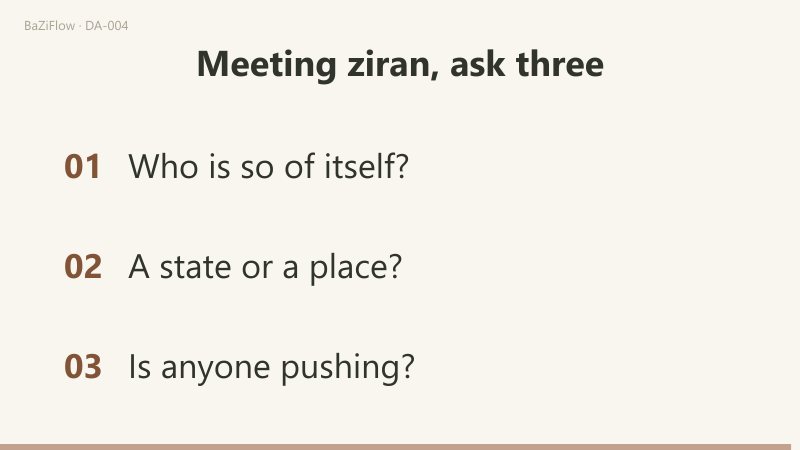
Who is so of itself?
Find the subject of the sentence: the people, the myriad things or the Way. Ziran describes that subject.
A state or a place?
Drop "the place where landscape is" into the sentence; only if it still makes sense is that reading worth considering.
Is anyone pushing?
Look at the neighboring words, such as "never ordered" or "not daring to act": needing no push is the core of "so of itself".
Questions readers ask next
Does "the Way follows ziran" mean the Way imitates nature?
That is not the usual reading. The same chapter describes the "something" as born before heaven and earth, so the world of landscape came after it. If ziran meant that world, the Way would be copying what it preceded. The smoother reading is that the line ends at the Way and looks for nothing higher.
Does "go with the flow" mean doing nothing at all?
The English phrase and its Chinese relative (shun qi ziran) are later idioms, often used to mean giving up effort. Laozi chapter 64 speaks of helping the ziran of the myriad things "without daring to act". Helping is itself an act; it simply does not override the direction things are already taking.
Does the Zhuangzi use the word ziran too?
Rarely. "Autumn Floods" has one line about Yao and Jie, where the second character means "regard as right": each takes himself to be right and condemns the other. "On Equalizing Things" never uses the word, yet speaks of every hollow "taking its sound from itself".
Was this article helpful?
Part of a learning path
Sources & references
Continue reading
Dao and De in the Laozi: Reading Chapters 1, 21, 25, 38 and 51 ↗
Wu Wei: Why It Is Not Doing Nothing, Read Through Chapters 2, 48, 57 and 64 ↗
Softness and Non-Contention: Read the Images First, Then Talk About Strength and Yielding ↗