

Output Generates Wealth and Officer Generates Resource
Content version · · Sources & references
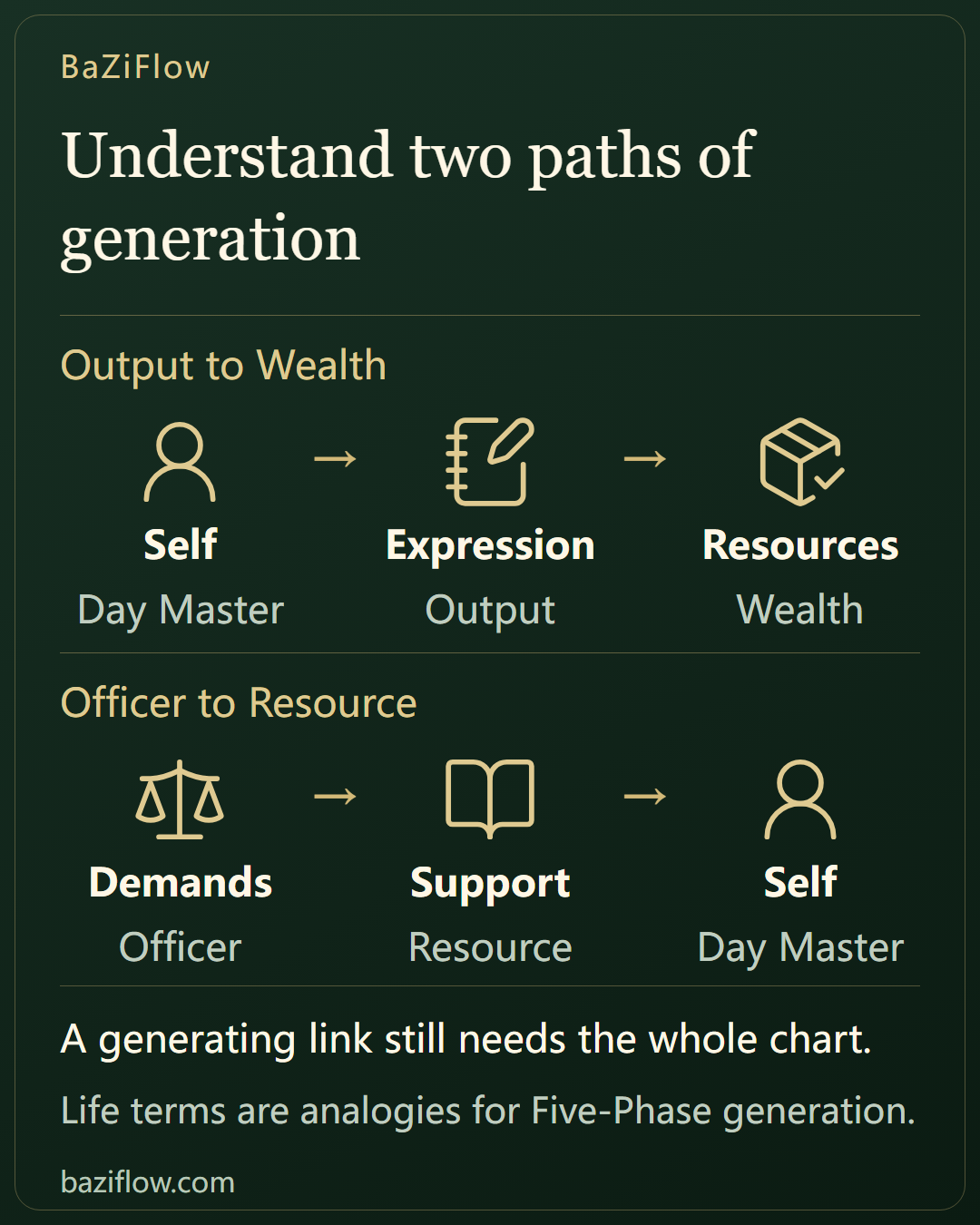
See where each generating chain begins and ends, then compare strength, position and interference. A Ten God label identifies a relationship; it does not establish a successful pattern.
The short version8 min read
One chain runs outward from the Day Master. The other returns through Resource. Start with that difference before judging what either chain can do in a full chart.
- Output generates Wealth: the Day Master generates Output, which generates Wealth. This describes elemental direction, not an income forecast.
- Officer generates Resource, which generates the Day Master. Whether Resource can transmit support, and whether that support is needed, both matter.
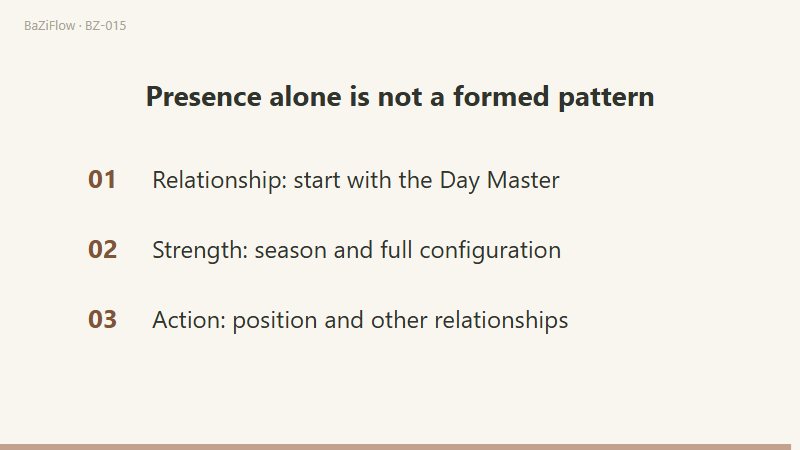
- Presence, effective action and a formed pattern are different claims. The month, strength, position and full configuration separate them.
Read first
Roots, expression and seasonal support: three different checks ↗
Start with the direction of generation
Output generating Wealth and Officer generating Resource are two elemental relationships in traditional BaZi, not two fixed personality types. One proceeds outward from the Day Master; the other returns through Resource. “Generates” means support between elements. It does not create a missing stem or promise a real-world outcome.
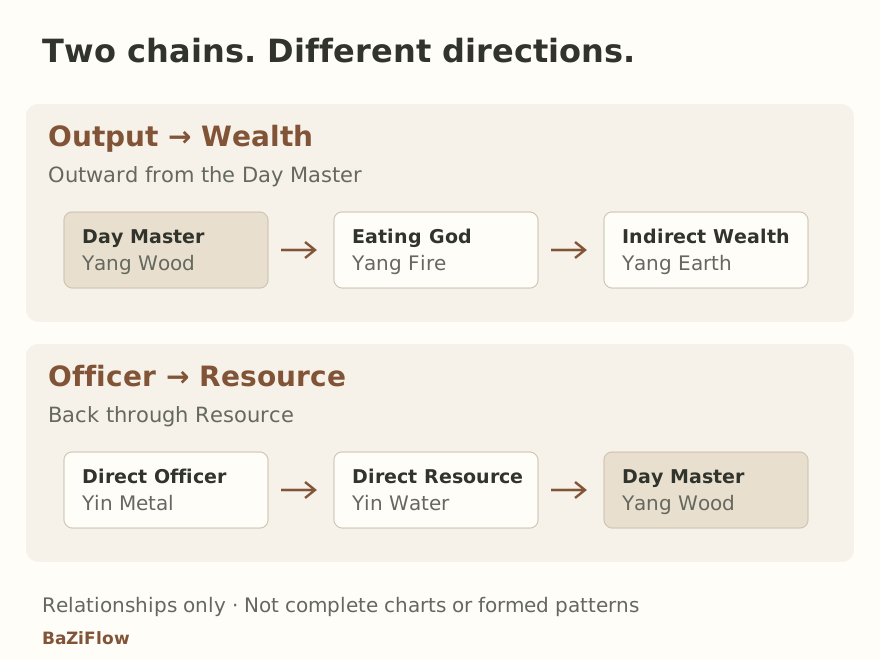
Relationship examples only. The first uses Eating God and Indirect Wealth; the second uses Direct Officer and Direct Resource. Neither is a complete natal chart.
Find the Day Master first: the heavenly stem of the day of birth. Every Ten God label is assigned relative to it. The same Fire stem can have a different role for a different Day Master. Yang Wood is a reference for the examples below, not an invented person or a substitute for all four pillars.
Ten God dictionary, measured from a Yang Wood Day Master
Companionssame as me
Outputwhat I generate
Wealthwhat I control
Officerswhat controls me
Resourcewhat generates me
Why Output generating Wealth moves outward
Output includes Eating God and Hurting Officer, the element generated by the Day Master. Wealth is the element controlled by the Day Master. For Yang Wood, Wood generates Fire and Fire generates Earth. Fire therefore belongs to Output and Earth to Wealth. Identifying this direction is the beginning of an interpretation, not its conclusion.
Polarity distinguishes the two Output roles. Yang Fire has the same polarity as Yang Wood and is Eating God; Yin Fire is Hurting Officer. Yang Earth is Indirect Wealth and Yin Earth is Direct Wealth. Yin Fire can also generate either Earth polarity, giving the Hurting Officer-to-Wealth direction. These are relational definitions, not proof that one person is gentle and another rebellious.
Even when Yang Fire and Yang Earth both appear, you have only identified participants. Fire must be able to act, Earth must receive its support, and the Day Master must tolerate the expenditure. Generating Output spends the Day Master’s strength; controlling Wealth also entails expenditure. A root means same-element support within a branch. A root or a Companion provides evidence about strength; neither one alone proves a strong Day Master.
Why Officer returns through Resource
Direct Officer belongs to the element controlling the Day Master; Resource belongs to the element generating it. For Yang Wood, Yin Metal controls Wood, but also generates Yin Water, which generates Wood. Officer and Resource emphasizes that second route without erasing the controlling relationship between Metal and Wood.
Direct Officer and Seven Killings share a controlling element, but differ in polarity. For Yang Wood, Yin Metal is Direct Officer and Yang Metal is Seven Killings. A route through Resource from Seven Killings is usually discussed as Killings and Resource, with its own conditions. Similar elemental direction does not make the two interchangeable.
Rules or demands can be a memory aid for Officer, and learning or support for Resource. Real qualifications, training and promotion depend on actual circumstances and action. The analogy cannot replace evidence about those circumstances.
Same participants, different conditions
These paired examples isolate conditions. They are not complete birth charts and make no claims about real people. Keeping the same relationship while changing its context shows why identical labels need not support identical conclusions.
Comparison one: Wood, Fire and Earth
Output can act and Wealth can receive
Suppose the full chart shows that Wood can tolerate expenditure, Fire is effective and Earth can receive it in the relevant positions. That supports examining the chain in action, but still does not establish a formed pattern from three stems.
Expenditure is too heavy, or Output is constrained
If Wood lacks support while Fire and Earth draw heavily on it, reassess the result. Strong Water acting on Fire may also matter. Water’s mere presence is insufficient: position and other controls must be examined.
Comparison two: Metal, Water and Wood
Resource supports a Day Master that needs it
Suppose Water can receive Metal’s support and act on Wood. That gives a basis for discussing the chain. Wealth or Hurting Officer may alter the picture and must still be considered.
Resource is constrained, or support is excessive
Weak Water controlled by effective Earth may not transmit support. Alternatively, already-heavy Resource may be unnecessary. Neither situation warrants copying the favorable interpretation from the other example.
In the first comparison, Water controls Fire and may constrain Fire’s support for Earth. Earth can in turn control Water, potentially protecting Fire. This is the logic of Wealth restraining Indirect Resource to protect Eating God; both actions need adequate strength and position.
A claim of control needs a target, relevant strength and an effective relationship. Hidden stems must not disappear from the analysis: not exposed does not mean absent. Conversely, finding a stem inside a branch does not prove that it is already performing the role claimed.
A relationship is not yet a formed pattern
In the pattern method used by Zi Ping Zhen Quan, the month is the starting point and all four pillars determine the configuration. Everyday references to Output generating Wealth may describe just one relationship. Claiming that an Eating God pattern is established is a broader judgment. Do not slide from the first claim into the second.
The chapter begins with the month as the starting point, then considers the four pillars together in judging formation and failure.
Output and Wealth: support, obstruction and rescue
Supporting conditions
- Fire can effectively support Earth.
- Wood can tolerate its expenditure.
Reasons to reassess
- Effective Water constrains Fire.
- Or Wood lacks support for the load.
Possible counteraction
- Earth controlling Water may protect Fire.
- Position and strength must support both actions.
Classical discussions of Indirect Resource meeting Eating God or Wealth supporting exposed Seven Killings have specific pattern contexts. These relationships deserve attention, but cannot become universal switches declaring failure whenever a label appears. Hurting Officer and Direct Officer likewise require their own context and counteracting relationships.
Rescue means that an existing part of the configuration restrains or mediates a problematic action. It does not mean freely replacing a time stem. A combination does not necessarily transform or cancel the original action; a clash does not automatically subtract strength. Explain the participants and effects instead of merely listing relationship names.
Three checks to keep beside a chart
Is the relationship correct?
Fix the Day Master and natal pillars, then record the relevant exposed and hidden stems with their positions. Keep luck-cycle and annual influences separate from natal facts.
Is the strength suitable?
The month branch supplies seasonal context. Consider roots, support and expenditure together. Counting participants or finding a root is not a sufficient strength assessment.
Can the action take effect?
Check position, exposure and other controlling or combining relationships. If you claim mediation, identify what transmits the action and why it is effective. Preserve uncertainty when evidence is missing.
The chapter on the order of generation and control compares configurations where the participants are similar but their positions differ. Preserve those positions in your notes. A list saying “Eating God present, Wealth present” throws away the very evidence needed to examine the interaction.
The same discipline matters when comparing two people. The same named combination need not imply equal capacity, identical interference or matching life outcomes. Conclusions should change with the actual evidence. If the available information only identifies a relationship, stop at that level rather than filling the gaps with generic favorable language.
Practice the labels with What are the Ten Gods?, then study the wider judgment in Patterns, formation and failure.
Questions readers ask next
How do Eating God and Hurting Officer differ here?
Both belong to Output, but their polarity relative to the Day Master differs. For Yang Wood, Yang Fire is Eating God and Yin Fire is Hurting Officer. Conditions involving Resource or Officers must be examined separately rather than copied between them.
Does having Officer and Resource establish this chain?
Their presence identifies possible participants. Officer generating Resource describes an action, not mere co-presence. Strength, location and the need for support still have to be checked, and no promotion follows automatically.
Does Indirect Resource or Seven Killings always break the chain?
No. Check its strength, target and other controlling or mediating relationships. Indirect Resource controlling Eating God and Wealth supporting Seven Killings are relationships to investigate, not automatic failure switches.
Was this article helpful?
Theme: Wealth & resources
Sources & references
Continue reading
Hidden stems: separate the branch list, visible expression and seasonal rulership ↗
Strong and weak Day Masters: references, relationship directions and evidence ↗
Bazi pattern formation: follow the conditions and assistance ↗