

Daguo: the ridgepole sags, weak at both ends
Content version · · Sources & references
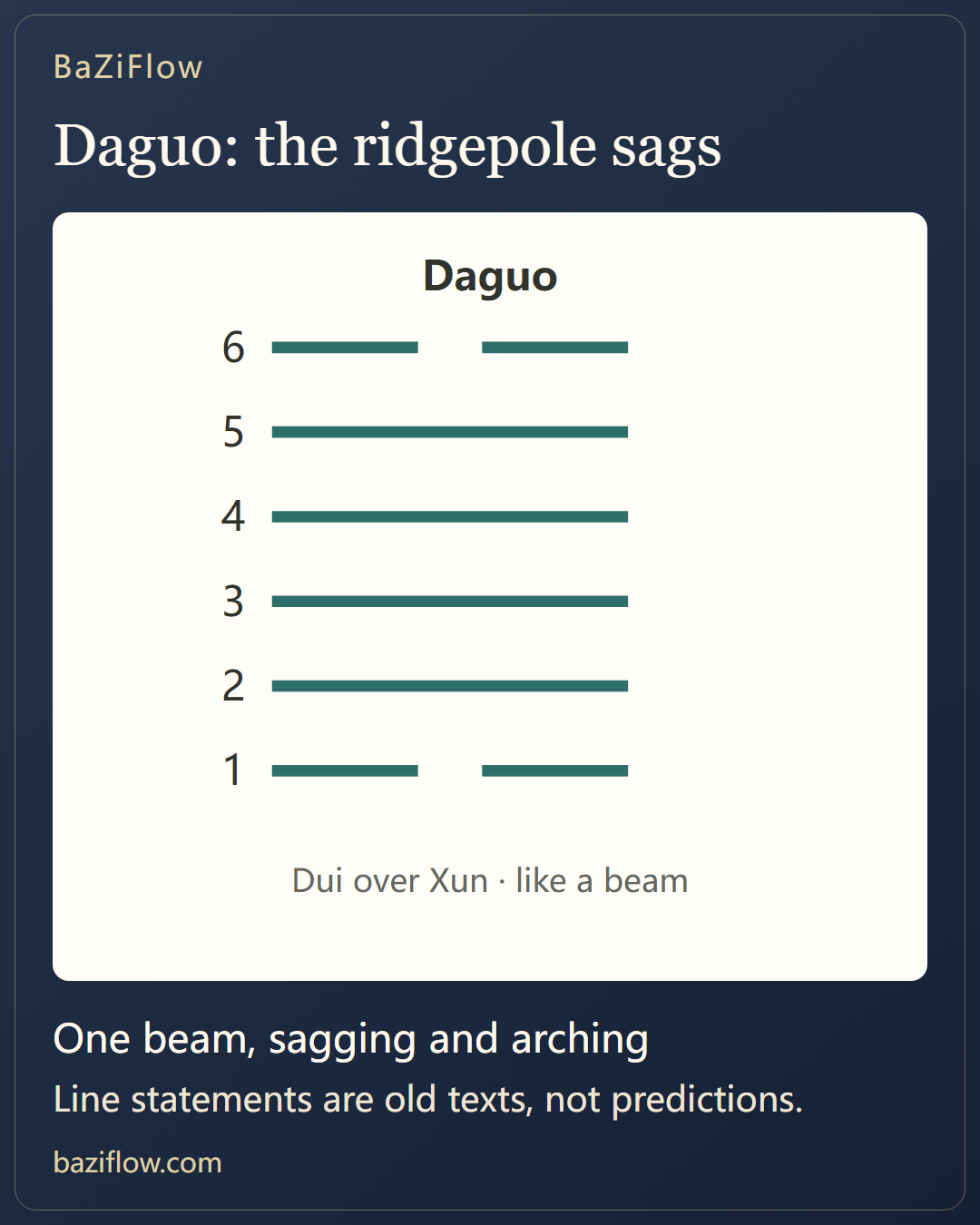
Daguo is the 28th hexagram: four yang lines between two yin, like a beam heavy in the center and thin at the tips. The judgment says the ridgepole sags; the statements run poplar to poplar and end in water over the head.
The short version7 min read
Daguo is heavy in the middle and light at the ends, and the Commentary on the Judgments follows the shape: the ridgepole sags, root and tip are weak. The statements put down white rushes first, set two poplars and two beams in the middle, and end with water over the head.
- Daguo (大過) is Dui (lake) over Xun (wind); the first and top lines are yin, and lines two to five are all yang. The Commentary says "the great go too far" and compares the figure to a roof beam: the ridgepole sags, root and tip are weak.
- The judgment says "the ridgepole sags" and then "fitting to have somewhere to go; success". The Commentary gives two conditions: the firm goes too far but stays central, and it enters gently and delights.
- The four middle statements run poplar, sagging beam, arching beam, poplar, held between "white rushes below" at the first line and "wading over the head" at the top; the Image is "stand alone without fear, withdraw without gloom".
Read first
The Sixty-Four Hexagrams: How Upper and Lower Trigrams Form One Figure ↗
Judgment and Line Statements: Whole Hexagram or Single Line? ↗
A beam: four yang in the middle, one yin at each end
Daguo (大過) is the 28th hexagram. The lower trigram is Xun (wind), the upper is Dui (lake). The first line at the bottom and the top line are yin; lines two through five are all yang. The ends are slight and the middle is heavy, and the Commentary on the Judgments likens it to the main beam of a roof: "the ridgepole sags; root and tip are weak".
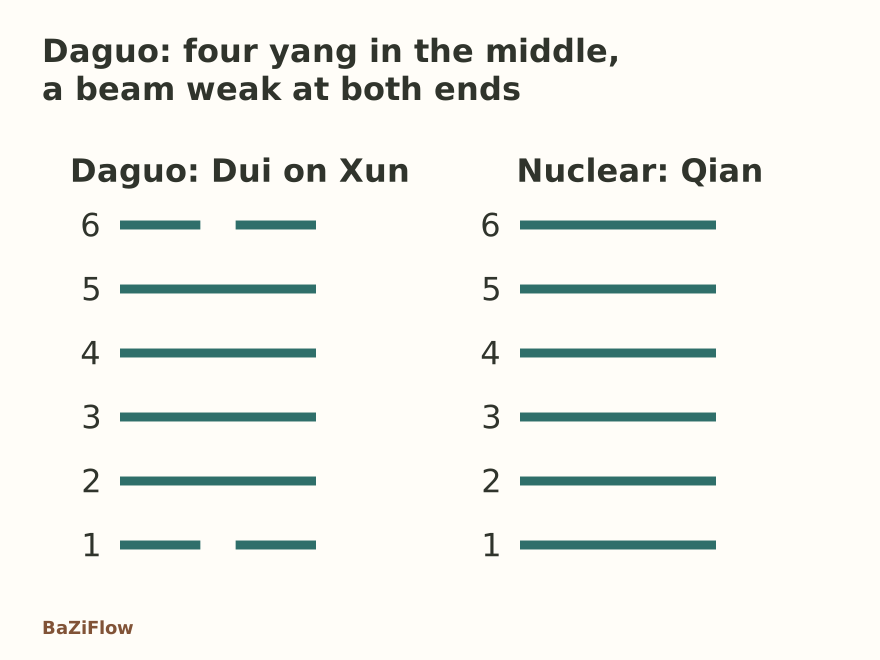
Daguo and its nuclear hexagram Qian: regroup the four middle yang lines as two to four and three to five and each group is a Qian.
Enlarge diagram · scroll sideways to read
Words in Daguo
- Daguo
- The Commentary on the Judgments says "the great go too far": the great side overshoots. "Great" means the yang lines and "go too far" means to exceed or overdo.
- Ridgepole sags
- The ridgepole is the main beam along the peak of a roof and "sags" means it bends downward. The phrase opens the judgment and recurs in line three; line four answers it with the opposite word, "the ridgepole arches".
- Root and tip
- The root is one end of the beam and the tip is the other. The Commentary glosses the sagging with "root and tip are weak", which matches the single yin line at each end of the figure.
In the Shuo Gua, Xun is wood and Dui is a lake, which is why the Image says the lake submerges the tree. From one figure the Commentary on the Judgments sees a beam and the Image sees water and wood.
The judgment and the Commentary: first "sags", then "success"
The judgment of Daguo is a little more than one line: "the ridgepole sags; fitting to have somewhere to go; success". It opens with bad news and ends with success, and the Commentary on the Judgments supplies the conditions in between.
Daguo: the great go too far. "The ridgepole sags": root and tip are weak. The firm goes too far yet stays central; entering gently and delighting, it proceeds. "Fitting to have somewhere to go", and so success. How great is the time of Daguo!
Enlarge diagram · scroll sideways to read
"Root and tip are weak" is read off the figure: the four middle yang lines are the body of the beam, and the yin lines at each end are its root and tip, weak. "The firm goes too far yet stays central" means that although the yang lines overshoot, lines two and five sit in the center of the lower and upper trigrams. "Entering gently and delighting, it proceeds" is the virtue of the two trigrams: Xun enters, Dui delights. With that the Commentary joins the opening "sags" to the closing "success".
The Image: the lake submerges the tree
The Image drops the beam and speaks of water and wood.
The lake submerges the tree: Daguo. The noble person stands alone without fear, withdraws from the world without gloom.
Enlarge diagram · scroll sideways to read
In this Image the noble person has two things to do, and each is followed by a feeling that is denied: standing alone, without fear; withdrawing, without gloom. Standing alone is one person on their feet, withdrawing is leaving the world, and fear and gloom are the moods most likely to arrive in either state. The tree is under water, yet the Image speaks of the person who stands, not of the drowned wood. The verb for withdrawing is also the name of the 33rd hexagram.
The six lines: poplar, sagging beam, arching beam, poplar
The six statements can be read like this: the first line at the bottom and the top line are yin, the two ends, and the four yang lines in the middle make a symmetrical sequence.
Enlarge diagram · scroll sideways to read
The first line is at the bottom and describes a very small act: "lay white rushes underneath", spreading a mat of rushes before setting something down. The Small Image is short: "the yielding is below". The top line is at the other end and describes a crossing: "wading too deep, the water covers the head", and the statement says both "misfortune" and "no blame".
The four in the middle run: line two a withered poplar, line three a sagging beam, line four an arching beam, line five a withered poplar. The poplar of line two puts out a shoot, and the poplar of line five puts out flowers, one at each end of the run. Between them is the one beam. At line three it sags: misfortune, and the Small Image says "it cannot be given support", nothing to prop it. At line four it arches: good fortune, and the Small Image says "it does not sag toward below", with a last clause, "something else brings regret".
Yi, Qian and the Xu Gua: two neighbors of Daguo
The inverse of Daguo is Yi (頤): every line changes polarity, the yin ends become yang and the four yang lines become yin, which gives the mouth. Flip Daguo over and you get Daguo again, so its reversed form is itself. Take lines two to four and then lines three to five and each group is three yang lines: the nuclear hexagram is Qian (乾), two of them stacked.
Enlarge diagram · scroll sideways to read
The Xu Gua goes from Yi to Daguo through the pair nourishing and moving: without first being nourished, a thing cannot be set in motion, and since "a thing cannot go on overreaching to the end", the next hexagram is Kan (坎). Daguo sits between those two gates, and what it writes about is going too far.
Questions readers ask next
Does the "guo" in Daguo mean a fault?
No. The Commentary on the Judgments explains it as "the great go too far", where guo means to exceed or go beyond. The great are the yang lines, which here crowd into four in the middle, more than the ordinary proportion.
Lines 2 and 5 both speak of an old man and an old woman: does the text approve?
The verdicts differ. Line 2 says "nothing unfavorable", while line 5 says "no blame, no praise", and its Small Image adds "how can that last" and "also a cause for shame". Both use the withered poplar, yet one verdict leans favorable and the other is reserved, so the pair cannot be taken as one approval.
Does "withdraw from the world without gloom" tell people to hide?
The Image sets "stand alone without fear" beside "withdraw without gloom". The first is one person standing, the second a leaving; both end on a feeling, fearless and not gloomy. The verb for withdrawing is also the name of the 33rd hexagram, which is no reason to merge the two.
Was this article helpful?
Sources & references
Continue reading
Yi (頤): a hexagram shaped like a mouth, and the "upside-down" and "against" nourishing ↗
Kan: repeated pits, "only the heart passes through", and "ill" only at the two ends ↗
The Sixty-Four Hexagrams: How Upper and Lower Trigrams Form One Figure ↗
Judgment and Line Statements: Whole Hexagram or Single Line? ↗