

Seven of Swords: five in arms, two left standing
Content version · · Sources & references
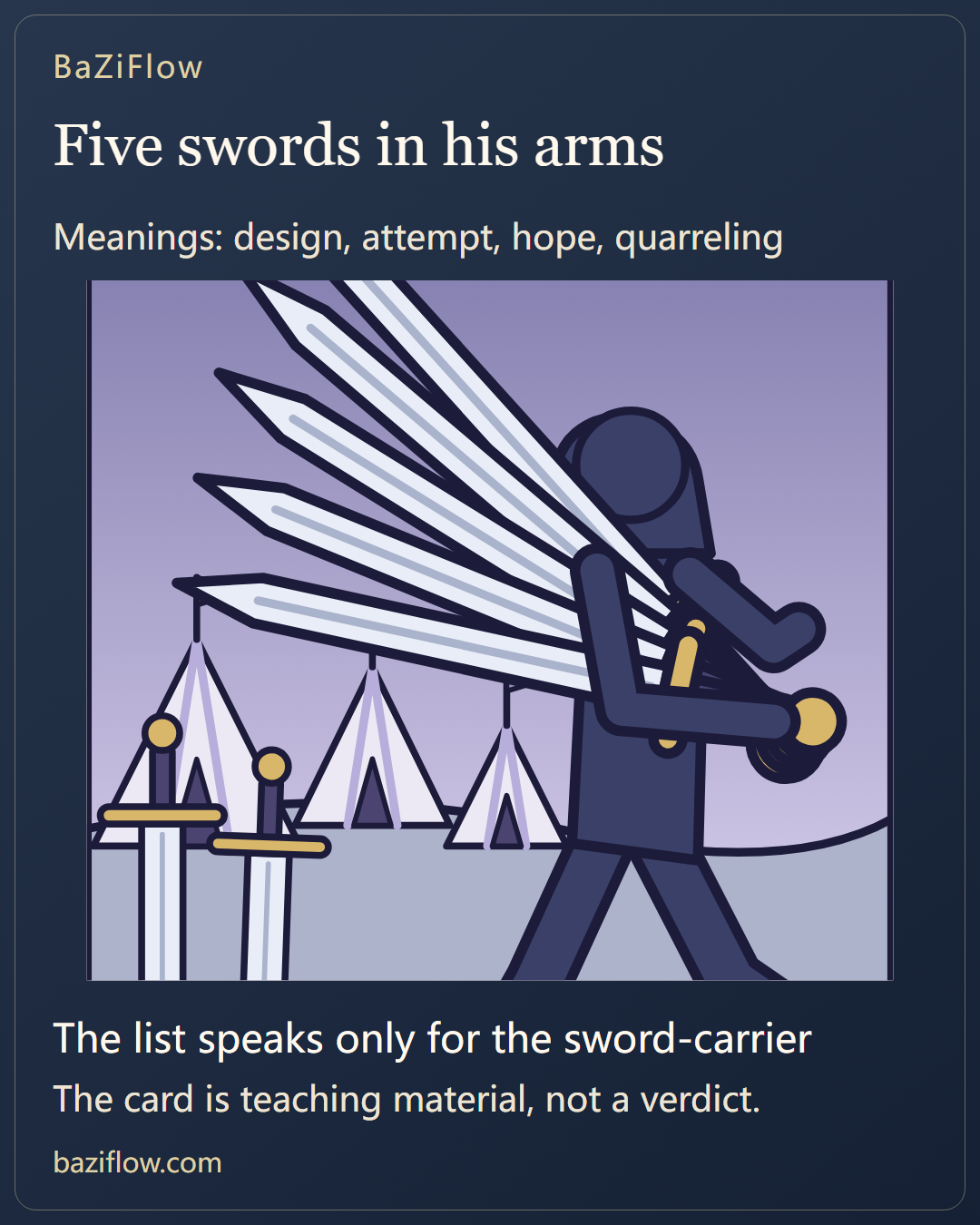
The Seven of Swords shows a figure hurrying off with five swords while two are left in the ground and a camp close by. Separate Waite's list, his reservation and the later "sneaking" reading, then try a handover sheet.
The short version6 min read
The Seven of Swords gives two numbers before anything else: five swords carried off, two left in the ground. Waite's list holds confidence and quarreling together, and he says himself that the meanings are widely at variance.
- Waite's picture: a man rapidly carrying away five swords while the other two stay stuck in the ground and a camp is close at hand; the list runs from design and hope to quarreling and a plan that may fail.
- Every word in the upright list belongs to the one carrying the swords; none says what the camp thinks. The reversed words are all speech: advice, instruction, slander, babbling.
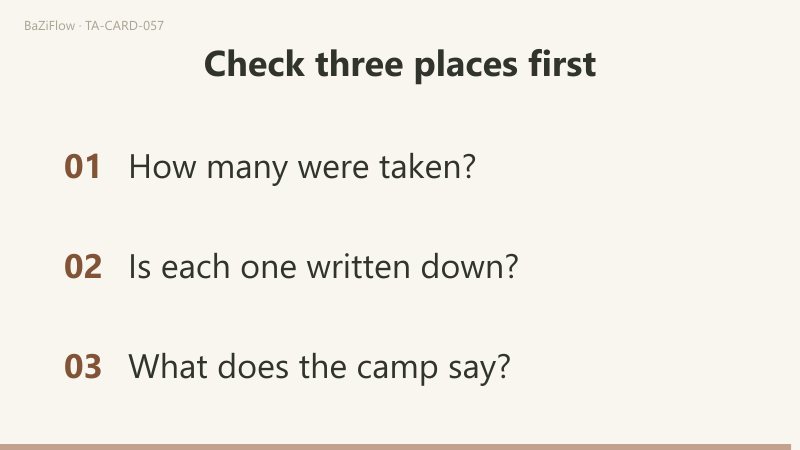
- In a question, check three places first: how many were taken, whether it was written down, and what the camp says. Do not use the card to judge anyone's motives.
Read first
Five in the arms, two left in the ground: count first
Waite's description of the Seven of Swords is two short sentences: a man in the act of carrying away five swords rapidly, while the two others of the card remain stuck in the ground. A camp is close at hand.
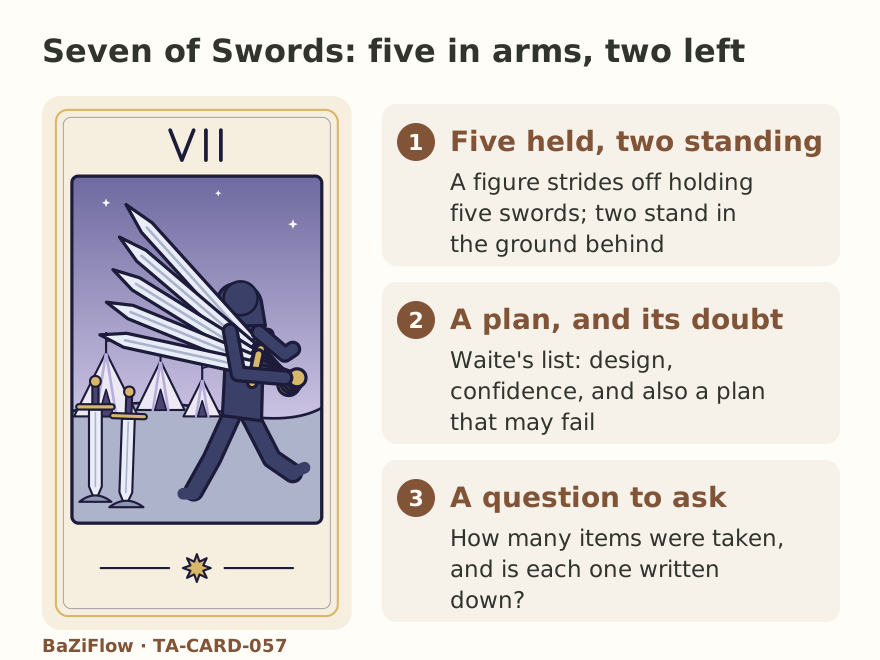
BaZiFlow original Seven of Swords
On the Rider-Waite-Smith card he wears a red cap and red boots, leans forward into a long step and turns his face back over his shoulder. A bundle of blades lies in his arms, pommels up by his shoulder and blades slanting down in front of him. The other two swords stand upright at the right, beside tents and a flag. Sorted by place, the picture has three spots: the arms, the ground and the background.
Enlarge diagram · scroll sideways to read
What Waite lists: a plan and a confidence, then an "also"
The divinatory meanings open with a run of forward-leaning words: design, attempt, wish, hope, confidence. Then comes "also", and the list turns to quarreling, a plan that may fail, and annoyance. Waite adds his own reservation right after: the design is uncertain in its import, because the significations are widely at variance with each other.
Design, attempt, wish, hope, confidence; also quarrelling, a plan that may fail, annoyance.
Enlarge diagram · scroll sideways to read
One thing stands out in these words: not one of them mentions anyone in the camp. Design, attempt, wish, hope and confidence all describe the mind of the one carrying the swords, while quarreling and annoyance are what the plan stirs up. The list speaks from one side only, and whoever asks the question has to supply the other.
The additional meanings, which Waite collects in Part III §4 from other readers, say: "Dark girl; a good card; it promises a country life after a competence has been secured". That is physical-appearance wording from the early 1900s. For teaching you need not use it as a label for anyone.
The camp, the stride and the five blades: who said what
The card has few details, but each one deserves a question: did Waite write it, is it seen in the picture, or was it added later?
Three details, three sources
- Five and two
- Waite states it outright: five swords carried away, the two others stuck in the ground. Seven is the number of the card, and five-and-two is how the picture divides it.
- The camp
- Waite says a camp is close at hand and never says whose it is or who is in it. The Rider-Waite-Smith picture shows tents and a flag on the right; swords beside tents give a military backdrop, which comes from the drawing, not from his explanation.
- The stride
- Waite writes "rapidly". The forward lean and the face turned back belong to the Rider-Waite-Smith drawing. The sense of sneaking is not written in this entry.
Enlarge diagram · scroll sideways to read
The third column holds convenient teaching analogies. They turn the card into something you can count, and none of them is a sentence from this entry. The next section uses the first of them, the count.
How to read it: sort a venue handover into carried, left and in sight
The Seven of Swords comes with a countable structure: some items carried off, some left where they were, and a camp close by, meaning there is somewhere to cross-check. Carry that over to a small everyday matter and you get three steps for a handover sheet.
Count: how many out, how many left
Do not judge yet; just count. The card's total is seven, split five and two. Take your own list and split it the same way into what has moved and what has not.
Match: is every destination written
For each item that left, the sheet should name where it went and who received it. For each one left behind, it should say why. If a line is missing, add it instead of guessing.
Look: what does the camp say
The word list holds only the carrier's state of mind. A camp close at hand suggests asking the nearest other party whether their records agree with your sheet.
A small example: after a neighborhood market, seven borrowed items are to be returned to the venue. Five are already on the truck and two still stand inside the hall. On the handover sheet:
Enlarge diagram · scroll sideways to read
Reversed and neighboring cards: from doing to saying
Waite's reversed list swaps the whole kind of word: good advice, counsel, instruction; slander, babbling. Upright circles planning and attempting; reversed circles speech, both the kind meant well and the kind meant to wound. The additional meanings add "good advice" under reversed as well, followed by "probably neglected".
Enlarge diagram · scroll sideways to read
When you read it reversed, the question can change to: in this matter, who is saying what to whom, and did anyone take it in? Say whose rules you are using before you turn the card.
Three other cards with swords, and where each stands
The winner and two who withdraw
Waite calls him the master in possession of the field, with the others' swords on the ground. There is an opponent present. The Seven has none on stage, only a camp.
A ferryman and his passengers
The list: journey by water, route, envoy, expedient. He carries people to the far shore, whereas the Seven carries swords and has no passenger.
Swords about a bound figure
A blindfolded, bound figure with the swords standing around her and nobody acting; in the Seven the swords are in the arms of the one who acts.
Questions readers ask next
Is the Seven of Swords the "stealing" card?
Waite's picture says "carrying away", and the list reads design, attempt, wish, hope, confidence, plus quarreling and a plan that may fail. No word for theft appears, and he adds that the meanings differ widely. Stealth and deceit are later readings, so label them as such.
How do I read the Seven of Swords reversed?
Waite's reversed words are good advice, counsel, instruction, and also slander and babbling. The extras give only "good advice, probably neglected". The upright words circle doing and the reversed ones circle saying, so you might ask who is speaking to whom.
Whose camp is it on the card?
Waite only says a camp is close at hand, without owner or occupants. The Rider-Waite-Smith picture puts tents and a flag on the right. Reading the camp as "a place where things get noticed" is a teaching borrowing, not Waite's sentence.
Was this article helpful?
Sources & references
Continue reading
Six of Swords: a punt with six swords crosses over, and Waite notes the load is light ↗
Eight of Swords: bound and blindfolded, blades standing near, and a yardstick of "durance" ↗