

Framing a tarot question
Content version · · Sources & references
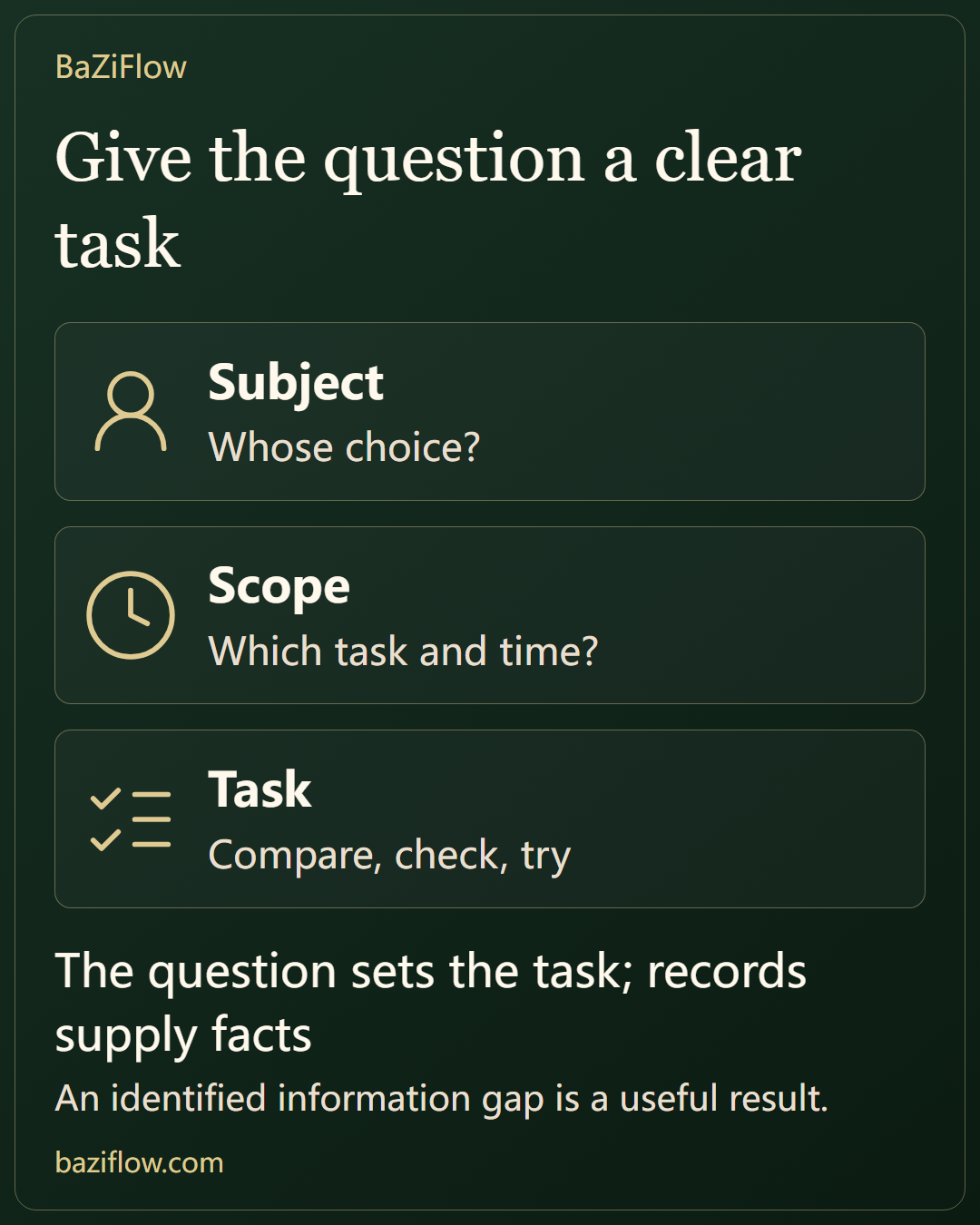
Separate a subject, a scope and a task from assumptions smuggled into the wording. A library-newsletter example shows how a specific question can support reflection while leaving facts and decisions with people.
The short version6 min read
A question sets the work a reading is meant to do. Define its subject, scope and task, then inspect any unconfirmed conclusion already hidden in the wording. This lets image associations address a specific situation while keeping real information gaps visible.
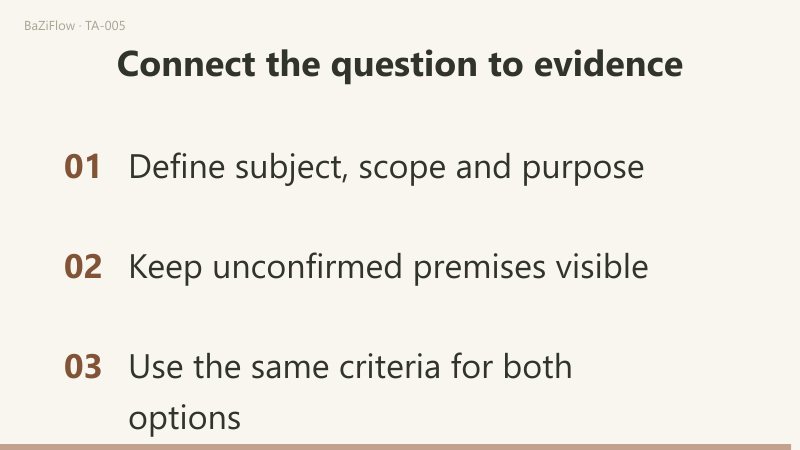
- Subject, scope and task constrain a discussion. Clear wording reduces arbitrary additions; it does not guarantee prediction.
- “Who is undermining me?” already assumes an underminer. Separate known observations from unknown causes before asking about motives.
- A choice needs shared comparison criteria. Requirements and dates must come from appropriate records rather than from an additional draw.
Read first
A clearer question is a clearer task, not a stronger oracle
“Will this work out?” leaves the reader to invent the activity, time period and standard of success. Narrowing it helps define the discussion and limits arbitrary additions. It does not turn an image into a reliable source of future facts.
For an original exercise, suppose you are preparing a library newsletter. Ask: “Before the deadline, what should I check in this draft?” The subject is your preparation, the scope is the current deadline, and the task is a check. Publication requirements, dates and permissions still need to come from actual records. A card may prompt an angle of attention; it cannot supply missing requirements.
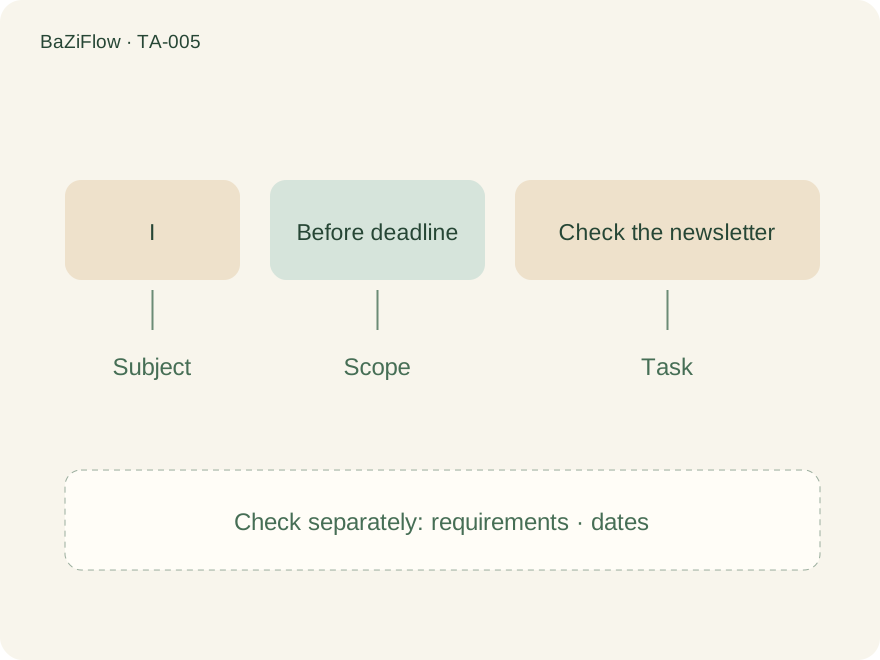
Original BaZiFlow question diagram. This is a teaching example, not a wording formula claimed to guarantee predictive accuracy.
| Component | Function in the example |
|---|---|
| Subject | My preparation, not someone else's unspoken intention |
| Scope | This draft before this deadline, not every future project |
| Task | Identify a check, not predeclare success or failure |
A well-framed question may remain unanswered because information is unavailable. That can be a useful result: it identifies the source you need rather than encouraging the reader to fill the gap with an interpretation.
Inspect the assumptions already inside the question
“Why does everyone undermine my work?” presupposes both a universal pattern and a motive. If the available fact is one late contribution, the question has added much more than the evidence supplies. “Why do I always fail?” can similarly erase completed work before any card appears.
List what is known and what is not. For the newsletter, perhaps one article is late, the deadline was sent on a particular date, and the contributor has not yet replied. Whether they saw the message or understood the specification may be unknown. Keep those as questions instead of converting them into an intention.
A revision might ask which preparation condition remains unconfirmed or which communication you can make clearer. This is not a demand to replace every negative word with a positive one. The purpose is to remove an unverified premise, while retaining real difficulties when evidence supports them.
The same discipline applies to a question about another person. Their thoughts cannot be established by choosing a clever form of words. You can examine your own communication, the information actually shared and the choices available to you without claiming to speak for them.
When the task and its unresolved assumptions are clear, preserve them in the draw record. If the wording changes later, retain both versions so the reader can see which question each interpretation actually answered.
Inference in the question
A workable revision
Give alternatives the same comparison questions
“Option A or option B?” sounds precise but may omit time, resources and practical requirements. Two cards placed symmetrically do not make the alternatives symmetrical. One newsletter format might require unavailable material while another uses what is already cleared. That difference needs to survive the symbolic discussion.
Compare each option against the same explicit dimensions, then list missing information separately. A card can prompt reflection on a preference, but a bright-looking image does not repair an unusable file or confirm a publication date. Keep the decision with the person who must act, and allow it to change when new facts arrive.
A more useful question than “Which option does the deck choose for me?” may be “What information do I still need to compare these options?” If the answer is a specification or a reply, obtaining it is the next practical step. Drawing again does not create an alternative source for that fact.
Same criterion
Required material
- Option A
- Check specification
- Option B
- Check specification
Available time
- Option A
- Check schedule
- Option B
- Check schedule
Missing facts
- Option A
- List separately
- Option B
- List separately
Historical procedure and evidence-based learning
Waite’s III.8 actually recommends its general method when no definite question is asked. If a particular period is intended, he asks that it be specified before shuffling. It supports declaring that time condition in advance, not a rule that every reading requires a specific question. The bounded learning task recommended here is this article’s exercise design.
The National Archives document-analysis resource teaches observation and contextual understanding as a basis for informed judgments. Its relevance here is educational: a question should lead towards appropriate evidence. It is not an institutional endorsement of tarot, and it should not be blended with the historical manual into an undefined claim of authority.
Image idea
- Suggests a focus
- Raises a question
Real records
- Supplies requirements
- Checks feasibility
Different jobs: an association does not supply a missing fact
An unconfirmed date is a concrete result
A newsletter editor may finish a reflective exercise with one unresolved date rather than a verdict about success. That can still identify useful work: obtain the event organiser’s confirmation. Making the question broader until every date seems possible would hide the gap instead of resolving it.
Record the initial question, known background, unverified assumptions and intended scope. If you change the question after seeing the cards, preserve the earlier version and explain what changed. Otherwise, a smooth interpretation may look like an answer to the original task when it actually answers a new one.
For the newsletter, an unconfirmed event date stays unconfirmed. Do not invent a date to complete the reading. The exercise can finish with a request to the organiser or a check of the publication calendar. One clearly identified information gap is a more concrete outcome than a paragraph broad enough to suit every draft.
Avoid widening the question whenever an image is difficult to use. If any card can become an answer only because the task continually expands, the wording has stopped constraining the discussion. It is acceptable to say that a proposed association did not help.
This gives us a test for the question itself: can it distinguish a missing fact from an interpretation? The comparison of two publication options above applies that test.
Find one premise
Check whether words such as always, deliberately or certainly have evidence.
Keep one bounded task
Choose a check or comparison without adding every future project.
Name the information source
Obtain a schedule or specification when that is what is missing.
Use a three-card spread to separate tasks after defining them. If the task keeps changing until an answer feels agreeable, review repeating the same question rather than treating each revision as new evidence.
Questions readers ask next
Must every tarot question specify a period of time?
Not every question needs an exact date, but its scope should be understandable. This article recommends bounded learning tasks. Waite’s III.8 allows a general reading without a definite question and asks for advance specification if a period is intended.
Is making the question sound positive enough?
No. Replacing “Why do I always fail?” with “How can I always succeed?” can retain an absolute premise. A useful revision identifies what is completed, what remains unfinished and which particular condition needs investigation.
When should I obtain information before drawing again?
When the missing answer is a course requirement, work schedule, date or specification, a relevant record or person can supply it. Images can then prompt reflection on preferences or preparation without disguising missing facts as interpretation.
Was this article helpful?
Theme: Decisions & questions
Part of a learning path
Tarot: from the question to the review · Step 3 of 3 available