

Justice: one scale, one sword
Content version · · Sources & references
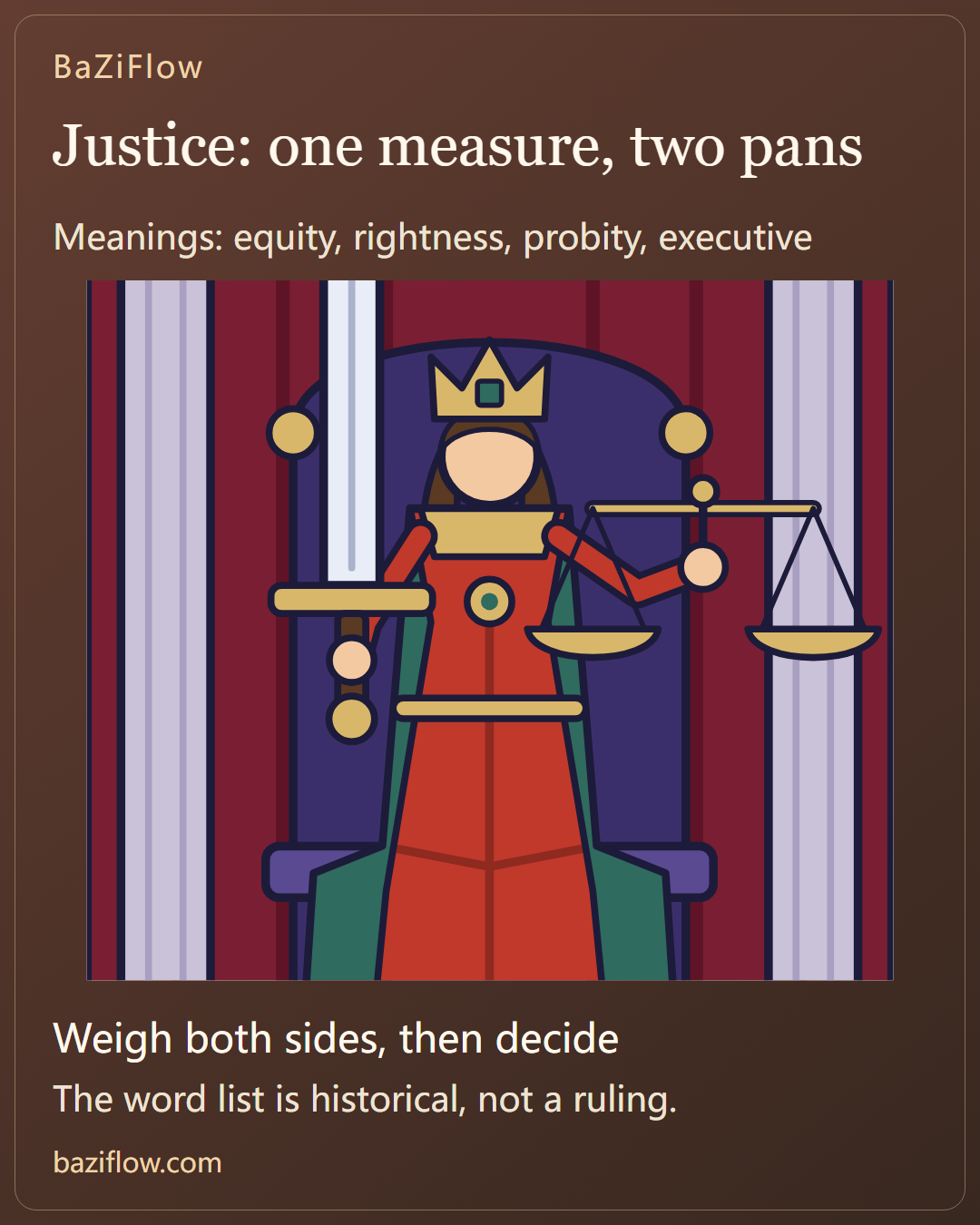
Justice seats a figure between two pillars, an upright sword in one hand and scales in the other. Separate Waite's picture, word list and the line he draws, then practice one measure for both sides on a shift schedule.
The short version7 min read
In Justice a sword stands up while a scale hangs down. Three of Waite's words ask "is it fair?" and one asks "was it carried out?", so first tell which question you are reading.
- Waite wrote almost no picture for the card. He notes one thing: the figure sits between pillars, like the High Priestess. The divinatory list is equity, rightness, probity, executive, and the deserving side winning in law.
- In Part II he draws a line: the principle that deals to each according to his works is different in essence from the spiritual justice tied to election, which has no canon of criticism.
- The reversed list has five items: law in all its departments, legal complications, bigotry, bias, excessive severity. The practice follows the picture: one hook, two pans, the sword held up first.
Read first
Start with the picture: between two pillars, a sword upright and a scale hanging
Waite wrote almost no picture for this card. He says it follows the traditional symbolism and carries above all its obvious meanings, so there is little to add beyond the few considerations collected in his first part. He adds one point only: the figure is seated between pillars, like the High Priestess.
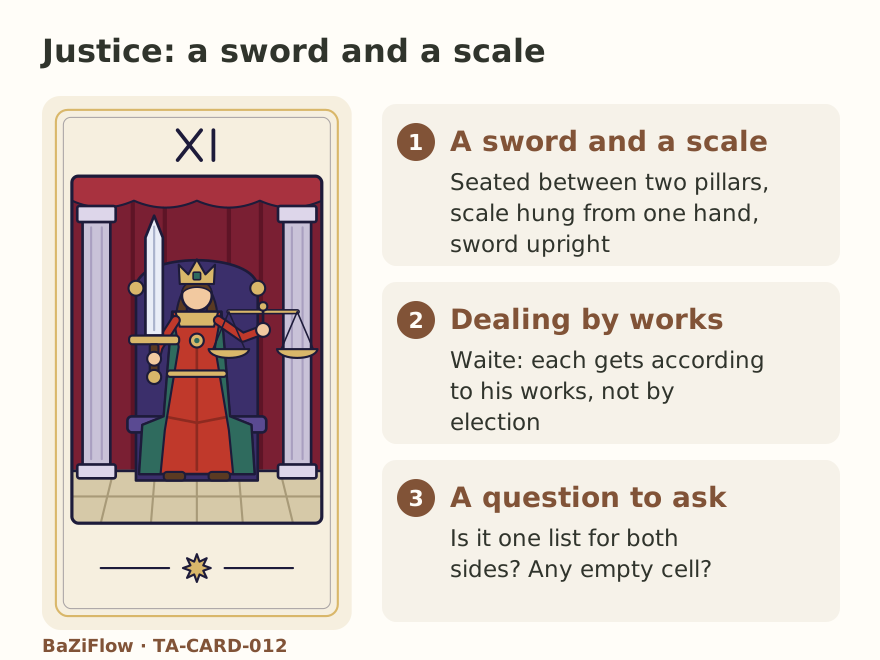
BaZiFlow's original Justice with three ways to read it
In the Rider-Waite-Smith picture a crowned figure sits at the center in a red robe and a green cape, with a square clasp at the chest. One hand grips an upright sword; from the other hangs a pair of scales, a pan at each end of the beam. Behind is a crimson-purple curtain, two tall grey pillars stand at the sides, and the numeral XI is printed in the yellow arch at the top.
Read it from the outside in: two pillars, one figure, and in the hands one sword and one scale.
Enlarge diagram · scroll sideways to read
What Waite lists: equity, rightness, probity, executive, and the deserving side
Waite's divinatory meaning is a single line:
Equity, rightness, probity, executive; triumph of the deserving side in law.
Of the four words, the first three ask "is this fair?" and the fourth, executive, asks "was the decision carried out?" The closing clause confines winning to the law and requires that the winner be the deserving side. No word in the list says "win" on its own.
Enlarge diagram · scroll sideways to read
Pillars, scale, sword: only the pillars come from Waite
Waite points only to the pillars: the figure sits between them, like the High Priestess, and he closes his note by saying that the pillars of Justice open into one world and those of the High Priestess into another. What each pillar stands for he does not say, and the scale and the sword get no mention at all.
Pillars, scale, sword: where each comes from
- Two pillars
- Waite says it outright: the figure sits between pillars, like the High Priestess, but the two sets open into different worlds. It is the only picture element he names for this card.
- Scale
- Not in Waite's text; in the picture it hangs from one hand. A scale compares two sides, which is common knowledge. Reading it as "one standard for both sides" is a borrowing from modern teaching.
- Sword
- Not in his text either. The word list has "executive", and a sword is commonly tied to judgment and power. Matching it to "executive" is a teaching correspondence, not Waite's statement.
Enlarge diagram · scroll sideways to read
The line Waite draws next is worth more than the pillars. He says the moral principle which deals unto every man according to his works, in strict analogy with higher things, differs in its essence from the spiritual justice involved in the idea of election.
The latter, he says, belongs to a mysterious order of Providence, "like the breathing of the Spirit where it wills", and we have no canon of criticism or ground of explanation concerning it. He compares it to the gifts of the poet: we have them or have not, and their presence is as much a mystery as their absence. The law of Justice, he concludes, is not involved by either alternative.
How to read it: one hook, two pans, and the sword held up until the weighing is done
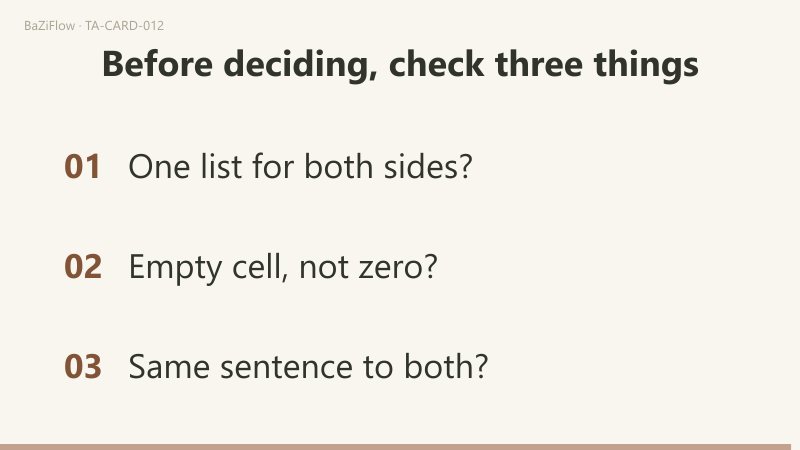
The picture supplies a structure: both pans hang from one hand, so both sides are weighed by the same measure, and the sword stays upright instead of pointing at either pan. Moved into daily life, that becomes three steps. It is teaching built on the picture, not Waite's own method.
Fix the hook: one list for both sides
Before you hear either side's reasons, write down what counts in this matter: who asked first, whose turn it was, which shift must be covered. Use one list for both sides; if you add an item halfway, add it for both.
Fill the pans: the same rows, once per side
Enter each side's facts against the same list. A cell you cannot fill is marked empty, not zero: empty means nobody has asked yet.
Lower the sword last: one sentence, the same for both
Write the decision as one sentence that names the items it rests on, and say that same sentence to both sides. While an empty cell remains, the sword stays up and the next step is to ask.
Say two colleagues both ask for the same week off, and the team needs at least two people on every shift that week. Three steps later you have a sheet like this:
Enlarge diagram · scroll sideways to read
What fits on the pans
On the scale
- Who filed first
- How often each had leave
Off the scale
- Liking one person more
- What nobody has asked
Before the sword
- Fill the empty cell
- Write the basis in a line
Reversed and neighboring cards: bias, excessive severity, and two more cards between pillars
Waite's reversed list for Justice has five items:
Law in all its departments, legal complications, bigotry, bias, excessive severity.
Read them in two groups. The first two words are about law itself growing wide and tangled; the last three are about the weighing going wrong. In the picture, bias is a beam tilted to one side, and excessive severity is a sword that has come down heavier than the weighing supports. That mapping is a teaching device, not Waite's wording.
Enlarge diagram · scroll sideways to read
Two more cards between pillars, and one that writes about lawsuits
Another pair of pillars, another world
Waite says her pillars, the J. and B. of the Temple, open into a different world than those of Justice. Her list: secrets, mystery, the future as yet unrevealed, silence.
Also seated between two pillars
Waite writes that these are not the pillars of the Temple the High Priestess guards. His list opens with marriage, alliance, captivity and servitude; by another account, mercy and goodness.
Law placed at the ending
Its list: change of position, renewal, outcome; another account specifies total loss through a lawsuit; the reversed list ends with deliberation, decision, sentence. Justice asks who deserves; Judgement asks how it ended.
Enlarge diagram · scroll sideways to read
Questions readers ask next
Does Justice mean "I will win"?
Only the last clause speaks of winning: the deserving side, in law. The other words are about fairness, rightness, probity and carrying out a decision. Who deserves what has to be checked against evidence; the card cannot answer it.
Is Justice number 8 or number 11?
In the Rider-Waite-Smith deck Justice is number 11, marked XI on the card, and Strength is 8. In some other deck traditions those two numbers are swapped, so when you read a source, check which system it uses.
Is reversed Justice just "unfair"?
Waite's reversed list reaches two ways: law itself growing wide and tangled, and the weighing going wrong through bigotry, bias and excessive severity. "Unfair" covers only the second.
Was this article helpful?
Sources & references
Continue reading
The High Priestess: seated between two pillars, her scroll half covered ↗
Strength: a lion led by a chain of flowers, already subdued, says Waite ↗