

Tongren (同人): how wide is the circle
Content version · · Sources & references
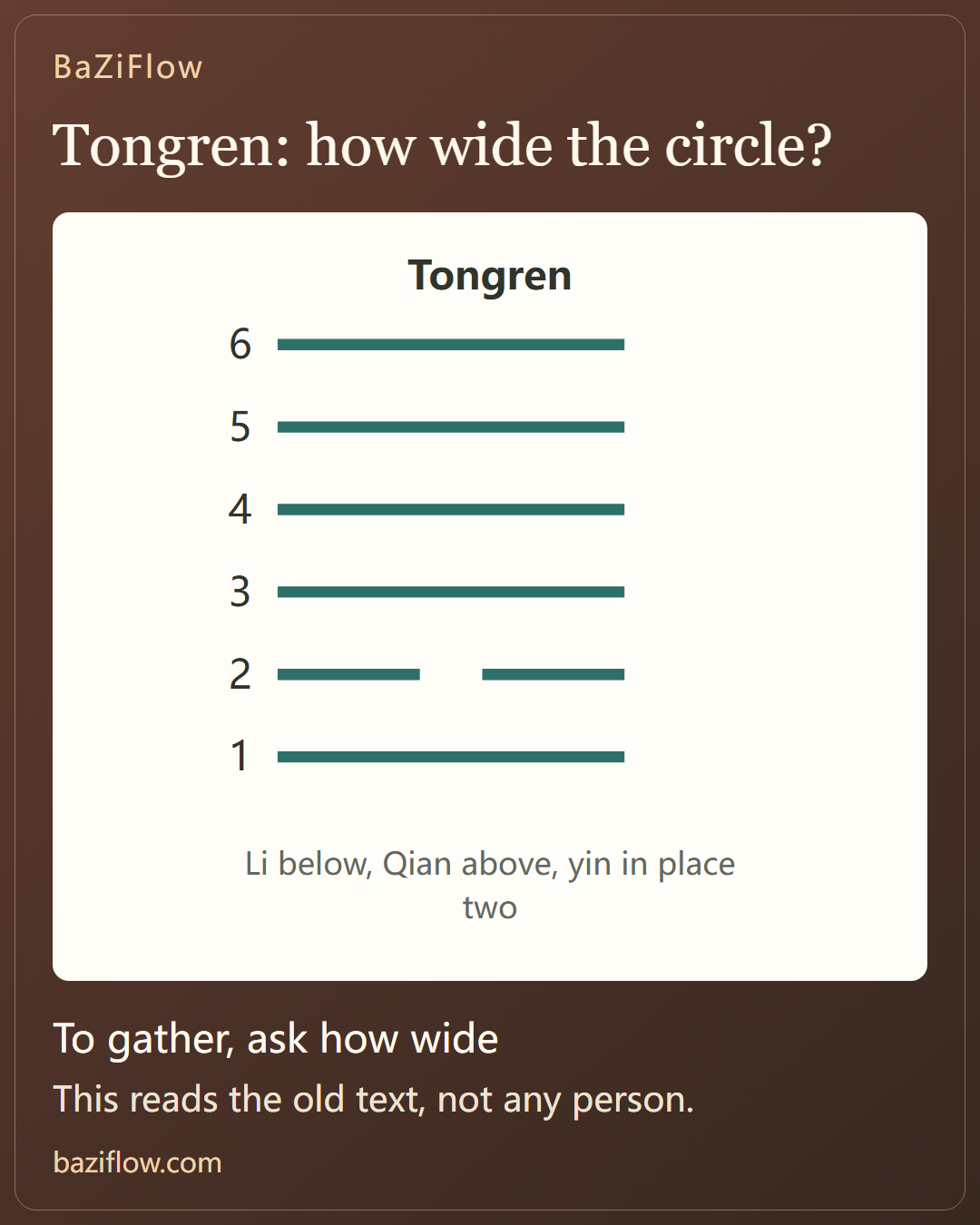
Tongren has Li (fire) below and Qian (heaven) above, with one yin line in the second place. Read the Judgment "gathering in the wild", the Great Image "sort the clans", and the places named in the six lines.
The short version7 min read
Tongren is about gathering people, but its text keeps naming places: the Judgment is in the wild, and the lines go in turn to the gate, the clan, the thicket, the wall and the outskirts. Read the places together and you can see how wide or narrow the circle of the "same" is.
- Tongren stacks Qian (heaven) on Li (fire) with a single yin line, in the second place. The Commentary on the Judgments explains the name with "the yielding gets its place and the middle, and answers Qian", then praises it as bright, strong and upright.
- The Judgment says "gathering in the wild: success", yet line 2 says "gathering in the clan: regret", which the Small Image calls "the way of regret". The same act of gathering, written with "wild" and with "clan", turns out opposite.
- The Great Image reads "heaven together with fire: Tongren; the noble person sorts the clans and distinguishes things": in a hexagram of gathering, the conduct is to sort and to tell apart.
Read first
The Sixty-Four Hexagrams: How Upper and Lower Trigrams Form One Figure ↗
Judgment and Line Statements: Whole Hexagram or Single Line? ↗
Heaven with fire: the shape of Tongren
Tongren (同人) sets Li (離, fire) under Qian (乾, heaven), and is read as Li below, Qian above. Only its second line is a broken yin line, and it sits exactly in the middle of the lower trigram; the other five lines are yang. In the Shuo Gua the word for Li is "clinging" and the word for Qian is "strength".
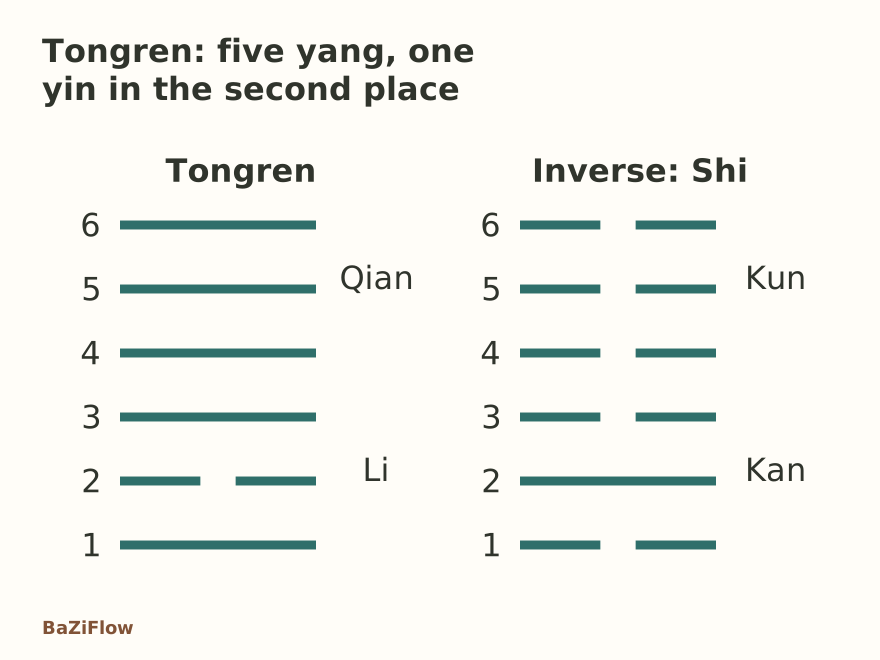
Tongren and its inverse hexagram Shi: a figure with its yin in place two and a figure with its yang in place two are each other's inverse.
Enlarge diagram · scroll sideways to read
Three terms to start with
- Tongren
- The name. The Commentary on the Judgments gives its origin first: "the yielding gets its place and the middle, and answers Qian: this is called Tongren". Line 2 is yin, holds its place, sits in the middle and answers Qian, hence the name. The Za Gua comments "closeness".
- The wild
- A place in the Judgment, open country. Five of the six lines also name places: gate, clan, thicket, wall, outskirts.
- Bright and strong
- The Commentary on the Judgments' description of the whole hexagram. Li is brightness and Qian is strength, and brightness joined to strength is "bright and strong".
The Judgment: gathering in the wild
The Judgment of Tongren reads: "Gathering with others in the wild: success. It is fitting to cross the great river; it is fitting for the noble person to be steadfast." The Commentary on the Judgments' explanation has two layers: first where the name comes from, and then the Judgment itself, quoted and carried forward.
Enlarge diagram · scroll sideways to read
In the second layer the Commentary on the Judgments brings the Judgment in: "Tongren, it says: gathering in the wild, success; fitting to cross the great river is the action of Qian." The words "it says" seem to let the Judgment speak for itself, and "crossing the great river" is credited to Qian's action. Then comes praise for the whole figure: "bright and strong, central and upright and answering: this is the noble person's uprightness".
Only the noble person is able to bring the aims of all under heaven through to one another.
That is the last sentence of the Commentary on the Judgments. The word "wild" is never glossed, but the tone of the whole passage is large.
The Great Image: heaven with fire, and sorting the clans
The Great Image (大象) of Tongren reads: heaven together with fire, Tongren; the noble person uses it to sort the clans and distinguish things. The first half is the figure, heaven (Qian) with fire (Li). The second half names two actions: sorting the clans and distinguishing things. Sorting is classifying, a clan is a kindred group, distinguishing is telling apart, and things are the objects around.
Enlarge diagram · scroll sideways to read
This hexagram is about coming together, yet the conduct it asks for is classifying and distinguishing. Before people are gathered, kinds have to be told apart and things made clear.
Six lines: gate, clan, thicket, wall, outskirts
Almost every one of the six statements names a place. It sets out at the gate and goes through the clan, the undergrowth and the wall, all the way to the outskirts.
Enlarge diagram · scroll sideways to read
First nine stands at the gate, and the moment he steps out he gathers with others, so there is "no blame", and the Small Image (小象) asks "who could blame him?". Six in the second place is "in the clan": a clan is a kindred group, the gathering stays among one's own, and the result is "regret", with the Small Image comment "the way of regret".
Nine in the third place: "he hides armed men in the thickets and climbs the high hill; for three years he does not rise". The Small Image comments that "the opponent is firm" and asks how he could go on. Nine in the fourth place: "he mounts the wall but cannot attack: good fortune". The Small Image reads it as "in right he cannot win" and "pressed, he returns to the rule": hemmed in, he returns to the norm.
Nine in the fifth place: "joining others: first wailing, then laughing. The great army overcomes and they meet." The Small Image's two comments are "because he is central and straight" and "it speaks of their overcoming one another". Top nine: "gathering in the outskirts: no regret". The outskirts are the land just outside a town, and the Small Image says "his aim is not yet achieved".
The neighbors of Tongren: Shi, Dayou and Gou
The inverse hexagram of Tongren is Shi: every line is flipped, the yin becomes yang, and the odd line still stands in place two. Turn the figure upside down and the yin line climbs to place five, giving its reversed hexagram Dayou, which is also the very next hexagram. The nuclear hexagram is Gou, built from the middle four lines as a new pair of trigrams, Xun below and Qian above.
Enlarge diagram · scroll sideways to read
Things cannot be blocked forever, so it was followed by Tongren.
The Xu Gua puts Tongren after Pi: a blockage cannot run to the end, so a hexagram of gathering follows. For what comes next, Dayou, its reason is that things must return to the one who is with others. The Za Gua gives Tongren a single word: "closeness".
Questions readers ask next
Does Tongren just mean companions?
The Za Gua comments with a single word, "closeness", while the Commentary on the Judgments explains the name from line 2 being central and answering Qian. Together they point to people gathering and growing close; how wide the gathering is depends on which place each line names.
What scene is "first wailing, then laughing" in line 5?
Literally he first cries out and later laughs, and the line goes on "the great army overcomes and they meet", a meeting after victory. The Small Image's two comments land on "central and straight" and on "overcoming", without developing the scene further.
What are the "armed men" hiding in the thicket?
The word means soldiers, armed people. Line 3 has them lying in ambush in the undergrowth and climbing a high hill, and for three years they cannot rise. A hexagram about gathering suddenly turns to opposition, and the Small Image's comment is "the opponent is firm".
Was this article helpful?
Sources & references
Continue reading
Pi (否): from "wrapping up" to "overturning", how a blockage runs its course ↗
Dayou: one yin line in the fifth place, held up by five yang lines ↗
The Sixty-Four Hexagrams: How Upper and Lower Trigrams Form One Figure ↗
Judgment and Line Statements: Whole Hexagram or Single Line? ↗