

Dayou: fire above heaven, on holding much
Content version · · Sources & references
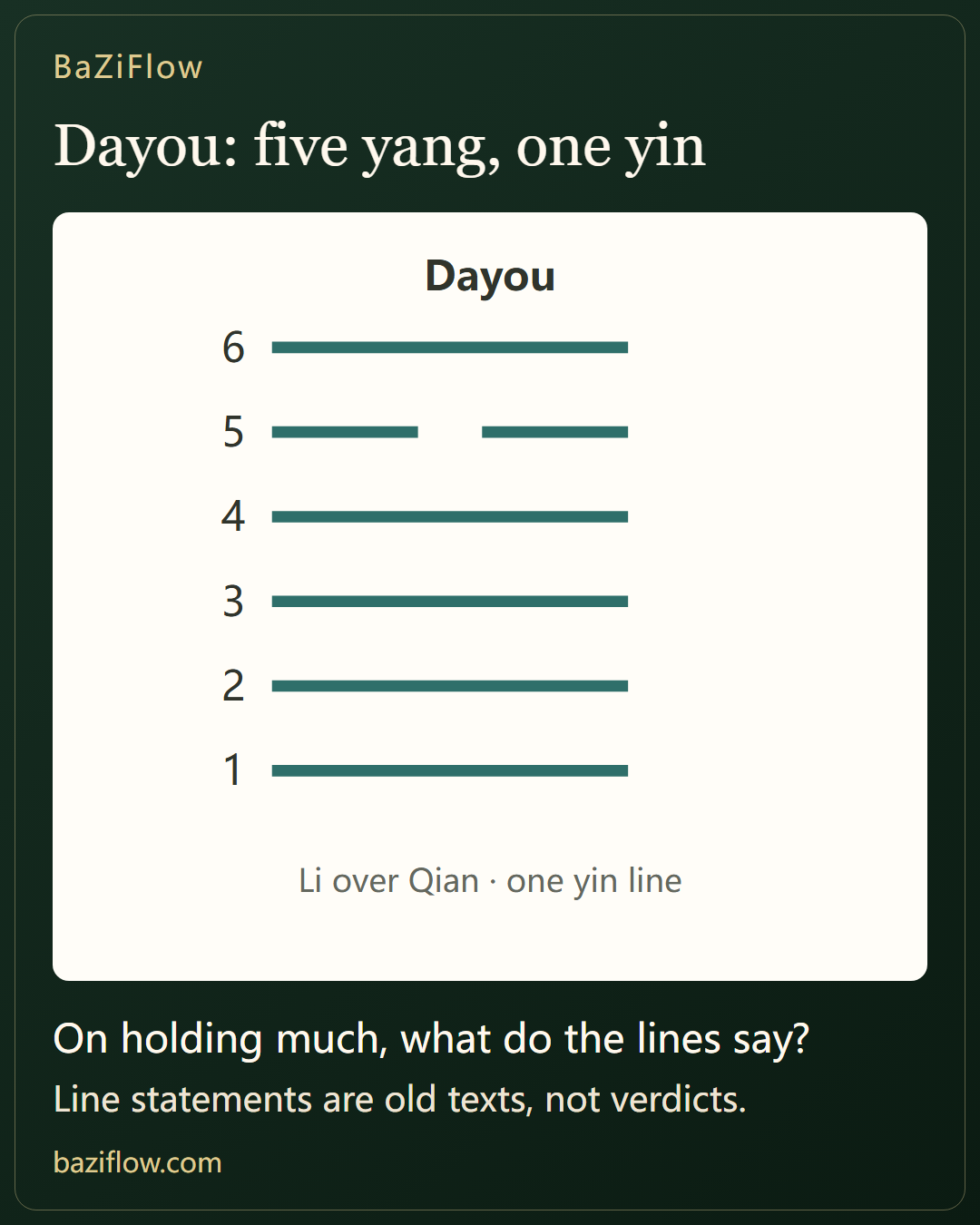
Dayou is the 14th hexagram: fire above heaven, with one yin line in the fifth place. The Commentary explains its name by position, not quantity; the lines run from "no contact with harm" to "blessed by heaven".
The short version7 min read
Dayou means "having much", yet the Commentary explains the name with one fact: a yin line has taken the fifth place, and the yang lines above and below answer it.
- Dayou (大有) is Li (fire) over Qian (heaven). Only the fifth line is yin; its inverse hexagram, Bi (比), has a single yang line in the same place.
- The Commentary works on two levels: position (the soft line in the honored seat, centered, answered above and below) explains the name, and character (firm and bright) explains "yuan heng".
- The Great Image calls for curbing evil and raising up good. The six statements read: no contact with harm, loading, offering, discerning, trust with dignity, help from heaven.
Read first
The Sixty-Four Hexagrams: How Upper and Lower Trigrams Form One Figure ↗
Judgment and Line Statements: Whole Hexagram or Single Line? ↗
Fire above heaven: five yang lines holding up one yin line
Dayou (大有) is the 14th hexagram: Qian (heaven) below, Li (fire) above. Of its six lines only one is yin, in the fifth place; the other five are yang. The name literally means "having much", but when the Commentary on the Judgments (彖传) explains it, the first thing it looks at is not a quantity. It looks at where that one yin line is sitting.
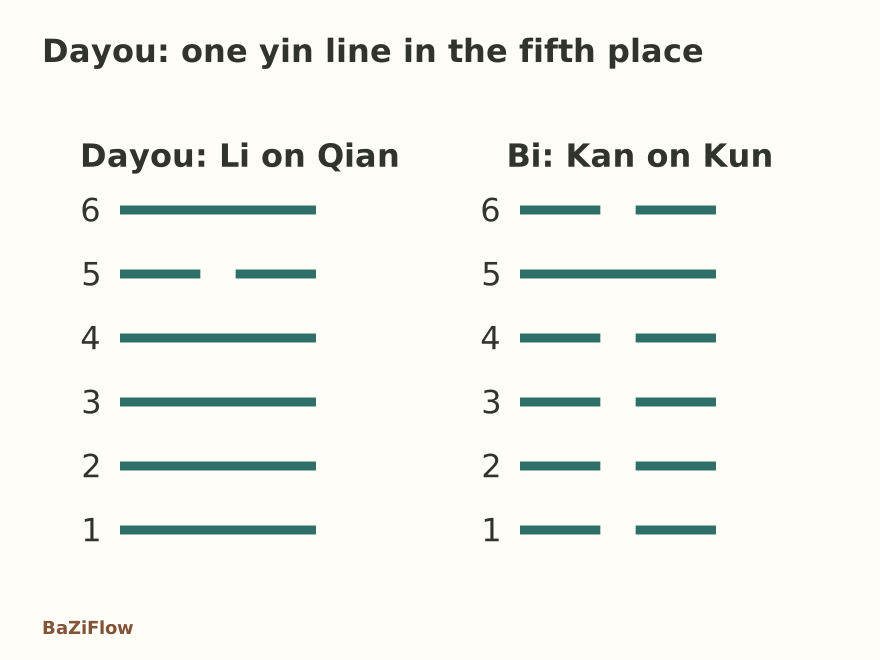
Dayou and its inverse Bi: the one odd line in each sits in the fifth place.
Enlarge diagram · scroll sideways to read
Three terms first
- Dayou
- Literally "having much". The reason the Commentary gives for the name is structural: who sits in which place, and who answers whom.
- Soft
- A yin line. Dayou has just one, the fifth line (six in the fifth place); the other five lines are firm, meaning yang.
- Honored seat
- The fifth place in the line order. "The soft gains the honored seat" means the yin line has taken that place.
The Shuo Gua gives each trigram one word: Qian is "strength" and Li is "clinging", and elsewhere it adds that Li means brightness. Strength below and brightness above, put together, are what the second half of the Commentary calls "firm strength and bright refinement".
How the Commentary builds the name: position, not quantity
The Commentary is a single sentence: "Dayou: the soft gains the honored seat and is centered in greatness, and above and below answer it; this is called Dayou. Its virtue is firm strength and bright refinement; it answers to heaven and moves in its season, and so: yuan heng." The first half accounts for the name and the second half for the judgment.
Enlarge diagram · scroll sideways to read
None of the three steps contains a number. The fifth place is the honored seat, and the yin line stands in the middle of the upper trigram, which the Commentary calls "centered in greatness". The five yang lines, one above it and four below, all answer it. So Dayou becomes a relation in the Commentary: whoever sits in that seat is answered from every side.
A two-word judgment and a one-verb Great Image
The judgment of Dayou is two words, yuan heng: a great beginning, passing through freely. Qian's judgment carries on with "li zhen" after the same two words; Dayou stops here, and the last clause of the Commentary, "and so yuan heng", points back to the two virtues just listed.
Fire is above heaven: Dayou. The noble person curbs evil and raises up good, and in this follows heaven's fine mandate.
The Great Image (大象) keeps its fixed pattern: first the figure, then what the noble person (in some hexagrams the former kings, a ruler or a great person) does with it; what each of the commentaries covers is laid out in the judgment and the commentaries. Here there are three actions: curb evil, raise up good, follow the fine mandate. "Fine" in "fine mandate" means good or beautiful, and the phrase is usually read as the good charge that heaven gives.
Enlarge diagram · scroll sideways to read
Li stands for brightness, and a fire held high shows everything. Only what is seen clearly can be sorted into good and evil, one pressed down and the other lifted. That is one way of joining the image to the conduct; the text itself supplies just the two halves.
The six statements: with so much in hand, what is each line doing
None of the six statements praises quantity. Each is about how to handle what one has, and each is followed by a short Small Image (小象) comment.
Enlarge diagram · scroll sideways to read
Line 1, at the foot: "No contact with harm, and no fault in that. Treat it as hard going and there is no fault." It has not met harm yet, and the advice is to treat the situation as difficult anyway. The second line: "A big cart to carry loads; there is somewhere to go; no fault." The Small Image says it is "loaded in the middle, so it does not fail": usually read as what is stored within does not fail. The third line: "A lord offers to the Son of Heaven; a petty person cannot manage it." The offering verb is the one usually read as "to present"; the Small Image is blunt: "for a petty person it is harm".
The fourth line says "not his …; no fault", and the character after "not his" is written in two ways in the sources, with its meaning debated; the Small Image only says "clear discernment", and that is the safer thing to hold on to. The fifth line is the only yin line: "His sincerity is linked to others; he has dignity; good fortune." Its Small Image gives two comments: "sincerity brings out his purpose", and "the good fortune of dignity is that he is easy-going and unguarded". The top line says "blessed by heaven; good fortune, nothing that does not benefit", and the Small Image opens with the hexagram's name: "the top of Dayou, supremely good".
Tongren, Bi, Guai: the neighbors of Dayou, and what comes next
Turn Dayou upside down and you have Tongren (同人), with its one yin line dropped from the fifth place to the second. This kind of reversal gives the reversed hexagram.
Enlarge diagram · scroll sideways to read
The inverse of Dayou is Bi (比): every line changes polarity, five yang lines become five yin lines, and the lone yin line becomes a lone yang line, still in the fifth place. Its nuclear hexagram is Guai (夬): lines two to four form the lower trigram and lines three to five the upper, giving Qian below and Dui above. Each neighbor is tied to Dayou in a different way: by turning it over, by swapping every line, or by taking its middle four lines.
The Xu Gua puts Dayou after Tongren with this sentence:
Those who are one with others will have things come to them; so Dayou follows.
People who stand with others find that things gather around them, and that is why this hexagram comes next. After it the Xu Gua says that one who has much must not be full, so the next hexagram is Qian (謙, "modesty"), not the Qian (乾) of heaven. That is why the six statements of Dayou are full of watchfulness.
Questions readers ask next
Is Dayou the most prosperous, smoothest hexagram?
Not in the text. The first line asks for care in hard going, the third says a petty person cannot manage the offering, and the Xu Gua moves straight on to "do not let the great be full". The hexagram is more about how to carry a lot than about how much there is.
How can a hexagram with one yin line be called "great possession"?
The Commentary answers from the structure. The yin line sits in the fifth place and in the middle of the upper trigram, and the five yang lines answer it. The name rests on that arrangement, not on a count of lines.
How are Dayou and Tongren related?
They are reversed forms of each other: turn one upside down and you have the other, and the single yin line drops from the fifth place to the second. The Xu Gua also puts Tongren just before Dayou.
Was this article helpful?
Sources & references
Continue reading
Tongren (同人): gate, clan, wild and outskirts, how wide is the circle of the same? ↗
Qian (謙): a mountain within the earth, and what the Commentary says four times ↗
The Sixty-Four Hexagrams: How Upper and Lower Trigrams Form One Figure ↗
Judgment and Line Statements: Whole Hexagram or Single Line? ↗