

Read the relation before the pair
Content version · · Sources & references
Compare two Tai Yang–Tian Liang placements and learn why a pair of star names is not a complete reading. Track location, scope and missing context before interpreting a combination.
The short version6 min read
A combination is more than two lists of star keywords. Tai Yang and Tian Liang share Mao or You, yet the positions and cited grades differ. Finding both names in one palace also differs from finding them somewhere in a four-palace inspection area.
- A combination record needs star names, actual locations and a relationship; a wide-area match does not prove co-residence.
- The cited table gives Miao–Miao at Mao and Ping–De at You for this pair, preserving a concrete difference despite shared names.
- A branch does not supply a palace topic, and transformations need their source; conclusions must stay within the supplied context.
Read first
The fourteen major stars: learn the roster and its structure ↗
Zi Wei brightness levels are table entries, not life scores ↗
Could another reader reconstruct your observation?
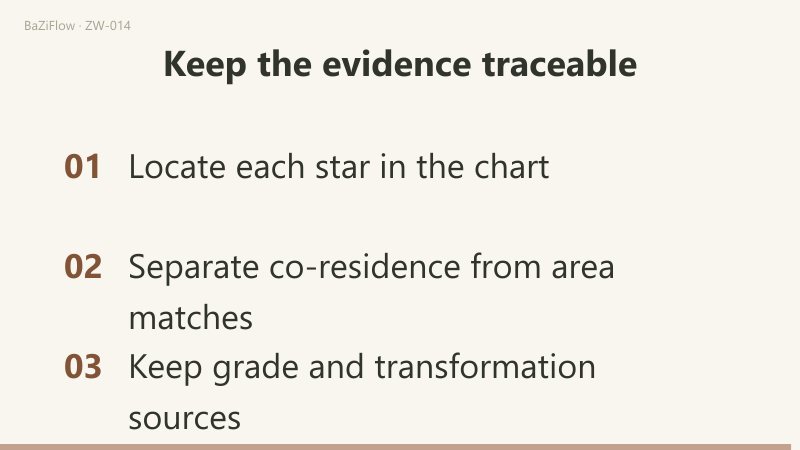
Imagine receiving a note that says, “These two stars appear together.” Before interpreting it, ask what “together” means. Did the writer find both names inside one palace, or somewhere in a four-palace inspection area? Those observations need different descriptions. A list of names does not preserve their relationship.
This matters even before you learn traditional symbolism. A useful chart note allows another reader to locate the evidence. “Tai Yang and Tian Liang occupy the Mao position in this excerpt” is testable against a diagram. “The chart has a protective, influential combination” has already moved into interpretation and may conceal an uncertain starting point.
The fourteen major stars provide the vocabulary. The next skill is giving that vocabulary an address. Avoid treating a search result containing two names as proof that the stars share a palace.
A controlled comparison with just four table entries
The iztro major-star guide lists Mao and You as the positions where Tai Yang and Tian Liang share a palace. Take these as two partial teaching examples. Neither is presented as a chart calculated from a birth date. The brightness values below all come from the same iztro star table. One caveat: the iztro 2.6.0 data behind the charts on this site records Tai Yang at You as Xian (shown as Fallen on this site’s charts), not Ping as in that table, so when you compare with a real chart the grade follows the software version in use; this cell only demonstrates that position and grade are updated together.
| Recorded property | Mao example | You example |
|---|---|---|
| Stars sharing the position | Tai Yang and Tian Liang | Tai Yang and Tian Liang |
| Tai Yang grade | Miao | Ping |
| Tian Liang grade | Miao | De |
| Named life-topic palace | Not supplied | Not supplied |
| Transformations and time layer | Not supplied | Not supplied |
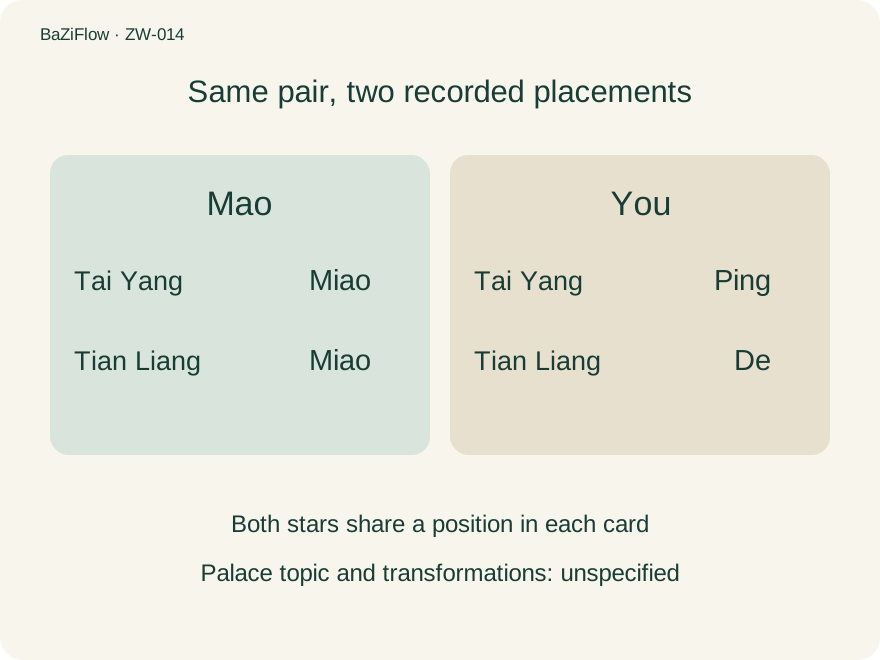
Original BaZiFlow comparison using the cited iztro placement and brightness references; these are partial examples, not personal charts.
The pair of names remains constant while the position and grades change. That is enough to show why a stock paragraph attached only to the pair loses information. It is not enough to rank two people's personalities, earnings or relationships. Traditional grades are classifications within a reading system, not measured scores for those outcomes.
Notice a second restraint in the table: Mao has not been labelled the Life palace. A branch position and a life-topic name are different pieces of information. Filling in the latter from habit would create evidence that the example never supplied. The brightness guide explains the grading vocabulary separately.
Update the cards sentence by sentence. Moving from Mao to You leaves “Tai Yang and Tian Liang share a palace” intact. “Both are at Mao” changes to “both are at You.” “Tai Yang Miao, Tian Liang Miao” becomes “Tai Yang Ping, Tian Liang De.” Relation, address and attributes are different records, so their changes need not be identical.
“This is the Life palace” is unsupported on both cards; it cannot be treated as an unchanged condition. The comparison is not an instruction to rewrite every sentence. It identifies what stays, what changes and what was never supplied, preventing the same career or personality verdict from obscuring distinct local evidence.
Co-residence stays
- Tai Yang + Tian Liang
Location and grades change
- Mao → You
- Miao / Miao → Ping / De
Keep a local claim local
A shared palace is a precise spatial statement. A relationship through the surrounding palaces is a broader one. The iztro palace documentation distinguishes checking whether one palace contains all the requested stars from checking whether all those stars occur within its three-direction-and-opposition area. Either check can be useful; they do not answer the same question.
You do not need software to preserve that distinction. On paper, mark the position of each star before drawing the relevant relationship. If two names lie in different boxes, do not describe them as sharing a box merely because both boxes participate in the same comparison. The palace relationships article develops this spatial reading.
A cropped chart adds another uncertainty. A missing label on the crop may reflect its boundaries or display settings. It does not establish that the complete chart lacks that star or transformation. Write “not visible in this excerpt” when that is all you know. This leaves a future reader room to complete the record without first undoing an invented absence.
One palace
- Inspect one box
- Both stars in that box
Four-palace area
- Inspect four positions
- Keep each star’s address
Interpretive vocabulary is not an addition formula
Traditional accounts attach symbolic associations to individual stars and discuss combinations within particular methods. Reading a combination involves deciding how those associations are being used in context. It does not follow that two lists of keywords can be added to produce a person's biography.
For example, a source's association with authority and another association with protection do not jointly establish that someone will be an effective manager. That claim would require evidence about the person and the circumstances, not merely a larger dictionary entry. A source may offer such a traditional interpretation; citing it accurately still does not turn it into an empirically established prediction.
If you are examining a practical question, identify the relevant palace topic and the chart layer before choosing an interpretation. A natal annotation, a decade annotation and an annual annotation should not be blended simply because a display places them near the same star. Similarly, a transformation needs its originating stem or layer recorded. More visible labels should produce a more traceable explanation, not a larger undifferentiated pile of positive and negative words.
Branch
Palace topic
Transformation source
Try editing a claim instead of expanding it
Start with: “This pair means the person is destined to lead.” There is no recoverable location, layer or personal evidence in that sentence. Replace it with an observation: “The supplied excerpt places Tai Yang and Tian Liang together at Mao; the cited table assigns both the Miao grade. The palace topic and transformation sources have not been checked.”
That revision finishes a modest task honestly. It establishes what the excerpt and reference support. A separate paragraph can then describe an interpretive question under a named method, with any missing conditions made explicit. There is no obligation to manufacture a career conclusion to make a short exercise feel complete.
As a comparison exercise, substitute the You card and its two grades. Ask which statements in your note must change and why. A purely spatial statement should change with the placement; an unsupported personality slogan might remain untouched, revealing how little it depended on the chart. The aim is not to make every sentence different at random. It is to keep each meaningful difference tied to a specific recorded condition.
Questions readers ask next
Do the words Tai Yang–Tian Liang prove co-residence?
Check where the names were found. Both names actually listed in one palace establish co-residence. A match within a four-palace inspection area still needs each star’s location recorded and does not establish the narrower claim.
Can the Mao and You cards rank two people’s lives?
No. They are partial placements with no birth dates, supplying co-residence and four grades from one source. Palace topic, transformations and cycles are unspecified; no person’s abilities or life outcomes have been measured.
Which statements change when the example moves to You?
The location changes from Mao to You. Under the cited table, Tai Yang changes from Miao to Ping and Tian Liang from Miao to De. Co-residence stays true, while the missing palace topic and transformations remain unspecified.
Was this article helpful?