

King of Wands: honesty and the strict-lenient pair
Content version · · Sources & references
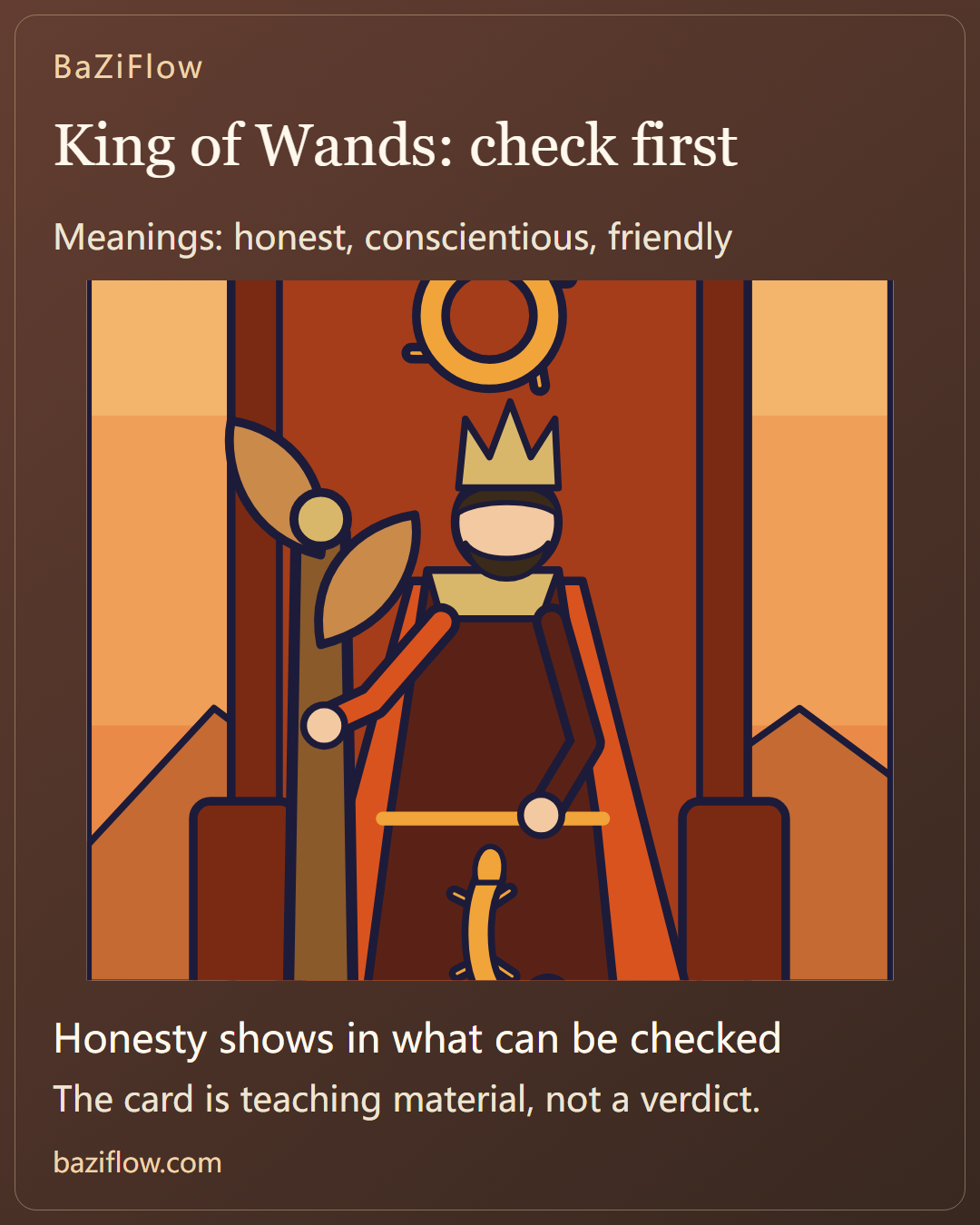
The King of Wands lifts a flowering wand, a lion blazoned behind his throne. Separate the picture, Waite's list and his extras, then turn honesty into something checkable and split the rules into fixed and open.
The short version6 min read
The King of Wands is a king seated with a flowering wand. Waite says the card "always signifies honesty", so the reading is to bring honesty down to practices that can be checked.
- Waite's description: the nature to which the card is attributed is dark, ardent, lithe, animated, impassioned, noble; the King lifts a flowering wand, wears a cap of maintenance beneath his crown, and the lion is blazoned on his throne.
- The main list gives friendly, honest and conscientious and says the card always signifies honesty, perhaps news of an unexpected heritage; the extras say generally favorable, a good marriage.
- Reversed, strict and lenient share one line: good, but severe; austere, yet tolerant. The exercise treats standards and tolerance as two dials, one column each.
Read first
Start with the picture: the cap beneath the crown, the lion behind the throne
Waite begins this card with a temperament. The physical and emotional nature to which it is attributed is dark, ardent, lithe, animated, impassioned, noble. Only then comes the picture: the King lifts a flowering wand, and, like his three counterparts in the other suits, wears what is called a cap of maintenance beneath his crown. He is connected with the symbol of the lion, which is blazoned on the back of his throne.
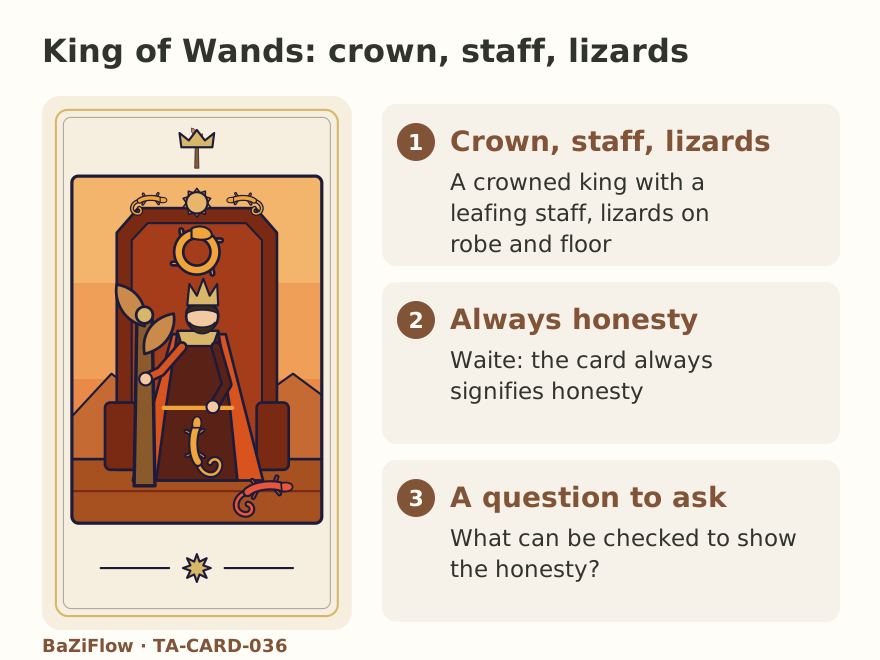
BaZiFlow original King of Wands with three labels
On the original RWS card the king sits in profile in a gold crown with a small red cap under it, a red robe, a green shoulder cape and an over-mantle with dark round figures. One hand holds a tall staff whose top shows a few leaf buds. On the hanging behind him is a black lion design, and a small lizard sits on the ground at his feet.
Enlarge diagram · scroll sideways to read
What Waite lists: "always signifies honesty", and an unexpected heritage
The divinatory meanings read: dark man, friendly, countryman, generally married, honest and conscientious. The next sentence is the firmest: the card always signifies honesty, and may mean news concerning an unexpected heritage to fall in before very long. Across the whole card, "honesty" is the only word he marks with "always".
Dark man, friendly, countryman, generally married, honest and conscientious. The card always signifies honesty...
Enlarge diagram · scroll sideways to read
Other readers add only two lines: generally favorable, perhaps a good marriage; reversed, advice worth heeding. These say nothing about the honesty of the main entry.
Flowering wand, cap of maintenance, lion: written, but not explained
All three details appear in Waite's entry, yet he explains none of them as "standing for" something on this card:
Wand, cap, lion: named, meaning not given
- Flowering wand
- Waite writes that he lifts a flowering wand and does not say what the flowers mean. On the RWS picture the top shows leaf buds, with no clear flower.
- Cap of maintenance
- Waite says the kings of all four suits wear it beneath the crown. In heraldry it is a ceremonial cap set under a crown, a mark of rank; the text gives it no further meaning.
- Lion at the back
- Waite says only that he "connects with the symbol of the lion", blazoned on the throne. Lions are often linked with kingship and courage; that is tradition, not Waite's sentence.
Enlarge diagram · scroll sideways to read
How to read it: strict and lenient are two dials
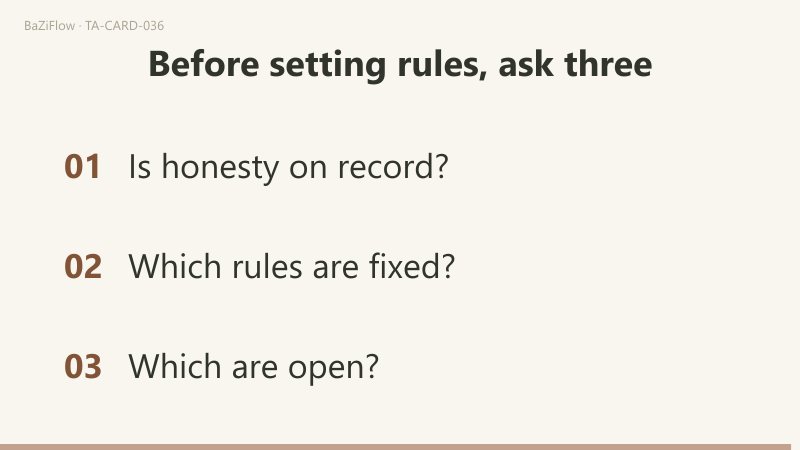
The reversed list puts severity and tolerance on one line: good, but severe; austere, yet tolerant. The two adjectives do not cancel, which shows they can hold together: one governs the standard, the other the margin for error. Put to use on setting rules, only three steps remain:
Is the honesty on record?
"Always signifies honesty" can be read as: the promise can be checked by others. Replace "he has always been this way" with published rules and a record that others can see.
Which rules are fixed?
"Severe" maps to standards: keep them few, each one writable, and visible to everyone.
Which are open to discussion?
"Tolerant" maps to margin: say what may change, until when, and who decides.
An example: three people are co-editing a short film, and the lead editor wants to set a few rules. Write them in two columns, fixed and open:
Enlarge diagram · scroll sideways to read
What makes a rules sheet hold up
Can be written
- Each standard has a source
- Open scope has a date
Cannot be written
- Rules "everyone knows"
- Held only in the lead's head
Do first
- Fixed rules in three or fewer
- Name who decides open ones
Reversed and neighboring cards: "good, but severe", and three roles at court
The reversed main entry is "good, but severe; austere, yet tolerant": here the reversal is not bad but lets two opposite tempers stand side by side. The extras reverse to "advice that should be followed", one line. When you cite a reversal, name the entry it comes from.
Three roles at the same court
Reversed, exactly "dishonest"
The King of Cups reversed lists dishonest, double-dealing, exaction; the King of Wands lists honesty as "always".
Seated in judgment
The King of Swords lists judgment, command, authority and law; also a king, but his severity falls on rulings, where the King of Wands' falls on character.
The counterpart in the same suit
Waite pairs her nature with the King's and calls it more magnetic; one is good will turned toward a neighbor, the other honesty to be checked by record.
Enlarge diagram · scroll sideways to read
Questions readers ask next
Does the King of Wands mean a married man from the countryside?
The list has "dark man", "countryman" and "generally married", a 1910 description of one type of man. Today you can keep the stance of steady, frank and responsible, and set aside looks and marital status; it is not for naming someone you know.
What does the King of Wands mean reversed?
Waite's reversed main entry reads: good, but severe; austere, yet tolerant. Two adjectives side by side show that strictness and tolerance can hold together. The extras reverse to "advice that should be followed"; say which of the two you quote.
"Always signifies honesty": does that mean the other person is reliable?
That sentence states what the card means, not a guarantee about a real person. To apply it to a real matter, ask: in which practices that others can check does the honesty show, and is there a record?
Was this article helpful?
Sources & references
Continue reading
Queen of Wands: magnetism is not an answer, so ask who she faces and whether there is room ↗