

Reading Qian and Kun together
Content version · · Sources & references
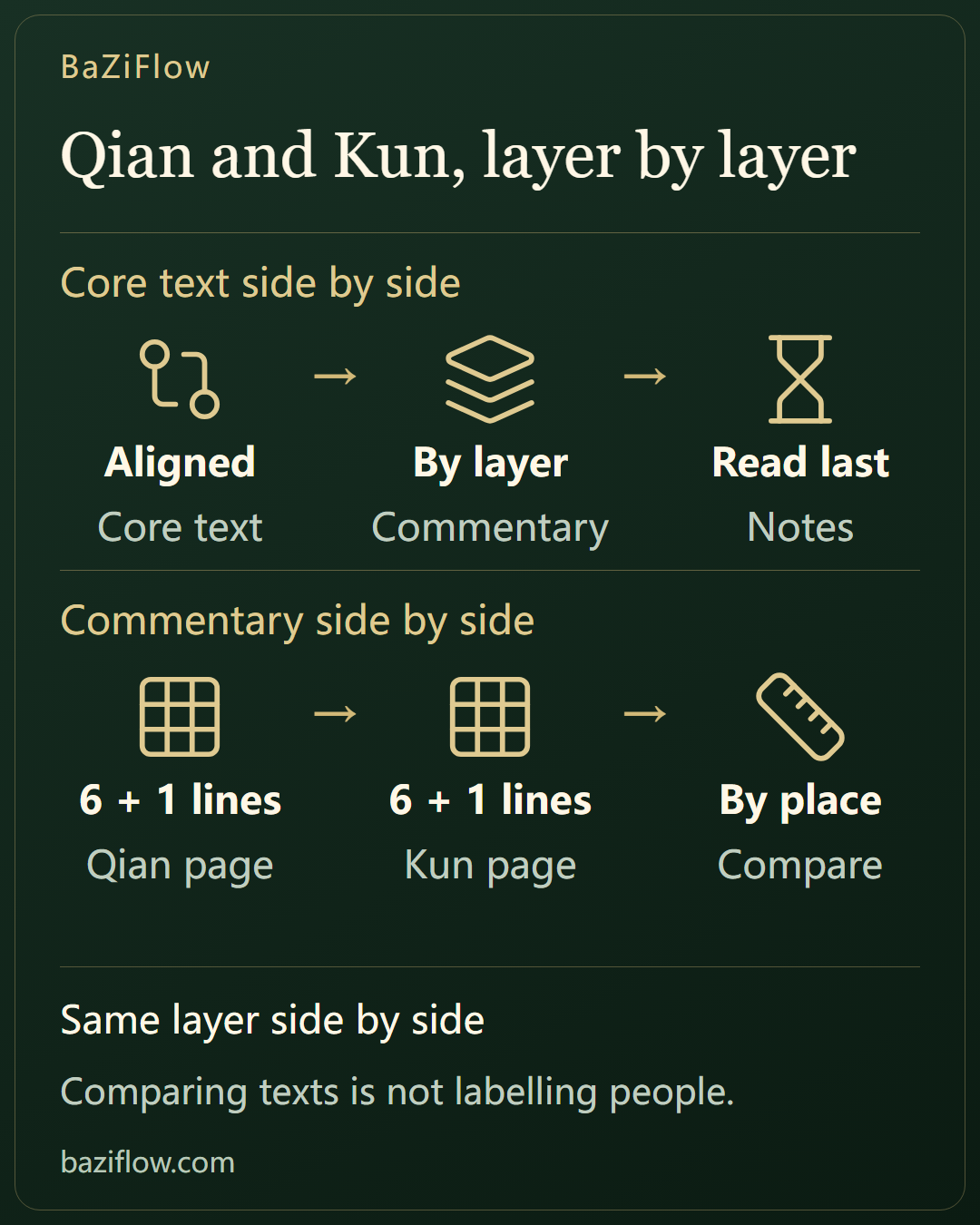
Set the core text of Qian (乾) and Kun (坤) side by side, then the three commentaries, and only then later explanations. Two places, Initial and Top, show how each layer words the same line. No personality labels.
The short version10 min read
The pages for Qian and Kun carry the same layers: core text, then three commentaries. Reading them together means setting one layer beside its twin, with later explanations added last.
- Both pages share one layout: a Judgment, six line statements and one extra statement (Using Nine or Using Six), followed by three commentary blocks, so every layer has a twin on the other page.
- One line statement can be explained in several places, each in different words. Initial Nine of Qian is taken up four times in the Wenyan alone, so a single sentence cannot stand for "what the commentary says".
- Words such as "strong", "following" or "soft" belong to the layer where they appear. Mark where a word comes from before comparing, and do not turn it into a label for a hexagram or a person.
Read first
Judgment and Line Statements: Whole Hexagram or Single Line? ↗
Line positions: the six places, Nine and Six, and the sayings about them ↗
Layers first, then side by side: reading two pages together
The pages for Qian (乾) and Kun (坤) in the Zhou Yi (周易) carry the same layers of text: the core text, followed by three commentaries, the Commentary on the Judgments (彖传), then the Commentary on the Images (象传), then the Wenyan (文言, the Commentary on the Words of the Text). To read the pages together, place one layer of the first beside the same layer of the second, then move on to the next.
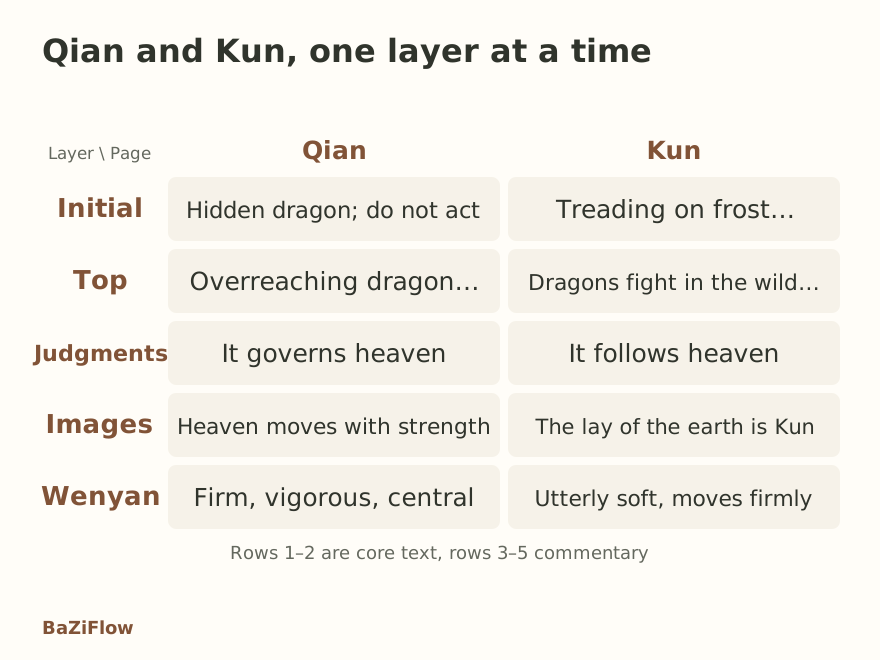
Qian and Kun side by side: one sentence per layer, with originals and sources in the text. A comparison of wording, not of character.
The layout is identical: one Judgment (卦辞), six line statements (爻辞) and one extra statement, Using Nine (用九) for Qian and Using Six (用六) for Kun, then the three commentary blocks. Other hexagram pages on Wikisource have no Wenyan block (see Core text and commentaries), so only this pair can be set side by side in all four layers.
Enlarge diagram · scroll sideways to read
Three steps of the reading
Core text side by side
Leave the commentaries closed and align the two pages' statements by place.
Commentaries side by side
One block at a time, asking whether it attaches to the whole figure or to one line.
Later explanations last
Notes come last, marked with whose words they are and which sentence they follow.
Core text side by side: two Judgments and six pairs of line statements
Open no commentary yet (for what the Judgment and the line statements each address, see Judgment and line statements). Qian's Judgment has four characters, Kun's runs longer, and both begin with the same two, "supreme, prosperous".
Two Judgments
Supreme, prosperous. Advantageous, steadfast.
Two short phrases, four characters in all.
Supreme, prosperous. Advantageous: the steadfastness of a mare.
It continues with the gentleman's journey and friends gained in the southwest, lost in the northeast, and ends: steady and steadfast, good fortune.
Next the line statements are aligned by place (the names of the places: Line positions: Initial to Top): Initial Nine of Qian faces Initial Six of Kun, Top Nine faces Top Six, and Using Nine faces Using Six.
Line statements by place (plain-sense translation)
- Initial
- Qian: A hidden dragon; do not act. Kun: Treading on frost, solid ice arrives.
- Second
- Qian: A dragon seen in the field; fruitful to see the great person. Kun: Straight, square, great; without practice, nothing is unfruitful.
- Third
- Qian: The gentleman is active all day, wary at dusk as if in peril; no blame. Kun: Holding the pattern within, it can be steadfast. In the king's service, no accomplishment of its own, yet a completion.
- Fourth
- Qian: Perhaps leaping, in the depths; no blame. Kun: A tied-up sack; no blame, no praise.
- Fifth
- Qian: A flying dragon in the sky; fruitful to see the great person. Kun: A yellow lower garment; supreme good fortune.
- Top
- Qian: An overreaching dragon; regret. Kun: Dragons fight in the wild; their blood is dark and yellow.
- Using Nine / Using Six (用九 / 用六)
- Qian: A flock of dragons without a head; good fortune. Kun: Fruitful to be steadfast for ever.
With the pairs aligned, the fourteen statements can be sorted again by whether the statement contains a dragon.
Enlarge diagram · scroll sideways to read
That will matter below. So far the original has only been set in rows; which statement answers which, the core text does not say.
Commentaries side by side: where each block attaches
All three commentaries follow the core text, each attached to a different place in it. Compare one block at a time, and first ask whether it attaches to the whole figure, to one line or to one word.
Enlarge diagram · scroll sideways to read
"Great is the origin of Qian" faces "utmost is the origin of Kun", "rely on it to begin" faces "rely on it to be born", and "governs heaven" faces "follows heaven" (顺承, "follows and receives"). The differences fall on a few words: begin and be born, govern and follow.
The first sentence of each Commentary on the Images
The movement of heaven is vigorous; so the gentleman strives of himself without ceasing.
First heaven, then "the gentleman...".
The lay of the earth is Kun; so the gentleman, with ample virtue, carries things.
First earth, then the same "the gentleman..." pattern.
That sentence speaks to the whole figure, and one sentence per line follows. On both pages its shape is the same: before "the gentleman" comes the image, after it what he does in the manner of that image. Each page also has one Wenyan block.
Words often lifted out, and the layer each sits in
- Strong (健)
- Qian, Images: "the movement of heaven is vigorous". Qian, Wenyan: "firm, vigorous, central and correct".
- Following / receiving from heaven (顺 / 承天)
- Kun, Judgments: "it follows and receives heaven" and "soft, following, advantageous and steadfast". Kun, Wenyan: "Is not the way of Kun one of following?" and, in a separate sentence, "It receives from heaven and moves in season."
- Mare (牝马)
- Kun, Judgment (core text): "advantageous: the steadfastness of a mare". Kun, Judgments: "the mare is of the kind of earth and travels the earth without limit", in the commentary's own words.
Two places read together: Initial and Top
Take the lowest place, Initial, and the highest, Top. For each, put the core text first, the Commentary on the Images next and the Wenyan last, and see what each layer says.
Enlarge diagram · scroll sideways to read
Initial Nine of Qian is explained in more than one place. The Images say "the yang is below". The Wenyan takes it up four times, each in different words: a hidden person with a dragon's virtue, "below", "yang qi lies hidden", and the gentleman who does not act because "hidden" means not yet seen.
For Initial Six of Kun the Images have two sentences about frost and ice. The Wenyan continues:
... What it came from came by degrees, from not distinguishing early enough. The Changes says "treading on frost, solid ice arrives"; this speaks, it seems, of following.
The Images cover only the order of frost and ice; the Wenyan moves from that step to "by degrees" and "not distinguishing early enough". Same line statement, different landing.
Now the top place:
Enlarge diagram · scroll sideways to read
"Overreaching", as a word, means knowing how to advance but not how to retreat, how to preserve but not how to perish, how to gain but not how to lose. ...
When yin doubts yang, they must fight; because it is suspected of having no yang, it is called "dragon". It has not yet left its kind, so it is called "blood". Dark and yellow are the mixing of heaven and earth: heaven is dark, earth is yellow.
Qian's Wenyan explains what "overreaching" means; Kun's takes up the line statement's words one by one: fight, dragon, blood, dark and yellow. "So it is called dragon" answers the dragon in the core text of Kun's top line, an echo visible only when the two pages are read together. "Exhausted" also appears once on each page, in Kun's Images ("its way is exhausted") and in Qian's Wenyan ("the calamity of coming to an end"): different sentences, different layers.
Later explanations last: notes and subcommentary
Later explanations come last: the subcommentary of Kong Yingda (孔颖达) and the older notes in the Zhou Yi Zhengyi (周易正义). Where the subcommentary mentions those notes it writes "Fusi's note", Fusi being the courtesy name of Wang Bi (王弼). Each is labelled with who says it and which sentence it follows.
Enlarge diagram · scroll sideways to read
First, the subcommentary itself reads the two pages together. Qian's Commentary on the Judgments says "begin", Kun's says "be born", and the subcommentary sorts them like this:
"Qian" is originally the start of qi, so it says "rely on it to begin"; "Kun" rests on completed form, so it says "rely on it to be born".
"The start of qi" and "completed form" are the subcommentary's words; the commentary itself says only "begin" and "be born".
Second, an old note reads the last statements of the two pages together:
... To be firm and vigorous and yet stand at the head of others is what things do not side with; to be soft and following and yet not upright is the way of the flatterer. So Qian's good fortune lies in "without a head", and Kun's advantage in "steadfast for ever".
"Firm and vigorous" and "soft and following" are the note's words; the core text has only "a flock of dragons without a head; good fortune" and "fruitful to be steadfast for ever".
Third, one sentence of the Wenyan already gets different readings:
"Blood dark and yellow": the Wenyan and two later readings
Dark and yellow are the mixing of heaven and earth
It adds that heaven is dark and earth yellow.
The blood bears the colours of both
"The top Six line holds the mixed qi of heaven and earth, so when it is wounded its blood is dark and yellow."
Still fighting yang, so wounded
The old note: "still fighting yang and so wounding each other, hence it says blood". Kong Yingda: "I fear Master Zhuang's words are not Wang's intent, and I do not adopt them."
Later readers already read that sentence in two ways, and the subcommentary says which it takes. They help in reading the commentary; they are not part of the core text or the commentaries.
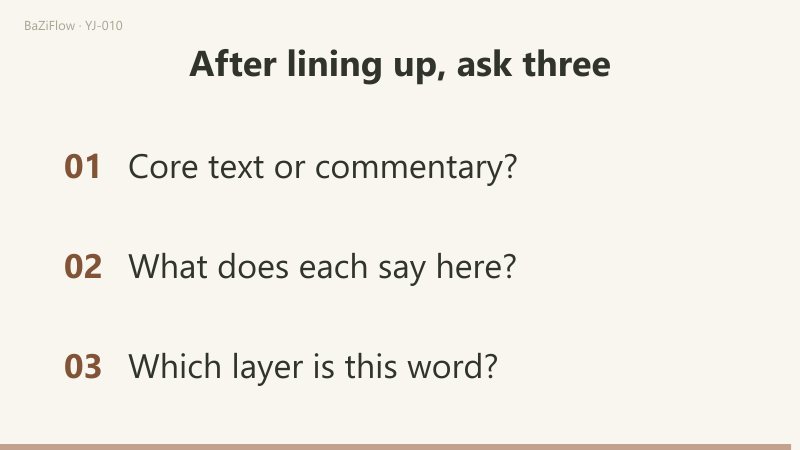
Is it core text or commentary?
Sort the sentence by its block before asking what it means.
What does each page say at this layer?
Set the same layer side by side and compare only the words on the page.
Which layer does this word come from?
For a word such as "following" or "firm", find first whether it sits in the core text, a commentary or a note.
Questions readers ask next
Which texts do I read when I read Qian and Kun together?
The Judgment, the six line statements and the extra Using Nine or Using Six, plus each page's Commentary on the Judgments, Commentary on the Images and Wenyan. Later notes and subcommentary are a separate layer and come last.
Does the Kun commentary say that women or subordinates should be docile?
No sentence on these pages demands that women or subordinates be docile. "Follows and receives heaven" is said of the "origin of Kun" in the Commentary on the Judgments. The Wenyan on Kun does, in its note on the Third line, set Kun's place beside wife and minister ("the way of earth, the way of a wife, the way of a minister"); that is the Wenyan's own analogy, to be read at its layer and not turned into a demand on people today. Its opening also calls Kun "utterly soft" in the sentence that says it moves "firmly".
When a later note disagrees with the commentary, whom should I follow?
First see what the commentary itself says, then what the note says and who wrote it. Later writers also disagree among themselves: in one passage Kong Yingda declines the reading of a scholar he quotes. Set them side by side with their sources and do not choose for the reader.
Was this article helpful?
Sources & references
Continue reading
Judgment and Line Statements: Whole Hexagram or Single Line? ↗
Line positions: the six places, Nine and Six, and the sayings about them ↗
The Sixty-Four Hexagrams: How Upper and Lower Trigrams Form One Figure ↗