

Give the selection reason before the palace
Content version · · Sources & references
A significator is a selected object of attention, not an answer hidden in a palace. Compare symbol-first and direction-first approaches, using a limited south-to-Li example with explicit source and scope.
The short version6 min read
A directional approach starts with a direction and looks up a palace; a symbol-first approach selects an object and finds its position. Under the cited southern example, Li nine is an address to inspect. The timed arrangement and interpretation method remain separate requirements.
- A significator is an object selected under a question and method, not necessarily a spirit-layer member.
- Direction-first and symbol-first lookup use different starting evidence.
- Keep the subject, layer and selection reason attached to the palace, including later method changes.
Read first
What would make you choose a different symbol?
Imagine two readers examining the same chart. One selects a door because its name sounds encouraging. The other picks a star that supports a preferred conclusion. Both produce fluent explanations, but neither has shown why that feature represents the question. The problem arises before interpretation: the evidence was selected to fit the answer.
A significator, often called the Useful God (用神) in this context, is the object selected for attention under a stated method. It is not necessarily a member of the spirit layer. Nor should its meaning be imported wholesale from the use of a similarly named term in Four Pillars analysis.
A useful starting record says what is being asked, whose situation is under discussion and which rule selects the object. If the rule cannot be stated until after the outcome is known, the reading has lost a stable point of comparison.
The source itself offers more than one entry point
The introductory notes of Qi Men Dun Jia Tong Zong distinguish an approach using the duty chief, duty door and time stem from a directional approach illustrated by information arriving from different directions. In its discussion of weather divination, the work also lists several possible objects of attention, including the chief, configurations, the Peng and Ying stars, and particular stems.
That variety is evidence about the text's organization of traditional methods. It is not evidence that those weather readings are effective forecasts. Actual weather questions call for meteorological information; the old examples are being used here to show how a reader selected chart material.
Consequently, this article does not supply a universal table assigning every modern question to one symbol. If a named teaching uses the day stem for the questioner, that rule should be recorded as belonging to that teaching. It should not be attributed to every Qimen source simply because it appears in one manual.
South
- Li · 9
North
- Kan · 1
Two ways of arriving at a palace
A symbol-first approach selects an object, such as a particular stem, and then finds its position in the current arrangement. A direction-first approach begins with a directional clue, identifies the corresponding palace and then inspects what is there. These are different orders of work.
| Approach | First known item | Next lookup | Information still needed |
|---|---|---|---|
| Symbol first | Object selected by a stated rule | Its layer and current palace | Relevant combinations and interpretation method |
| Direction first | A direction established by the case | The corresponding palace | The current contents of that palace |
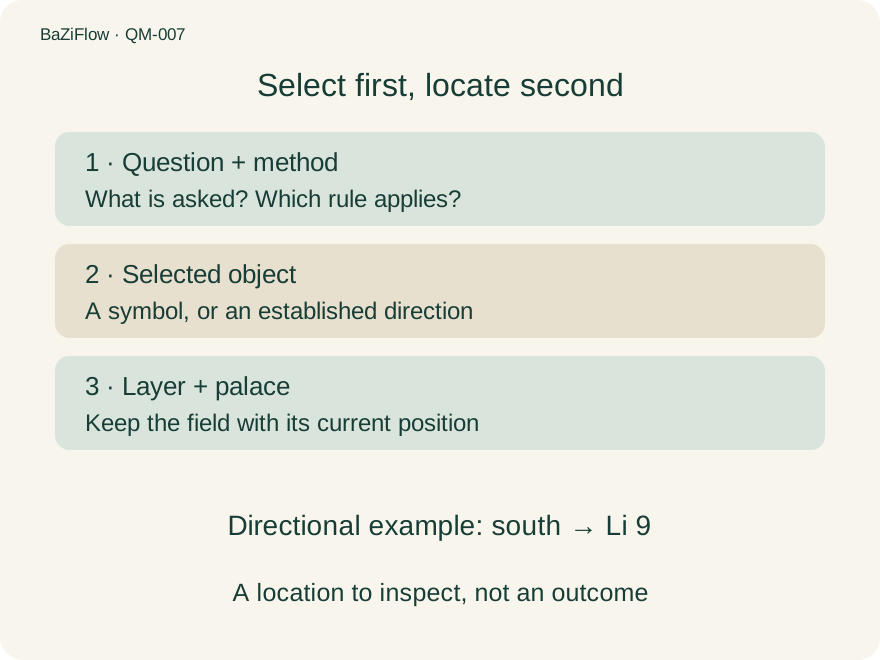
Original BaZiFlow reading map. The directional approach comes from Tong Zong; Shuo Gua, chapter five, supplies the Li–south association. This is not a complete divination.
Neither row permits switching to a more convenient object halfway through without explanation. If two methods are being compared, retain two labeled records. Combining the opening rule from one with the destination from another can produce a persuasive account that neither method actually supports.
Symbol first
Direction first
How far can the southern example take us?
Take the narrow directional example described in Tong Zong: the relevant information is known to come from the south, and the reader follows that source's directional approach. The lookup leads to Li. Chapter five of Shuo Gua explicitly associates Li with the south; in the palace numbering used here, this is palace 9.
This is enough to identify a place to inspect. It is not enough to fill that palace with a current star or door, because no timed chart has been supplied. A home association such as Tian Ying does not establish that the moving star layer contains Tian Ying there on this occasion.
It is also not enough to infer success, urgency or a person's emotional state. Li's traditional fire association cannot manufacture those facts. If the direction itself is uncertain, perhaps inferred from an ambiguous place name, even the initial lookup remains conditional. Record that uncertainty before reading further.
The example therefore stops at a deliberately modest result: under this named approach, inspect Li 9. A complete reading would require the actual arrangement and a stated account of how its contents bear on the question. A palace number functions as an address for that work, not its final answer.
Keep the layer and the subject attached
For a symbol-first method, the same stem may have different positions on the earth and heaven layers. “Yin Wood (乙) is in palace 9” is incomplete unless it specifies the layer. The heaven and earth plate explanation shows why two positions can coexist without contradiction.
Likewise, Zhi Fu (值符) may refer to the star serving as chief or to a spirit-layer label. A name alone does not establish which field to inspect. Preserve the category chosen by the method instead of searching the chart for any matching text.
Subject labels matter just as much. An item selected for the questioner does not become evidence about another person's private thoughts merely because a sentence switches pronouns. If two people or a person and an event are represented, give each selection its own reason and location before comparing them.
A durable case note retains the original question, the method, the selected object, its layer and its palace. Later outcomes can then be compared with what was actually recorded. If an alternative rule is introduced later, mark it as a later change rather than rewriting the earlier choice.
Once the lookup is sound, time and palace conditions in strength judgments explains why further information is still necessary. The aim is to make a traditional interpretation traceable. It does not turn a chosen symbol into an observed fact about the world, or remove uncertainty that the case never resolved.
Selection
Original
- When
- Before outcome
- Retain
- Subject, rule, symbol, layer
Alternative
- When
- Dated separately
- Retain
- Reason; original stays visible
Questions readers ask next
Can two methods ending at nine be merged into one reason?
Retain their origins. One may start from a southern clue and another from a selected stem’s current position. A shared endpoint neither removes that difference nor establishes independent confirmation.
Can Li’s fire association supply a missing southern clue?
That association describes the trigram, not the origin of this information. Establish the direction first; using the selected palace’s attributes to justify selecting it would make the reasoning circular.
Must every new question use a different significator?
Apply the named method to the new subject and event. The reason may still support the same object or require a different one. Record that decision instead of changing symbols mechanically or copying the previous conclusion.
Was this article helpful?
Part of a learning path
Sources & references
Continue reading
Duty chief and duty door: track the role before the position ↗