

Fire at the Mountain Foot: Yang Fire Monkey and Yin Fire Rooster
Content version · · Sources & references
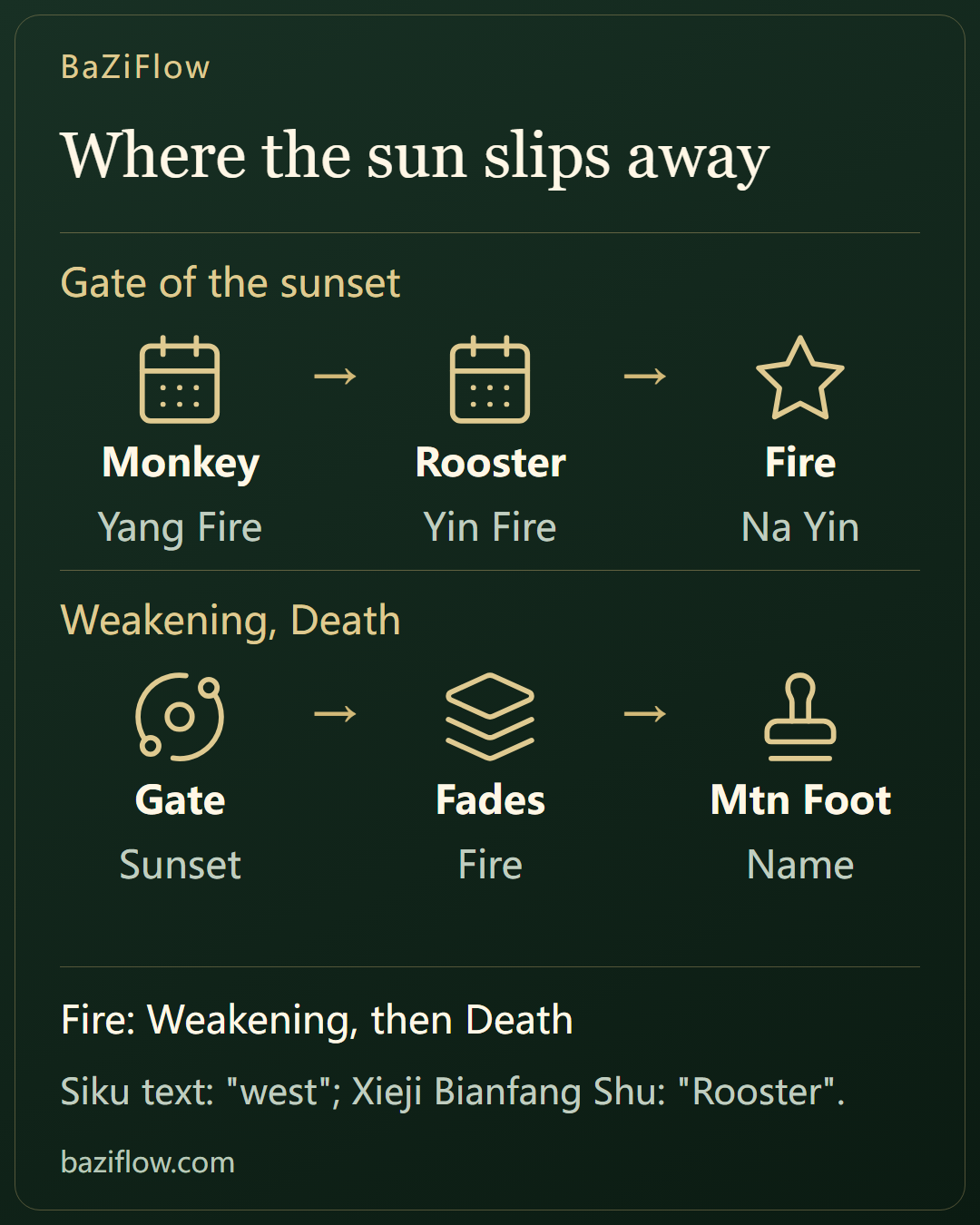
Yang Fire Monkey and Yin Fire Rooster share the seventeenth Na Yin name. Sanming Tonghui sunset images, Weakening and Death on the table, two readings of the fire, pairings checked, two Starts of Spring off the 4th.
The short version10 min read
Yang Fire Monkey and Yin Fire Rooster share the seventeenth Na Yin name, Fire at the Mountain Foot, and it paints a sunset: the sun has gone down behind the hill, the fire is still there, and its light has been drawn in.
- Yang Fire Monkey is the thirty-third of the sixty pillars and Yin Fire Rooster the thirty-fourth. Both stems are Fire over a Metal branch, and neither the Monkey nor the Rooster hides any Fire stem.
- The book gives two images: the section on Na Yin images says "faint and frail on the Dui seat", and the calendar specialists make the Monkey the earth's door and the west the gate where the sun goes in. On the table that is Fire at Weakening, then Death.
- The entry offers two readings: as a firefly it wants water and an autumn birth; as fire at the foot of a hill it wants wood, mountain and wind. The mountains it names sit on the Ox, the wind on the Dragon and Snake.
Read first
What is Na Yin in BaZi? Why Yang Wood Rat Gold in the Sea does not replace Yang Wood ↗
The gate of the sunset: two positions where the light is drawn in
The seventeenth Na Yin name is Fire at the Mountain Foot (山下火), shared by Yang Fire Monkey (丙申) and Yin Fire Rooster (丁酉). The name paints a sunset: the sun has sunk behind the hill, the fire is still there, and its light has been drawn in.
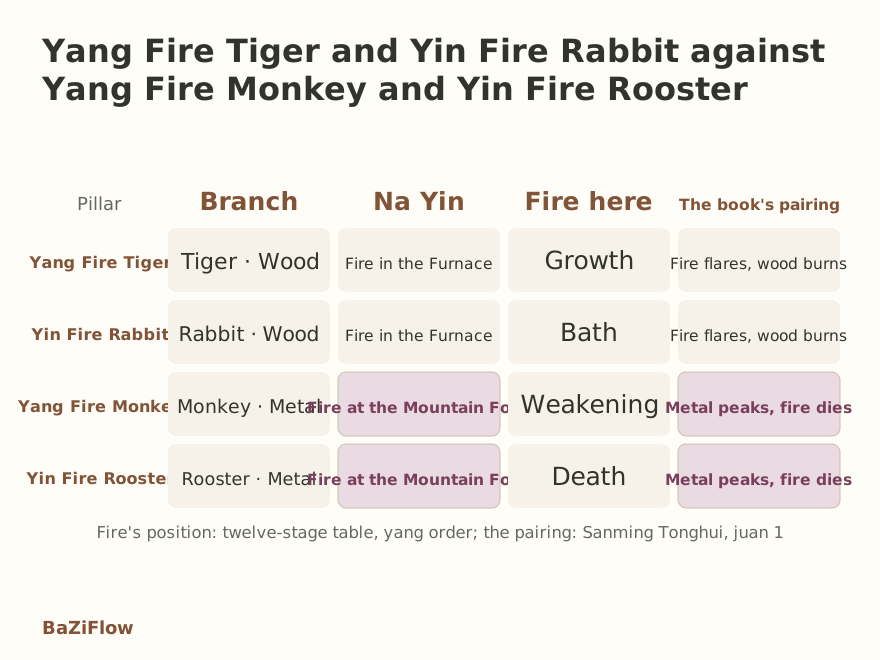
Comparison sketch: branch elements use the usual entry-level assignments, Fire's position is read from the twelve-stage table in yang order with Yang Fire as yardstick, and the pairing is quoted from Sanming Tonghui juan 1.
The figure sets it beside its neighbor. In juan 1 the Sanming Tonghui (三命通会) pairs Yang Fire Tiger and Yin Fire Rabbit with Yang Fire Monkey and Yin Fire Rooster:
Yang Fire Tiger and Yin Fire Rabbit face Yang Fire Monkey and Yin Fire Rooster: Furnace and Mountain-foot, where fire flourishes the wood is burned, where Metal flourishes the fire is put out.
The Tiger and Rabbit are Wood positions, where Fire climbs through Growth and Bath; the Monkey and Rooster are Metal positions, where Fire sinks through Weakening and Death.
Two images, both of a sunset
The book gives two reasons for the name. The first comes from the juan 1 section on Na Yin images:
Yang Fire Monkey and Yin Fire Rooster: the breath is stilled and the form hidden; its force hides its light and draws in like a tortoise; on the Dui seat it is faint and frail, and its brightness does not reach far; so it is called Fire at the Mountain Foot.
The Dui seat is the west in the later-heaven arrangement of the trigrams, the direction of the Rooster, and "draws in like a tortoise" is a tortoise pulling its head into its shell. The second reason is a view the book reports from the calendar specialists:
Yang Fire Monkey and Yin Fire Rooster: the Monkey is the door of the earth and the west the gate where the sun goes in; when the sun reaches here it hides its light, so it is called Fire at the Mountain Foot.
The Monkey double-hour runs from 3 to 5 p.m. and the Rooster's from 5 to 7. The Siku text reads "the west" here; the Xieji Bianfang Shu (协纪辨方书), juan 1, repeats the sentence with "the Rooster" and adds "at this hour". The Rooster is due west, so both point the same way.
Enlarge diagram · scroll sideways to read
The same passage calls the Dragon and Snake "meal time" and "mid-morning", the sun climbing toward noon, which fits Lamp Cover Fire for Yang Wood Dragon and Yin Wood Snake.
"Sick in itself", "dead in itself": the table says Weakening and Death
The third source is the book's commentary on each pillar, and it is blunt about this pair:
Yang Fire Monkey is fire sick in itself, Yin Fire Rooster is fire dead in itself; its qi is extremely faint, and only with wood to help does its qi begin to live; it fears the water of Yang Wood Monkey, Yin Wood Rooster, Yang Wood Tiger and Yin Wood Rabbit.
These name positions: Fire on the Monkey is at Weakening in the twelve-stage table, on the Rooster at Death. "Extremely faint" adds that the fire needs wood before it "begins to live". All four pillars it fears carry water: Yang Wood Monkey and Yin Wood Rooster Water in the Spring (the book calls it Well Spring Water), Yang Wood Tiger and Yin Wood Rabbit Water of the Great Stream.
Enlarge diagram · scroll sideways to read
The book counts the Fire of the Na Yin with Yang Fire as yardstick, in yang order; another table on this site looks up Yin Fire itself and runs yin stems backward, which makes the Rooster Growth. Say which one you quote; the whole layout is in the twelve-stage article.
One more sentence in the same juan puts Yin Fire Rooster beside three other pillars:
Yin Wood Rabbit, Yin Water Snake, Yin Fire Rooster and Yin Wood Pig: although water and fire here are at Death and Severance, they are clear and bright, which is excellent. Fire at Death or Severance is bright within and dim without, its light turned back on itself; water at Death or Severance is still and limpid, clear enough to light up whiskers and brows.
The four pillars in that one sentence
Water on the Rabbit: Death
Na Yin: Water of the Great Stream.
Water on the Snake: Severance
Na Yin: Long Flowing Water.
Fire on the Rooster: Death
Na Yin: this article's Fire at the Mountain Foot.
Fire on the Pig: Severance
Na Yin: Fire on the Mountain.
The book reads fire there as "bright within, dim without", the light turned inward, which leans the same way as "the sun hides its light".
One fire, two readings
The entry opens by sketching the fire:
Glimmering among the grass, glowing within the flowers, the light on leaves in a cold wood, the sparkle on a robe seen through a curtain: Dongfang Shuo named it the firefly.
The text then splits in two. The first line reads it as a firefly: the pattern "firefly lighting the water", which the book takes from a work it calls Miaoxuan (妙选), wants water (Rat or Pig among the branches, or a water Na Yin) and a birth in a Monkey or Rooster month, which is autumn. The second line starts afresh: "Some take fire at the mountain foot to like wood and mountain best, and more so when wind comes to brighten it, and then it is no longer judged as a firefly."
Enlarge diagram · scroll sideways to read
The "mountain" and the "wind" are pinned to particular branches. The book writes "the Wood of the Great Forest has Dragon and Snake as wind, and Mulberry Wood has Yin Water Ox as a mountain", also "Yin Wood Ox is a mountain", and, turning to Lamp Cover Fire, that "the lamp-head is Xun". In the later-heaven trigrams the Dragon and Snake belong to Xun (wind), the Ox and Tiger to Gen (mountain), the Rabbit to Zhen. Both mountains the book names sit on the Ox, Yin Water Ox and Yin Wood Ox; the wind sits on the Dragon and Snake.
Reading the table: mountain, wind and water, on which two pillars
Each place the entry names, against the two pillars in the engine's table:
Enlarge diagram · scroll sideways to read
Both "mountains" make a half-combination with Yin Fire Rooster, the Snake-Rooster-Ox trine. Both "winds", Dragon and Snake, are in some harmony with both pillars, and what they combine into is Metal or Water, never Fire; the Snake-Monkey harmony also carries a Punishment (相刑).
One Start of Spring on the 5th, one on the 3rd
The Yang Fire Monkey year is 1956 and the Yin Fire Rooster year 1957; the pair returns after sixty years, in 2016 and 2017 and again in 2076 and 2077. The year changes at the Start of Spring (立春), and the turning points around this pair fall at 5 February 04:11 in 1956, 4 February 09:54 in 1957, 4 February 15:49 in 1958.
The next round has 4 February 2016 at 17:46, 3 February 2017 at 23:34 and 4 February 2018 at 05:28, all in Beijing time. Of these six turning points, only 1956 (the 5th) and 2017 (the 3rd) fall off 4 February.
Enlarge diagram · scroll sideways to read
So the last 26 minutes of 3 February 2017 already belong to the Yin Fire Rooster year.
Two births either side of the Start of Spring
Born at 23:50 on 3 February 2017: which year pillar?
That spring began at 23:34 on 3 February and 23:50 is beyond it: Yin Fire Rooster, Fire at the Mountain Foot.
And born at 8 a.m. on 4 February 1957?
The 1957 spring begins at 09:54 on 4 February, still ahead: the year before, Yang Fire Monkey, same Na Yin.
Before this group comes Sandstone Metal (Yang Wood Horse, Yin Wood Goat); after it, Wood on the Plain (Yang Earth Dog, Yin Earth Pig). For the layers Na Yin and the five elements each cover, see Na Yin next to the plain five elements; the other fire pair is Fire in the Furnace.
Questions readers ask next
I was born in a Yang Fire Monkey or Yin Fire Rooster year. Is my Fire a dying fire?
Fire at the Mountain Foot is the traditional class name of the whole year pillar, and its picture comes from a sunset. When elements are counted, both stems are still Fire and the Monkey and Rooster are still Metal, with Na Yin as a separate layer. Weakening and Death are position names that explain where the name came from, and they describe nobody born then.
Yin Fire is at Growth on the Rooster, so why does the book say "dead in itself"?
Two ways of laying out the stages. The book runs Fire in yang order, which puts Fire at Death on the Rooster. This site, when it looks up Yin Fire itself, runs the yin stem backward, which puts Yin Fire at Growth there. The Na Yin Fire takes Yang Fire as its yardstick, so say which table you mean instead of mixing the two in one sentence.
The book says this fire likes water, then says it likes wood and mountains. Which is it?
The two lines match two images. Taken as a firefly in the grass it likes water; taken as fire at the foot of a hill it likes wood, mountain and wind. The text sets them side by side with "or some take it as... and then it is not judged as a firefly" and never rules between them, so state which line you are following.
Was this article helpful?
Sources & references
Continue reading
Five Elements cycles: learn the relationships, not just the order ↗