

Lin: land above the lake, the firm advances
Content version · · Sources & references
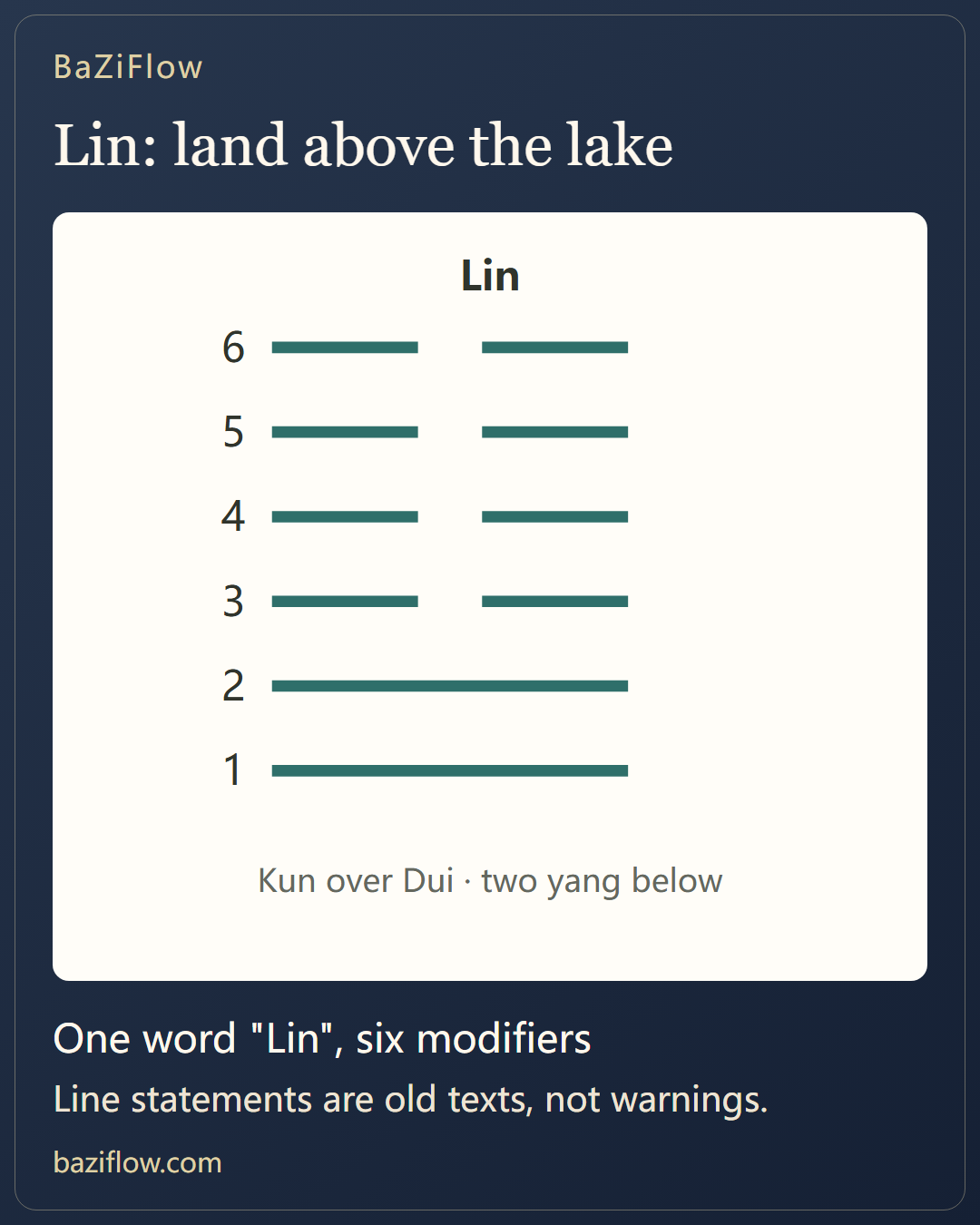
Lin is the 19th hexagram: land above a lake, two yang lines rising from the bottom. The Commentary says "the firm gradually advances" and mentions the eighth month; six statements keep Lin and change the word before it.
The short version7 min read
Lin means to draw near or face. The Commentary says two yang lines are slowly rising, the judgment leaves a warning about the eighth month, and the statements put five different words in front of Lin.
- Lin (臨) is Kun (earth) over Dui (lake). Only the first and second lines are yang, and the Commentary's opening "the firm gradually advances" is about them; turned over, the hexagram becomes Guan.
- The Commentary lists four traits: the firm advances, delighting and yielding, the firm is central and answered, great success through what is right; "the eighth month" is closed with "the decline is not far off".
- All six statements circle the word Lin, with these words before it: feeling, feeling, sweet, arriving, knowing, generous. Line three alone says "no benefit" first and "no fault" after.
Read first
The Sixty-Four Hexagrams: How Upper and Lower Trigrams Form One Figure ↗
Judgment and Line Statements: Whole Hexagram or Single Line? ↗
Land above the lake: two yang lines rising from the bottom
Lin (臨) is the 19th hexagram: Dui (lake) below, Kun (earth) above. Only the lowest two lines, first and second, are yang; the four above them are yin. In ordinary speech the word means to approach or to face, as in facing a river, and the Great Image (大象) is likewise "above the lake there is land": a stretch of ground facing the water.
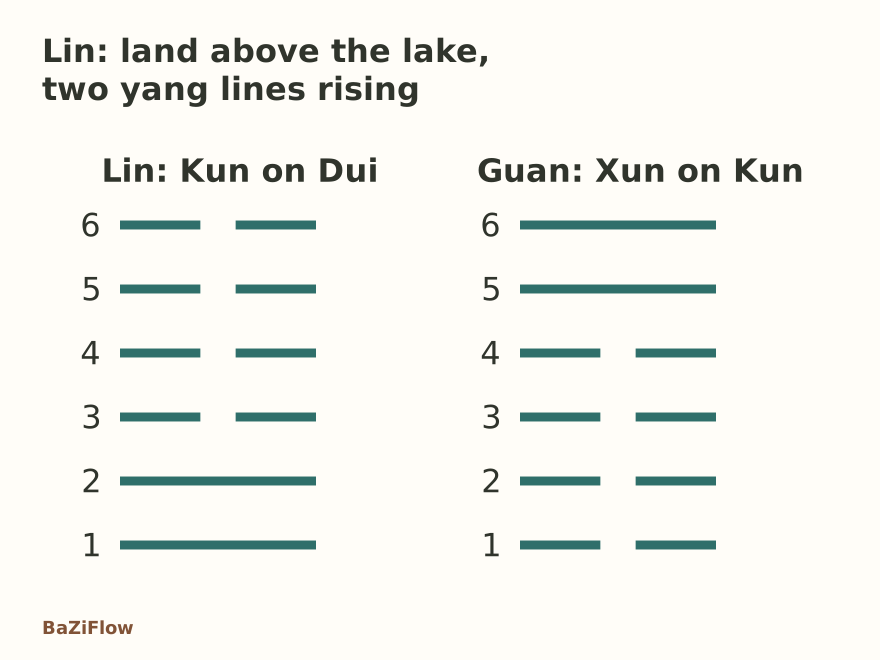
Lin and its reversed form Guan: turn Lin over and the two yang lines move from the bottom to the top.
Enlarge diagram · scroll sideways to read
Three terms to start with
- Gradually advancing
- The Commentary's opening, "the firm gradually advances and grows". The verb is to seep in, to push forward by degrees: the firm lines rise a little at a time.
- Dui and Kun
- The Shuo Gua says "Dui is delighting" and "Kun is yielding", and the Commentary joins them: delighting and yielding.
- "Lin means great"
- The Xu Gua explains the name as "great". That is a second line of meaning next to "draw near", and the two should be kept apart.
Two yang lines are pressed under four yin lines, rather like two forces just breaking surface. That is what the Commentary on the Judgments (彖传) says first: they are growing.
The Commentary: "the firm advances", and the eighth month
The judgment reads "yuan heng; li zhen; when the eighth month comes, there is misfortune", and the Commentary comments on it clause by clause.
Lin: the firm gradually advances and grows. Delighting and yielding; the firm is central and is answered. Great success through what is right: this is the way of heaven. "When the eighth month comes, there is misfortune": the decline is not far off.
Enlarge diagram · scroll sideways to read
"The firm advances" is read off the figure: two yang lines pushing up from the bottom. "The firm is central and answered" is about the second line: a yang line in the middle of the lower trigram, with the fifth line above answering it. After "great success through what is right" the Commentary closes the praise with "this is the way of heaven". Then the eighth month: which month is meant has long been disputed, and the Commentary adds only half a sentence, "the decline is not far off".
The Great Image: unending teaching, boundless protection
The Great Image of Lin puts the weight on "unending" and "boundless".
Above the lake there is land: Lin. The noble person is unending in teaching and thought, and unbounded in embracing and protecting the people.
Enlarge diagram · scroll sideways to read
"Teaching and thought" is instructing and giving care; "embracing and protecting" is tolerating and shielding. Each clause ends on a word for having no end. Set this beside the Xu Gua's "Lin means great": the name is "great" there, and the Great Image gives two acts without bounds, so the two echo each other in wording.
The six statements: one word, Lin, with five words before it
Every one of the six statements contains the word Lin, and the word in front changes: feeling, feeling, sweet, arriving, knowing, generous.
Enlarge diagram · scroll sideways to read
Lines 1 and 2 both say "approaching with feeling". The first word is explained in the Commentary of the hexagram Xian as "to feel", so it is usually read as approaching with feeling, a borrowed explanation. Line 1 says "staying on course brings good fortune" and the Small Image (小象) says "his aim carries out what is right". Line 2 says "good fortune, nothing unfavorable", yet its Small Image says "he has not yet gone along with the command". Taken literally it is "not yet following the order", and it has more than one reading, so only the literal sense is given.
Line 3: "A sweet approach: no benefit anywhere. Once he is anxious about it, there is no fault." The word is sweet: approaching sweetly brings no gain, and once he worries about it there is no fault. The Small Image says "his place is not fitting", a yin line in the third place, and also "the fault does not last". Line 4: "An arriving approach: no fault", and "his place is fitting". Line 5: "A knowing approach: what suits a great ruler; good fortune", with "it means acting from the center". Line 6: "A generous approach: good fortune, no fault", with "his aim is within".
Guan and Fu: neighbors of Lin, and the Xu Gua's "great"
Turn Lin upside down and you have Guan: the two yang lines go from the very bottom to the very top, which is why the two are side by side at the head of this article.
Enlarge diagram · scroll sideways to read
The inverse of Lin is Dun (遯): every line changes polarity, so the two yang lines become yin and the four yin lines become yang. The nuclear hexagram is Fu (復): lines two to four give the lower trigram, Zhen, and lines three to five the upper, Kun, so Fu keeps only the lowest yang line.
The Xu Gua attaches Lin to Gu with this sentence:
Only when there are affairs can anything grow large; so Lin follows, and Lin means the great.
Once there are affairs, something can grow large, and the Xu Gua says that is the reason for Lin, adding that Lin means "great". The hexagram after it is Guan; the Xu Gua says things must be great before they can be looked at, and that is the subject of the next article.
Questions readers ask next
Which month is "the eighth month"?
The text does not say, and readers have long disagreed. The Commentary adds only half a sentence, "the decline is not far off". When you read the clause, keep what the text fixes apart from later calculations rather than naming a month.
What does the first word in "approach with feeling" mean?
Its meaning is argued over. The Commentary of the hexagram Xian (咸) explains the word as "to feel", so here it is usually read as approaching with feeling. That is a borrowed explanation, not Lin's own definition, and should be marked as one.
Why does the Small Image mention the place only for lines three and four?
Line three is a yin line in the third place and the comment says "his place is not fitting"; line four is a yin line in the fourth place and the comment says "his place is fitting". Only those two comments cite the place, so only there does the text itself support talking about fitting and unfitting places.
Was this article helpful?
Sources & references
Continue reading
Gu: wind beneath the mountain, and how to count "three days before and after" ↗
Guan: wind over the earth, from "washed but not yet offered" to "observing my own life" ↗
The Sixty-Four Hexagrams: How Upper and Lower Trigrams Form One Figure ↗
Judgment and Line Statements: Whole Hexagram or Single Line? ↗