

En Guang: day forward, hour back
Content version · · Sources & references
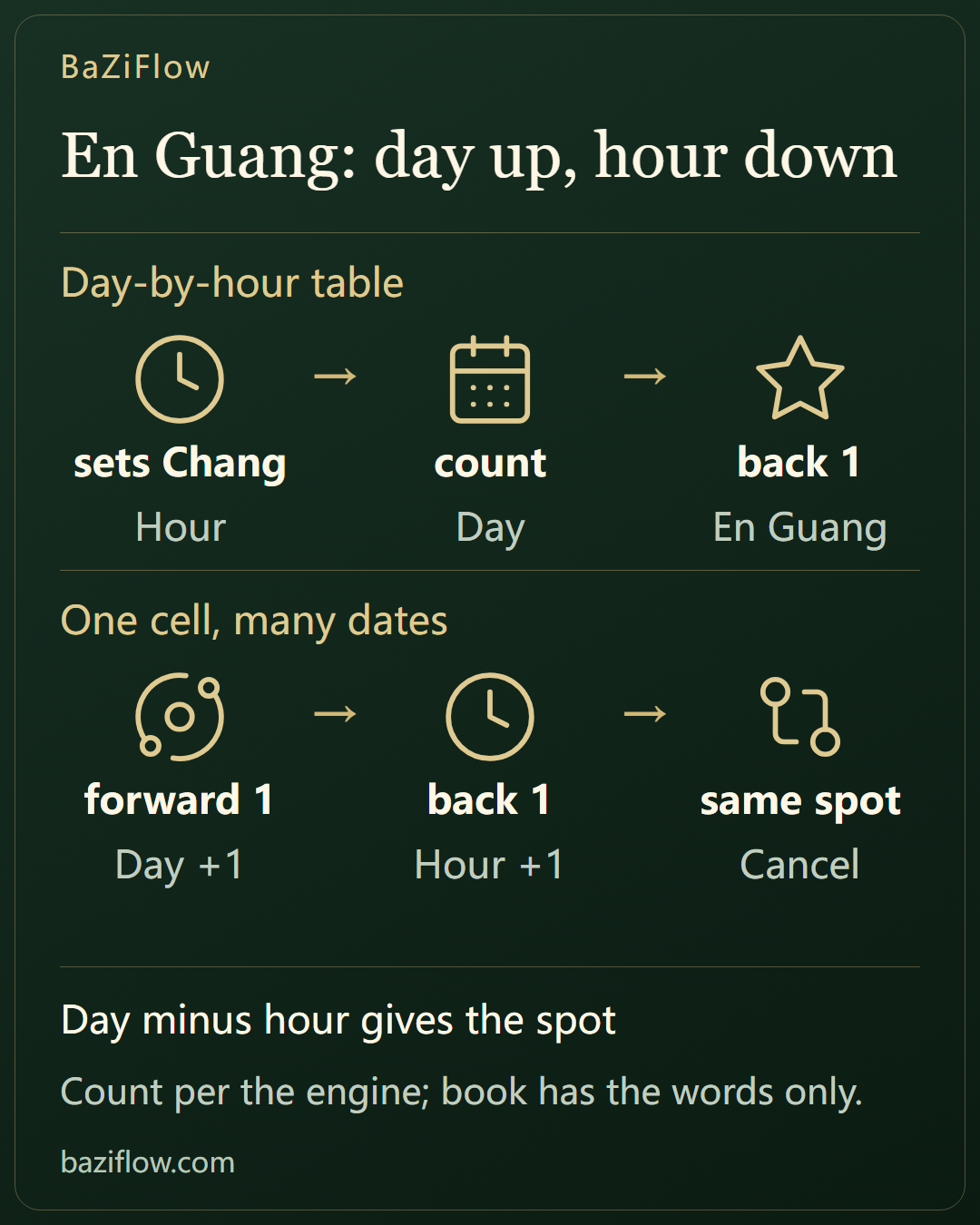
En Guang finds Wen Chang by birth hour, puts day 1 there, counts to the birth day and steps back one, so the month never enters. A day-by-hour table gives the landings, and the book has the words in one verse only.
The short version6 min read
En Guang is a minor star that looks at the birth day and hour and never at the month: Wen Chang is found by the hour, day 1 is put on its palace and counted to the birth day, and then the count steps back one. Each extra day moves it one palace forward and each later hour moves it one palace back.
- The landing depends on day and hour alone, with no month; day 1 sits one place before Wen Chang, day 2 on Wen Chang's own palace, and day 3 one place after.
- One more day moves it forward a palace and one more hour moves it back, so two cells with the same "day minus hour number" land on the same branch.
- The book has the words "En Guang" in one verse of juan 1 only; the juan 2 placement verses have no entry for it, the placement comes from the engine, and its meaning is not yet sourced.
Read first
What do Zi Wei's supporting, malefic and minor stars actually do? ↗
The day-by-hour table
En Guang (恩光) looks at two things only, the birth day and the birth hour, and the month plays no part. Find Wen Chang (文昌) from the hour, place lunar day 1 on the palace where it sits, count forward to the birth day, and finally step back one palace; where you stop is En Guang.
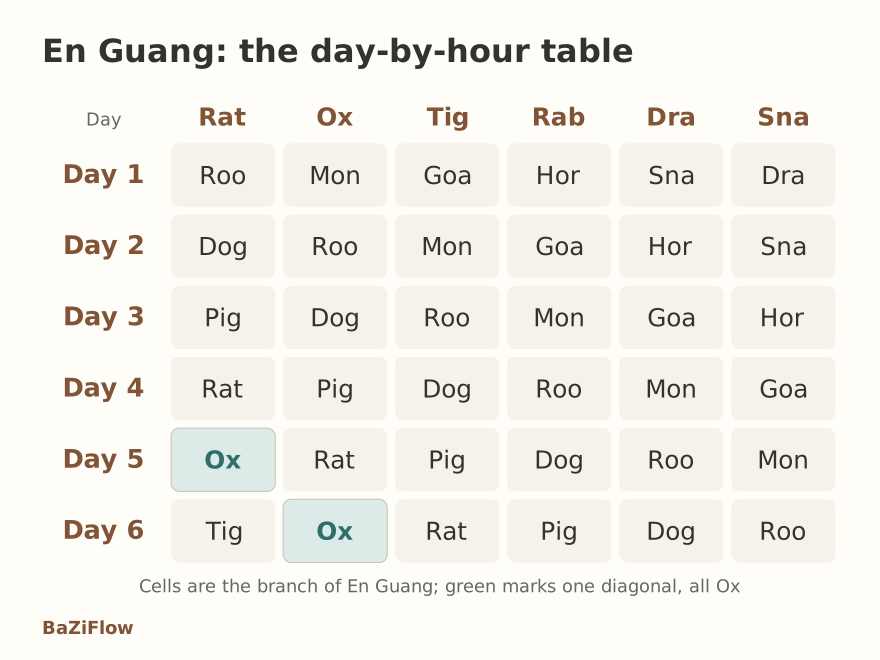
The table: all thirty-six cells were checked one by one against charts drawn with iztro 2.6.0; green marks cells on one diagonal, which all land on Ox.
The picture takes days 1 to 6 and the Rat to Snake hours, each cell giving the branch where En Guang lands. Read across and, within one day, every later hour moves En Guang one cell back; read down and, within one hour, every extra day moves it one cell forward.
There is no month column in the table: Wen Chang follows the birth hour only and En Guang is counted from Wen Chang, so the month has nowhere to enter. Wen Chang's own rule is in Wen Chang.
Three inputs, three roles
- Birth hour
- Decides where Wen Chang sits, which is the starting point of the day count.
- Birth day
- Decides how many palaces to go forward from that start before stepping back one.
- Birth month
- Takes no part in the branch of En Guang; it only reaches the palace name on the chart through the Life palace.
One day forward, one hour back: a diagonal is one cell
One more day moves the landing forward a palace and one more hour moves it back a palace. Forward and back cancel, so walking down and to the right in the table, one more day and one more hour, leaves En Guang where it was. The landing therefore depends only on "day minus hour number", where the hours are numbered Rat 0, Ox 1, up to Pig 11.
Enlarge diagram · scroll sideways to read
The whole lookup follows, each row labeled by the remainder of "day minus hour number" divided by 12:
| Remainder | En Guang | Remainder | En Guang |
|---|---|---|---|
| 0 | Monkey | 6 | Tiger |
| 1 | Rooster | 7 | Rabbit |
| 2 | Dog | 8 | Dragon |
| 3 | Pig | 9 | Snake |
| 4 | Rat | 10 | Horse |
| 5 | Ox | 11 | Goat |
When the day is smaller than the hour number, add 12 before taking the remainder: day 3 in the Horse hour (number 6) gives 3 - 6 = -3, plus 12 is 9, and En Guang lands on Snake.
On day 2, En Guang returns to the Wen Chang palace
What "step back one" does is clearest over the first three days:
Enlarge diagram · scroll sideways to read
On days 2, 14 and 26, En Guang shares Wen Chang's palace, a cycle of twelve days. The site default places the late Rat hour on the next day, so someone born after 11 pm on lunar day 1 is set as day 2, and En Guang also lands on Wen Chang's palace; the day-change setting is explained in the leap month and late-Rat-hour rules.
The one place the book has the words "En Guang"
Enlarge diagram · scroll sideways to read
Juan 1 has a rhapsody on women's charts, and the first half of its couplet on the ten-stem Hua Lu reads:
And if Lu Cun joins in as well
The two words "En Guang" sit in the second half of the same couplet. Whether they are plain words or the name of the star on a chart, the book does not say. The juan 2 placement verses have San Tai and Ba Zuo, Tai Fu and Feng Gao, and no En Guang.
Find Wen Chang from the hour
Wen Chang starts the Rat hour on Dog and counts back to the birth hour; the Rat hour is on Dog and the Pig hour on Pig.
Then work out "day minus hour number"
Keep the remainder after dividing by 12 and look up En Guang's branch in the table above.
Last, check day 2
When the day leaves remainder 2 on division by 12, En Guang must sit on Wen Chang's palace; if it does not, the count is wrong.
Day and hour: two problems
Born on lunar day 18 in the Dragon hour: which branch holds En Guang?
The Dragon hour is number 4, 18 - 4 = 14, remainder 2, so the Dog palace.
En Guang is on the Horse palace and the birth day is the 9th: which hour?
The Horse palace stands for remainder 10; 9 minus the hour number must be 10 mod 12, so the number is 11, the Pig hour.
The star with the same starting rule but counted from Wen Qu instead is Tian Gui; one looks at day minus hour and the other at day plus hour.
Questions readers ask next
En Guang ignores the month, so does everyone born on the same day and hour get the same landing, whatever the month?
The same branch position. A chart is read by palace name, though, and the name depends on where the Life palace sits, which comes from the month and hour together, so the names can differ.
Is En Guang always on Wen Chang's palace for someone born on day 2?
Yes, and also on days 14 and 26. The site default puts the late Rat hour on the next day, so a birth after 11 pm on lunar day 1 is set as day 2 and En Guang again lands on Wen Chang's palace.
Can the site tell me what En Guang means or what its brightness is?
The engine records no brightness grade for En Guang and the book has no entry for it, only one verse that contains the two words. To read a meaning you need another source, cited by name.
Was this article helpful?
Sources & references
Continue reading
Ba Zuo (八座): The Mirror of San Tai, Counted Back from You Bi ↗
Tian Gui (天贵): The Day-Plus-Hour Star Paired with En Guang, Missing from the Book We Hold ↗