

Define the event before selecting the relation class
Content version · · Sources & references
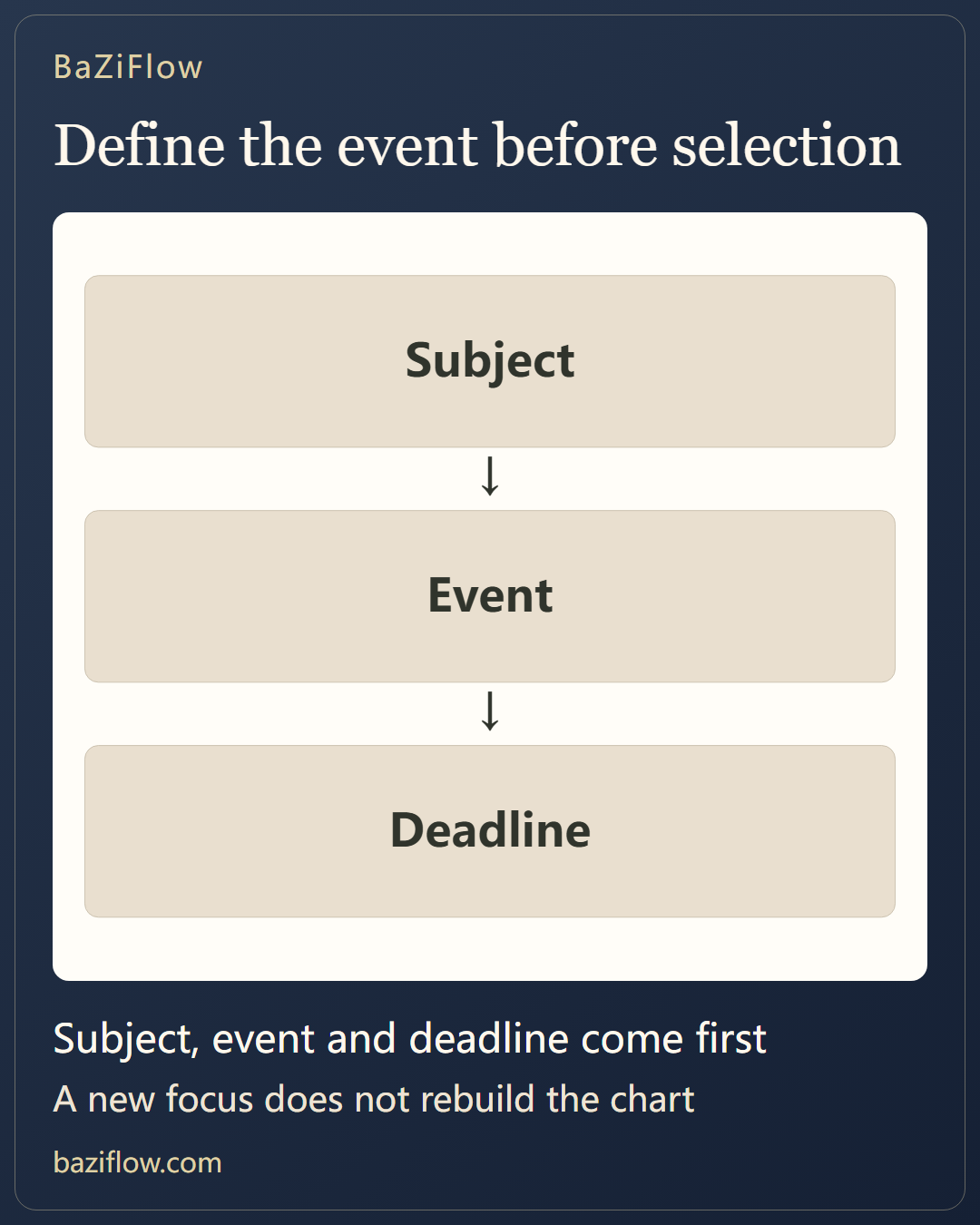
Compare document and payment targets in doubled Kan, distinguish proxy subjects and role labels, and keep alternatives within a common observation scope.
The short version6 min read
Doubled Kan uses palace Water: a document target points to Parents at line four Monkey Metal, while a specified payment points to Wealth at line three Horse Fire. A changed question changes the focus, not the relation table or Self/Response positions.
- Written confirmation and payment receipt need separate prospective definitions and corresponding observational evidence.
- Metal generating Water and Water controlling Fire establish the categories; Response at line three is a separate label.
- Proxy subjects, comparison criteria and deadlines must be supplied explicitly rather than inferred from category names.
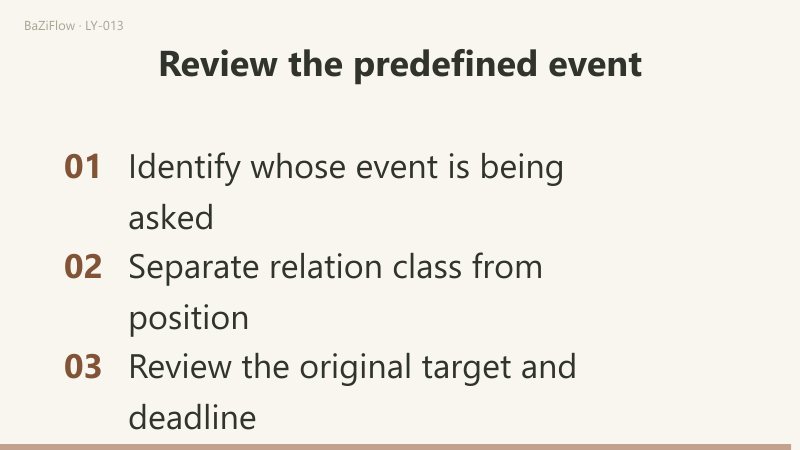
Read first
Choosing the useful god: define the subject and retain candidates ↗
Make the alternatives answer the same question
Suppose option A is assessed for obtaining approval, while option B is assessed for earning more money. Those are different outcomes. A favorable reading for each does not produce a meaningful ranking between them. Before comparing alternatives, fix a common event, observation period, and set of relevant real-world assumptions.
This is a lesson about the scope of a Liuyao question. Traditional role categories help identify what a reading is about, but they do not repair an undefined objective. The scope record proposed here is a modern teaching aid, not a claim that every historical school required the same form.
Document
- Sending record
Payment
- Account entry
Write a small scope contract
State whose situation is being considered, what object or process is involved, which observable event would count, and when observation ends. Also distinguish facts already known from developments that remain uncertain. “Will the institution send me the specified written confirmation by Friday?” is more bounded than “Will everything work out?”
A process can contain several events: approval, dispatch of a document, delivery, and receipt of an agreed payment. They may be related without being interchangeable. A notice that processing has begun is not evidence that money has arrived. If the question concerns dispatch, later receipt is a separate observation rather than a reason to silently change the original criterion.
These examples illustrate question design, not a basis for financial action. Existing agreements, receipts, and direct communication supply real-world evidence. Do not relabel something already known as a discovery made by the hexagram. If the scope changes, retain the previous version and say when the change occurred.
One teaching structure, two distinct targets
Use the doubled Kan hexagram as a fixed instructional structure. Its palace reference is Water. The Eight Palace diagrams in Zengshan Buyi assign Wealth to Horse (午) Fire at line three and Parents to Monkey (申) Metal at line four. The Useful God chapter (用神章第八) includes documents in the Parents category and material property in Wealth.
The following are two independently framed questions used to compare selection. No actual casting, calendar input, or moving lines have been supplied. This is not a claim that one real consultation has yielded two predictions.
| Target event | Traditional category | Candidate in doubled Kan | Relation to palace Water |
|---|---|---|---|
| Specified written confirmation is issued | Documents: Parents | Line 4, Monkey Metal | Metal generates Water |
| A specified agreed payment is received | Property: Wealth | Line 3, Horse Fire | Water controls Fire |
The arithmetic is relational: what generates the palace element belongs to Parents; what the palace element controls belongs to Wealth. The branch assignments come from the given hexagram diagram. They were not extracted from ordinary words such as “money” or inferred from a person's family status. See choosing the useful god for the underlying classification.
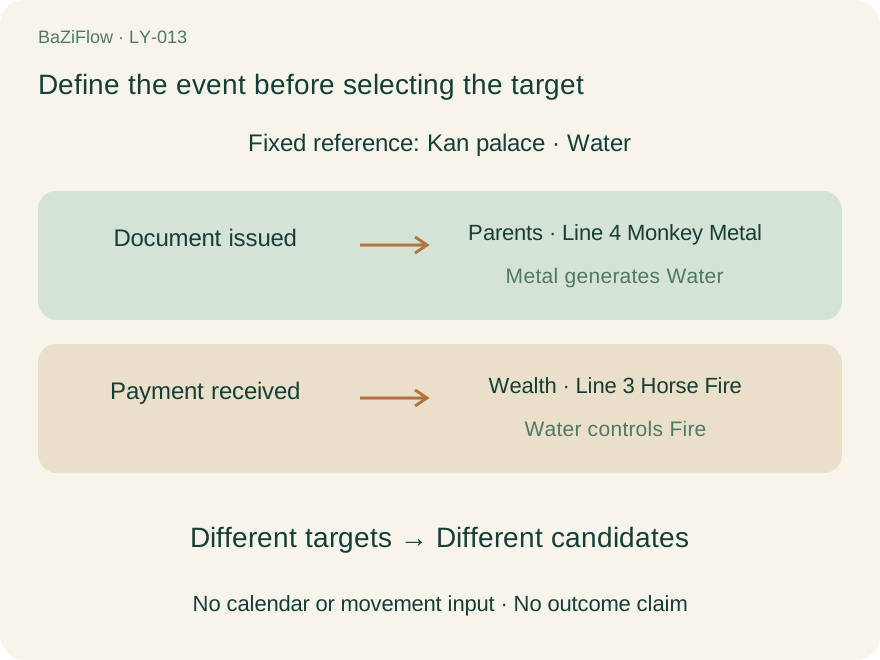
Original BaZiFlow scope comparison. Each row belongs to a separately framed question; neither row predicts completion.
Line three is also the Response position in doubled Kan. That coincidence does not make every Wealth line “the other party.” Relation class and Self/Response position are different layers. Nor does Parents at line four identify someone's actual parent. Finding a candidate answers a selection question, not whether the event will happen.
Parents · line 4
Wealth · line 3
Read the genre before assigning a person
Historical terminology changes its referent with the type of inquiry. The weather section of Huangjin Ce discusses Parents and Wealth in relation to rain and clear weather, and uses a setting in which Self relates to earth and Response to heaven. Reading those words as a literal mother, spouse, and negotiating partner would miss the chapter's subject.
This example illustrates the contextual nature of the traditional vocabulary; it is not offered as a replacement for meteorological forecasting. It also warns against taking a people-oriented maxim from one passage and treating it as a universal dictionary for every chapter.
Historical works contain social categories that do not transfer unchanged to contemporary relationships. State which aspect of a classification is being used, and do not assign a modern person an obsolete status merely because it appears in an old list. Differences among authors and types of inquiry should remain visible instead of being merged into a fictitious consensus.
Documents
- Parents category
Weather text
- Parents: rain context
Proxy questions need an explicit subject
The person recording a question, the person casting, and the person affected by the event may differ. Record those roles before explaining the convention adopted for a proxy inquiry. The person typing is not automatically entitled to the Self line simply because the interface says “your question.” The structural distinction is introduced in Self and Response lines.
Likewise, a role label cannot establish an unidentified third person's identity or demonstrate what someone privately thinks. Missing evidence about a real person remains missing. A symbolic category is not an identity lookup.
Where a process has genuinely separate targets, separate scope records can help. This is a practical proposal for review, not a declaration that all schools share an absolute one-question-one-hexagram rule. It also does not endorse repeatedly changing the wording or recasting until an agreeable interpretation appears. A new record should make a new objective explicit, rather than make an old claim impossible to assess.
Recorder
Caster
Event subject
Keep the boundary when the outcome arrives
After the observation period, compare evidence with the original event. A document being issued and a payment being received each need their own evidence. If no follow-up is available, record that absence; do not count it as success. If the objective was cancelled, retain the cancellation rather than inventing an outcome.
A clear scope still leaves other inputs to be supplied. In the Kan exercise there is no month, day, or movement information, so the lesson stops at candidate selection. Precision about the question cannot manufacture the missing conditions of a full interpretation.
The companion article on timing and uncertainty separates a fixed observation window from conditional timing candidates. Together these boundaries make a later review intelligible: readers can see which event was asked about, which traditional category was used, and which claims were never established.
Questions readers ask next
Does switching to a payment question require rebuilding Kan’s relatives?
No. Palace Water and the assigned branches retain their phase relations. The question changes which category and candidate position are examined. Selection should not be mistaken for a new construction of the chart.
Does Wealth at the Response position mean all wealth belongs to another party?
No. Wealth is derived from the palace-to-line phase relation; Response is derived from positional rules. Their overlap in this fixed figure establishes neither a universal identity rule nor real ownership of an asset.
How can incompatible comparison criteria be detected?
Place the event verbs, objects and deadlines side by side. Approval on one side and payment on the other do not form one criterion. Identify those differences before deciding whether a comparison is possible, rather than ranking unrelated outcomes.
Was this article helpful?
Sources & references
Continue reading
Locating Self and Response without confusing moving lines ↗
Timing judgments need uncertainty: candidates are not guarantees ↗