

Po Jun: Jia, Gui and a Snake-Pig line with no grade
Content version · · Sources & references
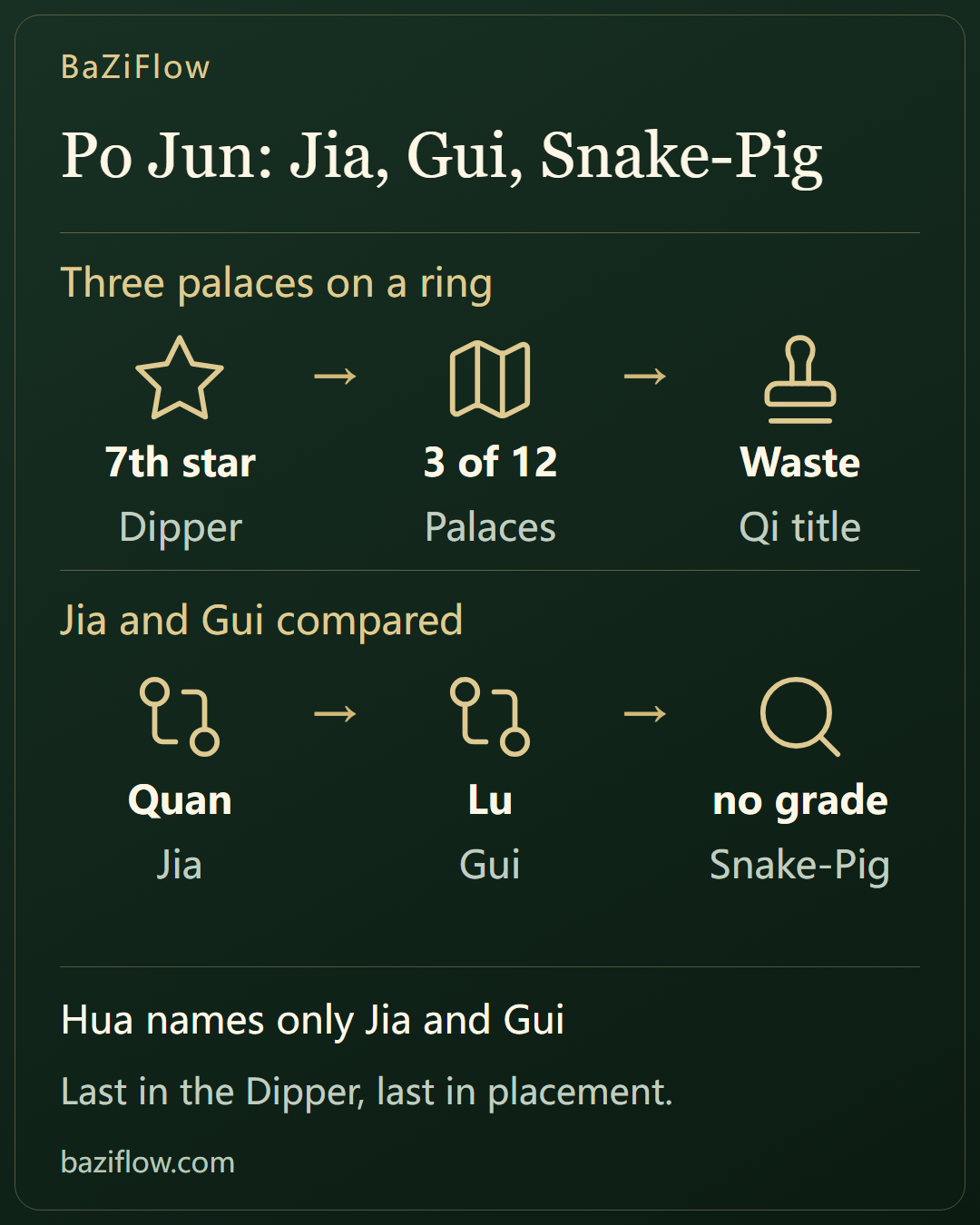
Po Jun is the seventh Northern Dipper star, the Waste. Its seat and three palaces on a ring, the entry against the grade table, "Gui and Jia" against the Hua verse, and the Snake-Pig line with a partner but no grade.
The short version7 min read
Po Jun is the seventh Northern Dipper star, given three palaces in the book; the Hua verse names it only on Jia and Gui, and the entry line for Snake and Pig gives no grade.
- Po Jun is last among the Northern Dipper stars and last in the placement verse too; the book says it governs "spouse, offspring and servants", which are the Partner, Children and Friends palaces.
- "Gui and Jia" are exactly the two stems where the verse names Po Jun (Lu on Gui, Quan on Jia), but the entry's other stems, Ding and Ji among them, have nothing to do with Hua, so a stem condition cannot simply be read as a transformation.
- Tian Xiang is opposite Po Jun on every chart; five of the six entry lines give a grade that matches the table, and the Snake-Pig line gives only a partner, Wu Qu.
Read first
The fourteen major stars: learn the roster and its structure ↗
The seventh Dipper star and its three palaces
In one sentence: Po Jun (破军) is the last seat of the book's Northern Dipper, its qi is called "Waste", and the affairs of three palaces, spouse, offspring and servants, are filed under it.
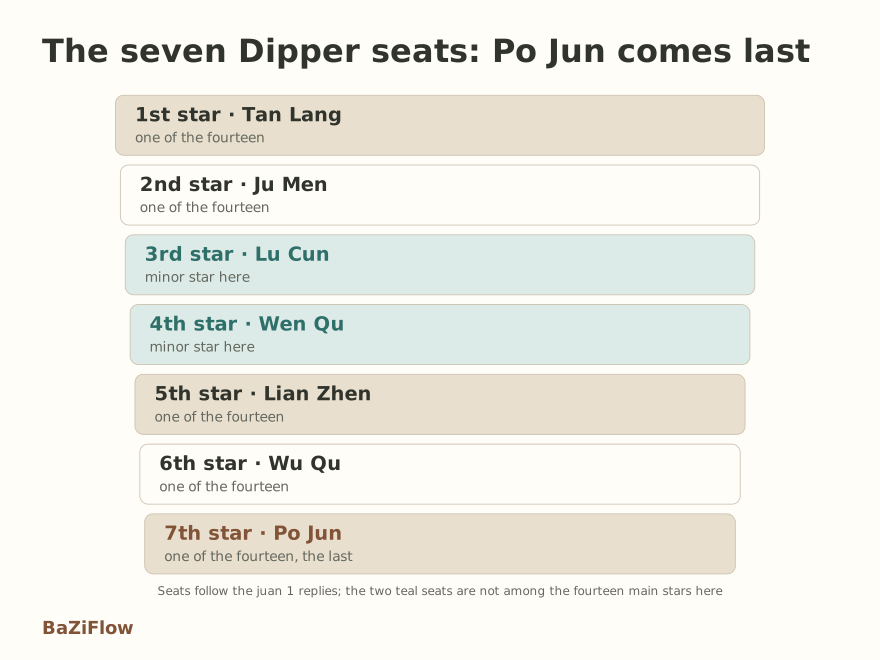
Seat chart: the seven Dipper seats come from the opening of each juan 1 reply; whether a star is one of the fourteen follows this site's star classes.
The picture is the book's Northern Dipper in seven seats. Each juan 1 reply opens by naming the star's seat, and the seven sentences together make this table; Lu Cun and Wen Qu are minor stars on this site and not among the fourteen main stars. The reply on Po Jun itself starts like this:
Po Jun belongs to Water and is the seventh star of the Northern Dipper, the spirit that governs spouse, offspring and servants. On Rat and Horse it enters the temple
Juan 2 keeps it as one line in its list of the stars' elements and qi titles:
Po Jun is Water, Northern Dipper, turns into Waste, governs spouse, children and servants.
Its element is Water, and the iztro 2.6.0 star table says Water as well. The placement verse closes with "Qi Sha, leave three empty, Po Jun's place", so the eight stars end with Po Jun: last seat, last in the order, and here the two orders coincide.
The three palaces can be put on the ring of the twelve:
Enlarge diagram · scroll sideways to read
The Partner palace sits right next to the Children palace; the Friends palace (the book's "servants") and the Children palace belong to one trine set, whose third palace is Parents. The three palaces are the book's filing; which palace Po Jun actually lands in still depends on the chart.
Jia and Gui: a stem condition against the Hua verse
The juan 1 reply on Po Jun carries a birth-year condition:
Only people born in Gui and Jia years meet the standard
The summary at the head of the juan 2 entry also mentions people of "Gui and Jia" years with Life on Rat or Horse (the verdict is not quoted). These two stems have one checkable overlap with the birth-year transformations. The example sentence in the juan 2 verse on Lu, Quan, Ke and Ji happens to be about Jia:
For example, for a person born in a Jia year Lian Zhen turns into Lu, Po Jun into Quan, Wu Qu into Ke and Tai Yang into Ji.
In the verse Po Jun appears on only two lines: Quan on Jia and Lu on Gui. The other eight stems do not name it, and Ke and Ji never fall to Po Jun. The iztro stem table says the same. Now count the stems attached to the six lines of the entry, and compare:
Enlarge diagram · scroll sideways to read
So the overlap is only half: "Gui and Jia" match the two verse lines for Po Jun, but nothing in the verse explains Ding or Ji, and the entry's stem conditions cannot be read across as transformations. How to use the whole verse is laid out in birth-year transformations.
Six position pairs: opposite is always Tian Xiang
Casting the twelve charts by the placement verse, the stars that share Po Jun's palace and the stars opposite it on each of its six pairs of positions are:
Enlarge diagram · scroll sideways to read
The three partners the entry writes (Zi Wei on Ox and Goat, Lian Zhen on Rabbit and Rooster, Wu Qu on Snake and Pig) all agree with the casting. Two more facts hold on every chart without being written:
The Snake-Pig line: a partner, no grade
The entry sorts Po Jun's twelve cells into six lines, and the first five give a grade: Rat-Horse enter the temple, Rabbit-Rooster sunken ground, Dragon-Dog Wang, Ox-Goat Wang, Tiger-Monkey De, all matching the grade table. Only the Snake-Pig line is different:
Snake and Pig palaces share with Wu Qu
It has a partner and no grade. Looking at the other records, the Snake-Pig grade shows up in only two of them:
Enlarge diagram · scroll sideways to read
So for Po Jun's grade on Snake or Pig the only sources to quote are the grade table or the engine, and the source has to be named; saying "the entry writes Ping" would be wrong. The juan 3 list likewise omits Tiger-Monkey (De) and Snake-Pig (Ping) and keeps only "Miao on Rat and Horse, Wang on Dragon, Dog, Ox and Goat, Xian on Rabbit and Rooster"; a cell absent from the list cannot be checked against it.
Two practice problems
Po Jun sits on Snake. Which grades do the entry and the table give, and which stars stand with it and across from it?
The entry gives only the partner Wu Qu and no grade; the table gives Ping; Wu Qu sits with it and Tian Xiang across.
For a person born in a Ji year, which transformation does the verse give Po Jun?
None. The Ji line gives Lu to Wu Qu, Quan to Tan Lang, Ke to Tian Liang and Ji to Wen Qu, with no place for Po Jun.
The star before Po Jun is Qi Sha; the rung scale itself is explained in brightness levels.
Questions readers ask next
Po Jun "governs spouse, children and servants". Does that make it bad in those palaces?
The sentence says which palaces the book files the star under; it is a division of labor and is not worded as fortune or misfortune. Which palace the star actually lands in depends on the chart, and the book's judgments for each palace are separate records to read apart.
Does Po Jun always turn into Lu or Quan for people born in Gui or Jia years?
Birth-year transformations are looked up by the birth year's stem in the verse: on Gui Po Jun turns into Lu, on Jia into Quan. That is the rule of the verse itself and is separate from the cell Po Jun lands in; look up the verse first, then the position.
Why does the Snake-Pig line of the entry have no grade?
The text gives only the partner Wu Qu and a string of stems and writes no grade. The Snake and Pig grade appears only in the grade table and the engine, both Ping; name the source when citing and do not say the entry wrote it.
Was this article helpful?
Sources & references
Continue reading
Qi Sha (七杀): Four Dipper Cells, the Rooster Clash, and Eight Meeting Charts ↗