

Visiting Guest: two behind the year branch
Content version · · Sources & references
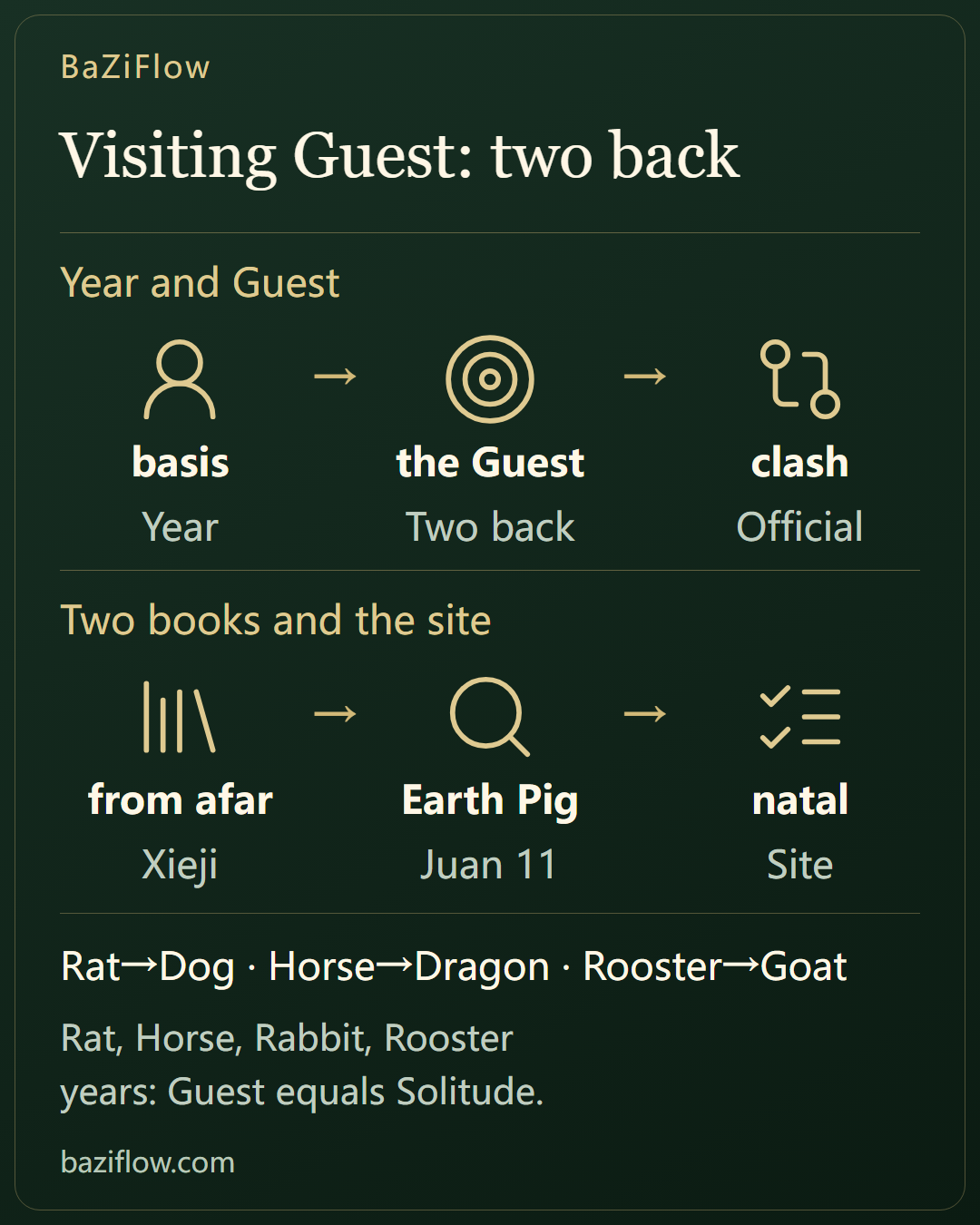
The Visiting Guest starts from the year branch and takes the second branch behind it, read in the month, day and hour pillars. A table, two charts, "a guest comes from elsewhere", and a Yin Earth Pig (己亥) case.
The short version8 min read
The basis of the Visiting Guest is the year branch: it lands on the second branch behind it and is looked for in the month, day and hour pillars; it and the Mourning Gate stand on opposite sides of the year branch, four places apart.
- The Visiting Guest, the Mourning Gate and the Year Breaker always form one Three Harmony group, the one that clashes the group of the year branch itself: a Rat year gives Dog, Tiger and Horse.
- The Xieji Bianfang Shu explains the "behind" with "a guest comes from elsewhere" and says its place always clashes the Official Talisman; both points can be checked against the engine.
- For Rat, Horse, Rabbit and Rooster years the Visiting Guest equals the Solitude Star and the Mourning Gate equals the Loneliness Star; the Sanming Tonghui sentence on a Rabbit person sits right on that overlap.
Read first
Symbolic Stars in BaZi: Check the Reference and Rule Before the Meaning ↗
The Visiting Guest stands two places behind
The Visiting Guest (吊客) stands at the back of the year branch. Start from the branch of the birth year and walk two places in reverse; the branch where you stop is the Guest.
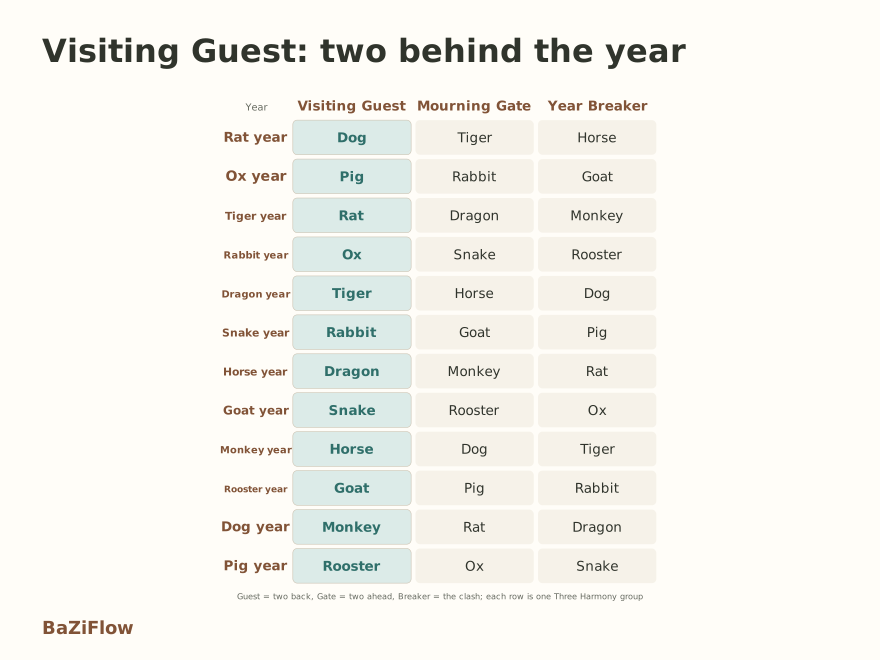
One row per year branch: the Visiting Guest follows the site engine (the second branch behind the year branch); the Mourning Gate and Year Breaker come from the same year table, and the three branches of each row form a Three Harmony group.
Each row of the table has three branches: the Visiting Guest in the first column, the Mourning Gate in the second, and in the third the Year Breaker (岁破), the branch standing directly across from the year branch. Read as a row, the three always make one Three Harmony group, Tiger-Horse-Dog for a Rat year and Snake-Rooster-Ox for a Rabbit year, and all twelve rows work this way.
A guest comes from elsewhere
Why is the place behind called a "guest"? The joint essay on these four gods in juan 3 of the Xieji Bianfang Shu (协纪辨方书), the Qing court almanac, offers an explanation:
A gate is always in front, so the place ahead is the Mourning Gate; a guest is one who comes from another quarter, so the place behind is the Visiting Guest.
The gate is in front and the visitor, who arrives from elsewhere, stands behind. The book quotes the Pengying Shu for each year's place, "in a Rat year it is at Dog and runs forward through the twelve branches", which agrees with the table above, and quotes the Jisui Li to say that its direction is a poor one for building that year and for matters like asking after the sick or paying condolences. All of this is the almanac's way of choosing days: it follows the Grand Duke of the year and has nothing to do with when a person was born.
Enlarge diagram · scroll sideways to read
Three branches make one group, with the Official across
The table's pattern was noticed in the book as well. The compilers of the Xieji Bianfang Shu argue that the places two ahead and two behind must belong to one Three Harmony group, and they take a Horse year as the case: two ahead is Monkey, two behind is Dragon, and between Monkey and Dragon the Rat is "arched" into place, which is exactly the clash of Horse, the Year Breaker. Write it out for a Rat year and the same structure appears: Horse sits between Tiger and Dog, and the three branches are the Mourning Gate, the Visiting Guest and the Year Breaker.
The other relation is the Official Talisman (官符): the book says the Visiting Guest's place always clashes it. The Official Talisman stands four ahead of the year branch, Dragon in a Rat year, and Dragon faces Dog directly.
Enlarge diagram · scroll sideways to read
A Yin Earth Pig person, and the minor luck at thirty-two
Juan 11 of the Sanming Tonghui (三命通会), a Ming-dynasty compendium, gives an example that uses the Visiting Guest:
For a person of a Yin Earth Pig year, the minor luck at thirty-two is Yin Fire Rooster, which sits at the Visiting Guest; the Grand Duke Yang Metal Horse is in a dead place, and it is again the palace of the six troubles; the three origins are under attack, hence the trouble of quarrels and paperwork.
Take someone born in a Yin Earth Pig (己亥) year. The year branch is Pig, and stepping back through Dog lands on Rooster, so Rooster is the Guest, which fits the book's Yin Fire Rooster (丁酉). The calendar checks out as well: by nominal age, a Yin Earth Pig person is thirty-two in a Yang Metal Horse year, the very Grand Duke named in the quotation.
Enlarge diagram · scroll sideways to read
After giving the position the book lists where the Grand Duke stands, the palace of the six troubles and the attacked "three origins" before it reaches "the trouble of quarrels and paperwork". The Visiting Guest is one link among several.
Rat, Horse, Rabbit, Rooster years: the same branch as Solitude and Loneliness
In another passage of the same juan, the book's author turns to the Loneliness and Solitude stars and mentions a Rabbit person in passing:
Likewise the Grand Duke must not stand on the Solitude Star: say a person of Tiger, Rabbit or Dragon meets the Grand Duke at Ox; the Dragon person gets "hook and noose", the Rabbit person "mourning and visiting", and the Tiger person is said to be "peeked at".
Ox is the Solitude Star of the Tiger-Rabbit-Dragon side and, for a Rabbit year, also the Visiting Guest; for the Tiger and Dragon people it gets other names, and for the Rabbit person it is called "mourning and visiting". Checking the engine shows a pattern: for the four branches Rat, Horse, Rabbit and Rooster, the Visiting Guest and the Solitude Star are the same branch, and so are the Mourning Gate and the Loneliness Star.
Enlarge diagram · scroll sideways to read
Two charts where Gate and Guest appear together
First chart: year Monkey, month Rat, day Dog, hour Horse. A Monkey year has its Mourning Gate at Dog and its Visiting Guest at Horse, so the day pillar's Dog is the Gate and the hour pillar's Horse is the Guest. Second chart: year Rabbit, month Ox, day Snake, hour Ox. A Rabbit year has its Gate at Snake and its Guest at Ox, so the day pillar's Snake is the Gate and the Ox in the month and hour pillars is the Guest.
Enlarge diagram · scroll sideways to read
Both shas stand in one chart and are marked on the pillars where they sit; the Ox that appears twice in chart B is marked twice. The site's line for the Visiting Guest is "a position of attachment and running about; easy to be distracted by other people's affairs, so mind how your energy is shared out", a prompt about energy.
The previous star is the Mourning Gate; how the Loneliness and Solitude stars are looked up is in Loneliness Star and Solitude Star; the word "clash" is easiest to place inside clash, punishment, harm and destruction; and how much one shensha should count in a whole chart is the subject of the place of shensha.
Questions readers ask next
I am a Rooster. Which branch is my Visiting Guest?
A Rooster year steps back two, through Monkey, to Goat, so the Guest is Goat. If the month pillar is Goat, the month pillar is hit; Goat is also the Rooster year's Solitude Star, and the two shas are each marked once.
Does the Visiting Guest mean visiting the sick or attending a funeral?
The name borrows the image of a guest who comes to pay condolences. The site's line is "a position of attachment and running about; easy to be distracted by other people's affairs", which is about how energy is spent, not about an itinerary or about particular people.
The book says the Visiting Guest "is the Heavenly Dog". What is that?
A small note in juan 3 of the Sanming Tonghui, under the "mourning and visiting" entry, gives the Visiting Guest that second name. Juan 4 of the Xieji Bianfang Shu has a separate "Heavenly Dog": a day spirit counted from the month, two places ahead of the month branch, on the same day as the Full day of the twelve day officers (the compilers argue it really applies only to the Dog day of the Monkey month). It is a different table from the Guest counted from the year.
Was this article helpful?
Sources & references
Continue reading
Mourning Gate (丧门): Two Places Ahead of the Year Branch, the Third of the Twelve ↗
Solitude Star (寡宿): One Before the Year Branch's Group, on the Four Storage Branches ↗