

Solar terms and Bazi months
Content version · · Sources & references
Separate a civil month, a lunar-calendar month and a BaZi solar month, then learn how to handle an uncertain birth near a boundary.
The short version4 min read
The common Ziping month rule uses twelve jie boundaries, rather than civil or lunar month starts. Locate the exact boundary first, then use the year stem to derive the month stem; knowing the month branch alone does not finish the pillar.
- Not all twenty-four solar terms change the month: Start of Spring and Awakening of Insects do; Rain Water between them does not.
- Put birth and boundary times on the same time basis, retaining both candidates when the uncertainty interval crosses the boundary.
- The branch is only part of the month pillar; the stem also depends on the selected year-stem rule.
Begin with a boundary worksheet
Before interpreting a month, put four items on a page: the original birth record, its time-zone basis, the neighbouring jie instants and any uncertainty range. Suppose a record straddles a verified boundary T. The correct worksheet retains two possible month branches; the extra digits on an ephemeris cannot narrow the birth record.
Enlarge diagram · scroll sideways to read
A month number is not enough
A birth record saying “first lunar month” has not yet supplied the BaZi month branch. A Gregorian month, a Chinese lunar-calendar month and a solar month in the usual Zi Ping convention are different intervals. Converting a date correctly is necessary, but copying its month number into a chart is not the conversion we need.
The twenty-four solar terms alternate between twelve jie and twelve intermediate qi. Under the convention used here, the jie open months: Start of Spring (Lichun) opens the Tiger month; Awakening of Insects (Jingzhe), the Rabbit; Pure Brightness (Qingming), the Dragon; Start of Summer, the Snake; Grain in Ear, the Horse; Minor Heat, the Goat; Start of Autumn, the Monkey; White Dew, the Rooster; Cold Dew, the Dog; Start of Winter, the Pig; Major Snow, the Rat; and Minor Cold, the Ox. These are branch assignments, not complete stem–branch pillars.
Jie boundaries define the months
Boundary
Within month
Test the rule with Rain Water
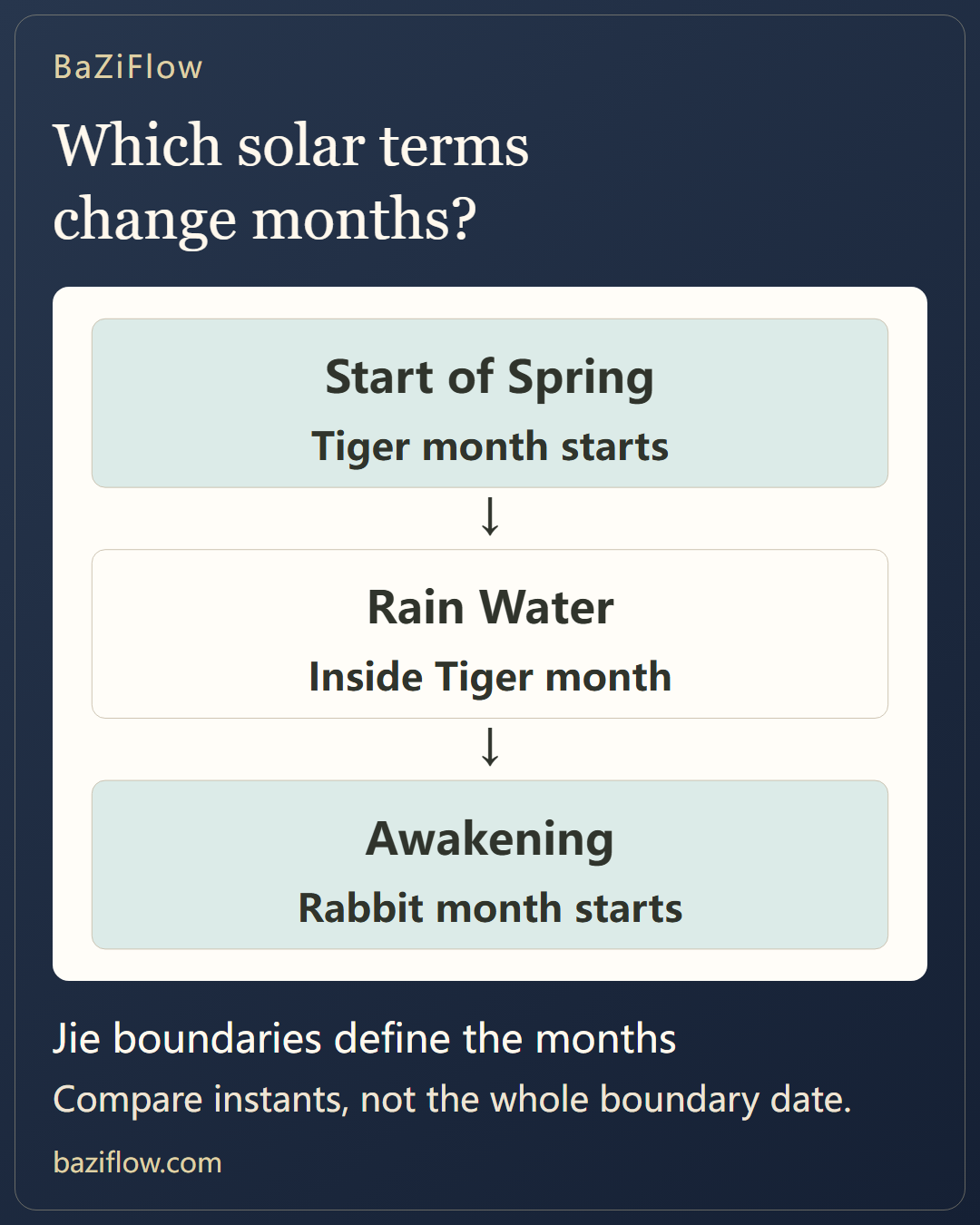
Rain Water, or Yushui, occurs between Lichun and Jingzhe. It is an intermediate qi: passing it does not begin a second month inside the Tiger interval. A new moon does not do that either. This small counterexample is more useful than memorising “solar terms matter”, which leaves open the mistaken idea that all twenty-four change the month.
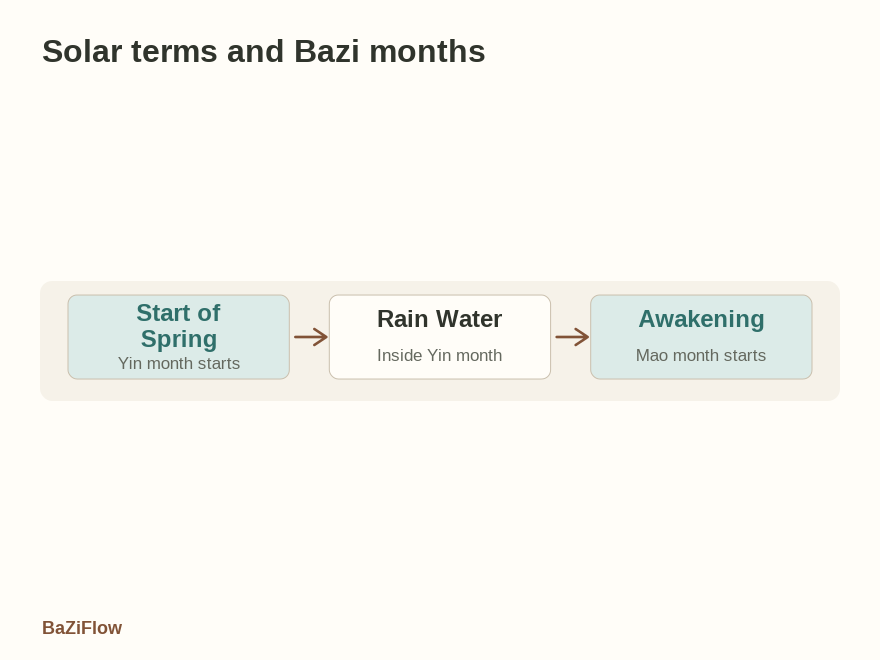
The Yin month runs from Start of Spring to Awakening of Insects. Rain Water lies inside it and does not start another month.
The Hong Kong Observatory documents the solar-longitude framework. That astronomical description supplies a calendar reference, not evidence that a month predicts personality. Its discussion of intermediate qi in the lunar calendar belongs to a different task; do not import that procedure into a BaZi month calculation.
Enlarge diagram · scroll sideways to read
Work with an instant, not a highlighted day
Let T stand for a verified boundary instant in a specified year. A record wholly before T belongs to the earlier interval; one wholly after T belongs to the later interval. An uncertain birth interval spanning T leaves two candidates. These are three different information states, not three complete natal charts. None warrants an invented account of the person's character.
Put the birth record and T on the same time basis before comparing them. Check the historical UTC offset and daylight-saving rule, rather than the birthplace's present offset. If a practitioner also applies apparent solar time, document that convention and its handling of the boundary. Never compare an adjusted birth clock with an unexplained boundary clock. A precise astronomical timestamp cannot repair a vague family recollection.
Enlarge diagram · scroll sideways to read
What the result does—and does not—establish
Identifying the Tiger month fixes only a branch. The month stem still depends on the relevant year stem and the adopted stem-assignment rule. Year and day boundaries are separate settings. This article does not certify an entire chart simply because its solar month was checked.
The seasonal label is also distinct from a weather report. A cool day or a Southern Hemisphere birthplace does not silently rewrite the calendar interval. Any alternative seasonal interpretation needs an explicit method, rather than an unannounced six-month shift.
Once the worksheet is complete, move to roots, exposed stems and seasonal support. That article explains why even a settled month branch is one condition in a traditional argument, not a complete strength judgement or a prediction of life outcomes.
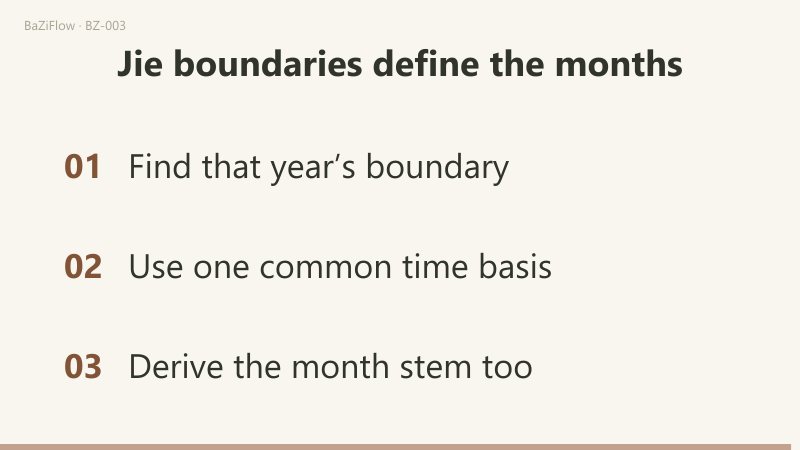
Find that year’s boundary
Obtain the twelve jie instants for the birth year and record the calendar source and time zone. A date-only calendar cannot supply a precise hour.
Use one common time basis
Check whether the birth record includes daylight saving time. Convert both birth and boundary instants to UTC or the same civil zone before comparing them. If the uncertainty interval crosses the boundary, keep both candidates.
Derive the month stem too
Record the branch for the solar-term interval. Use the established year stem and month-stem rule to derive the stem, then combine the two fields into the month pillar.
Questions readers ask next
Can a calendar date alone place a morning birth on the correct side of Start of Spring?
No. Obtain the boundary time for that year and express it on the same basis as the birth record. A date without an hour does not place every birth that day in the Tiger month.
Does a lunar leap month add another branch month under this rule?
No. This month sequence advances at the twelve jie boundaries rather than adding a branch for lunar intercalation. Locate the actual birth instant between the relevant boundaries.
If the birth-time interval crosses a boundary, may I choose the chart with the more appealing reading?
Interpretive preference cannot determine a time fact. Keep both candidates, identify which month fields differ, and seek better birth and boundary records before choosing.
Was this article helpful?
Sources & references
Continue reading
Roots, expression and seasonal support: three different checks ↗